




You Can Mix L-Ascorbic Acid at Home. Keeping It Alive Is the Hard Part.
The one home formulation with a genuinely coherent case, taken apart on its own terms: the pH window, the oxidation clock, and what a browning serum has actually become.

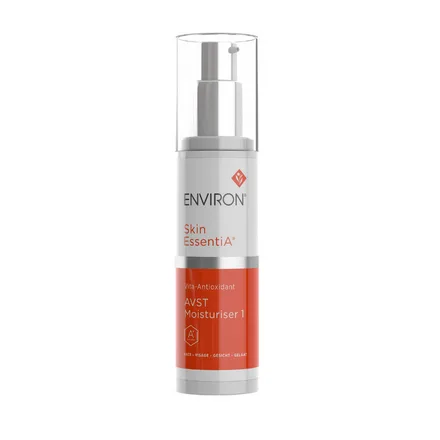
Most topical retinoid products on the market commit to a single concentration — 0.25%, 0.5%, 1% retinol — and expect users to either tolerate that concentration immediately or stop using the product. Environ's AVST methodology is structurally different: it offers a five-step progressive program (AVST 1 through AVST 5) with deliberately graduated vitamin A concentrations, designed for users to start at AVST 1, build tolerance over weeks, then step up incrementally over months. This product is the entry point — the lowest concentration in the program, formulated to be tolerable for retinoid-naive skin while delivering enough antioxidant and vitamin A activity to begin the long-term benefit curve.
The entry point of one of the most thoughtfully structured topical vitamin A programs in dermatology-developed skincare — a gentle retinyl palmitate moisturiser anchored by a real antioxidant load of vitamin C, vitamin E, EGCG, and South African botanicals. The price is steep relative to the retinoid concentration delivered, and progress is deliberately slow, but as a long-term tolerance-building introduction to topical vitamin A, AVST 1 earns its place in the program.
The case for it
What would change this: A declared concentration would move this to a firmer reading of the dose.
Same rule for everyone. “Supporting role” is the verdict on 8,197 of 45,024 concern verdicts across the catalog; rule R8a decided 1,489 of them. Unchanged since September 5, 2026, engine 5.1.1.
Brand or formulator? Disclose a concentration or correct a fact →
The studies behind the evidence row
The case for it
What would change this: A declared concentration would move this to a firmer reading of the dose.
Same rule for everyone. “Unproven” is the verdict on 1,111 of 45,024 concern verdicts across the catalog; rule R9 decided 1,111 of them. Unchanged since September 5, 2026, engine 5.1.1.
Brand or formulator? Disclose a concentration or correct a fact →
The studies behind the evidence row
The case for it
What would change this: A declared concentration would move this to a firmer reading of the dose.
Same rule for everyone. “Promising” is the verdict on 7,858 of 45,024 concern verdicts across the catalog; rule R9p decided 7,858 of them. Unchanged since September 5, 2026, engine 5.1.1.
Brand or formulator? Disclose a concentration or correct a fact →
The studies behind the evidence row
Also listed for Dullness and Rough Texture — the actives here (Vitamin E, Vitamin C, Green Tea Extract, Retinyl Palmitate) are in our research queue for those concerns; there is no verdict until their evidence rows are written. That is a gap in our table, not a mark against the product.
Does the jobDoes what a moisturizer is for: draws in water, softens and smooths.
Where our review and the verdict differ. The review below was written on the formulation and the published trials; the verdicts above apply the stricter standing test in our methodology — an active earns a recommendation only with guideline or regulatory standing for the concern. Where the two disagree, the verdict is DermApproved’s position.
A verdict is DermApproved’s assessment of how well a product’s ingredients fit a concern — never a claim about what the product treats. Evidence dots and collected reviews sit beside it and are never blended in. Rules 0.5.1 · evidence table ev-2026.09-r228 · how we decide
Most topical retinoid products on the market are structured as one-and-done propositions. A bottle of 0.5% retinol expects users to either tolerate the concentration immediately or abandon the product after a few weeks of reactive irritation. A prescription tretinoin script expects patients to push through three to six weeks of redness, flaking, and adjustment in exchange for the dramatic long-term results that the molecule can deliver. Environ's AVST methodology, built by Dr. Des Fernandes over three decades of clinical work on topical vitamin A, takes a different structural approach. The program ships as five sequential products — AVST 1, 2, 3, 4, 5 — with progressively higher vitamin A concentrations, and the entire methodology depends on users starting at AVST 1, building tolerance for weeks, then stepping up incrementally over many months. AVST 1 is therefore best understood not as a standalone product but as the entry point of a multi-year retinoid program, and reviewing it requires evaluating it within that context.
The formulation logic at AVST 1 reflects exactly what the methodology asks of it. The vitamin A active is retinyl palmitate — the weakest member of the retinoid family by conversion efficiency, requiring three enzymatic conversions in the skin (retinyl palmitate → retinol → retinaldehyde → retinoic acid) before reaching the biologically active form. Each conversion step loses some of the original concentration, which is precisely why Environ uses it specifically at this stage of the program. For retinoid-naive skin, retinyl palmitate produces meaningful but very gradual vitamin A activity without the reactive redness, flaking, and adjustment that stronger retinoids trigger. The trade-off is slower visible results in the short term and a methodology that depends on long-term commitment to play out.
Sitting underneath the retinyl palmitate is a substantial antioxidant load that anchors the broader formulation. Vitamin C appears in two forms — the lipid-soluble ascorbyl tetraisopalmitate and free ascorbic acid — both at positions on the INCI suggesting meaningful concentrations. Vitamin E appears in both stable ester and free alcohol forms. EGCG from green tea, rooibos and honeybush extracts from South African botanicals, and beta-carotene as a secondary vitamin A precursor round out a real multi-pathway antioxidant layer. Most entry-level retinoid moisturisers do not bother with this much antioxidant infrastructure; Environ's clinical philosophy treats the antioxidant load as an inseparable part of the vitamin A program, on the principle that the skin's vitamin A is depleted by daily UV-driven oxidation and needs antioxidant defense alongside the retinoid replacement.
The sensorial experience matches the philosophy. The cream is a light, cushioned satin-finish texture that absorbs cleanly with no immediate tingle, no flushing, and no characteristic retinoid adjustment burn. The deliberately low vitamin A concentration means that the typical first-month initiation period — dryness, flaking, peeling, reactive redness — is largely absent. Most users notice nothing dramatic in the first few weeks beyond a slight improvement in radiance and texture, which can be frustrating for results-impatient buyers but is exactly the experience the AVST methodology is designed to produce. The real benefits compound as users step up through the program. By AVST 2 (typically the 4–8 week mark), the vitamin A concentration is meaningfully higher and the visible effects become more apparent. By AVST 4 and 5, after many months of progressive use, the cumulative effect is comparable to mid-strength retinol routines from other brands, but delivered without the initiation burden.
The value question is the most complicated part of the assessment. AVST 1 is priced around $96 for 50 mL, which works out to nearly $2 per mL for an entry-level retinoid moisturiser. A user committed to the full five-step program will eventually move through hundreds of dollars of product on the way to AVST 5, and the math depends entirely on whether the user values the structural tolerance-building methodology over the alternative of either a prescription tretinoin script (cheaper, more aggressive, requires a doctor) or a direct-to-consumer 0.5% retinol product (cheaper, less structured, more reliant on user willpower to push through irritation). For users who have previously failed to tolerate stronger retinoids, who have rosacea-prone or sensitive skin that cannot accommodate aggressive vitamin A introduction, or who genuinely buy into the long-term-program philosophy that the AVST methodology embodies, the value math holds. For users buying skincare on a pure cost-per-active basis without that philosophical buy-in, the price will feel steep relative to what a CeraVe Resurfacing Retinol Serum or a Naturium Retinol Cream delivers at a fraction of the cost.
The limitations are honest and important. Retinyl palmitate's slow conversion trajectory means visible results take longer than higher-grade retinoids would deliver. The methylparaben and propylparaben in the preservation system will deter users who avoid parabens on principle, regardless of the dermatology consensus on their safety. The Environ system is sold exclusively through licensed estheticians and approved retailers, which means access requires going through the brand's professional channel — a feature for users who want clinical oversight, a friction point for users who prefer direct-to-consumer convenience. The product is not pregnancy-safe and must be discontinued during pregnancy and breastfeeding. And the broader question of whether vitamin A needs to be introduced as a structured five-step program at all is a philosophical one that the brand answers in the affirmative but that many dermatologists working with prescription tretinoin would answer differently.
None of those criticisms invalidate the product within its niche. The AVST methodology is a coherent, clinically defensible, and surprisingly thoughtful approach to long-term topical vitamin A management, and AVST 1 is the entry point that the entire program depends on. For the right user — retinoid-naive, sensitive-skin-prone, philosophically aligned with the gradual-progression model, and willing to commit to a multi-year skincare investment — this is one of the more sophisticated retinoid introductions available in the spa-professional channel. For everyone else, simpler dedicated retinoid products from clinical or direct-to-consumer brands will deliver the underlying chemistry at meaningfully lower cost.
The hero actives that drive this product's performance.
| Ingredient | Function | Evidence |
|---|---|---|
| Retinyl Palmitate | The signature vitamin A ester that defines this entry-level moisturiser in Environ's step-up program. Retinyl palmitate converts in the skin through retinyl palmitate → retinol → retinaldehyde → retinoic acid, which is the active form that binds nuclear receptors. The conversion is inefficient and gradual, which is exactly the point — Environ built the AVST system as a low-and-slow vitamin A introduction protocol, and AVST 1 is the entry concentration that lets retinoid-naive skin build tolerance before stepping up. | Not yet assessed |
| Beta-Carotene | A pro-vitamin A carotenoid that converts to retinol in the body and contributes a secondary vitamin A precursor pathway alongside the retinyl palmitate. In this moisturiser it also serves as a lipid-soluble antioxidant in the oil phase, reinforcing the formula's antioxidant-and-retinoid positioning that has been Environ's signature for over thirty years. | Not yet assessed |
| Tocopheryl Acetate + Tocopherol (Vitamin E) | Vitamin E appears in both stable ester and free alcohol forms and is one of the most thoroughly validated topical antioxidants in cosmetic formulation. Listed high on the INCI of this moisturiser, it protects the oxidation-sensitive vitamin A and the unsaturated lipids in the formula from degradation during wear, and provides a baseline lipid-soluble antioxidant load that complements the water-soluble vitamin C. | Limited for Aging |
| Ascorbyl Tetraisopalmitate + Ascorbic Acid (Vitamin C) | Two forms of vitamin C — the lipid-soluble ester ascorbyl tetraisopalmitate and free ascorbic acid — sit higher on the INCI than the retinyl palmitate, suggesting meaningful concentrations. Together they deliver antioxidant activity in both the lipid and water phases of the skin, and provide synergistic photoprotection alongside the vitamin E that is well-documented in the dermatology literature. | Limited for Aging |
| Rooibos + Honeybush Leaf Extract | Two indigenous South African botanicals that Environ has used as signature antioxidant ingredients since the brand's early years. Rooibos supplies aspalathin and other polyphenols with documented antioxidant and anti-inflammatory activity; honeybush contributes mangiferin and isoflavones. They reinforce the formula's regional identity and add a secondary antioxidant layer alongside the vitamin C and vitamin E. | Not yet assessed |
| Epigallocatechin Gallate (EGCG) | The primary catechin in green tea, with a substantial dermatology literature behind its antioxidant, anti-inflammatory, and photoprotective activity. In this moisturiser EGCG contributes a third polyphenol antioxidant alongside the rooibos and honeybush extracts, all sitting underneath the primary vitamin A, C, and E active layer. | Not yet assessed |
Water, Hydrogenated Polydecene, Sorbitol, Tocopheryl Acetate, Glyceryl Stearate, PEG-100 Stearate, Cetearyl Alcohol, Caprylic/Capric Triglyceride, Ethoxydiglycol, Dimethicone, Panthenol, Sorbitan Stearate, Polysorbate 60, Ascorbyl Tetraisopalmitate, Ascorbic Acid, Rosmarinus Officinalis (Rosemary) Leaf Extract, Epigallocatechin Gallate, Retinyl Palmitate, Tocopherol, Aspalathus Linearis (Rooibos) Leaf Extract, Cyclopia Genistoides (Honeybush) Leaf Extract, Polygonum Cuspidatum Extract, Beta-Carotene, Ascorbyl Palmitate, Glycerin, Polyglyceryl-10 Laurate, Helianthus Annuus (Sunflower) Seed Oil, Sodium Hydroxide, Xanthan Gum, Maltodextrin, Gelatin, Sucrose, Zea Mays (Corn) Oil, Zea Mays (Corn) Starch, Disodium EDTA, Methylparaben, Propylparaben
moisturizer
AM & PM
Apply after cleansing and toner and after the Environ pre-cleanser-and-toner system, before sunscreen in the AM. Use AVST 1 twice daily for a minimum of 4–6 weeks before stepping up to AVST 2 — the step-up methodology depends on building skin tolerance before increasing concentration. Always finish AM use with broad-spectrum SPF since retinoids increase photosensitivity. Pair with Environ's complementary toner and skin essentia products for the brand's intended layering system. Do not combine with other retinoids or aggressive AHA/BHA exfoliants in the same routine.
Immediate: skin feels cushioned and looks slightly more luminous after the first application thanks to the vitamin C and E load. Short-term (2–4 weeks): improved hydration retention and softer texture, no dramatic retinoid effects yet because the AVST 1 vitamin A concentration is deliberately low. Full benefits (8–16 weeks): gradual improvement in tone, texture, and small fine lines, with most users stepping up to AVST 2 around the 4–8 week mark once tolerance is established. The full Environ step-up program is designed to play out over months rather than weeks.
The vitamin A pathway in this formulation is well-documented in the dermatology literature. Retinyl palmitate is the storage form of vitamin A in skin and requires conversion through retinol and retinaldehyde to retinoic acid for biological activity. A 2019 review in Dermato-Endocrinology summarized the conversion pathway and the relative efficacy of different vitamin A esters in topical applications. Dr. Des Fernandes himself has published clinical research on retinyl palmitate's role in long-term photoaging management, including a 2002 paper documenting cumulative benefits of low-concentration vitamin A use over many months of consistent application.
The antioxidant infrastructure is supported by extensive clinical literature. Vitamin C in both lipid-soluble and water-soluble forms is one of the most thoroughly validated topical antioxidants, with the practical caveat that its activity is significantly amplified when combined with vitamin E — a synergy this formula explicitly leverages. EGCG has a substantial dermatology literature behind its antioxidant, anti-inflammatory, and photoprotective activity. The rooibos and honeybush extracts have a smaller but growing literature behind their aspalathin and mangiferin content respectively, with both botanicals showing antioxidant activity in cosmetic applications. The synergy this formula targets — a low-concentration vitamin A primary active surrounded by a substantial multi-pathway antioxidant load — represents one of the more clinically coherent approaches to entry-level retinoid formulation, and reflects Environ's broader philosophy that topical vitamin A and topical antioxidants are inseparable parts of a single program rather than independent additions to a routine.
Many dermatologists familiar with the Environ system frequently recommend the AVST step-up program for patients who have previously failed to tolerate prescription tretinoin or higher-strength retinol products. Dermatologists also commonly point to this methodology as a reasonable approach for retinoid-naive patients in their twenties beginning long-term photoaging prevention routines. For patients with active acne, established photoaging, or aggressive hyperpigmentation, dermatologists typically recommend prescription tretinoin or adapalene as a more direct and cost-effective approach, with the AVST program reserved for the sensitive-skin or retinoid-cautious subset of patients.
Apply after cleansing and toner, twice daily on dry skin. Use a pea-sized amount for face and neck. Always finish AM use with broad-spectrum SPF, since retinoids increase photosensitivity. Use AVST 1 for a minimum of 4 weeks and ideally 6–8 weeks before consulting a licensed esthetician or Environ-trained practitioner about stepping up to AVST 2. Do not combine with other retinoids, prescription tretinoin, AHAs, BHAs, or benzoyl peroxide in the same routine — the AVST methodology is designed to be the primary active program. Store the airless pump bottle upright in a cool, dark place to maximize vitamin A stability.
At $96 for 50 mL, this entry-level moisturiser sits firmly in the premium dermatologist-developed tier. The price-per-active is high for what is technically the weakest member of the retinoid family, and a user committed to the full AVST 1 through 5 progression will move through several hundred dollars of product over many months. Compared to direct-to-consumer alternatives like CeraVe Resurfacing Retinol Serum or Naturium Retinol Cream at a fraction of the cost, the cost-per-active gap is substantial. What you pay for is the structural step-up methodology, the antioxidant infrastructure, the clinical philosophy behind Dr. Des Fernandes' three decades of vitamin A research, and the spa-professional channel positioning. For users committed to that program, the value math holds; for users buying on pure cost-per-active, direct-to-consumer retinoid products deliver meaningfully more active per dollar.
Retinoid-naive users wanting to begin a long-term topical vitamin A program with minimal irritation, particularly those with sensitive, rosacea-prone, or barrier-compromised skin that has previously failed to tolerate prescription tretinoin or stronger retinol products. Also a strong fit for users in their twenties beginning long-term photoaging prevention who value the structural progressive methodology over a single fixed-concentration product. Best for users with access to a licensed Environ practitioner who can guide the step-up.
Users with active acne, established photoaging, or aggressive hyperpigmentation will see faster and more cost-effective results from prescription tretinoin or adapalene. Anyone pregnant or breastfeeding should skip this product entirely. Users avoiding parabens on principle will find the methylparaben and propylparaben in the preservation system a dealbreaker. Pure cost-per-active optimizers should look at direct-to-consumer retinol products from CeraVe, Naturium, or Paula's Choice instead.
Ready to try Environ Vita-Antioxidant AVST Moisturiser 1?
Buy at Amazon ♥Light, cushioned cream with a soft texture that absorbs cleanly to a satin finish.
Fragrance-free, with a very faint neutral cream note from the natural oils and botanicals.
50 mL airless pump bottle with a protective cap, designed to limit air exposure and slow vitamin A oxidation.
First application feels like a light, cushioned daily moisturiser — no immediate tingle, no retinoid-style adjustment redness, and a soft satin finish that absorbs cleanly. The deliberately low vitamin A concentration means the typical retinoid initiation period of dryness, flaking, and reactive redness is largely absent. Most users notice subtle improvements in texture and radiance over the first month, with the more meaningful results building as they step up to AVST 2, 3, 4, and eventually 5 in Environ's progressive program over many months.
2–3 months applied morning and evening to the face
All Year
Environ was founded in 1990 by Dr. Des Fernandes, a South African plastic surgeon whose clinical interest in topical vitamin A for photoaging dated back to the 1980s. Fernandes published research on retinyl palmitate's role in long-term photodamage management and was one of the early advocates of the principle that the body's natural vitamin A levels in the skin are depleted by daily UV exposure and need topical replacement. The AVST step-up methodology was built around this philosophy — that vitamin A is a daily skin nutrient rather than a periodic treatment, and that the right way to introduce it is through gradual progressive exposure that allows the skin to build tolerance to increasing concentrations.
Environ was founded in 1990 in South Africa by Dr. Des Fernandes, a plastic surgeon who pioneered the use of topical vitamin A for skin aging and was one of the earliest clinicians to publish on the role of retinyl palmitate in long-term photoaging management. The brand has been sold exclusively through licensed estheticians and skin clinics for over three decades and remains one of the most-recommended dermatologist-developed lines in the spa-professional channel.
Retinyl palmitate is just a marketing-version of retinol with no real activity.
Retinyl palmitate does require enzymatic conversion to retinol and then to retinoic acid to be biologically active, and that conversion is less efficient than starting with retinol directly. But retinyl palmitate is genuinely active at the right concentrations — it just produces a slower, gentler trajectory than higher-grade retinoids. Environ's clinical rationale for using it specifically is that the slower trajectory is the point, not a limitation, for users building long-term tolerance.
If a retinoid is gentle, it must not be doing anything.
Topical vitamin A produces measurable effects on skin biology — fibroblast collagen synthesis, keratinocyte turnover, melanin distribution — across a wide range of concentrations and conversion forms. The gentleness of AVST 1 reflects the deliberately low concentration of retinyl palmitate, not the absence of activity. Over months of consistent use, the cumulative effect on skin biology is real, just slower than a prescription tretinoin would produce.
The Vitamin STEP-UP SYSTEM is Environ's five-product progressive program for introducing topical vitamin A. Users start with AVST 1 (the lowest vitamin A concentration), use it twice daily for a minimum of 4–6 weeks to build tolerance, then step up to AVST 2, 3, 4, and eventually 5 over many months. The methodology is built around the idea that the right way to introduce vitamin A is through gradual progressive exposure rather than committing to a single high concentration.
Retinyl palmitate is an ester of retinol and palmitic acid. The skin converts it through retinyl palmitate → retinol → retinaldehyde → retinoic acid, which is the active form. Each conversion step loses some of the original concentration, so retinyl palmitate is less potent per unit than retinol directly. It is the gentlest member of the retinoid family by conversion efficiency, which is precisely why Environ uses it as the entry concentration in the AVST program.
Environ's protocol recommends a minimum of 4 weeks at AVST 1 before considering a step-up, with most users staying at AVST 1 for 6–8 weeks. The signal that you are ready to step up is that AVST 1 is producing no irritation, no flaking, and no reactive redness at twice-daily use. If you are still experiencing any reactivity, stay at AVST 1 longer. The step-up should be made through a licensed esthetician or skin clinic familiar with the Environ system.
No — topical retinoids in general are on most pregnancy-avoidance lists, and retinyl palmitate is no exception. The dermatology consensus is to discontinue all topical vitamin A products during pregnancy and breastfeeding and resume after weaning. For pregnancy-safe alternatives, Environ's non-retinoid moisturisers and antioxidant serums are available, or general fragrance-free clinical creams from CeraVe or La Roche-Posay work well.
The formulation includes methylparaben and propylparaben as preservatives. Parabens have been used in cosmetic preservation for decades and are well-studied, with the FDA, EU, and most dermatology bodies considering them safe at the concentrations used in cosmetics. Some users avoid parabens on principle and prefer alternative preservation systems, which is a legitimate personal preference but not a dermatology-recommended switch.
Environ's intended methodology assumes the AVST moisturiser is used within the brand's complete pre-cleanser, cleanser, toner, and complementary product system. The AVST product alone delivers meaningful benefits, but the full step-up methodology is built around the integrated system. For users committed to the long-term program, the complete Environ routine is usually recommended; for users wanting just the vitamin A benefit, AVST 1 can work as a standalone within a different brand routine, with the caveat that the brand's overall layering logic is designed around its own products.
Prescription tretinoin or adapalene will produce faster and more dramatic results than the AVST program for active acne, photoaging, and hyperpigmentation. The trade-off is significantly higher irritation potential, a longer adjustment period of redness and flaking, and the prescription requirement. Environ's AVST methodology is built for users who want the long-term benefits of vitamin A without the irritation burden of prescription-strength retinoids, particularly those who have previously failed to tolerate stronger formulations.
Recurring themes our editors read across retailer reviews of this product — summaries in our words, not quotations, and not a substitute for your own patch test.
Genuinely gentle introduction to topical vitamin A for retinoid-naive users
Substantial vitamin C and E antioxidant load alongside the retinoid
Pleasant cushioned cream texture absorbs cleanly
South African rooibos and honeybush botanicals reinforce brand identity
Step-up methodology produces sustained long-term results
Backed by Dr. Des Fernandes' decades of vitamin A clinical work
Retinyl palmitate is the weakest retinoid by conversion efficiency
Price is steep for an entry-level retinoid product
Step-up program commitment can feel slow for results-impatient users
Only available through licensed estheticians and approved retailers
Contains parabens, which some users avoid on principle
Verified answers from our questions library — the nuance a product page cannot carry.