




The Truth About Pore Strips, Pore Vacuums, and 'Shrinking' Your Pores
You cannot shrink a pore. But you can change how visible it is — and almost everything sold to 'minimize' pores is pulling the wrong lever.
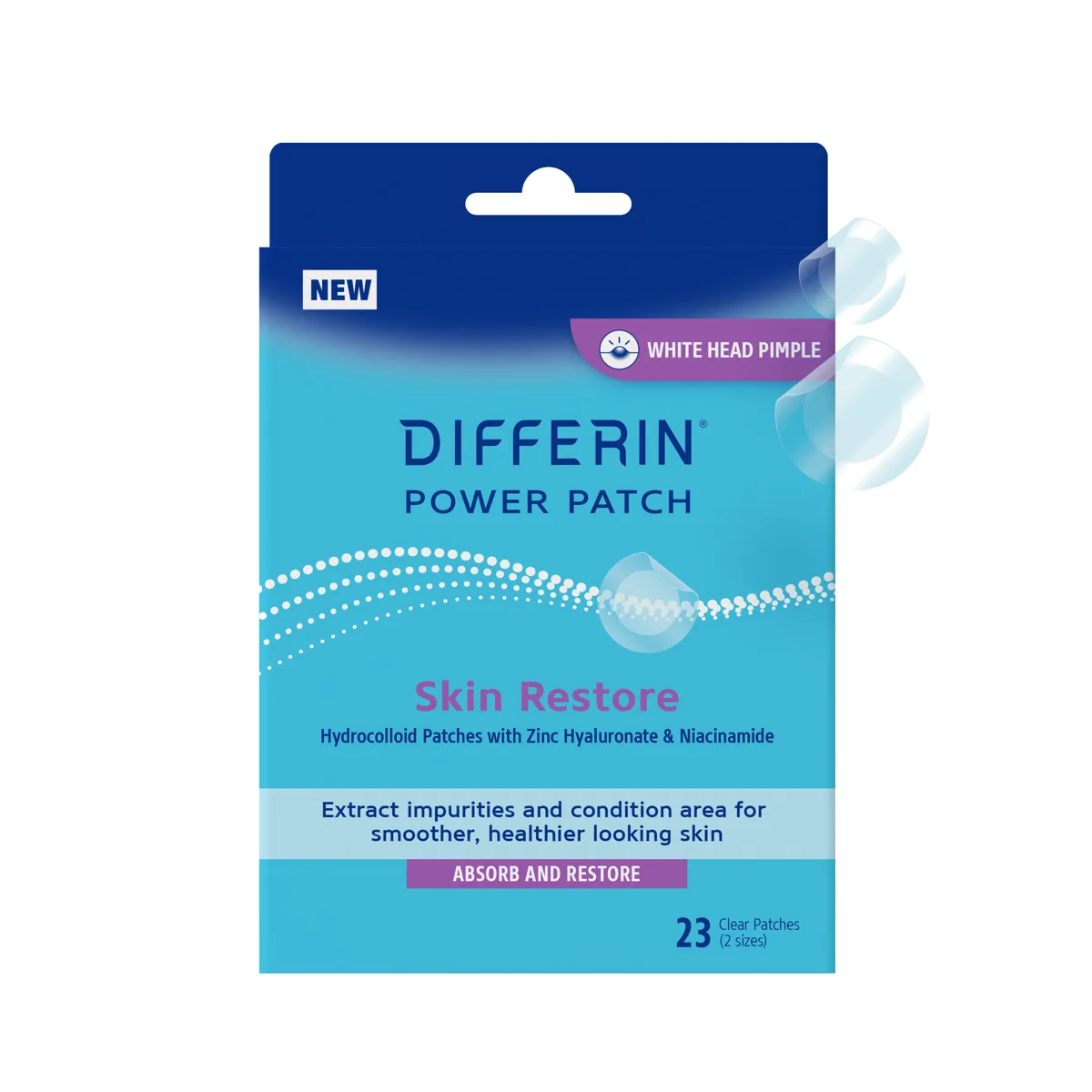
Where most hydrocolloid patches are just an absorbent seal, Differin loads this one with a four-active payload — niacinamide to calm, salicylic acid to exfoliate, and zinc hyaluronate to hold moisture — so the spot finishes calmer and less dried-out than a bare dressing leaves it. It's a restore-and-soothe patch for blemishes that have already erupted, not a treat-it-early acid patch.
A genuinely upgraded hydrocolloid patch that does the satisfying overnight whitehead-flattening trick while soothing the aftermath with niacinamide and zinc hyaluronate. It's gentle, fragrance-free, and cheap, with the only real catch being that — like all hydrocolloid patches — it needs a blemish that has actually come to a head to do anything at all.
The case for it
Cautions: fungal-acne triggers.
What would change this: A declared concentration would move this to a firmer reading of the dose.
Same rule for everyone. “Strong choice” is the verdict on 1,459 of 45,024 concern verdicts across the catalog; rule R3 decided 567 of them. Unchanged since September 5, 2026, engine 5.1.1.
Brand or formulator? Disclose a concentration or correct a fact →
The studies behind the evidence row
The case for it
Cautions: fungal-acne triggers.
What would change this: A declared concentration would move this to a firmer reading of the dose.
Same rule for everyone. “Strong choice” is the verdict on 1,459 of 45,024 concern verdicts across the catalog; rule R3 decided 567 of them. Unchanged since September 5, 2026, engine 5.1.1.
Brand or formulator? Disclose a concentration or correct a fact →
The studies behind the evidence row
A verdict is DermApproved’s assessment of how well a product’s ingredients fit a concern — never a claim about what the product treats. Evidence dots and collected reviews sit beside it and are never blended in. Rules 0.5.1 · evidence table ev-2026.09-r228 · how we decide
Anyone who has lived through the hydrocolloid patch era knows the bittersweet morning-after ritual: you peel the patch off, admire the cloudy little disc of fluid it pulled from your whitehead, and then notice the spot underneath is flatter, yes, but also weirdly dry, faintly red, and slightly crater-like, as if the patch did its job a little too enthusiastically. That last-mile problem — the calm-but-roughed-up skin a plain dressing leaves behind — is the exact gap Differin is aiming at with the Power Patch Skin Restore, and it's the most useful lens for judging whether the extras here are real or just label decoration.
Start with what it fundamentally is. Underneath the marketing, this is a hydrocolloid patch, and hydrocolloid is borrowed straight from wound care. The cellulose-gum-and-resin matrix is absorbent and gel-forming; press it over an open or weeping whitehead and it wicks up the exudate, swelling into that telltale white dome while keeping the area sealed in a moist micro-environment. That moist healing is genuinely effective biology — occluded wounds re-epithelialize faster and with less scabbing than ones left to dry out — which is why these patches earned their cult status in the first place. So the base mechanism here is sound and entirely proven; there's no smoke and mirrors at the structural level.
The difference is what Differin parked in the adhesive. Read the list and, after the patch-forming polymers and waxes, you hit niacinamide, then salicylic acid, then zinc hydrolyzed hyaluronate. These aren't headline concentrations, but their placement is logical. As the patch hydrates and draws fluid, those actives dissolve into the wet interface and diffuse into the softened spot. Niacinamide is the one doing the most meaningful work against the post-eruption redness — it's a well-evidenced anti-inflammatory and tone-evener, and it directly targets that lingering pink halo a bare patch leaves. The zinc hyaluronate is a clever inclusion: it's a hybrid that holds water in the treated area while zinc lends a mild astringent, skin-conditioning effect, which counters the over-dried feeling. The salicylic acid is a low, supportive dose that gently keeps the softened pore clear rather than acting as a primary exfoliant. Put together, the claim that this finishes a spot calmer and less parched than plain hydrocolloid is, in my reading, basically fair — modest, but real.
In practice the patch behaves exactly as a good hydrocolloid should. There's no sting on application — no alcohol, only a whisper of salicylic acid — so it's comfortable even on already-irritated skin, and the soft matte top is close to invisible under indoor light. The two sizes, eight large and fifteen small, let you match the patch to the spot, and the milky absorption disc that shows up over an open whitehead after a few hours is as satisfying as ever, the small gross trophy that tells you it worked. Removal is clean and non-tugging, and the soothed-rather-than-stripped feeling afterward is the most noticeable improvement over generic patches.
The honest limitation is the one that haunts every hydrocolloid patch, no matter how loaded: it can only act on a blemish that has something to absorb. On a closed comedone, a deep under-the-skin ache, or a true cyst, there's no fluid to wick and nothing for the matrix to do, so the patch mostly just protects the area and discourages you from picking — useful, but not the dramatic flattening the format is famous for. People who slapped one on a deep bump and felt underwhelmed weren't using a bad product; they were using the right product at the wrong stage. This is an eruption-stage tool: wait until the whitehead has a head, then deploy it.
It's worth dwelling for a moment on why the format suits acne so well beyond the chemistry, because the patch does a second, quieter job that doesn't show up on the ingredient list: it physically stops you touching the spot. Picking and squeezing is one of the biggest preventable drivers of post-inflammatory marks and scarring, and a patch sitting over a blemish is a small, dumb, effective barrier between your fingers and your face. For the chronic pickers among us, that alone can be worth the price of admission, marks prevented being far easier than marks faded. The patch also keeps makeup, dirt, and stray bacteria off the open spot while it resolves, which is the same wound-care logic that makes hydrocolloid useful in the first place. So even when the absorption is modest, the protective function is always working.
The other small gripes are practical. Twenty-three patches per carton is a fairly modest count, and because the split skews toward the small size, heavy users can burn through the larges and be left with a pile of tiny dots. None of this dents the core proposition, though. As a fragrance-free, gentle, genuinely four-active hydrocolloid patch from a brand with real acne lineage, sold for well under ten dollars, it's an easy thing to keep in a drawer. It won't fix your acne — that still takes a consistent leave-on routine — but for the specific job of flattening and soothing a whitehead overnight without leaving a dry red mark behind, it does meaningfully better than the bargain-bin alternative, and that targeted improvement is exactly what it set out to deliver.
The hero actives that drive this product's performance.
| Ingredient | Function | Evidence |
|---|---|---|
| Hydrocolloid Matrix (Cellulose Gum) | The structural core of the patch — the cellulose-gum gel absorbs exudate and oil from an open or weeping whitehead, creating the sealed, moist micro-environment that lets the wound flatten and resolve faster while the actives below sit dissolved in that fluid. | Not yet assessed |
| Niacinamide | Dosed ahead of the other actives so it diffuses into the hydrated spot as the patch draws fluid, calming the redness and supporting tone recovery in the post-blemish skin that hydrocolloid alone wouldn't address. | Limited for Acne |
| Salicylic Acid | Present at a low, supportive level to gently exfoliate the softened skin under the patch and keep the pore clear as the hydrocolloid pulls the plug loose — a finishing touch rather than the primary actor here. | Regulator-approved for Acne · emerging certainty |
| Zinc Hydrolyzed Hyaluronate | A hybrid of hyaluronic acid and zinc that holds moisture in the treated area while zinc lends mild astringent and skin-conditioning support, helping the spot finish calmer rather than dried out the way a bare hydrocolloid patch can leave it. | Not yet assessed |
Ingredient standings describe the active at treatment-level doses and vehicles; this product's own condition grades weigh its actual formula.
Cellulose Gum, Hydrogenated Styrene/Methylstyrene/Indene Copolymer, Petrolatum, Pentaerythrityl Hydrogenated Rosinate, Hydrogenated Styrene/Butadiene Copolymer, Hydrogenated Castor Oil, Ozokerite, Glyceryl Isostearate, Polyglyceryl-3 Oleate, Niacinamide, Salicylic Acid, Zinc Hydrolyzed Hyaluronate, Pentaerythrityl Tetra-Di-T-Butyl Hydroxyhydrocinnamate
treatment
AM & PM
Best on a whitehead that has already come to a head — pop the patch onto clean, dry skin with no product underneath and leave it overnight so the hydrocolloid can draw the fluid out and the niacinamide can settle in.
Visible flattening and a drawn-out white absorption disc often appear after a single overnight wear; lingering redness usually settles over the following day or two as the niacinamide does its work.
Two evidence streams underpin this patch. The first is moist wound healing, the principle behind hydrocolloid dressings since their adoption in clinical wound care decades ago: an occluded, moist environment accelerates re-epithelialization and reduces crusting compared with letting a lesion dry out and scab, which is precisely why a hydrocolloid dot flattens an open whitehead faster and cleaner than air exposure. Applied to acne, the patch absorbs exudate while sealing the spot, and a body of dermatology literature supports hydrocolloid patches for superficial, open inflammatory lesions specifically. The second stream is the added actives, where niacinamide carries the strongest data: topical niacinamide has well-documented anti-inflammatory effects and a track record in acne, including studies showing it can rival some traditional treatments for inflammatory lesions while improving barrier function and reducing redness — exactly the post-eruption calming this patch is designed to provide. Salicylic acid's comedolytic, mildly anti-inflammatory profile is long established, though its role here is supportive given the low dose. Zinc's astringent and anti-inflammatory contributions to acne care are recognized, and pairing it with hyaluronate adds a humectant counterweight to the drying tendency of occlusion. The formulation logic is the real story: this isn't a single hero ingredient but a sequenced system where the hydrocolloid does the mechanical work and the dissolved actives address the redness and dryness that the mechanical step alone would leave behind. The science supports each piece; the value is in how they're layered.
Hydrocolloid patches are widely viewed in clinical settings as a low-risk, useful adjunct for individual superficial blemishes rather than a treatment for acne as a condition. A frequent point of clinical guidance is that these dressings shine on open or whiteheaded lesions, where they absorb fluid and create the moist environment that speeds resolution, and that they offer the added benefit of acting as a physical barrier against picking — a meaningful contributor to scarring and dark marks. The inclusion of niacinamide is generally regarded favorably, since it has solid evidence for reducing inflammation and supporting the barrier. Standard advice is to reserve patches like this for erupted spots, keep a consistent leave-on regimen for ongoing breakouts, and see a clinician for persistent cystic or nodular acne that surface patches cannot address.
Wait until a blemish has come to a head — an open or whiteheaded spot is what hydrocolloid acts on. Cleanse and dry the area completely, with no serum, cream, or oil underneath, then choose the patch size that covers the spot with a small margin and press it on firmly. Leave it on overnight, or for at least six to eight hours, so it can absorb fluid; you'll see it whiten where it's working. Peel gently in the morning and resume your routine on the surrounding skin. Use a fresh patch if the spot is still draining.
Under eight dollars for a hydrocolloid patch carrying four actives is a strong deal, particularly from a brand with genuine acne credentials rather than a generic white-label. You're paying drugstore prices for a meaningful upgrade over plain hydrocolloid: the niacinamide and zinc hyaluronate that soothe and prevent over-drying aren't free to formulate, and they're the reason this finishes a spot better than a bargain dot. The single 23-count pack means no bulk tier to chase, and the modest count is the one ding on per-patch value if you break out often. Overall the price clearly reflects the formula, not brand markup — a fair, honest spend.
Buy this if you get the occasional whitehead and want to flatten it overnight while sparing yourself the dried-out, still-red aftermath of cheaper patches. It suits oily and combination skin especially, but its gentle, fragrance-free build makes it comfortable for sensitive skin too, and it's a smart anti-picking tool for anyone who can't resist a spot.
Pass if your breakouts are mostly closed comedones, deep painful bumps, or cysts — there's no fluid for the hydrocolloid to draw, so it won't deliver the flattening you're after. Frequent breakouts may also burn through the modest 23-count pack quickly, and those wanting a treat-it-early acid patch should look at the salicylic-acid Fast Fix instead.
Ready to try Differin Power Patch Skin Restore?
Buy at Amazon ♥Slightly thicker, flexible hydrocolloid dot with a soft matte top; turns milky and swollen where it absorbs fluid, the classic sign it's working.
No added fragrance; essentially odorless straight off the liner.
Carton with peel-off sheets holding 8 large and 15 small patches on a backing.
Comfortable and undramatic on application — no sting, since there's no alcohol and only a low dose of salicylic acid. Over a few hours you'll see the patch over an open whitehead start to whiten and puff as it absorbs fluid; that cloudy disc is exactly what you want to see and confirms the hydrocolloid is doing its job.
23 patches lasts roughly three to six weeks for someone treating the occasional whitehead, less if breakouts are frequent.
All Year
After bringing over-the-counter adapalene to the masses in 2016, Differin moved into the pimple-patch boom with a two-part Power Patch line. Skin Restore is the hydrocolloid half of that strategy, aimed at the eruption stage — the whitehead with a head — and built around the brand's 4-in-1 Hydrotech claim of absorbing, soothing, exfoliating, and restoring in one dot.
Differin earned its credibility by bringing adapalene 0.1%, a true prescription-grade retinoid, to over-the-counter shelves in 2016. Backed by parent company Galderma, the brand has dermatological depth, though this hydrocolloid patch is a recent extension into the pimple-patch category rather than a long-studied product.
A hydrocolloid patch will clear any pimple you stick it on.
It only works on a blemish that has fluid to absorb — an open or whiteheaded spot. On a closed, deep, or cystic bump there's nothing for the hydrocolloid to draw out, so it mostly just sits there protecting the area.
Adding actives to a hydrocolloid patch is just marketing.
The niacinamide and zinc hyaluronate here do measurably more than a plain dressing — they address the redness and post-spot dryness that bare hydrocolloid leaves behind, which is a real, if modest, upgrade.
It's a hydrocolloid patch, so it works on blemishes that have come to a head — open or whiteheaded spots with fluid to absorb. On closed comedones, deep bumps, or cysts there's nothing for it to draw out, so it mainly just protects the area and stops you picking.
Skin Restore is a hydrocolloid patch with niacinamide and zinc hyaluronate built to absorb fluid from erupted whiteheads and soothe the aftermath. Fast Fix is a clear salicylic-acid film that delivers acid into emerging spots you can feel before they surface — different tools for different stages.
Yes — over an open whitehead the hydrocolloid absorbs fluid and swells into a cloudy white disc, which is the visible sign it's pulling the gunk out. If it stays clear, there likely wasn't fluid to absorb, meaning the spot wasn't at the right stage.
It contains only a low, supportive level of salicylic acid alongside niacinamide and zinc hyaluronate, and exposure under an occlusive patch is minimal. It's generally considered low-risk, but it's always wise to confirm with your doctor before using any salicylic-acid product while pregnant.
Wear it overnight or for at least six to eight hours so the hydrocolloid has time to absorb fluid and the niacinamide can settle into the spot. Replace it with a fresh patch if the blemish is still draining the next day.
Less so. The added zinc hyaluronate holds moisture in the treated area and the niacinamide calms redness, so the spot tends to finish calmer and less parched than the dried-out result a bare hydrocolloid patch often leaves.
Recurring themes our editors read across retailer reviews of this product — summaries in our words, not quotations, and not a substitute for your own patch test.
Visibly flattens whiteheads overnight
Soothes redness while it works
Sticks well but removes without irritation
Nearly invisible on the skin
Only works on whiteheads with a head
Results less dramatic on deep bumps
Modest patch count per pack
Two sizes can run out unevenly
Verified answers from our questions library — the nuance a product page cannot carry.