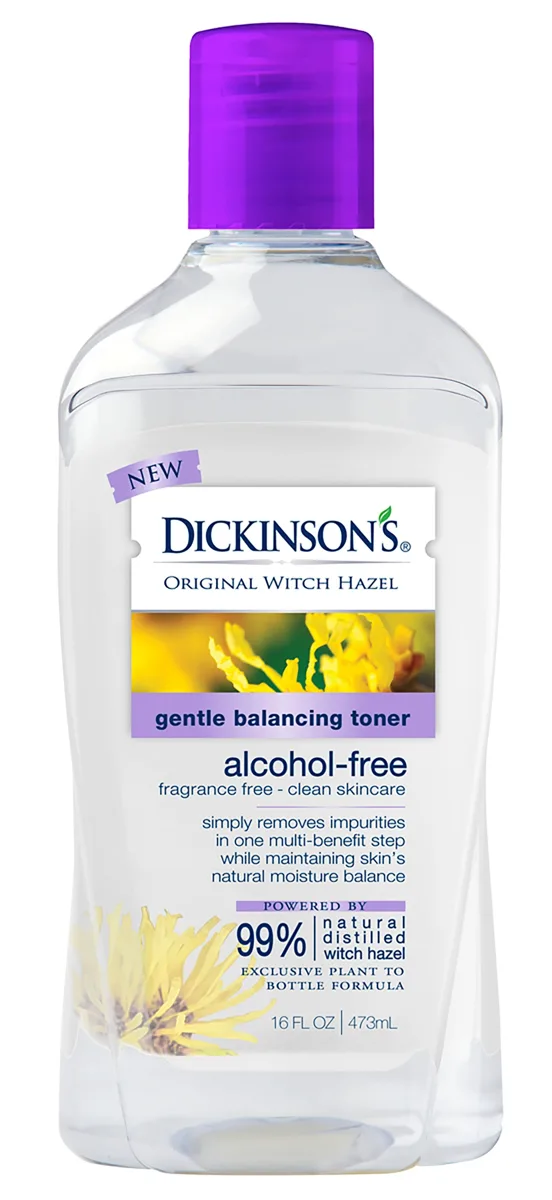
It's the same heritage distilled witch hazel as the famous astringent, minus the 14% grain alcohol — a three-ingredient, fragrance-free 'gentle' toner that trades hard oil-stripping for broad, everyday tolerability, all in a giant bottle at drugstore pricing.
The peacemaker of the Dickinson's witch hazel family: same heritage distillate as the famous astringent, but alcohol-free, so it tones and refreshes without leaving skin tight or stripped. It's a genuinely gentle, fragrance-free daily toner that suits combination, normal, and even sensitive skin — just don't expect the hard oil control of the alcohol version.
Supporting rolefor SensitivityIn your profileYou chose · Mostly gentle: known irritants — usable for sensitive skin with a patch test.Not yet assessedStandard tolerabilityNo reviews collected yet
The case for it
Hamamelis Virginiana has no evidence row yet for this concern — it is in the research queue.
The formula carries no trigger this concern is sensitive to, with the cautions noted.
Cautions: known irritants.
What would change this: A researched evidence row for the lead active would replace this with a verdict.
Same rule for everyone. “Supporting role” is the verdict on 8,197 of 45,024 concern verdicts across the catalog; rule F3 decided 183 of them.
Unchanged since September 5, 2026, engine 5.1.1.
Also listed for Excess Oiliness, Large Pores and Dullness — the actives here (Witch Hazel, phenoxyethanol) are in our research queue for those concerns; there is no verdict until their evidence rows are written. That is a gap in our table, not a mark against the product.
Falls shortJudged as a toner, it comes up short on: adds something real. Not measured from the label: restores skin pH, plays well with what follows.
A verdict is DermApproved’s assessment of how well a product’s ingredients fit a concern — never a claim about what the product treats. Evidence dots and collected reviews sit beside it and are never blended in.
Rules 0.5.1 · evidence table ev-2026.09-r228 · how we decide
Assessment
Pros & Cons
Pros
✓ Alcohol-free, so it tones without tightness or stripping
✓ Gentle enough for daily whole-face use on most skin types
✓ Fragrance-free with just three simple ingredients
✓ Fungal-acne safe and compatible with retinoids and acids
✓ Enormous 16 oz bottle for around six dollars
✓ Comfortable for sensitive skin that dislikes astringents
✓ Witch hazel tannins offer mild toning and oil balance
Cons
✗ Milder oil control than the alcohol-based version
✗ No hydrating, brightening, or exfoliating actives
✗ Single-purpose formula won't satisfy treatment-seekers
✗ Very oily skin may want something stronger
✗ Witch hazel tannins can still bother very reactive skin
Review
Full Review
There's a quiet lesson in comparing the two toners Dickinson's puts on the same shelf. One is the bracing, 14%-alcohol Pore Perfecting astringent that oily skin adores and dry skin flees. The other is this — the Gentle Balancing Toner — which is, essentially, the same 1866-vintage distilled witch hazel with the grain alcohol taken out. That single subtraction changes almost everything about who the product is for. Where the astringent is a specialist tool for greasy skin, this is a generalist, a toner most faces can use daily without a second thought. It's the same botanical heritage wearing much softer manners.
The ingredient list is about as short as skincare comes: witch hazel water, a preservative, and a boost of witch hazel extract. That's the whole thing. Witch hazel is a legitimately interesting botanical — its distillate carries tannins that lend a mild astringent, toning quality, plus polyphenols with documented antioxidant and soothing activity. In the Pore Perfecting formula, those benefits arrive alongside a heavy dose of oil-stripping alcohol; here, they arrive more or less alone. The result is a toner that still does the gentle, refreshing, faintly tightening things witch hazel is known for, but without the defatting harshness that made the classic version divisive. The lone non-active, phenoxyethanol, is simply a broad-spectrum preservative — necessary in a water-based, low-alcohol formula that can't self-preserve the way a high-alcohol one can.
Using it is a study in restraint. Swept on with a cotton pad or pressed in with the hands, it's a thin, clear liquid that vanishes instantly with a soft, clean finish — no cool sting, no squeak, no sense that it's pulling anything out of your skin. It's fragrance-free, with only the faint woody note of witch hazel itself. That mildness is precisely the point: it makes the toner comfortable for daily, whole-face use rather than the spot-treat-the-T-zone caution the alcohol version demands. For combination and normal skin looking for a light, genuinely no-drama step between cleansing and serums, it slots in effortlessly.
The trade-offs are the mirror image of the astringent's. What you gain in gentleness you give up in intensity: this won't deliver the aggressive, immediately matte oil-cut that shine-prone skin gets from the alcohol formula. Very oily skin that specifically wants that stripped-clean feeling may find this too polite. It's also, by design, a minimalist product — there are no hydrating humectants, no niacinamide, no exfoliating acids, none of the multitasking the modern toner-essence category piles on. It refreshes and balances; it does not treat. If you're hoping a toner will hydrate, brighten, or clear acne on its own, this isn't built for that, and its honesty about being a simple step is either refreshing or underwhelming depending on what you wanted.
One genuine advantage worth flagging: because it's just witch hazel and a preservative, with no oils or fatty acids, it's fungal-acne safe — a quiet plus for anyone navigating that particular headache who wants a gentle, compatible toner. And the removal of alcohol means it plays nicely in a routine alongside retinoids and acids without compounding dryness, which the astringent version can't claim.
On value, it's the same easy math that flatters the whole Dickinson's line. A 16-ounce bottle for right around six dollars lasts months of daily use and dwarfs the per-ounce cost of boutique toners many times its price. You're paying for distilled witch hazel and a preservative in plain packaging — no fragrance, no marketing story, no markup. For a gentle, functional, everyday toner, the cost-per-use is trivial.
It's also worth situating this toner in the broader arc of how witch hazel's reputation has swung. For years it was the drugstore go-to, then the barrier-first movement recast alcohol-heavy astringents as skin-care villains, and witch hazel got caught in the crossfire — often unfairly, since the botanical itself was rarely the problem. Reformulations like this one are the correction: they isolate what witch hazel genuinely offers, the antioxidant polyphenols and gentle astringency, from the alcohol that earned the category its bad name. Understanding that history helps explain why a nearly 160-year-old ingredient can still feel relevant on a modern shelf — it just needed to be deployed more thoughtfully than the old splash-it-on astringents were.
Who should buy it? Combination and normal skin wanting a mild, fragrance-free daily toner, sensitive skin that found regular witch hazel astringents too harsh, fungal-acne sufferers needing a compatible option, and anyone who likes a simple, cheap, no-frills step to refresh and prep skin after cleansing. Who should skip: very oily skin chasing maximum shine control, which the alcohol-based Pore Perfecting version serves better, and anyone wanting a toner that actively hydrates, exfoliates, or treats — this one deliberately stays in its lane. Judged as the gentle generalist it is, it's an easy, inexpensive yes.
Formula
Key Ingredients
The hero actives that drive this product's performance.
The near-entirety of the bottle, and in this alcohol-free 'Gentle' version it's the sole active driver — an astringent, antioxidant-rich witch hazel distillate that tones and refreshes without the defatting grain-alcohol punch of the brand's Pore Perfecting formula.
A concentrated witch hazel top-up that reinforces the tannin-driven toning and adds soothing polyphenols, deepening the botanical benefit in a formula that has otherwise been stripped back to just witch hazel and a preservative.
Not yet assessed
Phenoxyethanol
The lone functional non-active — a broad-spectrum preservative keeping this water-based, alcohol-free formula stable and safe over its shelf life, which matters more here precisely because there's no high-alcohol content doing self-preservation.
Sweep on with a cotton pad or press in with hands after cleansing and before serums. Being alcohol-free, it's gentle enough for whole-face use rather than T-zone-only, and it layers cleanly under a hydrating serum and moisturizer. Follow with actives as normal.
Results Timeline
A clean, balanced, lightly refreshed feel immediately after use with none of the tightness of an alcohol toner. Over regular use, combination skin may see steadier oil balance and a smoother, less dull surface; the effect is gentle maintenance rather than dramatic change.
This toner is essentially a delivery vehicle for witch hazel with the confounding variable of alcohol removed, which makes its science cleaner to assess than the astringent version's. Hamamelis virginiana distillate carries tannins — hamamelitannin chief among them — along with proanthocyanidins and other polyphenols, and a 2025 review in Molecules (Wójciak and colleagues) surveying witch hazel's skincare pharmacology documents meaningful free-radical scavenging and anti-inflammatory activity, including suppression of inflammatory mediators such as IL-6 and IL-8 partly via NF-κB pathway modulation, and scavenging of reactive oxygen species. Those tannins are also responsible for the mild astringency that gives the toner its balancing, subtly pore-refining feel: they transiently bind surface proteins to tighten the skin. The important formulation point is what's absent. By omitting the 14% grain alcohol found in the brand's Pore Perfecting toner, this version removes the primary driver of dryness and barrier disruption, leaving witch hazel's polyphenol benefits without the defatting cost — a genuinely gentler proposition supported by the ingredient rationale. The same review notes an honest limitation that applies here: robust clinical trials specifically demonstrating witch hazel's cosmetic efficacy remain limited, so the mechanistic promise is stronger than the large-scale outcome data. As a simple, well-tolerated toner, though, the alcohol-free design is the scientifically sensible way to deploy witch hazel on a broad range of skin.
Clinically, the alcohol-free approach to witch hazel is the one that tends to earn a nod. Where high-alcohol astringents draw caution for their barrier-drying potential, a low- or no-alcohol witch hazel toner is generally viewed as a mild, optional step that most skin — including sensitive and combination types — can tolerate. Standard guidance frames a toner like this as non-essential but harmless: it can lend a light astringent, antioxidant benefit and a feeling of freshness, but it should not replace a proper cleanser or a treatment product with proven actives. Because it omits alcohol, clinicians would consider it reasonable even for drier or reactive skin, with the usual note that witch hazel's tannins occasionally provoke very sensitive individuals, so a patch test remains sensible. For anyone whose skin was irritated by traditional witch hazel astringents, this gentler reformulation is the version that fits conservative, barrier-conscious advice.
Guidance
Usage & Recommendations
How to Use
After cleansing, apply to the whole face with a saturated cotton pad or by pressing it in with clean hands, morning and night. Because it's alcohol-free, you don't need to restrict it to oily zones — it's gentle enough for all-over use. Let it absorb for a moment, then follow with your serums and moisturizer as usual; it layers well under hydrating and treatment actives. There's no need to rinse. If your skin is very reactive, patch test first for witch hazel tannins, and keep it away from the immediate eye area.
Value Assessment
At roughly $5.90 for a full 16 fluid ounces, this lands among the cheapest per-ounce toners available, and a single bottle stretches across many months of daily whole-face use. Smaller sizes exist, but the big bottle is the obvious buy. The comparison that highlights its value is against the wave of gentle, alcohol-free 'balancing' toners from boutique brands, which routinely charge five to ten times more per ounce for a similar mild, witch-hazel-or-humectant premise dressed in nicer packaging. Here you're paying purely for distilled witch hazel and a preservative, with no fragrance or markup. For a simple, well-tolerated everyday toner, the value is essentially unbeatable — the only thing you forgo is the multitasking actives some pricier toners layer in.
Who Should Buy
Combination and normal skin types wanting a mild, fragrance-free daily toner to refresh and balance after cleansing, and sensitive skin that found traditional witch hazel astringents too harsh. It's also a smart, compatible pick for anyone managing fungal acne or building a simple, budget-friendly routine.
Who Should Skip
Very oily skin chasing the maximum matte, oil-stripped finish will get more from the alcohol-based Pore Perfecting version. Skip it too if you want a toner that actively hydrates, brightens, or exfoliates, since this one is a deliberately simple refresh-and-balance step rather than a treatment.
A thin, clear, water-like liquid that absorbs instantly with a soft, non-tingly finish — noticeably less bracing than an alcohol astringent.
Scent
No added fragrance; only a faint, clean witch hazel note.
Packaging
A large 16 fl oz plastic bottle with a simple cap (smaller sizes available) — plain, splash-onto-cotton packaging.
Finish
natural
What to Expect on First Use
Skin feels clean and balanced rather than stripped, with none of the cool sting of a high-alcohol toner. There's no fragrance. Even sensitive and drier skin generally tolerates it, though very reactive skin should still patch test for witch hazel tannins.
How Long It Lasts
The 16 fl oz bottle lasts many months of daily use; whole-face application uses a bit more per pass than spot-toning but still stretches a long way.
As barrier-first skincare pushed back against high-alcohol astringents, Dickinson's leaned on its 1866 witch hazel heritage to offer a gentler path: an alcohol-free 'Gentle Balancing' toner for people who wanted witch hazel's tone-and-refresh benefits without the drying sting.
About Dickinson's Legacy Brand (20+ years)
Dickinson's has distilled witch hazel since 1866 and remains one of the top-selling toner makers in the US; this alcohol-free 'Gentle' formula is its answer to demand for witch hazel benefits without the drying edge of its classic astringent.
Brand founded: 1866
Myth vs. Reality
Common Myths
Myth
Alcohol-free witch hazel toner does nothing without the alcohol.
Reality
The alcohol mainly provided aggressive oil-stripping and a tingle; the witch hazel itself carries the astringent tannins and antioxidant polyphenols that tone and refresh. Removing the alcohol yields a gentler but still functional toner, just with milder oil control.
Myth
A toner is an essential step that deep-cleans your skin after washing.
Reality
A gentle toner like this isn't a second cleanser — it lightly refreshes, balances, and preps skin, but a good cleanser should already have done the cleaning. Its real value is as a mild, comfortable, optional step, not a pore-scrubbing necessity.
FAQ
Frequently Asked Questions
Is Dickinson's Gentle Balancing Toner really alcohol-free?
Yes — unlike the brand's Pore Perfecting Toner, which contains 14% grain alcohol, this Gentle Balancing formula is alcohol-free and about 99% natural. That's what makes it far less drying and suitable for daily whole-face use across more skin types, including drier and more sensitive ones.
How is this different from Dickinson's Pore Perfecting Toner?
Both are built on Dickinson's distilled witch hazel, but the Pore Perfecting version adds 14% grain alcohol for a stronger, oil-stripping astringent aimed at oily skin. This Gentle Balancing toner drops the alcohol for a milder, more broadly tolerated tone-and-refresh, trading some oil control for comfort.
Can sensitive skin use this witch hazel toner?
Generally yes — removing the alcohol makes it much gentler than a typical witch hazel astringent, and it's fragrance-free. Witch hazel tannins can still occasionally bother very reactive skin, so patch test first, but most sensitive and combination skin tolerates this well.
Does the Gentle Balancing Toner help with oily skin and pores?
It offers gentle oil balancing and can make pores look a little refined through witch hazel's astringent tannins, but it's milder than the alcohol-containing version. If you have very oily skin and want maximum shine control, the Pore Perfecting formula does more; for balanced daily use, this is the comfortable choice.
Do I need to moisturize after using this toner?
You should still moisturize as part of any routine, but because this toner is alcohol-free, it won't leave skin tight or stripped the way an astringent can. It simply refreshes and preps skin for the serums and moisturizer that follow.
Is Dickinson's Gentle Balancing Toner safe during pregnancy?
It's a simple, fragrance-free, alcohol-free formula of witch hazel and a preservative with no actives of concern, so it's generally considered pregnancy-friendly. As always, run any product by your doctor if you have specific concerns.
Reviews
What Reviewers Tend to Say
Recurring themes our editors read across retailer reviews of this product — summaries in our words, not quotations, and not a substitute for your own patch test.
Common Praise
Tones without the tight, dried-out feeling
Gentle enough for daily whole-face use
Fragrance-free and simple
Huge bottle for the price
Common Complaints
Milder oil control than the alcohol version
Basic, single-purpose formula
Some want more active ingredients
Notable Endorsements
The alcohol-free 'gentle' member of a heritage witch hazel line since 1866
The supplier specification for standard witch hazel water caps the tannin content — the fraction all the research is about — at a level indistinguishable from none. The tightness you feel is the solvent.
Occupational hand dermatitis is one of the most common work-related diseases on earth, it follows a script, and the cheapest fix works only if you start it before the skin splits.
Every post that dismantles a home remedy owes the reader a replacement. The honest replacement list is embarrassingly cheap, and one item on it is cheaper still — it is a bath.
Products, answers, therapy guides, tools and articles in one search. Brand names,
slang and abbreviations all work — accutane finds isotretinoin, bacne finds truncal acne.