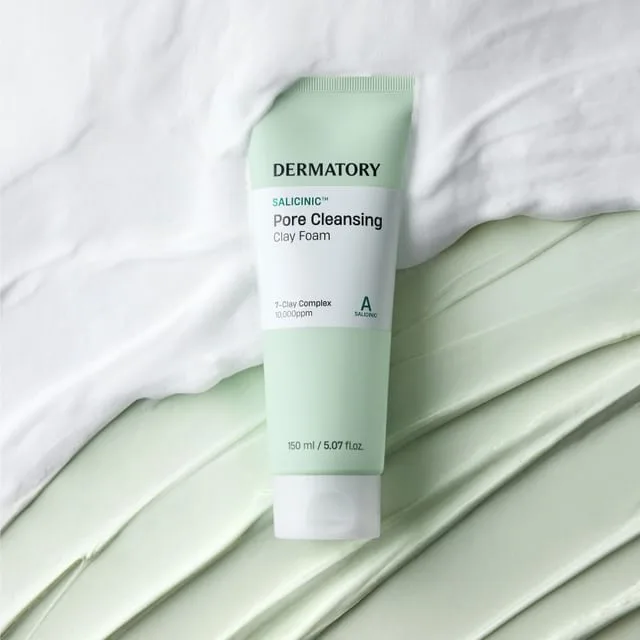
It combines a 4,000ppm BHA dose with a heavy multi-clay-and-charcoal blend in a single foaming cleanser, so one daily wash both exfoliates inside the pores and absorbs surface oil — a deep-cleansing, mattifying step aimed squarely at oily, congested skin.
An effective, affordable deep-cleansing clay foam for oily, congested skin, pairing a 4,000ppm BHA dose with a heavy multi-clay-and-charcoal blend. It washes skin to a matte, deeply clean finish and clears blackheads over time. The soap-and-clay base plus tea tree, rosemary and menthol make it a firmly oily-skin product that can dry out or irritate delicate complexions, but for its target audience it does a satisfying job.
As a 2024 pore-care launch from Dermatory with a growing rather than deep review base, this clay foam's score leans on its formulation — a functional BHA dose with a multi-clay-and-charcoal blend over a soap base — alongside early feedback rather than years of independent long-term data. Its broader performance across skin types over time continues to be established.
Verdicts
How well it fits each concern
Verdict by concern tap a concern for the case
Supporting rolefor Excess OilinessIn your profileYou chose · Rinse-off foam: Salicylic Acid gets seconds of contact, so this supports a routine for excess oiliness rather than treating it.Moderate evidenceStandard tolerabilityNo reviews collected yet
The case for it
Salicylic Acid has early or mechanistic evidence for this concern, not trial-backed standing.
It is in a rinse-off product, so it gets seconds of contact rather than the leave-on exposure the evidence assumes.
The formula carries no trigger this concern is sensitive to, with the cautions noted.
Cautions: fungal-acne triggers.
What would change this: The same active in a leave-on form would be judged on its evidence rather than its contact time.
Same rule for everyone. “Supporting role” is the verdict on 8,197 of 45,024 concern verdicts across the catalog; rule R6 decided 2,017 of them.
Unchanged since September 5, 2026, engine 5.1.1.
R6 — Contact time cannot deliver a leave-on claim; the product is judged on its job (cleansing without aggravating). Explicit exceptions (BPO wash, SA cleanser, medicated shampoos) never reach this rule because their rows set rinse_off_ok. · the full register
Carrying active
Salicylic Acid
Standing
plausible — trials support it
Form
contact limited — studied range 30%, from the trials on the row; needs leave-on contact; judge it after ~6 weeks
Tolerability
standard — fungal triggers
Row checked
against its sources on July 17, 2026 (evidence table ev-2026.09-r228)
Good choicefor BlackheadsIn your profileYou chose · Salicylic Acid is an approved or monograph active for blackheads, but this foam carries it at 0.4% — below the 0.5–2% the evidence and approvals rest on.Moderate evidenceStandard tolerabilityNo reviews collected yet
The case for it
Salicylic Acid is a first-line active — approved, monograph-listed or named in current guidelines — for this concern.
It is present below the studied range.
The formula carries no trigger this concern is sensitive to, with the cautions noted.
Cautions: fungal-acne triggers.
What would change this: A concentration inside the studied range would raise this a step.
Same rule for everyone. “Good choice” is the verdict on 9,564 of 45,024 concern verdicts across the catalog; rule R4 decided 84 of them.
Unchanged since September 5, 2026, engine 5.1.1.
R4 — Right molecule, weak dose: still a reasonable choice, not the strong one. · the full register
Carrying active
Salicylic Acid
Standing
first line — a regulator recognises it for this use; trials support it · per 21 CFR § 333.350 - Labeling of acne drug products. (US Code of Federal Regulations (Legal Information Institute, Cornell Law School)), opened July 27, 2026
Form
sub threshold (declared 0.4%) — studied range 0.5–2%, from the OTC monograph or label; judge it after ~6 weeks
Tolerability
standard — fungal triggers
Row checked
against its sources on July 27, 2026 (evidence table ev-2026.09-r228)
The studies behind the evidence row
OTC monograph, Topical Acne Drug Products — salicylic acid 0.5–2% recognized as an acne treatment active — US Food and Drug Administration
Supporting rolefor Large PoresIn your profileYou chose · Rinse-off foam: Salicylic Acid gets seconds of contact, so this supports a routine for large pores rather than treating it.Not yet assessedStandard tolerabilityNo reviews collected yet
The case for it
Salicylic Acid has been researched for this concern and the evidence does not support it.
It is in a rinse-off product, so it gets seconds of contact rather than the leave-on exposure the evidence assumes.
The formula carries no trigger this concern is sensitive to, with the cautions noted.
What would change this: The same active in a leave-on form would be judged on its evidence rather than its contact time.
Same rule for everyone. “Supporting role” is the verdict on 8,197 of 45,024 concern verdicts across the catalog; rule R6 decided 2,017 of them.
Unchanged since September 5, 2026, engine 5.1.1.
R6 — Contact time cannot deliver a leave-on claim; the product is judged on its job (cleansing without aggravating). Explicit exceptions (BPO wash, SA cleanser, medicated shampoos) never reach this rule because their rows set rinse_off_ok. · the full register
Carrying active
Salicylic Acid
Standing
none
Form
contact limited — studied range 0.5–2%, from the OTC monograph or label; needs leave-on contact; judge it after ~6 weeks
Good choicefor AcneIn your profileYou chose · Salicylic Acid is an approved or monograph active for acne, but this foam carries it at 0.4% — below the 0.5–2% the evidence and approvals rest on.Moderate evidenceStandard tolerabilityNo reviews collected yet
The case for it
Salicylic Acid is a first-line active — approved, monograph-listed or named in current guidelines — for this concern.
It is present below the studied range.
The formula carries no trigger this concern is sensitive to, with the cautions noted.
Cautions: fragrance; known irritants; fungal-acne triggers.
What would change this: A concentration inside the studied range would raise this a step.
Same rule for everyone. “Good choice” is the verdict on 9,564 of 45,024 concern verdicts across the catalog; rule R4 decided 84 of them.
Unchanged since September 5, 2026, engine 5.1.1.
R4 — Right molecule, weak dose: still a reasonable choice, not the strong one. · the full register
Carrying active
Salicylic Acid
Standing
first line — a regulator recognises it for this use; trials support it · per § 333.310 Acne active ingredients. (U.S. Food and Drug Administration — 21 CFR Part 333 Subpart D (Topical Acne Drug Products), Code of Federal Regulations via GovInfo), opened July 27, 2026
Form
sub threshold (declared 0.4%) — studied range 0.5–2%, from the OTC monograph or label; judge it after ~6 weeks
Tolerability
standard — fragrance load, irritant load, fungal triggers
Row checked
against its sources on July 27, 2026 (evidence table ev-2026.09-r228)
As a cleanserNot judged: what a cleanser is for — surfactant mildness, pH match to skin, rinses clean without stripping — cannot yet be measured from the ingredient list (only puts something back can).
A verdict is DermApproved’s assessment of how well a product’s ingredients fit a concern — never a claim about what the product treats. Evidence dots and collected reviews sit beside it and are never blended in.
Rules 0.5.1 · evidence table ev-2026.09-r228 · how we decide
Assessment
Pros & Cons
Pros
✓ Functional 4,000ppm BHA exfoliates inside pores
✓ Heavy multi-clay-and-charcoal blend absorbs oil deeply
✓ Clears blackheads and congestion over time
✓ Cooling, satisfying deep-clean finish for oily skin
✓ Doubles as a quick clay mask
✓ Affordable and concentrated
✓ Cruelty-free formula
Cons
✗ Soap-and-clay base can dry and tighten the skin
✗ Tea tree, rosemary and menthol can irritate sensitive skin
✗ Firmly an oily-skin product, not for dry or reactive skin
✗ Easy to over-use and over-strip
✗ Fungal-acne-prone users should approach with caution
Review
Full Review
Dermatory built its reputation on gentleness — hypoallergenic, fragrance-free, cica-soothing products for sensitive skin. So the Salicylic Pore Cleansing Clay Foam is a bit of a departure, and it's worth flagging that up front, because anyone who comes to it expecting the brand's signature mildness will be surprised. This is an actives-forward, deep-cleansing wash aimed squarely at oily, congested, blackhead-prone skin, and it brings the kind of ingredients that demand respect: a meaningful dose of BHA, a heavy clay blend, charcoal, and a cooling, herbal essential-oil kick. Judged as what it is — a serious pore-cleanser for oily skin — it's effective. Judged by the brand's gentle reputation, it's a different animal.
The active core is the salicylic acid, present at a declared 4,000ppm — 0.4 percent. BHA is oil-soluble, which means it can penetrate into the sebum-filled pore lining and dissolve the gunk that leads to blackheads and congestion, and in a cleanser it does focused work on the pores during the wash. It's reinforced by willow bark and spiraea (meadowsweet) extracts, both natural sources of related salicylates. This is a genuine, functional exfoliating component, not a token splash, and it's the reason the foam can claim real pore-clearing benefit over time rather than just a surface clean.
The clay side is equally serious. Kaolin leads at 9,000ppm, joined by an almost showy multi-clay blend — bentonite, montmorillonite, illite, Moroccan lava clay, sea silt, hectorite — plus charcoal powder. Clays and charcoal absorb excess oil and draw impurities from congested pores, giving the foam its deep-cleansing, mattifying character. For someone with genuinely oily skin who loves that squeaky-clean, oil-stripped feeling, this combination delivers it emphatically. There's even a touch of protease, a gentle enzymatic exfoliant, rounding out the pore-clearing approach.
But all of this points firmly in one direction, and honesty requires naming it: this is an oily-skin product, and it can be harsh on anyone else. The cleansing base is a potassium soap (palm acid plus potassium hydroxide), softened by an amino-acid co-surfactant but still alkaline. Combined with the oil-absorbing clays and the BHA, it's a genuinely deep-stripping wash. Layer on tea tree oil, rosemary oil and menthyl lactate — which give the cooling, herbal, slightly tingly sensation — and you have a formula with real irritation potential for dry, sensitive or reactive skin. Despite being free of added synthetic fragrance, those essential oils make it anything but a sensitive-skin cleanser. Dry and reactive complexions should steer clear; oily skin that loves a deep clean will be delighted.
Using it well is essential, as with any potent cleanser. The smart approach is to treat it as a targeted deep-cleanse — daily or every other day on the oily T-zone — rather than scrubbing your whole face raw twice a day. You can also leave the lather on for a minute or two as a quick clay mask for extra oil absorption. Crucially, follow it with a hydrating toner and a moisturizer, because the clays, soap and BHA together can leave even oily skin tight if you overdo it. And avoid stacking it with other strong acids or retinoids in the same routine, which compounds the exfoliation.
Value is good. At around fifteen dollars for 150ml, it's affordable, and because it's a concentrated, multi-tasking pore-cleanser-and-mini-mask, it earns its place for oily skin. You're getting a functional BHA, a genuine clay blend and charcoal in one tube for the price of a basic foaming wash, which is a sensible buy for congestion-prone skin. The deep-clean satisfaction it delivers is exactly what its audience is looking for.
There's a useful broader point here about brands that span very different skin-care philosophies under one name. Dermatory is, at heart, a sensitive-skin brand, and the existence of an aggressive, essential-oil-spiked clay cleanser in its catalog is a reminder not to assume that everything from a 'gentle' label is gentle. Brands extend into adjacent categories all the time, and a product's positioning within a range matters as much as the brand's overall reputation. Someone with reactive skin who trusts Dermatory for its cica pads could easily pick this up assuming the same mildness and end up stripped and stinging. The lesson, as ever, is to read the actual formula rather than the logo on the tube — and in this case the formula is shouting 'oily skin only' quite clearly to anyone who looks.
The verdict is clear and skin-type-specific. If your skin is oily or combination and prone to blackheads, congestion and midday shine, and you want a satisfying deep-cleansing wash that exfoliates pores and absorbs oil in one step, this clay foam is an effective, affordable, well-built choice. If your skin is dry, sensitive, rosacea-prone or barrier-compromised, this is firmly not for you — the soap, clay, BHA and essential oils will likely leave you tight and irritated, and Dermatory's own gentle cica products are a far better fit. Match it to genuinely oily skin, use it with restraint, and it does its deep-cleaning job very well.
Formula
Key Ingredients
The hero actives that drive this product's performance.
At a declared 4,000ppm, the oil-soluble BHA penetrates into pores to dissolve sebum and loosen blackheads as you cleanse, the active core of the pore-clearing claim alongside the willow bark and spiraea that supply related salicylates.
Kaolin at 9,000ppm leads a multi-clay blend with bentonite, montmorillonite, illite and lava clay that absorbs excess oil and draws impurities from congested pores, giving the foam its deep-cleansing, mattifying character.
Adds an antibacterial, blemish-targeting note suited to oily, breakout-prone skin, working with the BHA to keep pores clearer, though as an essential oil it raises the formula's irritation potential.
Use as a daily or every-other-day deep-cleansing wash on oily areas, or leave the lather on briefly as a mini clay mask; follow with a hydrating toner and moisturizer to offset the clay and soap.
Results Timeline
Skin feels deeply cleansed, matte and fresh from the first wash; clearer pores and fewer blackheads build with consistent use over a few weeks, while over-washing can dry the skin.
The foam combines chemical and physical pore-clearing mechanisms. Salicylic acid at 4,000ppm is a lipophilic beta-hydroxy acid that penetrates sebum-rich follicles to dissolve oil and loosen comedones, with strong evidence for reducing blackheads and congestion; willow bark and spiraea provide additional natural salicylates. The clay system — kaolin at 9,000ppm plus bentonite, montmorillonite, illite, lava clay and others — and charcoal work by adsorption, binding and removing excess sebum and surface debris, a well-established oil-control mechanism. Protease adds mild enzymatic exfoliation. The cleansing base is a potassium soap formed from hydrogenated palm acid and potassium hydroxide, effective but alkaline, supplemented by the milder amino-acid surfactant potassium cocoyl glycinate. The counterweights are significant: the alkaline base, absorbent clays and BHA can over-strip, and tea tree and rosemary essential oils plus menthyl lactate, while giving antibacterial and cooling effects, raise irritation and sensitization potential. The honest scientific read is a genuinely effective deep-cleansing and pore-exfoliating formula whose efficacy for oily skin is real and whose drying-and-irritation potential for other skin types is equally predictable.
Dermatologist Perspective
Salicylic acid cleansers combined with clay and charcoal are generally regarded in clinical practice as useful for oily, comedonal and mildly acne-prone skin, since BHA effectively targets follicular sebum and clays absorb surface oil. Dermatology guidance would, however, caution that the alkaline soap base, absorbent clays and added essential oils — tea tree, rosemary — plus menthol make this poorly suited to dry, sensitive, rosacea-prone or barrier-impaired skin, which are steered toward gentler, low-pH, fragrance- and essential-oil-free cleansers. For oily skin, clinicians would advise using it judiciously rather than over-washing, following with moisturizer, and avoiding simultaneous use with other strong acids or retinoids to prevent over-exfoliation. As a rinse-off, its BHA contact time is limited, so it supports rather than replaces leave-on treatments for acne, and consistent sun protection remains essential alongside any exfoliating routine.
Guidance
Usage & Recommendations
How to Use
Wet your face with lukewarm water, squeeze a small amount of the clay cream into damp hands, and work it into a creamy lather before massaging gently over the oilier areas of the face. Either rinse promptly, or for extra oil absorption leave the lather on for a minute or two as a quick clay mask before rinsing thoroughly. Use it daily or every other day rather than over-washing, focusing on the T-zone, and always follow with a hydrating toner and moisturizer to offset the clay and soap. Avoid layering it with other strong acids or retinoids in the same routine, and wear daily sunscreen.
Value Assessment
At around fifteen dollars for 150ml, this clay foam is affordable and, because it combines a functional BHA, a genuine multi-clay blend and charcoal in one tube — and can double as a quick clay mask — it offers good value for oily, congested skin. The concentration of actives genuinely justifies the price over a basic foaming cleanser. As an emerging dermo-cosmetic brand product, the pricing is accessible. The value is real but strictly skin-type-dependent: oily and combination skin that suits the deep-cleansing formula gets strong worth, while dry or sensitive skin that ends up tight, irritated or needing extra products to recover would find the apparent bargain illusory, and should choose a gentler cleanser instead.
Who Should Buy
Choose it if your skin is oily or combination and prone to blackheads, congestion and shine, and you want a satisfying deep-cleansing wash that exfoliates pores with BHA and absorbs oil with clay and charcoal in one step. It's an affordable, effective pick for genuinely oily, deep-clean-loving skin.
Who Should Skip
Steer clear if your skin is dry, sensitive, rosacea-prone or barrier-compromised, since the soap-and-clay base, BHA and essential oils will likely leave it tight and irritated — Dermatory's gentle cica products suit you far better. Anyone who reacts to tea tree, rosemary or menthol should also avoid it.
Ready to try Dermatory Salicylic Pore Cleansing Clay Foam?
A dense, grey-tinged clay cream that whips into a creamy foam with a cooling, deep-cleansing feel.
Scent
Fragrance-free of added perfume, with a natural herbal-minty note from the tea tree, rosemary and menthol.
Packaging
A 150ml squeeze tube, practical and travel-friendly for daily pore-care use.
Finish
non-greasyfast-absorbing
What to Expect on First Use
The first wash foams into a cool, creamy clay lather that rinses to a deeply clean, matte feel; oily skin tends to love it, while drier skin may sense tightness and a tingle from the menthol.
How Long It Lasts
Around 3-4 months of regular use from the 150ml tube.
It sits in Dermatory's pore-care line, a more targeted, actives-forward range than the brand's hypoallergenic cica products, built for oily and blemish-prone skin that wants a serious deep-cleanse.
About Dermatory Established Brand (5–20 years)
Dermatory is a Korean dermo-cosmetic brand known for sensitive-skin lines, but this pore-cleansing clay foam is a more targeted, actives-forward product aimed at oily, congested skin. Its credibility rests on a sensible pore-care deck of BHA, clays and charcoal rather than the gentle positioning of the brand's hypoallergenic ranges.
Brand founded: 2018 · Product launched: 2024
Myth vs. Reality
Common Myths
Myth
A salicylic clay cleanser will shrink your pores permanently.
Reality
Pore size is largely genetic; what this foam does is clear sebum and debris and absorb oil so pores look less congested and less visible, which reverses if you stop — it cleans and refines, it doesn't permanently shrink.
FAQ
Frequently Asked Questions
How much salicylic acid is in the clay foam?
It contains salicylic acid at a declared 4,000ppm (0.4%), an oil-soluble BHA that penetrates pores to dissolve sebum and loosen blackheads during cleansing, supported by willow bark and spiraea for related salicylates.
Is this clay foam good for oily, congested skin?
Yes — it's built for it. The BHA, a heavy multi-clay blend and charcoal deeply cleanse and absorb oil, leaving oily and blemish-prone skin matte and fresh. It's less suited to dry or sensitive skin.
Will the clay foam dry out my skin?
It can. Between the absorbent clays, the soap base and the BHA, it's a deep-cleansing wash that dry or sensitive skin may find tightening. Use it on oilier areas, don't over-wash, and follow with a hydrating moisturizer.
Why does the foam feel cooling or tingly?
It contains menthyl lactate plus tea tree and rosemary oils, which give a fresh, cooling sensation. That feel is pleasant for many but can irritate sensitive or reactive skin, so patch test if you're prone to reactions.
Can I use it as a clay mask?
Yes — you can leave the lather on for a minute or two as a quick clay mask for extra oil absorption before rinsing, though daily use as a wash is the primary way it's intended to be used.
Reviews
What Reviewers Tend to Say
Recurring themes our editors read across retailer reviews of this product — summaries in our words, not quotations, and not a substitute for your own patch test.
The whole case for salicylic acid rests on one unglamorous fact of chemistry: it dissolves in oil. Understand that, and you know exactly when it beats a glycolic acid — and when it's overkill.
The strongest counterexample to blanket botanical scepticism is also one of the more common contact allergens — and holding both facts at once is the only honest way to read it.
Essential oils are declared by botanical name rather than as fragrance, which is why the most heavily perfumed products in the natural aisle can carry the reassuring word — and why the bottle gets more sensitising the longer you own it.
Products, answers, therapy guides, tools and articles in one search. Brand names,
slang and abbreviations all work — accutane finds isotretinoin, bacne finds truncal acne.