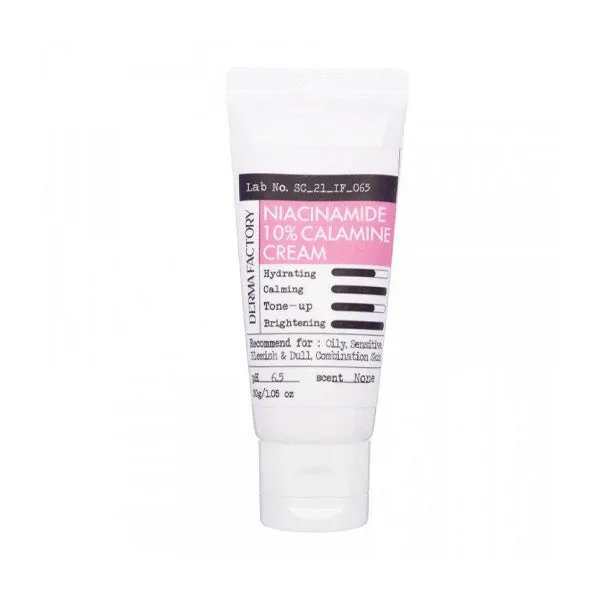
It pairs a declared 10 percent niacinamide with 5 percent zinc oxide and 5 percent calamine in an oil-free silicone base, turning a classic calamine remedy into a mattifying, colour-correcting daily cream.
A clever, inexpensive update of classic calamine: declared 10 percent niacinamide with 5 percent zinc oxide and 5 percent calamine in a fragrance-free, oil-free silicone cream that calms redness, controls shine and adds a soft tone-up. It is too mattifying for dry skin, and despite the zinc it is not a sunscreen.
English-language reviews for this cream are scarce, so the assessment relies mainly on its declared 10 percent niacinamide, 5 percent zinc oxide and 5 percent calamine, the pH printed on the label, and published evidence for these ingredients.
Verdicts
How well it fits each concern
Verdict by concern tap a concern for the case
Promisingfor Excess OilinessIn your profileYou chose · Niacinamide has trial-level evidence for excess oiliness but no guideline or regulatory standing yet — promising, short of a recommendation; the other actives here are not yet assessed for it.Moderate evidenceStandard tolerabilityNo reviews collected yet
The case for it
Niacinamide has trial-level evidence for this concern but no guideline or regulatory standing yet.
It is present at an effective concentration, declared or high in the ingredient list.
The formula carries no trigger this concern is sensitive to, with the cautions noted.
Cautions: fungal-acne triggers.
What would change this: Guideline or regulatory standing for the active on this concern would move this from a promising bet to a recommendation.
Same rule for everyone. “Promising” is the verdict on 7,858 of 45,024 concern verdicts across the catalog; rule R9p decided 7,858 of them.
As of September 25, 2026, engine 5.1.1.
R9p — 0.5.0: 'Unproven' beside three filled dots read as one question answered twice with opposite words (7,018 rows). The chip measures standing, the dots measure trial volume; where the row carries at least one RCT or a tier-2 source (moderate dots) and the active is present at a working level, the honest word is Promising. Unproven is reserved for plausible-standing rows with limited or weak evidence, or an under-dosed form. Same rank as Unproven — a bet either way; the dots order them. · the full register
Carrying active
Niacinamide
Standing
plausible — trials support it
Form
adequate (declared 10%) — studied range 2%, from the trials on the row; needs leave-on contact; judge it after ~8 weeks
Tolerability
standard — fungal triggers
Row checked
against its sources on July 17, 2026 (evidence table ev-2026.09-r228)
Good choicefor SensitivityIn your profileYou chose · No fragrance, drying alcohol, declarable allergens or sensitising preservatives in this cream — the profile sensitive skin looks for.Not yet assessedGentleNo reviews collected yet
The case for it
Niacinamide has no evidence row yet for this concern — it is in the research queue.
The formula carries none of the triggers this concern is sensitive to.
What would change this: A researched evidence row for the lead active would replace this with a verdict.
Same rule for everyone. “Good choice” is the verdict on 1,938 of 45,024 concern verdicts across the catalog; rule F2 decided 1,938 of them.
As of September 25, 2026, engine 5.1.1.
Promisingfor Dark SpotsIn your profileYou chose · Niacinamide has trial-level evidence for dark spots but no guideline or regulatory standing yet — promising, short of a recommendation; the other actives here are not yet assessed for it.Moderate evidenceGentleNo reviews collected yet
The case for it
Niacinamide has trial-level evidence for this concern but no guideline or regulatory standing yet.
It is present at an effective concentration, declared or high in the ingredient list.
The formula carries none of the triggers this concern is sensitive to.
What would change this: Guideline or regulatory standing for the active on this concern would move this from a promising bet to a recommendation.
Same rule for everyone. “Promising” is the verdict on 7,858 of 45,024 concern verdicts across the catalog; rule R9p decided 7,858 of them.
As of September 25, 2026, engine 5.1.1.
R9p — 0.5.0: 'Unproven' beside three filled dots read as one question answered twice with opposite words (7,018 rows). The chip measures standing, the dots measure trial volume; where the row carries at least one RCT or a tier-2 source (moderate dots) and the active is present at a working level, the honest word is Promising. Unproven is reserved for plausible-standing rows with limited or weak evidence, or an under-dosed form. Same rank as Unproven — a bet either way; the dots order them. · the full register
Carrying active
Niacinamide
Standing
plausible — trials support it
Form
adequate (declared 10%)
Tolerability
gentle
Row checked
against its sources on July 17, 2026 (evidence table ev-2026.09-r228)
Also listed for Dullness — the actives here (Niacinamide, Zinc Oxide, Calamine, Adenosine) are in our research queue for that concern; there is no verdict until their evidence rows are written. That is a gap in our table, not a mark against the product.
A verdict is DermApproved’s assessment of how well a product’s ingredients fit a concern — never a claim about what the product treats. Evidence dots and collected reviews sit beside it and are never blended in.
Rules 0.5.1 · evidence table ev-2026.09-r228 · how we decide
Assessment
Pros & Cons
Pros
✓ Declared 10 percent niacinamide for redness, oil and marks
✓ Zinc oxide and calamine calm and mattify the skin
✓ Soft tint colour-corrects redness
✓ Fragrance-free and oil-free, suitable for fungal acne
✓ Label states pH and exact concentrations
✓ Very low price at some retailers
Cons
✗ Not moisturising enough for dry skin
✗ No SPF despite zinc oxide content
✗ Single tint may leave a cast on deeper skin
✗ Ten percent niacinamide can tingle for reactive skin
Review
Full Review
Calamine is the pink lotion many people remember being dabbed on chickenpox and insect bites as children. It is simply zinc oxide with a little iron oxide, which gives it that familiar dusty-rose colour, and it has been used for more than a century to soothe itchy, irritated skin. Derma Factory's Niacinamide 10% Calamine Cream takes that old remedy, puts it into a modern silicone cream, and pairs it with a high dose of niacinamide. The result is not quite a moisturiser, not quite a treatment and not quite makeup, but a little of each: a calming, oil-controlling cream with a soft tone-up effect.
The label, in Derma Factory's usual lab-report style, is admirably specific. It declares niacinamide at ten percent, zinc oxide at five percent and calamine at five percent, gives the pH as 6.5 and states that there is no scent. The ingredient list confirms all three actives near the top. That means there is roughly ten percent zinc-based mineral in total, which is a lot for a leave-on cream that is not a sunscreen, and it explains the product's character. The zinc and calamine sit on the skin, absorbing oil and slightly mattifying, and their pale pink-beige tint softens redness and uneven tone in the way a colour-correcting primer would.
The base is built around silicones rather than oils. Cyclohexasiloxane, a volatile silicone, evaporates after application, leaving caprylyl methicone and a silicone emulsifier to hold the minerals in a smooth, slightly powdery film. Disteardimonium hectorite and sodium chloride stabilise the water-in-silicone emulsion, and triethoxycaprylylsilane coats the mineral particles so they spread evenly instead of clumping. Glycerin and butylene glycol add a little hydration, and adenosine appears for a minor anti-wrinkle claim. There are no plant oils, no fatty esters and no fragrance, which makes this unusually suitable for oily and fungal-acne-prone skin.
Niacinamide at ten percent is the workhorse. It is among the most versatile, best-studied cosmetic ingredients: it strengthens the skin barrier, reduces redness over time, regulates oil, and helps fade dark marks by reducing pigment transfer. Ten percent is on the high side; some people with very sensitive skin experience flushing or tingling at that level, although many tolerate it well. The zinc minerals add their own soothing reputation and a small amount of oil absorption, and the combination fits the brand's stated targets of oily, sensitive, blemish-prone and dull skin.
It is important to be clear about what the zinc oxide is not doing. Five percent zinc oxide and five percent calamine will provide some incidental UV scattering, but this cream carries no SPF rating and has not been tested as a sunscreen. It should not replace sunscreen, and the brand itself advises using one during the day. Think of the minerals as a calming, mattifying and colour-correcting layer, not as sun protection.
In use, the cream is soft and pinkish in the tube, spreads easily, and sets within a minute or two to a satin-matte finish with a light, even tone. On fair to light-medium skin the tint looks natural and softens redness around the nose and cheeks. On deeper skin tones it may leave a slight cast. It works as a final skincare step in the morning, either alone for a no-makeup look or under foundation, and it can be dabbed a little more thickly on red or blemished areas, as the brand suggests.
Because the texture is silicone-heavy and mineral-rich, it is not particularly moisturising. Dry skin will likely need a hydrating serum or moisturiser underneath, and very dry patches may look emphasised by the powdery finish. Oily and combination skin, by contrast, will probably appreciate the oil control and shine reduction.
It also fits neatly around other treatments. Because the cream contains no acids or retinoids, it can follow a salicylic acid toner or sit over a prescription acne gel without adding much irritation, and its zinc minerals help tone down the redness those treatments can leave behind. In summer, some oily-skinned users skip a separate moisturiser entirely and use this as their only cream under sunscreen. In winter, the same people may prefer to keep it for the T-zone and red patches. Reapplying during the day is easy too: a tiny amount pressed over shiny areas refreshes the matte finish without disturbing makeup much.
The limitations are modest. The cream will not treat active acne on its own, since there is no exfoliant or antibacterial agent beyond zinc. The tint is a single shade, so it suits some skin tones better than others. And although the formula is simple and fragrance-free, the high niacinamide level may be too much for the most reactive skin.
Derma Factory is a young Korean brand, founded around 2019, that sells simple, single-focus formulas at very low prices, and it labels its products like laboratory samples with declared concentrations and pH. This cream has been around for a few years, with reasonable numbers of reviews on Korean platforms but little English-language feedback.
At about seven dollars for 30 g at DodoSkin, the price is very low, even if other retailers charge two or three times as much. For oily, redness-prone skin that wants a calming, mattifying, tone-evening layer with a strong niacinamide dose, it is excellent value. Just keep a real sunscreen on top.
Formula
Key Ingredients
The hero actives that drive this product's performance.
The classic pink zinc and iron oxide powder, declared at 5 percent, giving the cream its soothing reputation and a soft colour-correcting tint over redness.
Apply as the final skincare step, thinly all over or more thickly on red areas; in the morning follow with a real sunscreen, since the minerals carry no SPF rating.
Results Timeline
Immediate: a satin-matte finish with a soft tone-up that tones down redness. Two to four weeks: less shine and calmer-looking skin. Eight weeks and beyond: dark marks may fade gradually thanks to niacinamide.
Pairs Well With
A hydrating serum for dry areasA broad-spectrum sunscreen
Niacinamide is one of the best-characterised cosmetic actives. Controlled studies have shown that topical niacinamide improves barrier function by increasing ceramide synthesis, reduces transepidermal water loss, lowers sebum production and reduces hyperpigmentation by inhibiting the transfer of melanosomes from melanocytes to keratinocytes. Anti-inflammatory effects also contribute to reduced redness. Studies commonly use 2 to 5 percent; 10 percent is well tolerated by many, although transient flushing or irritation is reported more often at higher levels.
Calamine is a mixture of zinc oxide with a small proportion of ferric oxide, long used as a mild antipruritic and protectant. Zinc oxide itself has astringent, mildly antimicrobial and soothing properties and absorbs oil. In this cream, the combination of 5 percent zinc oxide and 5 percent calamine forms a mineral film that mattifies and optically softens redness.
Although zinc oxide is a UV filter in sunscreens, UV protection depends on particle size, concentration, dispersion and film uniformity, and is only established by SPF testing. This cream has not been tested or labelled for sun protection, so any incidental UV scattering should not be relied upon. Adenosine appears for its modest wrinkle-improvement effects, and the silicone-based, oil-free vehicle is suited to oily and acne-prone skin.
Dermatologist Perspective
Niacinamide is frequently recommended in dermatology for acne-prone, oily and redness-prone skin because it is well tolerated and supports barrier function. Zinc-based products such as calamine have long been used to soothe irritated skin. Clinicians generally advise that tinted or mineral-containing creams without an SPF rating should not be relied on for sun protection, and that a separate broad-spectrum sunscreen be applied daily, particularly when treating post-inflammatory marks. Patients with very sensitive skin may be advised to start high-concentration niacinamide every other day, and those with dry skin to layer a moisturiser underneath mattifying products.
Guidance
Usage & Recommendations
How to Use
At the end of your skincare routine, squeeze a small amount onto the fingertips and spread it evenly across the face, following the direction of the skin texture. Use a thin layer for everyday tone care, and dab a little extra on red or blemished areas. In the morning, finish with a broad-spectrum sunscreen, as this cream does not provide rated protection. If your skin is dry, apply a hydrating serum or moisturiser first.
Value Assessment
DodoSkin sells the 30 g tube for about seven dollars, which is exceptional value for a cream with declared 10 percent niacinamide and 10 percent zinc minerals; other US-facing retailers charge closer to eighteen dollars. Even at the higher price, the fragrance-free, oil-free formula and calming tint make it good value for oily and redness-prone skin. Derma Factory's pricing reflects its budget, single-focus model rather than any compromise in its declared actives.
Who Should Buy
People with oily, combination or redness-prone skin who want a fragrance-free, mattifying cream with high-strength niacinamide and a soft colour-correcting tint, including those with fungal-acne concerns.
Who Should Skip
Those with dry or flaky skin who need rich moisture, people with deeper skin tones who dislike any cast, and anyone who flushes easily with high-strength niacinamide.
Ready to try Derma Factory Niacinamide 10% Calamine Cream?
A soft, pinkish silicone cream that spreads easily and sets to a smooth, slightly powdery film.
Scent
No scent, as the label states.
Packaging
A 30 g white squeeze tube with a pink lab-style label.
Finish
mattenatural
What to Expect on First Use
Skin looks more even and less red straight away, with a satin-matte finish. Some people feel brief tingling from the 10 percent niacinamide. Dry patches may look more obvious without a moisturiser underneath.
The cream updates the old-fashioned calamine lotion for daily facial use, combining its soothing zinc minerals with high-strength niacinamide in Derma Factory's lab-coded single-focus range.
About Derma Factory Established Brand (5–20 years)
Derma Factory, a Korean brand dating to around 2019, sells low-cost single-active formulas labelled like lab samples with declared concentrations and pH. It has not published clinical studies of its own products.
Brand founded: 2019
Myth vs. Reality
Common Myths
Myth
Zinc oxide in this cream means you can skip sunscreen.
Reality
The cream has no SPF rating and has not been tested for UV protection. Daily sunscreen is still needed.
Myth
Calamine only works on insect bites and rashes.
Reality
Calamine's zinc and iron oxides can also calm the look of redness and absorb oil on the face, which is how it is used here.
FAQ
Frequently Asked Questions
Does Derma Factory's Niacinamide 10% Calamine Cream have SPF?
No. It contains zinc oxide and calamine but carries no SPF rating, so use a separate sunscreen.
Is the Derma Factory calamine cream fragrance-free?
Yes. The label states scent: none, and the formula has no essential oils.
Can the calamine cream be used under makeup?
Yes. It sets to a satin-matte finish with a light tint that works well under foundation.
Is Derma Factory's calamine cream suitable for fungal acne?
It contains no plant oils or fatty esters, so it is generally considered fungal-acne friendly.
Will 10 percent niacinamide irritate sensitive skin?
Most people tolerate it, but some feel tingling or flushing. Start every other day if your skin is reactive.
Is the Derma Factory calamine cream good for dry skin?
It is quite mattifying, so dry skin should apply a moisturiser underneath or use it only on red areas.
Reviews
What Reviewers Tend to Say
Recurring themes our editors read across retailer reviews of this product — summaries in our words, not quotations, and not a substitute for your own patch test.
Five brands that own the feed, judged on their ingredient lists rather than their view counts — including the one active all five suddenly added at once, and what that tells you.
Nearly every trial that made this ingredient famous ran at 2–5%. The double-digit numbers on the shelf are answering a question the biology never asked.
It was invented to stop bleeding during surgery. In 2026 it's in dozens of brightening serums — and the evidence is better than most trend ingredients can claim.
Pore size is mostly genetic and you can't permanently shrink it — but you can dramatically change how visible pores look, and the products that do it aren't the ones labeled 'pore-minimizing.'
Jun 3, 2026· 5 min
Questions people ask about sensitive skin
Verified answers from our questions library — the nuance a product page cannot carry.
Products, answers, therapy guides, tools and articles in one search. Brand names,
slang and abbreviations all work — accutane finds isotretinoin, bacne finds truncal acne.