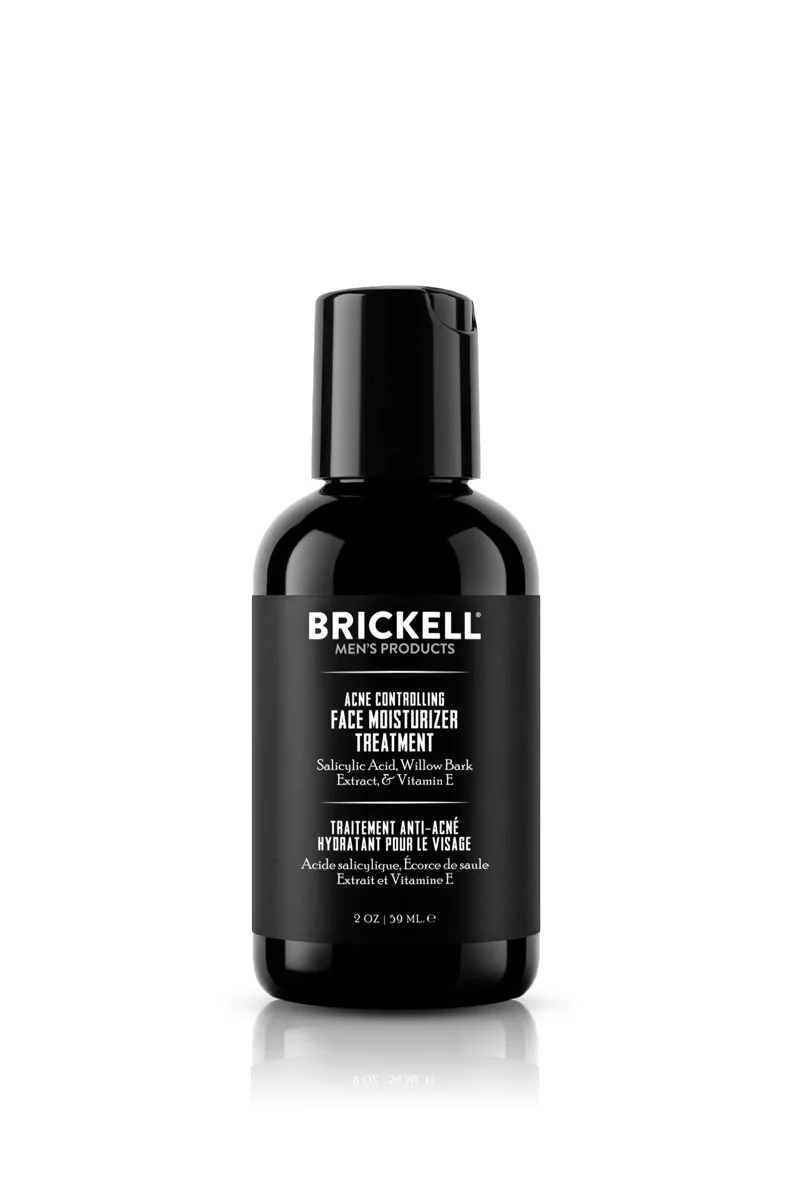
It is one of very few natural-positioned men's moisturizers to carry a full 2% salicylic acid active as an OTC drug, which is the right active in the format where it works best. What also sets it apart, less happily, is the vehicle: coconut oil, isopropyl palmitate, cocoa and shea butter and beeswax in a product for acne-prone skin, a pairing of active and base that pulls in opposite directions.
A leave-on moisturizer with a full 2% salicylic acid active is the right idea, and this one delivers the acid in the format where it actually works. It then dissolves that acid in coconut oil, isopropyl palmitate, butters and beeswax and scents it with tea tree, peppermint and citrus oils, which is close to the opposite of what acne-prone skin needs. Combination skin in winter may get on with it; oily, inflamed or sensitive skin should not try.
Verified feedback on this lotion is limited to the seventy-four reviews on Brickell's own site, which run strongly positive as brand-hosted reviews usually do, and although it has been listed on Amazon since early 2020 that volume could not be confirmed; the brand publishes no clinical testing. The grade therefore rests on the well-documented behaviour of 2% leave-on salicylic acid and of the comedogenic oils and essential oils around it, with real-world reports serving as a modest cross-check rather than the foundation.
Verdicts
How well it fits each concern
Verdict by concern tap a concern for the case
Strong choicefor AcneIn your profileYou chose · Salicylic Acid is an approved or monograph active for acne; this lotion carries it at 2%.Moderate evidenceStandard tolerabilityNo reviews collected yet
The case for it
Salicylic Acid 2% is a first-line active — approved, monograph-listed or named in current guidelines — for this concern.
It is present at an effective concentration, declared or high in the ingredient list.
The formula carries no trigger this concern is sensitive to, with the cautions noted.
Cautions: fragrance; known irritants; fungal-acne triggers.
Same rule for everyone. “Strong choice” is the verdict on 1,459 of 45,024 concern verdicts across the catalog; rule R2 decided 892 of them.
As of September 25, 2026, engine 5.1.1.
R2 — A regulator- or guideline-recognised first-line active, declared at an effective strength, in a form the claim supports. · the full register
Carrying active
Salicylic Acid 2%
Standing
first line — a regulator recognises it for this use; trials support it · per § 333.310 Acne active ingredients. (U.S. Food and Drug Administration — 21 CFR Part 333 Subpart D (Topical Acne Drug Products), Code of Federal Regulations via GovInfo), opened July 27, 2026
Form
adequate (declared 2%) — studied range 0.5–2%, from the OTC monograph or label; judge it after ~6 weeks
Tolerability
standard — fragrance load, irritant load, fungal triggers
Row checked
against its sources on July 27, 2026 (evidence table ev-2026.09-r228)
Strong choicefor BlackheadsIn your profileYou chose · Salicylic Acid is an approved or monograph active for blackheads; this lotion carries it at 2%.Moderate evidenceStandard tolerabilityNo reviews collected yet
The case for it
Salicylic Acid 2% is a first-line active — approved, monograph-listed or named in current guidelines — for this concern.
It is present at an effective concentration, declared or high in the ingredient list.
The formula carries no trigger this concern is sensitive to, with the cautions noted.
Cautions: fungal-acne triggers.
Same rule for everyone. “Strong choice” is the verdict on 1,459 of 45,024 concern verdicts across the catalog; rule R2 decided 892 of them.
As of September 25, 2026, engine 5.1.1.
R2 — A regulator- or guideline-recognised first-line active, declared at an effective strength, in a form the claim supports. · the full register
Carrying active
Salicylic Acid 2%
Standing
first line — a regulator recognises it for this use; trials support it · per 21 CFR § 333.350 - Labeling of acne drug products. (US Code of Federal Regulations (Legal Information Institute, Cornell Law School)), opened July 27, 2026
Form
adequate (declared 2%) — studied range 0.5–2%, from the OTC monograph or label; judge it after ~6 weeks
Tolerability
standard — fungal triggers
Row checked
against its sources on July 27, 2026 (evidence table ev-2026.09-r228)
The studies behind the evidence row
OTC monograph, Topical Acne Drug Products — salicylic acid 0.5–2% recognized as an acne treatment active — US Food and Drug Administration
Not for thisfor Large PoresIn your profileYou chose · The actives here have been researched for large pores and the evidence does not support the claim.Not yet assessedStandard tolerabilityNo reviews collected yet
The case for it
Salicylic Acid 2% has been researched for this concern and the evidence does not support it.
It is present at an effective concentration, declared or high in the ingredient list.
The formula carries no trigger this concern is sensitive to, with the cautions noted.
Same rule for everyone. “Not for this” is the verdict on 488 of 45,024 concern verdicts across the catalog; rule R10 decided 488 of them.
As of September 25, 2026, engine 5.1.1.
Does the jobDoes what a moisturizer is for: draws in water, softens and smooths.
A verdict is DermApproved’s assessment of how well a product’s ingredients fit a concern — never a claim about what the product treats. Evidence dots and collected reviews sit beside it and are never blended in.
Rules 0.5.1 · evidence table ev-2026.09-r228 · how we decide
Assessment
Pros & Cons
Pros
✓ Full 2% salicylic acid OTC active in a leave-on format with real contact time
✓ Aloe leaf juice first in the list gives a cool, light application
✓ Glycerin, hyaluronate and panthenol offset the acid's drying pull
✓ One-step routine for men who will not use a separate treatment
✓ Rosehip, tamanu and borage oils suit dry cheeks in cold months
✓ Fairly priced for a monograph acne moisturizer from a small brand
✓ Flip-cap squeeze bottle keeps the acid formula clean and easy to dose
Cons
✗ Coconut oil, isopropyl palmitate, butters and beeswax in an acne product
✗ Non-comedogenic claim is not supported by the inactive ingredient list
✗ Too heavy for oily skin, especially in summer
✗ Tingle on application is the essential oils, not efficacy
✗ 2 oz bottle empties in about a month at the recommended dose
Review
Full Review
Read the top line of the label and this is a good acne product. Salicylic acid 2%, declared as an OTC active, in a leave-on moisturizer: that is the maximum monograph dose in the format that gives a beta-hydroxy acid the hours of contact it needs to work inside a pore, rather than the thirty seconds a wash allows. Brickell put the right molecule at the right strength in the right place, and on that count the Acne Controlling Face Moisturizer Treatment deserves more credit than most natural-positioned acne lines earn. Then read the inactive list, and the formula starts arguing with itself.
After the aloe and the water come sunflower oil, a glyceryl stearate emulsifier, isopropyl palmitate, cetyl alcohol, glycerin, stearic acid, geranium hydrosol, coconut oil, jojoba, cocoa butter, beeswax, shea butter, rosehip, tamanu, macadamia, borage, flax and evening primrose oils. That is the vehicle of a rich winter face cream for dry skin, and it is essentially the same oil-and-butter architecture Brickell uses across its range, with an acid stirred in. Isopropyl palmitate and coconut oil are two of the more consistently pore-clogging materials in the old rabbit-ear and human back-comedogenicity studies; cocoa butter, beeswax and macadamia oil score in the middle. The label says non-comedogenic, a phrase no regulator defines or tests. The ingredient list says otherwise, and on skin that clogs easily the list wins.
The essential oils compound the problem. The bottle is scented with lemon, lime and ginger oils and finishes, as the last two ingredients, with peppermint and tea tree. Tea tree has some evidence for mild acne, at around 5 percent in a dedicated gel; at the bottom of a list it is a fragrance note with a reputation. Peppermint has no acne evidence and a well-documented tendency to irritate, and citrus oils on inflamed skin are a sensitisation risk that dermatology has been warning about for years. Men who like the cool tingle this lotion produces on application are feeling the peppermint and the acid, not the product working, and men with red, inflamed breakouts are the ones most likely to be stung by it.
It is fair to say what the formula does well, because it does some things well. Aloe leaf juice is the first inactive ingredient, ahead of the water, and the lotion goes on cool and light despite the oil load, with a satin finish and only a faint waxy drag as the beeswax sets. Glycerin, sodium hyaluronate and panthenol keep the 2% acid from tightening the skin the way a plain salicylic gel would, which is the genuine advantage of putting the active in a moisturizer. On a combination-skin man with dry cheeks, clogged pores across the nose, and no sensitivity to fragrance, in a cold month, this can be a sensible single-step routine, and the brand's own reviews contain a fair number of exactly that person reporting fewer blackheads within a few weeks. Brickell has a decade of selling to men who want one product rather than four, and the lotion is built for that customer. The label copy also lists willow bark extract among its key ingredients, and willow bark does not appear anywhere on the actual ingredient list; the salicylic acid is the declared synthetic active, which is the better ingredient anyway, but the gap between the marketing sheet and the label is a pattern that repeats across this bottle.
It is not built for the customer the name suggests. Oily, breakout-prone skin is the population that buys an acne moisturizer, and it is the population most likely to find that the base outruns the active over a month, with new congestion appearing along the jaw and forehead just as the salicylic acid clears the old blackheads. The brand-site reviews are overwhelmingly positive, as brand-site reviews tend to be, and the few unhappy ones cluster on exactly that point. Sensitive skin has a separate problem in the essential oils. And anyone using a retinoid or benzoyl peroxide already has enough going on without a second leave-on acid wrapped in peppermint. Summer makes all of this worse, because the butters and beeswax that feel comforting in January sit heavily on a sweating face in July, and the reviews that mention the season are the ones most likely to mention new spots.
Brickell launched this in January 2020 as the moisturizing step of its four-piece Acne Controlling System, its first real venture into acne care, and the lotion reads like exactly that: the brand's dry-skin formulating instincts applied to a category with different rules. The company runs no clinical testing, and while Amazon has stocked it for six years, the only review count that can be verified is the seventy-four on Brickell's own site, so there is no large pooled record to settle the argument either way. At $23 for 2 oz it is fairly priced for a monograph salicylic acid moisturizer from a small brand, though the bottle empties in about a month at the recommended twice-daily dose. The honest recommendation is narrow: combination or normal skin, winter, no fragrance sensitivity, patience with a two-week adjustment, and a readiness to stop if the jawline starts clogging. For the oily, inflamed face on the front of the acne aisle, a salicylic acid product in an oil-free base does the same job without the contradiction.
Formula
Key Ingredients
The hero actives that drive this product's performance.
The declared OTC active at the top of the monograph range, and in a leave-on moisturizer it gets the contact time a wash cannot give it. It is doing real work against blackheads and clogged pores here; the problem is that the base it has been dissolved in is full of the oils and waxes a salicylic acid moisturizer is supposed to help you avoid.
Both sit in the top ten inactive ingredients, and both rank among the more reliably pore-clogging materials in the comedogenicity literature. In a dry-skin cream they would be unremarkable; in a moisturizer sold to acne-prone men and labelled non-comedogenic they are the central contradiction of the formula.
The first inactive ingredient, ahead of the water, which is why the lotion goes on cool and light despite the oil load behind it. It gives the soothing that the brand credits to a long botanical list, and it is the reason the lotion is bearable on skin that a 2% acid would otherwise tighten.
The last two ingredients on the label, present for scent and for tea tree's modest antibacterial reputation. In a leave-on product on inflamed skin, both are recognised irritants and sensitisers, and the peppermint in particular adds a tingle that acne-prone men often mistake for the product working.
The water-binding pair that lets the lotion claim hydration alongside the acid. They sit after the oils, so their contribution is real but secondary; the glycerin and aloe higher up do more of the lifting against salicylic-acid dryness.
Three heavy occlusives that give the lotion a slightly waxy, balm-like drag as it sets. They make sense for dry skin in winter, and they are exactly what most people fighting breakouts have learned to keep off their face; the beeswax also rules out the vegan label the rest of Brickell's range carries.
Not yet assessed
Ingredient standings describe the active at treatment-level doses and
vehicles; this product's own condition grades weigh its actual formula.
Use it as the moisturizer step, not in addition to one, and not on the same night as a retinoid, a benzoyl peroxide or another salicylic acid product; two percent leave-on acid plus the essential oils is plenty for one face. Morning use needs sunscreen on top. If it is drying, drop to once daily rather than layering a second cream, since the base already carries more oil than acne-prone skin wants. Start with every other evening for the first week.
Results Timeline
Immediate: a cool, then faintly tingling application from the aloe and peppermint, with a slightly waxy finish. Blackheads and surface congestion can improve within two to four weeks from the leave-on salicylic acid; oily or clog-prone skin may see new congestion from the oil-and-wax base over the same period, which is why it splits reviewers.
Brickell Acne Controlling Face Moisturizer Treatment for Men
Sunscreen
Sample PM Routine
Gentle cleanser
Brickell Acne Controlling Face Moisturizer Treatment for Men
Evidence
Science & Expert Perspective
The Science
The pharmacology of this product is sound and its formulation science is not, and the two need separating. Salicylic acid at 2 percent is the ceiling of the FDA acne monograph for leave-on products, and the mechanism is well characterised: a lipophilic beta-hydroxy acid that penetrates sebum, loosens the corneocyte cohesion inside the follicular opening, and reduces comedone formation, with modest anti-inflammatory activity as a salicylate. Leave-on delivery matters; comparative work on salicylic acid vehicles has consistently shown that contact time governs efficacy, which is why a 2 percent lotion outperforms a 2 percent wash for comedonal acne. Placing the active in a moisturizer with glycerin, sodium hyaluronate and panthenol is also a legitimate strategy for improving tolerability, and small studies of salicylic acid in emollient bases report less dryness and better adherence than gel or alcohol vehicles.
The vehicle chosen here, however, carries its own literature. The comedogenicity of cosmetic raw materials was mapped in rabbit-ear assays and later in human back-patch studies, and while those models are imperfect and dose-dependent, isopropyl palmitate and coconut oil rank among the more consistent comedogens in them, with cocoa butter, beeswax and macadamia oil in the intermediate range. No study has tested this particular finished product, and finished formulas can behave differently from their raw materials, but there is no evidence to support the non-comedogenic claim and reasonable grounds to doubt it on oily skin.
The essential oils have a mixed record. Tea tree oil has small controlled trials in mild-to-moderate acne, including a 1990 comparison with 5 percent benzoyl peroxide, but at 5 percent concentration; its position as the final ingredient here is far below that. Peppermint oil has no acne evidence and is a recognised irritant, and citrus essential oils, including limonene-rich lemon and lime, are frequent sensitisers in patch-test series and a poor choice on inflamed skin. Aloe vera has modest soothing evidence; the long botanical list beyond it, from horsetail to arnica, has no clinical support in this context. No study exists for the product itself.
Dermatologist Perspective
Clinical practice would separate the active from the vehicle immediately. Two percent salicylic acid in a leave-on emollient base is a reasonable first-line choice for comedonal acne, and there is an argument in dermatology for exactly this format in men who will not use a separate treatment, since a moisturizer they apply anyway is the treatment most likely to be used. The reservations are the vehicle and the scent. A clinician looking at an inactive list headed by coconut oil, isopropyl palmitate, cocoa butter and beeswax would not expect it to suit oily, breakout-prone skin, whatever the label says about comedogenicity, and would generally steer that patient to a salicylic acid product in an oil-free or gel base. The tea tree, peppermint and citrus oils are a separate concern: essential oils in leave-on acne products are a common cause of irritant and allergic contact dermatitis in the patients who present with acne that is 'not getting better', and the standard advice for inflamed skin is fragrance-free. Where the lotion could fit is combination or drier acne-prone skin in winter, once daily, with sunscreen by day and no other leave-on exfoliant or retinoid in the same routine.
Guidance
Usage & Recommendations
How to Use
Start slowly. For the first week apply a blueberry-sized amount once daily, in the evening, to a clean, dry face, avoiding the eye area and any open or freshly shaved skin, and move to twice daily only if there is no stinging or new congestion. A light flake or a brief run of surface spots in the first two weeks is the acid clearing pores; new clogged bumps along the jaw or forehead after week three are the oil base and a signal to stop. In the morning follow with a broad-spectrum sunscreen, since salicylic acid raises sun sensitivity. Do not layer it with a retinoid, benzoyl peroxide or another leave-on acid in the same application; alternate nights instead. Wash hands after use, as the essential oils can irritate the eyes.
Value Assessment
Twenty-three dollars for 2 oz is about $11.50 an ounce, which is ordinary for a leave-on salicylic acid moisturizer and reasonable from a small brand rather than a multinational pharmacy label. The bottle is the catch: at the brand's twice-daily blueberry-sized dose it lasts four to five weeks, so the real cost is closer to twenty-five dollars a month, and there is no larger size. What the money buys is a genuine monograph dose and a comfortable aloe-and-glycerin feel; what it does not buy is a base suited to the skin the product is named for, or any clinical evidence, since Brickell tests nothing and the only verifiable review count is the seventy-four on its own site. For a combination-skin man who wants one natural-positioned product with a real active, the price is fair. For oily or sensitive skin, the same money on an oil-free, fragrance-free salicylic acid lotion is better spent.
Who Should Buy
Men with combination or normal acne-prone skin, dry cheeks and a clogged T-zone, who want a single natural-positioned moisturizer with a real 2% salicylic acid active and who tolerate essential-oil fragrance. It suits cold months and once-daily use best.
Who Should Skip
Oily, inflamed or sensitive skin should avoid it: the coconut oil, ester and butter base can clog, and the tea tree, peppermint and citrus oils can sting and sensitise. It is also the wrong pick for anyone already on a retinoid or benzoyl peroxide, for vegans, and for summer use on breakout-prone skin.
Ready to try Brickell Acne Controlling Face Moisturizer Treatment for Men?
A pale, medium-weight lotion that spreads cool and easy from the aloe, then sets with a faint waxy drag as the beeswax and butters take over, leaving a low-sheen finish.
Scent
A warm, spicy citrus of lemon, lime and ginger essential oils with a peppermint edge underneath, noticeable for ten minutes and faint after.
Packaging
A 2 oz black flip-cap squeeze bottle in Brickell's house livery; it dispenses cleanly but the small size empties fast at the twice-daily dose.
Finish
satinlightweight
What to Expect on First Use
Expect a cool aloe slip, then a tingle from the peppermint and the acid that some men read as the product working and sensitive skin reads as a warning. Skin feels hydrated and slightly waxy at first. Over the first two weeks salicylic acid can cause light flaking and a brief uptick in surface breakouts as clogged pores clear; if the new spots keep coming past week three, particularly on oily areas, the oil-and-wax base rather than a purge is the likelier cause.
How Long It Lasts
About four to five weeks at the recommended twice-daily blueberry-sized dose, or two months used once a day.
Brickell launched the lotion in January 2020 as the moisturizing step of its four-piece Acne Controlling System, alongside a wash, a spot treatment and a scar cream, applying the brand's rich natural-oil formulating style to an acne line for the first time. The result reads like the brand's dry-skin creams with an OTC active added, which explains both its comfort and its contradictions.
About Brickell Established Brand (5–20 years)
Brickell is a US men's grooming brand founded in 2014 around natural-ingredient formulas, sold chiefly through its own store and Amazon, with a decade of retail history and a large review base on its core products. This moisturizer is an OTC acne drug by virtue of its 2% salicylic acid active, but the brand runs no clinical studies of its own and its formulation choices here sit uneasily with the acne claim.
Brand founded: 2014 · Product launched: 2020
Myth vs. Reality
Common Myths
Myth
If it says non-comedogenic on the label, it will not clog pores.
Reality
Non-comedogenic is an unregulated marketing term with no required test behind it. This lotion's inactive list includes coconut oil, isopropyl palmitate, cocoa butter, beeswax and macadamia oil, all of which score in the mid-to-high range on the classic comedogenicity scales. The 2% salicylic acid does help keep pores clear, but on skin that clogs easily the base can outrun the active, and the label word should not be the deciding factor.
Myth
Tea tree and peppermint oils make an acne moisturizer more effective.
Reality
Tea tree oil has modest evidence for mild acne at around 5 percent in dedicated gels; here it is the last ingredient on the label, at a fragrance-level dose, and peppermint has no acne evidence at all. What both reliably add in a leave-on product on inflamed skin is irritation and sensitisation risk. The tingle they produce is not the acid working; it is the essential oils.
FAQ
Frequently Asked Questions
Does Brickell Acne Controlling Face Moisturizer clog pores?
It can on oily, clog-prone skin. The label says non-comedogenic, but the inactive list carries coconut oil, isopropyl palmitate, cocoa butter, shea butter, beeswax and macadamia oil, several of which are well-documented pore cloggers. The 2% salicylic acid works against that, which is why combination skin often gets on with it while very oily skin reports new congestion.
Is Brickell Acne Controlling Face Moisturizer an OTC drug?
Yes. It declares salicylic acid 2% as an active ingredient, which places it under the FDA acne monograph as an over-the-counter drug rather than a cosmetic. That is the top of the permitted leave-on range, and it is a genuine dose.
Can I use Brickell's acne moisturizer with a retinol or benzoyl peroxide?
Not in the same application. Two percent leave-on salicylic acid plus tea tree, peppermint and citrus essential oils is already a lot of stimulation for acne-prone skin; adding a retinoid or benzoyl peroxide the same night invites irritation. Alternate nights, or use the acid moisturizer in the morning under sunscreen and the other active at night.
Is Brickell Acne Controlling Face Moisturizer vegan?
No. Unlike most of Brickell's range it contains beeswax, and the brand states it is not vegan. It is not tested on animals.
Why does Brickell's acne moisturizer tingle or sting?
Three things: the 2% salicylic acid, the peppermint essential oil, and the citrus-ginger fragrance oils, all on skin that may already be inflamed. A brief cool tingle is normal; persistent stinging, redness or burning means the essential oils are irritating you and the product should be stopped.
Is Brickell Acne Controlling Face Moisturizer safe during pregnancy?
Two percent topical salicylic acid in a small facial dose is generally regarded as low risk, but obstetric guidance varies on leave-on salicylates, and the essential-oil load is an added variable. Anyone pregnant should ask their own clinician before using it rather than rely on a general answer.
Reviews
What Reviewers Tend to Say
Recurring themes our editors read across retailer reviews of this product — summaries in our words, not quotations, and not a substitute for your own patch test.
The whole case for salicylic acid rests on one unglamorous fact of chemistry: it dissolves in oil. Understand that, and you know exactly when it beats a glycolic acid — and when it's overkill.
The strongest counterexample to blanket botanical scepticism is also one of the more common contact allergens — and holding both facts at once is the only honest way to read it.
Essential oils are declared by botanical name rather than as fragrance, which is why the most heavily perfumed products in the natural aisle can carry the reassuring word — and why the bottle gets more sensitising the longer you own it.
The burn trials are real and the skeptics who dismiss aloe as folklore are wrong — but the same substance has delayed healing in other wounds, and none of it says anything about what a soothing gel does to intact skin.
Aug 28, 2026· 9 min
Questions people ask about Acne
Verified answers from our questions library — the nuance a product page cannot carry.
Products, answers, therapy guides, tools and articles in one search. Brand names,
slang and abbreviations all work — accutane finds isotretinoin, bacne finds truncal acne.