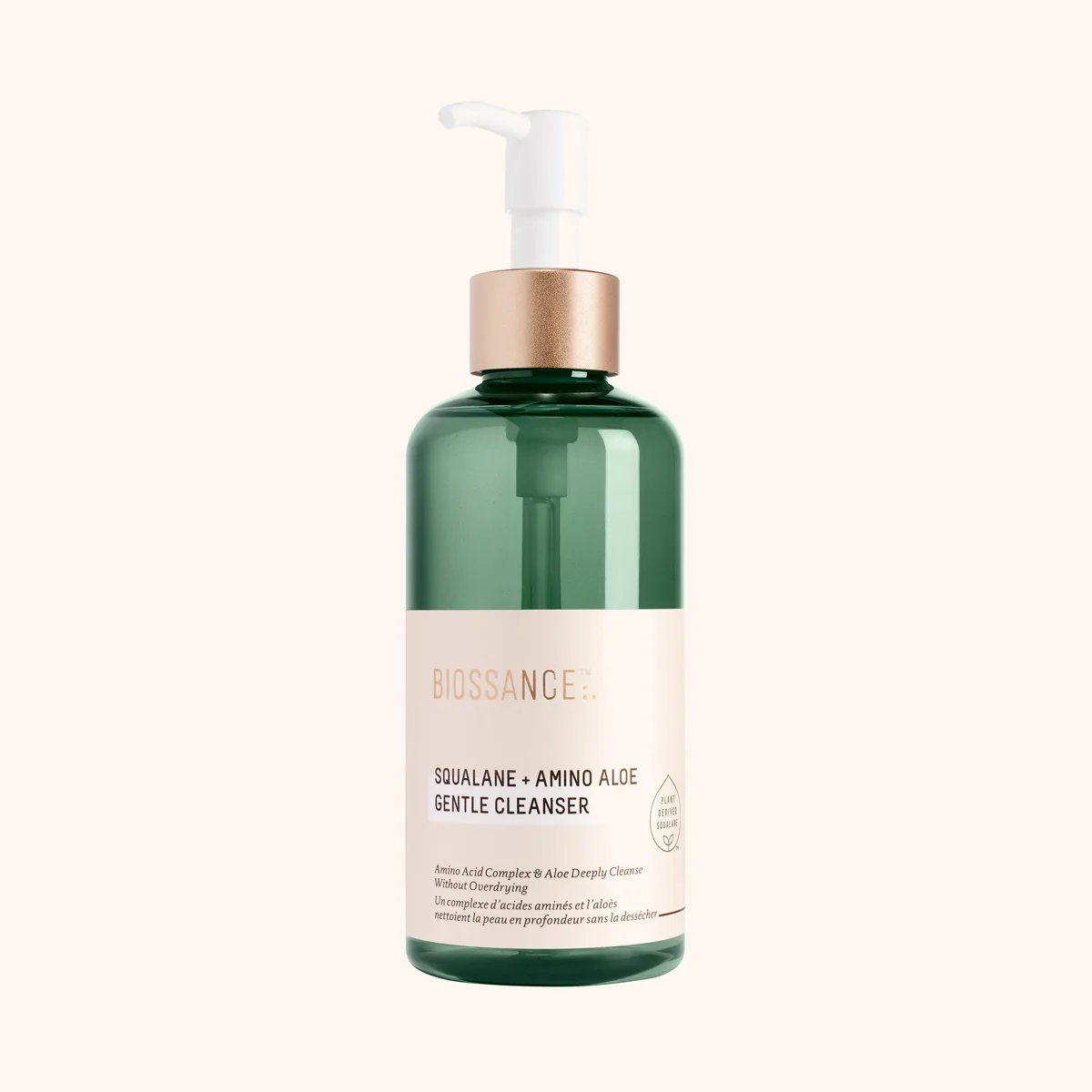
Rather than relying on harsh sulfates, this cleanser cleans with a lipo-amino acid surfactant built on an aloe-juice base instead of plain water, then quietly buffs in a touch of sugarcane squalane to keep the barrier intact. It is one of the few gentle gel cleansers that treats the rinse-off step as a chance to condition rather than simply degrease.
A thoughtfully mild gel cleanser that washes away the day without leaving skin tight, thanks to an amino-acid surfactant on an aloe base and a whisper of squalane. The herbal-citrus essential-oil scent is the catch — lovely for most, a dealbreaker for fragrance-sensitive skin. Solid, if pricey, for a daily wash.
Supporting rolefor DrynessIn your profileYou chose · Rinse-off gel: Squalane gets seconds of contact, so this supports a routine for dryness rather than treating it.Moderate evidenceStandard tolerabilityNo reviews collected yet
The case for it
Squalane has trial-supported standing for this concern.
It is in a rinse-off product, so it gets seconds of contact rather than the leave-on exposure the evidence assumes.
The formula carries no trigger this concern is sensitive to, with the cautions noted.
Cautions: fragrance.
What would change this: The same active in a leave-on form would be judged on its evidence rather than its contact time.
Same rule for everyone. “Supporting role” is the verdict on 8,197 of 45,024 concern verdicts across the catalog; rule R6 decided 2,017 of them.
Unchanged since September 5, 2026, engine 5.1.1.
R6 — Contact time cannot deliver a leave-on claim; the product is judged on its job (cleansing without aggravating). Explicit exceptions (BPO wash, SA cleanser, medicated shampoos) never reach this rule because their rows set rinse_off_ok. · the full register
Carrying active
Squalane
Standing
supported — its mechanism is established
Form
contact limited — studied range 1–100%, from the trials on the row; needs leave-on contact
Tolerability
standard — fragrance load
Row checked
against its sources on July 17, 2026 (evidence table ev-2026.09-r228)
The studies behind the evidence row
International Cosmetic Ingredient Dictionary and Handbook — declared function — Personal Care Products Council
Harry's Cosmeticology / Baran & Maibach Textbook of Cosmetic Dermatology — humectant, emollient and occlusive classification — standard reference text
Supporting rolefor DehydrationIn your profileYou chose · Rinse-off gel: Aloe Vera gets seconds of contact, so this supports a routine for dehydration rather than treating it.Moderate evidenceStandard tolerabilityNo reviews collected yet
The case for it
Aloe Barbadensis Leaf Juice has trial-supported standing for this concern.
It is in a rinse-off product, so it gets seconds of contact rather than the leave-on exposure the evidence assumes.
The formula carries no trigger this concern is sensitive to, with the cautions noted.
What would change this: The same active in a leave-on form would be judged on its evidence rather than its contact time.
Same rule for everyone. “Supporting role” is the verdict on 8,197 of 45,024 concern verdicts across the catalog; rule R6 decided 2,017 of them.
Unchanged since September 5, 2026, engine 5.1.1.
R6 — Contact time cannot deliver a leave-on claim; the product is judged on its job (cleansing without aggravating). Explicit exceptions (BPO wash, SA cleanser, medicated shampoos) never reach this rule because their rows set rinse_off_ok. · the full register
Carrying active
Aloe Barbadensis Leaf Juice
Standing
supported — its mechanism is established
Form
contact limited
Tolerability
standard
Row checked
against its sources on July 17, 2026 (evidence table ev-2026.09-r228)
The studies behind the evidence row
International Cosmetic Ingredient Dictionary and Handbook — declared function — Personal Care Products Council
Cosmetic Ingredient Review — safety assessment and reported function — CIR Expert Panel
Also listed for Dullness — the actives here (Aloe Vera, Amino Acids, Squalane, Moringa) are in our research queue for that concern; there is no verdict until their evidence rows are written. That is a gap in our table, not a mark against the product.
Does the jobDoes what a cleanser is for: surfactant mildness, rinses clean without stripping. Not measured from the label: pH match to skin.
A verdict is DermApproved’s assessment of how well a product’s ingredients fit a concern — never a claim about what the product treats. Evidence dots and collected reviews sit beside it and are never blended in.
Rules 0.5.1 · evidence table ev-2026.09-r228 · how we decide
Assessment
Pros & Cons
Pros
✓ Genuinely non-stripping amino-acid surfactant system
✓ Aloe-juice base buffers and soothes during cleansing
✓ Light, soft foam that rinses completely clean
✓ Touch of squalane leaves skin feeling cushioned, not tight
✓ Sulfate-free, vegan, and cruelty-free certified
✓ Pleasant herbal-citrus experience for those who enjoy scent
✓ Transparent, fully disclosed ingredient list
Cons
✗ Essential-oil fragrance rules it out for reactive skin
✗ Contains citral, citronellol, and linalool allergens
✗ Too gentle to remove heavy or waterproof makeup alone
✗ Priced above comparable gentle gel cleansers
✗ No fragrance-free version offered
Review
Full Review
The unglamorous truth about cleansers is that they are designed to leave. You apply them, you rinse them, and within thirty seconds the vast majority of what you paid for is in the municipal water supply. That makes the cleanser the single hardest place in a routine to justify a premium price, and it is exactly where Biossance has chosen to plant a flag with this amino-aloe gel. The question worth asking, then, is not whether it cleans — almost everything cleans — but whether the formulation does anything a basic gentle wash does not. On balance, it does a little, and that little is genuinely well thought out, even if it does not fully escape the suspicion that a chunk of the price is buying the Biossance name and a recyclable pump bottle. Start with what the brand built the whole thing around. Instead of sodium lauryl sulfate or the harsher coconut sulfates that headline most foaming washes, the lead cleansing agent is a lipo-amino acid, cocoyl proline, supported by sodium cocoyl isethionate and a coco-glucoside surfactant. This is a deliberately soft surfactant system, the kind that lifts oil and grime without yanking the skin's own lipids out from under it. You can feel the philosophy at the sink: the gel works into a light, soft foam, does its job, and rinses away to leave skin that feels clean and a touch cushioned rather than squeaky and stretched. For anyone whose skin tightens, stings, or flakes after a typical foaming cleanser, that distinction is not marketing fluff — it is the difference between a cleanser you tolerate and one you actually look forward to. What pushes it a step past a plain mild cleanser is the supporting cast. The second ingredient is aloe barbadensis leaf juice, not water, which means the entire base is soothing aloe rather than a neutral aqueous carrier. It is a small formulation flex but a real one: the surfactants are diluted into something calming rather than something inert. Then there is the squalane, the brand's signature sugarcane-fermented emollient, dropped in at a low level to leave a barely-there conditioning film so the skin is not left bare and vulnerable post-rinse. Moringa extract and a hydrolyzed pea protein round things out with purifying and conditioning claims that are more supporting flavor than headline act. None of this transforms a cleanser into a treatment — it should not, and anyone promising that is selling you something — but it does make this a cleanser that respects the barrier instead of bullying it. Now the asterisk, and it is a meaningful one. This is not a fragrance-free formula, and the scent is not from a generic parfum but from a stack of essential oils: rosemary leaf oil, lemongrass, geranium, and clary sage, with citral, citronellol, and linalool dutifully listed at the end as the allergens those oils naturally contain. For most people the aroma reads as a pleasant, spa-like herbal-citrus lift that vanishes on rinse. But essential oils are among the more common contact sensitizers in skincare, and a cleanser sits on the face long enough to matter. If your skin is reactive, rosacea-prone, or you are simply trying to keep your routine fragrance-free on a dermatologist's advice, this is the formula to walk past — there is no unscented version, and no amount of gentle surfactant chemistry cancels out a fragrance allergy. It is a frustrating choice on Biossance's part, because everything else about the formula is calibrated for sensitive skin, and the fragrance load is the one thing standing between this and a near-universal recommendation. As a daily-use cleanser the texture and experience are genuinely pleasant. It double-cleanses beautifully as the second step after an oil cleanser or balm, sweeping away the residue without overcleaning, and on a low-makeup day it works fine on its own. Where it underperforms is heavy or waterproof makeup — the gentleness that makes it kind to the barrier also means it will not single-handedly dissolve a full face of long-wear foundation or waterproof mascara. Treat it as the gentle second act rather than the heavy lifter and it shines. On value, twenty-six dollars for two hundred milliliters lands in the comfortable-but-not-cheap zone. You are paying a clean-beauty premium, and you can find perfectly competent amino-acid cleansers for less. What you are buying here is a specific, well-executed gentle experience, a transparent ingredient list, the squalane-and-aloe touches, and the sustainability story Biossance has built its brand on. Whether that is worth the markup depends on how much you value those things — but it is at least an honest premium for real formulation choices, not just a heavier bottle and a confident font. One more practical note worth making: a little goes a long way here. A single pump worked into wet hands produces plenty of soft lather for the whole face, which stretches the bottle across months and quietly improves the cost-per-wash math that the sticker price alone makes look unfriendly. And because the surfactant system is so mild, it does not punish you for cleansing twice a day, which is exactly what you want from a face wash that is meant to be used morning and night for years rather than cycled through and abandoned. In the end, this is a cleanser that knows precisely what it is: a gentle, conditioning daily wash for people who would rather not strip their skin, wrapped in a scent that is either its best feature or its dealbreaker depending entirely on who you are.
Formula
Key Ingredients
The hero actives that drive this product's performance.
The amino-acid-derived cleansing agent the product is named for. It loosens and dissolves makeup, sunscreen, and sebum so the mild sulfate-free surfactant blend here can rinse them away without the squeaky, tight feeling that strips this formula deliberately avoids.
Sits as the second ingredient, effectively serving as the water phase, so the entire cleanser is built on a soothing aloe base rather than plain water. It buffers the surfactants and helps skin feel calm and comfortable instead of dehydrated after rinsing.
The brand's signature sugarcane-derived emollient, included at a low level to offset the mild stripping that any foaming cleanser causes. It leaves a faint conditioning film so the barrier is not left bare, which is the point of a gentle cleanser like this.
Established mechanismfor Dryness · established mechanism
A botanical extract Biossance leans on for its purifying claims; it helps lift particulate pollution and grime during the cleansing step, complementing the surfactant action rather than driving it.
Not yet assessed
Ingredient standings describe the active at treatment-level doses and
vehicles; this product's own condition grades weigh its actual formula.
Massage onto damp skin as the first step of a morning routine or the second step of a double-cleanse at night, after an oil-based cleanser has removed makeup and sunscreen. Follow immediately with toner or essence while skin is still damp.
Results Timeline
Skin feels clean and comfortable rather than tight from the very first wash. There is no real treatment timeline for a cleanser; any improvement in overall comfort or reduced post-cleanse dryness is apparent within the first few uses.
The interesting science here is in the surfactant chemistry rather than any single active. Lipo-amino acid surfactants like the cocoyl proline that leads this formula belong to a class of mild, biodegradable cleansing agents derived from amino acids and fatty acids; dermatology and cosmetic-science literature consistently rates amino-acid-based surfactants as gentler on the stratum corneum than sulfates, with less disruption to skin lipids and a smaller rise in transepidermal water loss after washing. Pairing them with sodium cocoyl isethionate, a notably mild isethionate surfactant, reinforces that low-irritation profile. The aloe-juice base and low-dose squalane address the other half of the cleansing problem — barrier maintenance. Squalane is a well-established skin-identical emollient, structurally similar to the squalene our own sebaceous glands produce, and leaving a trace film after rinse helps counter the mild lipid loss inherent to any wash-off step. Aloe contributes humectant polysaccharides and has supportive evidence for soothing irritated skin. The honest counterweight is the fragrance: essential oils such as rosemary, geranium, and lemongrass contribute the listed allergens citral, citronellol, and linalool, all recognized contact sensitizers, which is why the formula carries real value for tolerant skin and real risk for reactive skin. The takeaway is that the cleansing-and-conditioning logic is sound and evidence-aligned, while the fragrance choice is a formulation trade-off rather than a scientific necessity.
Dermatologist Perspective
Within clinical guidance, gentle, sulfate-free cleansers built on amino-acid surfactants are generally favored for daily use because they remove debris while minimizing barrier disruption — a priority for anyone managing dryness or compromised-barrier conditions. Dermatologists often note that the cleanser is the easiest step to get wrong by over-stripping, and a formula like this, buffered with aloe and a trace of emollient, fits the standard recommendation to avoid harsh foaming agents. The common clinical caveat applies, however: essential-oil fragrances are frequent culprits in cleanser-related contact dermatitis, and patients with rosacea, eczema, or known fragrance sensitivities are routinely steered toward fragrance-free alternatives. For tolerant, non-reactive skin, a mild scented gel like this is considered a reasonable, barrier-respecting choice.
Guidance
Usage & Recommendations
How to Use
Use on damp skin morning and night. Dispense one pump, warm it between wet fingertips, and massage over the face in light circles for fifteen to twenty seconds, then rinse thoroughly with lukewarm water. At night, treat it as the second step of a double cleanse — remove makeup and sunscreen first with an oil cleanser or balm, then follow with this gel to clear away residue. Keep it away from the eye area, since the essential oils can sting. Apply the rest of your routine while skin is still slightly damp to seal in hydration.
Value Assessment
At twenty-six dollars for the standard 200 mL bottle, this sits at the upper end of the gentle-cleanser market — clearly a clean-beauty premium rather than a bargain. The price buys a well-built amino-acid surfactant system, an aloe base, the brand's squalane, and a transparent, sustainability-minded sourcing story, all of which are real and not purely marketing. That said, capable sulfate-free amino-acid cleansers exist for noticeably less, so the markup is justified mainly if those brand values and the specific texture matter to you. A travel size is available for trialing, and an occasional jumbo limited edition improves the per-milliliter math for committed repurchasers. Reasonable value for the experience; not the most cost-efficient way to cleanse gently.
Who Should Buy
A strong pick for normal, combination, or mildly dry skin that wants a non-stripping daily cleanser and genuinely enjoys a fresh herbal-citrus scent. It suits fans of clean-beauty sourcing who double-cleanse and want a gentle second step that respects the barrier rather than degreasing it.
Who Should Skip
Skip it if your skin is sensitive, rosacea-prone, eczema-prone, or you are keeping your routine fragrance-free, because the essential-oil blend is a real sensitization risk. Heavy-makeup wearers wanting a single-step remover, and anyone seeking the lowest cost-per-wash, will also be better served elsewhere.
Ready to try Biossance Squalane + Amino Aloe Gentle Cleanser?
Clear, lightweight gel that whips into a soft, low-foam lather when worked with water, then rinses clean with no residue.
Scent
A distinct herbal-citrus aroma from rosemary, lemongrass, geranium, and clary sage oils — noticeable in the hand and during the wash, fading after rinse.
Packaging
Opaque pump bottle that protects the formula and dispenses a controlled amount; the standard 200 mL size is joined by a travel size and an occasional jumbo limited edition.
Finish
non-greasylightweight
What to Expect on First Use
From the first wash skin feels decongested but not parched, with none of the post-cleanse tightness that signals barrier disruption. Anyone unused to scented cleansers will notice the herbal-citrus aroma immediately; it dissipates quickly and is not meant to linger on the skin.
How Long It Lasts
Roughly 3 to 4 months of once- or twice-daily use from the 200 mL bottle, depending on how generous each pump is.
Biossance built its identity on fermenting sugarcane into squalane, and this cleanser extends that ethos to the wash-off category — a notoriously hard place to add meaningful skincare because most of it goes down the drain. The amino-acid surfactant choice reflects the broader clean-beauty shift away from sulfates toward milder, plant-derived cleansing agents.
About Biossance Established Brand (5–20 years)
Biossance launched in 2016 as the consumer skincare arm of Amyris, a biotech company that pioneered fermenting sugarcane into cosmetic-grade squalane. That biotech lineage gives the brand a genuine ingredient-sourcing story, though most of its formulations rely on well-studied actives rather than proprietary clinical research.
Brand founded: 2016 · Product launched: 2021
Myth vs. Reality
Common Myths
Myth
A gentle, sulfate-free cleanser cannot actually get your face clean.
Reality
The lipo-amino acid and coconut-derived surfactants here genuinely dissolve sebum and most daily grime; what they struggle with is heavy, long-wear, or waterproof makeup, which is why this works best as the second step of a double cleanse rather than a standalone makeup remover.
Myth
If a cleanser foams, it must be stripping your skin.
Reality
Foam comes from the surfactant type and air, not inherent harshness. This formula produces a soft lather from mild amino-acid and isethionate surfactants and is buffered with aloe and squalane, so it foams lightly while staying non-stripping.
FAQ
Frequently Asked Questions
Is the Biossance Amino Aloe Cleanser sulfate-free?
Yes. It cleans with a lipo-amino acid surfactant plus mild coconut-derived agents like sodium cocoyl isethionate, with no SLS or SLES. That is what makes it foam softly while staying non-stripping.
Does the Biossance Amino Aloe Cleanser contain fragrance?
It is not fragrance-free. The scent comes from essential oils including rosemary, lemongrass, geranium, and clary sage, which carry the listed allergens citral, citronellol, and linalool. Fragrance-sensitive skin should approach with caution.
Can this cleanser remove makeup on its own?
It removes light makeup and daily grime well, but its gentleness means it struggles with heavy or waterproof makeup. It works best as the second step of a double cleanse after an oil cleanser or balm.
Is the Biossance Amino Aloe Cleanser good for dry skin?
Yes, for dry skin that is not reactive. The aloe base and trace of squalane help offset the mild stripping any wash causes, so skin feels comfortable rather than tight afterward.
Is this Biossance cleanser safe to use while pregnant?
It contains no retinoids, salicylic acid, or other actives typically flagged during pregnancy, so it is generally considered pregnancy-safe. As always, anyone with fragrance sensitivity or specific concerns should confirm with their provider.
How long does one bottle of this cleanser last?
The 200 mL bottle typically lasts about three to four months with once- or twice-daily use, depending on how much you dispense per pump.
Reviews
What Reviewers Tend to Say
Recurring themes our editors read across retailer reviews of this product — summaries in our words, not quotations, and not a substitute for your own patch test.
Common Praise
Cleans thoroughly without tightness
Light gel-to-foam lather
Leaves skin feeling soft
Pleasant herbal-citrus scent
Common Complaints
Scent is too strong for fragrance-sensitive users
Pricey for a daily cleanser
Not enough makeup-removing power on its own
Pump can dispense too much
Notable Endorsements
Frequently featured in clean-beauty cleanser roundupsPopular Sephora repurchase among Biossance fans
The burn trials are real and the skeptics who dismiss aloe as folklore are wrong — but the same substance has delayed healing in other wounds, and none of it says anything about what a soothing gel does to intact skin.
IPL is a filtered flashlamp, a true vascular laser is one wavelength aimed at haemoglobin, and the choice between them turns on a distinction almost no consult makes: whether your redness is vessels or a state.
The supplier specification for standard witch hazel water caps the tannin content — the fraction all the research is about — at a level indistinguishable from none. The tightness you feel is the solvent.
Products, answers, therapy guides, tools and articles in one search. Brand names,
slang and abbreviations all work — accutane finds isotretinoin, bacne finds truncal acne.