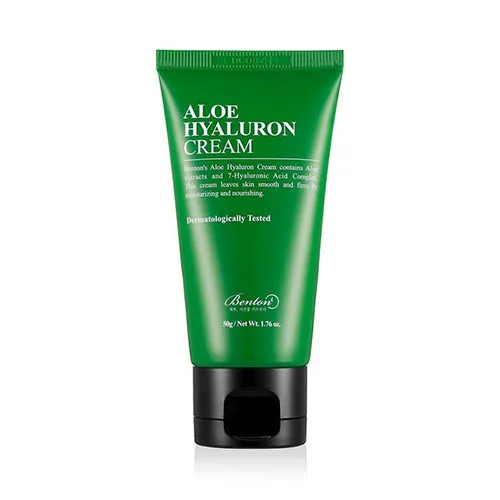
Aloe leaf water as the literal first-position base — the founding Benton move applied to a moisturizer — modernized with seven hyaluronate forms and executed with the brand's unbroken fragrance-free discipline: the rare twenty-dollar cream engineered to be reliably, deliberately uneventful on every skin type that needs uneventful.
The bland cream as deliberate achievement: aloe water in first position, seven hyaluronate forms modernizing the founding plant, fragrance-free to Benton's unbroken discipline, and engineered to be reliably uneventful on retinoid nights, flare weeks, and every skin type that needs uneventful. Twenty dollars, vegan, three-season honest — deep winter borrows an oil, and nothing else about this jar requires a footnote.
Good choicefor DehydrationIn your profileYou chose · Aloe Vera is a reference standard by mechanism for dehydration; this cream carries it high in the ingredient list.Moderate evidenceStandard tolerabilityNo reviews collected yet
The case for it
Aloe Vera has trial-supported standing for this concern.
It is present at an effective concentration, declared or high in the ingredient list.
The formula carries no trigger this concern is sensitive to, with the cautions noted.
Same rule for everyone. “Good choice” is the verdict on 9,564 of 45,024 concern verdicts across the catalog; rule R5 decided 9,072 of them.
Unchanged since September 5, 2026, engine 5.1.1.
Avoidfor SensitivityIn your profileYou chose · This formula carries fragrance — the kind of thing reactive skin flags first.Not yet assessedCarries a triggerNo reviews collected yet
The case for it
Aloe Vera has no evidence row yet for this concern — it is in the research queue.
The formula carries a known trigger for this concern, which decides the verdict before any efficacy question.
What would change this: Removing the trigger named above would let the actives be judged on their own.
Same rule for everyone. “Avoid” is the verdict on 1,909 of 45,024 concern verdicts across the catalog; rule F1 decided 605 of them.
Unchanged since September 5, 2026, engine 5.1.1.
Supporting rolefor DrynessIn your profileYou chose · Nothing here targets dryness directly; humectant and occlusive hydration is the recognised companion to treating it, and this cream does that without known triggers.Not yet assessedStandard tolerabilityNo reviews collected yet
The case for it
Aloe Vera has no evidence row yet for this concern — it is in the research queue.
The formula carries no trigger this concern is sensitive to, with the cautions noted.
Cautions: fragrance.
What would change this: A researched evidence row for the lead active would replace this with a verdict.
Same rule for everyone. “Supporting role” is the verdict on 8,197 of 45,024 concern verdicts across the catalog; rule R8 decided 4,250 of them.
Unchanged since September 5, 2026, engine 5.1.1.
R8 — The category's job (barrier care, humectant hydration, gentle cleansing, photoprotection) is the documented supportive role for this concern. This is the honest verdict for a moisturizer on an acne page. · the full register
Also listed for Excess Oiliness — the actives here (Aloe Vera, emollients, Panthenol (Vitamin B5) are in our research queue for that concern; there is no verdict until their evidence rows are written. That is a gap in our table, not a mark against the product.
Falls shortJudged as a moisturizer, it comes up short on: seals moisture in, supplies barrier lipids.
A verdict is DermApproved’s assessment of how well a product’s ingredients fit a concern — never a claim about what the product treats. Evidence dots and collected reviews sit beside it and are never blended in.
Rules 0.5.1 · evidence table ev-2026.09-r228 · how we decide
Assessment
Pros & Cons
Pros
✓ Aloe-water-first construction with genuine soothing density
✓ Seven-form HA update modernizes the hydration architecture
✓ Light enough for oily skin solo, layerable for dry
✓ Fragrance-free, alcohol-free, vegan, drama-free throughout
✓ Twenty-dollar bland-cream benchmark with twelve-year brand receipts
Cons
✗ Treats nothing — plumbing, not treatment, by design
✗ Fails deep winter alone; the oil supplement is a second purchase
✗ Tub format requests spatula discipline
✗ Drugstore ceramide tubs match the tolerance with more lipid
✗ Botanical tail is story-tier garnish
✗ Trace citrus and calamus leave faint audit pencil marks
Review
Full Review
Boring is the hardest brief in skincare. Exciting formulas write themselves — add the acid, the perfume, the tingle, the gold — but a cream engineered to do nothing wrong on every face that needs nothing done wrong is a discipline problem: every ingredient must justify itself against the question 'could this ever, on any skin, on its worst week, cause a comment?' The genre this discipline produces — the bland cream — is dermatology's quiet favorite and marketing's despair, because its entire value proposition is the absence of events. Benton's Aloe Hyaluron Cream is the genre's twenty-dollar benchmark in current K-beauty: the founding indie's first plant, rebuilt around modern humectant architecture, with a formula whose every exclusion is the feature and whose owners' highest praise — 'nothing happens' — is meant exactly as written.
The construction follows Benton's founding grammar. Aloe leaf water sits in literal first position — the brand's signature move since 2011, the soothing plant as solvent rather than garnish — reinforced by juice and extract deeper in the deck. The 2020-era modernization is the seven consecutive hyaluronate entries mid-formula: fragments through crosspolymer, the staggered-weight surface-hydration roster that updated the franchise's 2013 chemistry to current humectant standards. The conditioning floor runs betaine, panthenol, and glyceryl glucoside — comfort, barrier-recovery support, aquaporin-adjacent humectancy — and the emulsion architecture is the genre's correct choice: olive-derived olivate emulsifiers with light esters, sealing genuinely but breathably, the construction that lets one jar serve oily skin as its only moisturizer and dry skin as its three-season base. The exclusion list is the actual formula: no fragrance, no alcohol, no essential oils, no drama — vegan throughout, with only trace grapefruit and calamus extracts deep in the deck as the audit's faint pencil marks.
In use, the cream performs the genre's defining non-performance. It breaks cool, spreads thin, sets light, and stings nothing — not retinoid-sanded cheeks, not post-acid mornings, not the flush of a flare week — and by the second jar its owners have typically stopped thinking about it entirely, which is the genre's graduation ceremony. The seal holds a steady moisture baseline that reactive skin reads as fewer bad days rather than any visible event; oily skin runs it solo year-round; dry skin runs it three seasons and supplements deep winter with a drop of oil beneath, which the formula accepts without pilling. As the bland layer atop ambitious routines — the position dermatology's adherence logic keeps assigning — it argues with no active this catalog has ever covered.
The critiques are the genre's own, stated honestly. Nothing here treats: tone, texture, and pigment belong to the actives this cream exists to buffer, and buyers reading the seven-HA roster as treatment ambition should re-read it as plumbing. The deliberate lightness genuinely fails hard winters alone — the supplement strategy is the design, not a flaw, but it's a second purchase. The tub format requests spatula discipline. The botanical tail (perilla, schisandra, hollyhock) is story-tier. And the bland genre's structural risk applies: at twenty dollars this cream competes with drugstore ceramide tubs that match its tolerance with more lipid — the K-beauty fluency, aloe-first construction, and gel-cream elegance are what the premium buys, and skin that wants richness over elegance should take the drugstore's deal. A genre note that explains the price positioning better than any ingredient: bland creams sell on trust velocity. The category's buyers — retinoid initiates mid-sandpaper, eczema-adjacent flare veterans, the once-burned-twice-auditing — purchase against downside, not upside, and a brand's track record is the actual active ingredient. Benton's twelve years of fragrance-free discipline, its crisis-forged disclosure habits, and the aloe wing's five-year incident-free run are what twenty dollars buys over an anonymous tub of identical chemistry: the reasonable expectation, backed by archive, that nothing will happen. In no other genre is reputation so literally the formula — and in no other genre does a catalog's job reduce so cleanly to confirming the archive says what the label hopes. The archive, for the record, does. (Retailer pages even disagree about whether the aloe runs 40 or 45 percent and the HA forms seven or eight — the kind of discrepancy that matters nowhere chemistry-wise and gets cited here purely as a reminder that marketing decks drift while INCI lists don't.)
The recommendation writes itself along the genre's lines. Reactive, combination, actives-running, and flare-prone skin gets the benchmark bland cream at indie pricing — buy it, forget it, and let the absence accumulate. Oily skin gets the rare 'cream' that respects its preferences year-round. Deep-winter dry skin budgets the oil supplement or shops richer. And anyone bored by the prospect of nothing happening should sit with the genre's quiet truth: in a routine full of deliberate irritants, the layer that never makes news is the one doing the most underrated work in the lineup. Benton built its name leading with ingredients; here, a decade on, it leads with restraint — the founding plant, the modern water-holding, and the discipline to leave everything else out. Boring, benchmarked.
Formula
Key Ingredients
The hero actives that drive this product's performance.
Triple-form aloe with leaf water in literal first position — the founding Benton construction carried into cream format, soothing as the solvent rather than the garnish.
Seven consecutive hyaluronate entries mid-formula — the staggered-weight surface-hydration architecture, here updating the brand's 2013-era aloe chemistry to the modern humectant standard.
Established mechanismfor Dehydration · established mechanism
The conditioning floor under the headline duo — osmolyte comfort, barrier-recovery support, and aquaporin-adjacent humectancy keeping the cream's soothe claim honest on reactive days.
Established mechanismfor Dehydration · established mechanism
The gel-cream's structural choice — olive-derived emulsifiers and light esters sealing without weight, the architecture that lets an aloe-based cream serve oily and dry skin from the same jar.
Not yet assessed
Ingredient standings describe the active at treatment-level doses and
vehicles; this product's own condition grades weigh its actual formula.
A cherry-sized amount as the final step over toner and serum, morning and night — the gel-cream sets light enough for sunscreen in minutes. Reactive days take a thicker layer as a soothing overnight pack; dry winters layer a drop of oil underneath rather than fighting the formula's deliberate lightness.
Results Timeline
Immediate: cool-set hydration with the aloe calm and zero sting on treated skin. Two weeks: the steadier moisture baseline and reduced reactive episodes a bland, well-floored cream reliably builds. This is maintenance moisturization with soothing manners — transformation was never on the jar.
Pairs Well With
retinoid and acid routines (as the bland seal)the brand's soothing gel (underneath)facial oils (winter supplement)
The bland-cream genre has real science underneath its anticlimax, and this formula executes the canon. Tolerability engineering is subtraction-first: fragrance, ethanol, and essential-oil exclusion removes the three leading leave-on sensitization vectors in patch-test surveillance, and the remaining deck's allergen surface — trace grapefruit and calamus at tail positions — approaches the theoretical minimum for a botanically-branded product. The aloe base carries the genus's documented polysaccharide soothe-and-hydrate file at first-position density, with the standing processing caveat that leaf-water bases vary in acemannan retention. The seven-hyaluronate roster follows established weight-dependent surface-hydration logic — genuinely better water-holding than the franchise's earlier single-salt chemistry, bounded as ever at the stratum corneum. The conditioning floor's components (betaine's osmolyte buffering, panthenol's barrier-recovery record, glyceryl glucoside's aquaporin literature) are the genre's standard evidence-backed escorts. The emulsion choice is the formula's quiet sophistication: olivate-ester systems produce lighter occlusion than ceramide-petrolatum architectures — the documented trade this cream makes deliberately, buying oily-skin universality at the cost of deep-winter sufficiency, which the comparative TEWL hierarchy of emollient classes predicts exactly. The fatty alcohol run (cetyl through lauryl) is emulsion structure, not the 'alcohol' reactive buyers fear — a perennial label-reading correction worth making. Net: a subtraction-engineered, evidence-floored maintenance cream whose claims and architecture are in rare perfect agreement.
Dermatologist Perspective
The bland moisturizer is dermatology's most-prescribed cosmetic category in everything but name — the 'plain, fragrance-free cream' of every retinoid handout and eczema action plan — and this formula meets the specification with room to spare: clinicians auditing it would note the subtraction discipline, wave it through for retinoid initiation, acid routines, and most reactive presentations, and reserve only the standard caveats — eczematous skin may want heavier lipid (ceramide-dominant formulas remain the flare-adjacent standard), and 'aloe' branding occasionally surprises the rare aloe-sensitized patient worth a patch test. The fatty-alcohol correction gets clinical airtime constantly: cetyl and stearyl alcohols are emulsion fats, not irritant ethanol, and patients fleeing them flee structure, not risk. The genre counsel that frames any recommendation: the moisturizer's job in an actives routine is to be forgettable, and formulas achieving reliable forgettability at drugstore-adjacent prices are adherence infrastructure clinicians actively want patients to find.
Guidance
Usage & Recommendations
How to Use
Twice daily, as the routine's closing layer: a cherry-sized scoop — spatula-served from the tub — warmed briefly and pressed over toner- or serum-prepped skin, setting light enough for sunscreen within minutes. Reactive days take a thicker layer as an overnight soothing pack; deep winter layers a drop of facial oil beneath rather than fighting the deliberate lightness. It buffers over retinoids and follows acids without comment, which is its entire personality. Keep the tub lidded and cool, patch-test only if aloe itself has ever been your problem, and expect two to three months of service per jar — most of which you'll spend not thinking about it, as designed.
Value Assessment
Twenty dollars for 50g at twice-daily cherry-size runs two to three months — seven to ten dollars monthly, the indie-K-beauty sweet spot — purchasing tolerance engineering that the prestige bland tier (the sensitive-skin lines of dermatological houses) prices at three times the rate, and the drugstore matches only with heavier, less elegant textures. The honest cross-shop: ceramide drugstore tubs deliver more lipid per dollar for the genuinely dry, making this cream's premium a fluency-and-lightness purchase — correct for the combination-to-oily and reactive constituencies, optional for everyone else. Within Benton's aloe wing, the gel-plus-cream pairing at thirty-seven combined dollars remains one of K-beauty's cheapest complete soothe-and-seal systems, and the cream alone is the single-purchase answer for buyers wanting the franchise in one jar.
Who Should Buy
Reactive, combination, and actives-running skin that needs the bland layer dermatology keeps prescribing — plus oily faces wanting a cream that respects their preferences, vegans navigating around Benton's bee-and-snail wings, and anyone whose routine has enough events already.
Who Should Skip
Deep-winter and eczema-grade dryness — ceramide-heavy formulas serve the lipid deficit this lightness deliberately declines. Treatment shoppers reading HA rosters as ambition, drugstore pragmatists who'd rather have more lipid than more fluency, and excitement seekers in the wrong genre entirely.
A bouncy aloe gel-cream that breaks cool, spreads thin, and sets to a supple, breathing softness — the founding plant's gel character matured into an actual emulsion.
Scent
None added; the faint green-water note of unfragranced aloe, gone at set.
Packaging
A 50g tub in Benton's clinical beige — austere, functional, and best served with the spatula discipline all tubs request.
Finish
naturallightweight
What to Expect on First Use
First application is the bland-cream ideal executed: cool break, quick light set, no sting on freshly-treated or flushing skin, and the quiet realization by night three that nothing — which is to say everything — has happened. Reactive-skin owners recognize the absence as the product.
As Benton's 2013-era aloe line aged, the brand rebuilt it around modern humectant architecture — this cream pairing the founding plant with the seven-form HA roster as the franchise's everyday moisturizer, the soothing gel's graduate step for routines that outgrew gel-only hydration.
About Benton Established Brand (5–20 years)
The cream chapter of Benton's modernized aloe line — leaf water as the first-position base in the brand's founding style, updated with a seven-form hyaluronic complex, and carrying the fragrance-free discipline the 2011-founded indie has never broken.
Brand founded: 2011 · Product launched: 2020
Myth vs. Reality
Common Myths
Myth
Aloe creams are just aloe gel with thickener.
Reality
The emulsion matters: this formula's ester-olivate architecture seals water the gel format surrenders to evaporation, turning aloe's transient cooling into durable moisturization. Gel soothes the moment; the cream keeps the moment — different jobs, and the franchise sells both for the reason.
Myth
A bland cream means a lazy formula.
Reality
Bland is engineered: every exclusion — fragrance, alcohol, essential oils, drama — is a compatibility decision that lets the cream sit atop retinoids, acids, and flaring skin without comment. The seven-HA update and conditioning floor are the quiet work; uneventfulness at this tolerance level is the formula's entire achievement.
FAQ
Frequently Asked Questions
Gel or cream — which Benton aloe do I want?
By job: the soothing gel is the flexible aftercare layer (thin, evaporative, multi-duty), the cream is the actual moisturizer (sealed, durable, final-step). Routines running actives often keep both — gel to de-escalate, cream to seal — but a single-purchase buyer wanting daily moisture takes the cream.
Is it moisturizing enough for dry skin?
Three seasons, yes — the ester-olivate seal holds genuine moisture despite the light set. Deep winter and desert climates want a drop of facial oil layered beneath rather than a heavier cream over; the formula accepts the supplement without pilling.
Will it sting on retinoid-treated or flaring skin?
Its defining feature is that it doesn't — no fragrance, no alcohol, no essential oils, and an aloe-panthenol floor built for exactly those nights. The trace grapefruit and calamus extracts sit deep enough that even most reactive users never notice them.
Is it actually vegan, given Benton's bee products?
Yes — the aloe line carries none of the Snail Bee franchise's animal-derived signatures, and the brand designates it vegan. Buyers avoiding the snail-and-venom decks entirely can live in Benton's aloe and green-tea wings.
Can oily skin use a 'cream' this rich-sounding?
The name oversells the weight — this is a gel-cream that sets lighter than most lotions, and oily-skinned reviewers routinely run it as their only moisturizer year-round. The seal is real but breathable; shine arrives from skipped technique, not the formula.
What do the seven hyaluronate forms actually add?
Staggered surface hydration — fragments associating with the upper layers, heavier salts filming above — which modernizes the aloe base's transient moisture into the layered water-holding current humectant design expects. It's an update, not a transformation: the cream hydrates better than its 2013 ancestors, identically gently.
Reviews
What Reviewers Tend to Say
Recurring themes our editors read across retailer reviews of this product — summaries in our words, not quotations, and not a substitute for your own patch test.
Common Praise
calms retinoid nights without a single sting
light enough for oily skin, layerable for dry
fragrance-free blandness in the best sense
Common Complaints
too light alone for hard winters
jar-adjacent tub prefers a spatula
nothing exciting happens — which is the point
Notable Endorsements
Cream tier of Benton's modernized founding-plant franchise
The burn trials are real and the skeptics who dismiss aloe as folklore are wrong — but the same substance has delayed healing in other wounds, and none of it says anything about what a soothing gel does to intact skin.
The internet's favorite hydrator has a counterintuitive dark side — in dry air, a humectant with nothing to seal it can pull water out of your skin instead of into it.
Products, answers, therapy guides, tools and articles in one search. Brand names,
slang and abbreviations all work — accutane finds isotretinoin, bacne finds truncal acne.