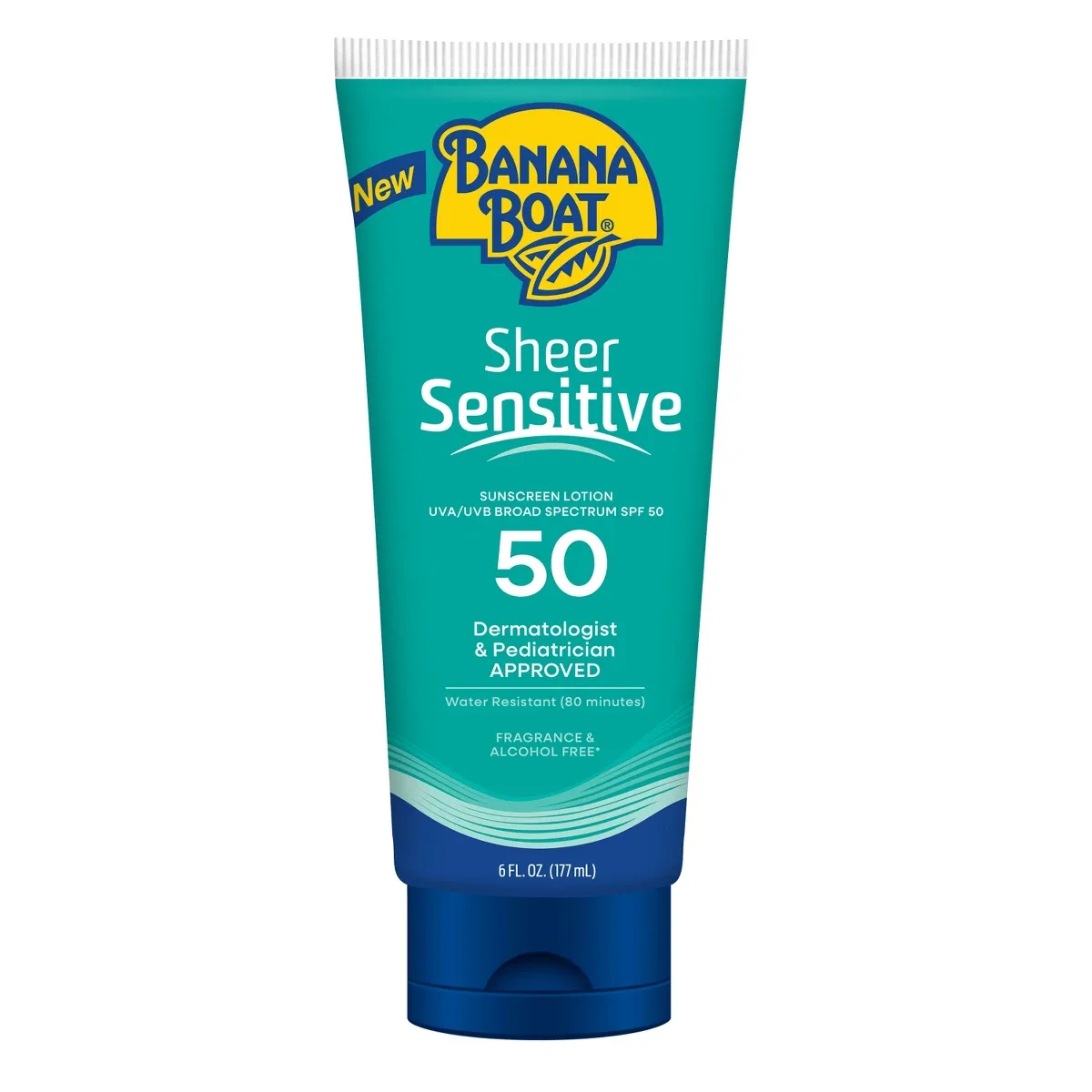
It is a fragrance-free, oil-free chemical body sunscreen at SPF 50 that genuinely disappears on all skin tones, using silica and dimethicone to dry a four-filter set of avobenzone, octocrylene, homosalate and octisalate to a sheer matte finish, and it costs nine dollars for six ounces. Its independent UV test is better than most drugstore sunscreens can show.
A nine-dollar, fragrance-free, oil-free chemical body sunscreen at SPF 50 that disappears on every skin tone, dries to a comfortable matte finish and, on independent testing, blocks UVA and UVB in the high eighties of percent. The 'sensitive' is a fragrance-free label on octocrylene and avobenzone rather than a mineral promise, which the reactive minority should know; for everyone else it is one of the best-value body sunscreens on a drugstore shelf.
This lotion launched in 2025 and has a few hundred retailer reviews rather than the thousands its older siblings carry, so the tolerability picture rests on early feedback plus the well-documented profile of its four filters; its protection figures come from a single independent lab test and its FDA-monograph labelling. The judgements on finish, protection and who should avoid it are confident on those grounds, and the reported praise and complaint patterns may shift after a second summer.
Verdicts
How well it fits each concern
Verdict by concern tap a concern for the case
Full protectionfor Sun DamageIn your profileYou chose · Broad-spectrum SPF 50 with avobenzone: the protection sun damage calls for.Moderate evidenceGentleNo reviews collected yet
The case for it
Avobenzone 2.7% + Octocrylene 5% is a first-line active — approved, monograph-listed or named in current guidelines — for this concern.
It is present at an effective concentration, declared or high in the ingredient list.
The formula carries none of the triggers this concern is sensitive to.
Same rule for everyone. “Full protection” is the verdict on 2,288 of 45,024 concern verdicts across the catalog; rule P1 decided 2,232 of them.
As of September 25, 2026, engine 5.1.1.
P1 — Photoprotection standing is regulatory (M020 / Annex VI filters; 21 CFR 201.327 attaches the early-skin-aging claim to tested broad-spectrum SPF 15+). SPF 30 is the AAD daily-use bar. · the full register
Carrying active
Avobenzone 2.7% + Octocrylene 5%
Standing
first line — a regulator recognises it for this use; trials support it · per 21 CFR § 352.10 Sunscreen active ingredients (US FDA — 21 CFR Part 352 (Sunscreen Drug Products for Over-the-Counter Human Use), via Cornell Legal Information Institute; part heading marked [STAYED INDEFINITELY], effective date stayed at 66 FR 67485), opened September 1, 2026
Form
adequate (declared 2.7%) — studied range up to 3%, from the OTC monograph or label; needs leave-on contact
Tolerability
gentle
Row checked
against its sources on September 1, 2026 (evidence table ev-2026.09-r228)
21 CFR § 352.10 Sunscreen active ingredients — US FDA — 21 CFR Part 352 (Sunscreen Drug Products for Over-the-Counter Human Use), via Cornell Legal Information Institute; part heading marked [STAYED INDEFINITELY], effective date stayed at 66 FR 67485, opened September 1, 2026
Does the jobDoes what a sunscreen is for: UVA coverage, kind to the skin wearing it. Not measured from the label: pleasant enough to actually use.
A verdict is DermApproved’s assessment of how well a product’s ingredients fit a concern — never a claim about what the product treats. Evidence dots and collected reviews sit beside it and are never blended in.
Rules 0.5.1 · evidence table ev-2026.09-r228 · how we decide
Assessment
Pros & Cons
Pros
✓ Independent lab test measured roughly 86 percent UVB and 89 percent UVA blocking
✓ Genuinely no white cast on any skin tone
✓ Fragrance-free, oil-free, alcohol-free and dye-free
✓ Silica-dried, non-greasy matte finish that wears under clothing
✓ Water resistant for the labelled eighty minutes
✓ Nine dollars for six ounces, cheap enough to apply the right amount
✓ FDA OTC monograph sunscreen with labelled actives
Cons
✗ 'Sensitive' means fragrance-free, not mineral; octocrylene and avobenzone are common filter allergens
✗ Not suitable for chemical-filter-allergic skin, body eczema or children under two
✗ Slightly drying matte finish on very dry skin
✗ Homosalate at 7.5 percent sits in the range some regulators are still assessing
✗ Needs reapplication every two hours like any chemical sunscreen
✗ Not fungal-acne-safe on the body for the strictest routines
Review
Full Review
A decade of marketing has taught sunscreen buyers that 'sensitive' means zinc, white and chalky, and Banana Boat's Sheer Sensitive Sunscreen Lotion is built to unteach that. Its actives are avobenzone, homosalate, octisalate and octocrylene, four conventional chemical filters, and its claim to the sensitive label rests on what has been left out: no fragrance, no oil, no alcohol, no dyes. That is a narrower definition than the mineral aisle uses and, for most people who buy sensitive sunscreens because scented ones sting or greasy ones break them out, it is the one that matters. For the smaller group whose sensitivity is a real allergy to chemical filters, it is the wrong bottle, and the label does not say so. Both halves of that are worth stating before anything else.
The filter set is old, well understood and effective. Avobenzone at 2.7 percent is the only broad-UVA filter the US monograph allows and it degrades in sunlight on its own, so octocrylene at five percent is there to stabilise it; homosalate at 7.5 percent and octisalate at 4.5 percent are salicylate UVB filters that carry most of the SPF number and help dissolve the avobenzone. It is the same combination that anchors most of the American chemical-sunscreen shelf, and its performance here has been checked by someone other than Banana Boat: The Sunscreen Tester's independent lab measurement put UVB blocking at about 86 percent and UVA at about 89 percent at the tested thickness, a four-star result consistent with the SPF 50 broad-spectrum label. That is more verification than most nine-dollar sunscreens can show, and it settles the only question that matters about a sunscreen, which is whether it works.
The 'sheer' half of the name is formulation rather than filters. Silica sits third among the inactive ingredients and absorbs the oily feel of a filter load that is, in total, nearly twenty percent of the lotion; dimethicone spreads it thin and gives the eighty-minute water resistance; an acrylate copolymer sets the film. The result is a light lotion that disappears on every skin tone with no cast, dries to a faintly matte, comfortable finish, wears under clothing without transferring once set, and does not smell of anything but a whisper of sunscreen. Glycerin at second, with aloe juice and vitamin E acetate at the end, keeps it from feeling drying on most skin, though very dry skin will notice the matte silica finish and want moisturiser underneath. The Target and Walmart reviews, several hundred at very high ratings within the first season, are almost all about the same three things: no cast, no grease, no smell. Those are the three things a body sunscreen most often fails at, and this one does not.
One practical point that the independent test makes vivid: the measured protection was obtained at the laboratory application density of two milligrams per square centimetre, which is roughly a shot glass for an adult body, and consumer studies consistently find people apply a quarter to a half of that. At half the dose, an SPF 50 behaves like an SPF 7 to 10 in practice. The cheapness of this bottle is therefore not incidental to its effectiveness; a sunscreen that costs nine dollars gets applied like a lotion rather than a luxury, and that is worth more SPF than any formulation trick.
The honest caveats are about the filters. Octocrylene and avobenzone are the two chemical filters most often implicated in sunscreen contact allergy and photoallergy, and octocrylene has drawn additional scrutiny for degrading to benzophenone over a product's shelf life; none of that makes the lotion unsafe for the general population, and the concentrations are within FDA limits, but a person with a history of reacting to sunscreens, a child under two, or an eczema flare on the body is exactly the person the sensitive label attracts and exactly the person who should use Banana Boat's mineral Sensitive line instead. Homosalate at 7.5 percent sits within the range the EU tightened to in 2022 after endocrine-activity questions, and below the US maximum; the science there is unresolved rather than alarming, and it is the reason some buyers choose mineral filters on principle. Banana Boat's own history includes the 2021 benzene recalls that hit aerosol sunscreens across several brands, handled by voluntary recall; its lotions were not implicated, and that episode is a reason to prefer lotions over sprays generally rather than a mark against this one.
On value the case is simple. Nine dollars for six ounces, at a shot-glass per full-body application, is six to eight beach days of protection, which is the price at which people actually apply enough sunscreen; a fragrance-free chemical body sunscreen with an independent test and no cast at this price is about as good as the drugstore gets, and the face version in the same line completes the set for a similar sum.
So the recommendation is broad and plainly bounded. Normal, combination, oily and most sensitive skin, on bodies going to the beach, the park or the school run, will find this a sheer, comfortable, effective, cheap sunscreen that they will use generously, which is the property that matters most. Anyone with a known chemical-filter allergy, eczema on the body, a baby, or a principled preference for mineral filters should read the actives and reach one shelf over. The word sensitive on this bottle means fragrance-free; taken that way it is entirely honest.
Formula
Key Ingredients
The hero actives that drive this product's performance.
The UVA half of the filter set: avobenzone is the only broad-UVA filter in the US monograph and is unstable in sunlight on its own, so octocrylene at five percent is here to stabilise it as well as to add UVB coverage. Together they are why the lotion earns its broad-spectrum label and why independent testing measured UVA blocking in the high eighties of percent.
Regulator-approvedfor Sun Damage · emerging certainty
Two salicylate UVB filters that carry most of the SPF 50 rating and help dissolve the avobenzone; homosalate at 7.5 percent is half the US maximum and within the range the EU tightened to in 2022, and octisalate is the milder of the pair. They are old, well-characterised filters that the 'sensitive' label is quietly relying on being unremarkable.
Regulator-approvedfor Sun Damage · limited certainty
The 'sheer' in the name: silica third on the inactive list absorbs the oily feel of eleven-plus percent of chemical filters and gives a dry, matte-ish finish, and dimethicone spreads the lotion thin and helps it resist water for the labelled eighty minutes. They are why a chemical body lotion at SPF 50 does not feel greasy.
Glycerin second on the inactive list for a light humectant cushion, with aloe juice and vitamin E acetate at the tail as the 'nourishing' story; they keep the lotion comfortable on dry summer skin and contribute nothing to protection.
Not yet assessed
Ingredient standings describe the active at treatment-level doses and
vehicles; this product's own condition grades weigh its actual formula.
Apply generously to the body fifteen minutes before sun, over moisturiser if any, and reapply every two hours and after eighty minutes of swimming or sweating; it is a body lotion, and the face version of the same line has a different filter balance. It wears under clothing without transfer once dry.
Results Timeline
Protection begins about fifteen minutes after application and lasts the labelled eighty minutes of water resistance, with reapplication every two hours; independent testing measured UVA and UVB blocking in the high eighties of percent. The benefit is cumulative and invisible, less sunburn today and less photoageing and skin-cancer risk over years, and depends entirely on using enough and reapplying.
Pairs Well With
Banana Boat Sheer Sensitive Face Lotion SPF 50 for the faceA fragrance-free after-sun moisturiserSun-protective clothing for long exposure
This lotion is a conventional FDA-monograph chemical sunscreen, and its actives are among the most studied molecules in cosmetics. Avobenzone, butyl methoxydibenzoylmethane, is the only US-approved filter with strong absorption across UVA1 and is photolabile, losing a substantial fraction of its absorbance within an hour of sun exposure unless stabilised; octocrylene at five percent is a triplet-state quencher that stabilises avobenzone and adds UVB and short-UVA absorption, a pairing that is the standard basis for broad-spectrum labelling in US chemical sunscreens. Homosalate at 7.5 percent and octisalate at 4.5 percent are salicylate esters absorbing in the UVB range, weak filters individually that contribute to the SPF number in combination and act as solvents for the avobenzone. Independent measurement by The Sunscreen Tester recorded UVB blocking of 85.75 percent, UVA blocking of 88.65 percent and an overall UV index blocking of 88.46 percent at the tested application thickness, consistent with the labelled SPF 50 and broad-spectrum status; as with all sunscreens, real-world protection scales with application density, and typical consumer use at a quarter to half the tested two milligrams per square centimetre yields a fraction of the labelled SPF.
The vehicle is designed for spread and finish. Silica at third among inactives is an oil-absorbing, light-scattering particle that mattifies the high filter load, dimethicone reduces surface tension for thin spreading and contributes to water resistance, and acrylates/C12-22 alkyl methacrylate copolymer forms the water-resistant film that supports the eighty-minute claim. Glycerin adds humectancy, cetearyl alcohol, glyceryl stearate and PEG-100 stearate form the emulsion, and aloe leaf juice and tocopheryl acetate are label-level conditioners. Tolerability considerations are the filters themselves: octocrylene and avobenzone are the leading causes of sunscreen contact allergy and photoallergy in patch-test series, and octocrylene has been shown to accumulate benzophenone, a degradation product, as products age; homosalate has demonstrated weak endocrine activity in vitro that led the EU's SCCS to lower its permitted concentration to 7.34 percent in 2022, a level this formula sits close to, with no established human harm at cosmetic exposure. Chlorphenesin and cetearyl alcohol are occasional sensitisers. The evidence supports the sunscreen's protection claims and identifies the chemical filter set as the reason 'sensitive' here should be read as fragrance-free rather than hypoallergenic.
Dermatologist Perspective
The clinical position on chemical versus mineral sunscreens is pragmatic: the best sunscreen is the one applied generously and reapplied, and a cast-free, fragrance-free chemical lotion that people will actually use on their bodies is, for most patients, a better real-world choice than a mineral one they apply thinly to avoid the white film. This lotion fits that reasoning well, and its independent UV test is the kind of verification clinicians welcome from a mass-market brand. The exceptions are the standard ones and they are the group the label courts: patients with a documented sunscreen allergy, in which octocrylene and avobenzone are the usual culprits, patients with active atopic dermatitis on the body, infants and toddlers, and patients who prefer to avoid homosalate and octocrylene while the regulatory questions about them remain open are all directed to a zinc-based sunscreen. Melasma patients are generally advised toward tinted mineral filters on the face regardless, since visible light matters there and this is a body lotion. Pregnant patients are often counselled toward mineral filters on a precautionary basis given the systemic absorption data on chemical filters, though no harm has been established. The aerosol benzene episode of 2021 is a reason to prefer lotions such as this one over sprays.
Guidance
Usage & Recommendations
How to Use
Fifteen minutes before going outdoors, apply the lotion generously to all exposed skin, about an ounce, a shot glass, for the whole body, spreading it evenly and letting it dry to its matte finish before dressing. Reapply at least every two hours, and immediately after eighty minutes of swimming or towelling off, since the water resistance is limited to that window. Use it on the body and the Sheer Sensitive face lotion on the face, or this one on the face in a pinch; keep it out of the eyes, and do not use it on broken or freshly treated skin. Children under six months should not use sunscreen at all, and children under two are better served by a mineral formula. Store below thirty degrees, out of direct sun in the bag, and discard after the printed expiry, since avobenzone and octocrylene degrade with age.
Value Assessment
Nine dollars for six ounces is drugstore pricing at its most useful, because a sunscreen only works at the dose people are willing to apply, and a bottle this cheap covers six to eight full-body applications at the recommended shot-glass amount without anyone rationing it. What the money buys is a monograph-compliant four-filter set with an independent UV test, a fragrance-free, oil-free, cast-free vehicle that wears well, and Edgewell's manufacturing scale; what it does not buy is a mineral formula or any hypoallergenic assurance beyond the omission of fragrance. Against mineral sensitive sunscreens at twice the price it wins on finish and cost and loses on suitability for the genuinely allergic; against other drugstore chemical lotions it matches them on price and beats most on scent and cast. For the majority of bodies it is excellent value, and the face version in the same line completes the set for a similar sum.
Who Should Buy
Anyone with normal, combination, oily or mildly sensitive skin who wants a cheap, fragrance-free, cast-free body sunscreen at SPF 50 that they will actually apply in the right amount, particularly people with deeper skin tones who are tired of mineral casts and people whose 'sensitivity' is to scent and grease rather than to filters. Families buying for beach and school-run use get a lot of protection for nine dollars.
Who Should Skip
Anyone with a documented allergy to chemical sunscreen filters, active eczema on the body, a child under two, or a principled preference to avoid octocrylene and homosalate should use Banana Boat's mineral Sensitive line or another zinc-based sunscreen. Very dry skin may find the matte silica finish drying without moisturiser underneath, and the face is better served by the line's face lotion.
A light, white, medium-viscosity lotion that spreads thin and sheer, absorbs within a minute with a silica-dried, faintly matte finish and no visible cast on any skin tone.
Scent
Fragrance-free with only the faint, neutral smell of chemical sunscreen filters that fades on absorption.
Packaging
A 6-ounce squeeze bottle with a flip cap in Banana Boat's white-and-blue Sheer Sensitive livery; sturdy, beach-bag-proof and easy to dispense.
Finish
invisiblenon-greasymatte
What to Expect on First Use
The first application is what a modern chemical body sunscreen should be: a light lotion that spreads a long way, disappears without cast or greasiness and dries to a comfortable, slightly matte finish under clothing. There is no scent and, on most skin, no sting; the small minority who react to octocrylene or avobenzone will know within the first day.
How Long It Lasts
About six to eight full-body applications, so a week of beach days or a month of arms-and-neck use.
FDA OTC monograph sunscreenBroad spectrumWater resistant 80 minutes
Background
The Story Behind This Product
Banana Boat launched the Sheer Sensitive line in 2025 as the fragrance-free, no-white-cast alternative to its mineral Sensitive range, answering the two complaints that drove people away from mineral formulas, the cast and the chalk, with a chemical filter set dried down by silica; it sits alongside a face version with a lighter filter balance.
About Banana Boat Legacy Brand (20+ years)
Banana Boat has sold mass-market sunscreen since 1978 and is now part of Edgewell, whose sunscreens are FDA-regulated OTC drugs with labelled actives and SPF testing; the brand was among those caught in the 2021 benzene contamination recalls of aerosol sunscreens, which it handled with a voluntary recall, and its lotions have not been implicated. Its formulas are conventional, inexpensive and widely tested by independent labs.
Brand founded: 1978 · Product launched: 2025
Myth vs. Reality
Common Myths
Myth
A sunscreen labelled 'sensitive' uses mineral filters.
Reality
This one uses avobenzone, octocrylene, homosalate and octisalate, all chemical filters; 'sensitive' here means fragrance-free, oil-free and alcohol-free. Most sensitive skin tolerates it well, but the minority who react to octocrylene or avobenzone, the two most common chemical-filter allergens, should look at Banana Boat's mineral Sensitive line instead.
Myth
No white cast means less protection.
Reality
White cast is a property of mineral filters, which scatter light; chemical filters absorb UV without scattering visible light, so a sheer finish says nothing about protection. Independent testing measured this lotion blocking about 86 percent of UVB and 89 percent of UVA, consistent with its SPF 50 broad-spectrum label when applied at the tested thickness.
FAQ
Frequently Asked Questions
Is the Banana Boat Sheer Sensitive Sunscreen Lotion SPF 50 mineral or chemical?
Chemical. Its actives are avobenzone 2.7 percent, homosalate 7.5 percent, octisalate 4.5 percent and octocrylene 5 percent, a conventional broad-spectrum set; 'sensitive' refers to the fragrance-free, oil-free, alcohol-free base. Banana Boat's mineral option for sensitive skin is its separate Sensitive 100% Mineral line.
Does the Banana Boat Sheer Sensitive lotion leave a white cast?
No. Chemical filters absorb UV without scattering visible light, and silica dries the lotion to a sheer, faintly matte finish, so it disappears on all skin tones; that is the line's whole selling point over mineral sunscreens. Independent testing confirmed the protection is not reduced by the sheer finish.
How much of the Banana Boat Sheer Sensitive lotion should I use?
About an ounce, a shot glass, for the whole body, applied fifteen minutes before sun and reapplied every two hours and after eighty minutes of swimming or sweating. At that dose a six-ounce bottle covers six to eight full-body applications, and using less than the tested amount is the main reason any sunscreen underperforms its label.
Is Banana Boat Sheer Sensitive safe for sensitive skin and children?
It is fragrance-free, oil-free and alcohol-free and Banana Boat labels it for kids and adults, and most sensitive skin tolerates it. Octocrylene and avobenzone are the chemical filters most often implicated in contact allergy, so anyone with a history of sunscreen reactions, eczema on the body or a child under two should use a mineral sunscreen instead.
How well does the Banana Boat Sheer Sensitive SPF 50 actually protect?
An independent lab test by The Sunscreen Tester measured it blocking about 86 percent of UVB and 89 percent of UVA at the tested thickness and rated it four stars, consistent with its SPF 50 broad-spectrum label. Protection in practice depends on applying enough and reapplying every two hours, as with every sunscreen.
What is the difference between the Banana Boat Sheer Sensitive body lotion and face lotion?
Same line and finish, different filter balance: the body lotion reviewed here uses homosalate at 7.5 percent, while the 3-ounce face lotion drops homosalate to 4 percent for a lighter feel and adds a few more skin-conditioning ingredients. Both are fragrance-free and cast-free; the face version is simply tuned for the face.
Reviews
What Reviewers Tend to Say
Recurring themes our editors read across retailer reviews of this product — summaries in our words, not quotations, and not a substitute for your own patch test.
Common Praise
No white cast on any skin tone
Lightweight, non-greasy and absorbs fast
Fragrance-free and does not sting
Cheap enough to use generously
Common Complaints
Chemical filters still irritate some sensitive skin
Slightly drying matte finish on very dry skin
Octocrylene and avobenzone are not what 'sensitive' implies
Needs reapplication like any chemical sunscreen
Notable Endorsements
Independent UV-blocking test published by The Sunscreen TesterDermatologist and paediatrician approved (brand claim)
IPL is a filtered flashlamp, a true vascular laser is one wavelength aimed at haemoglobin, and the choice between them turns on a distinction almost no consult makes: whether your redness is vessels or a state.
The critics are right about the data gap, and they are right that it took two decades to move. What follows from that is not the conclusion most people draw.
Products, answers, therapy guides, tools and articles in one search. Brand names,
slang and abbreviations all work — accutane finds isotretinoin, bacne finds truncal acne.