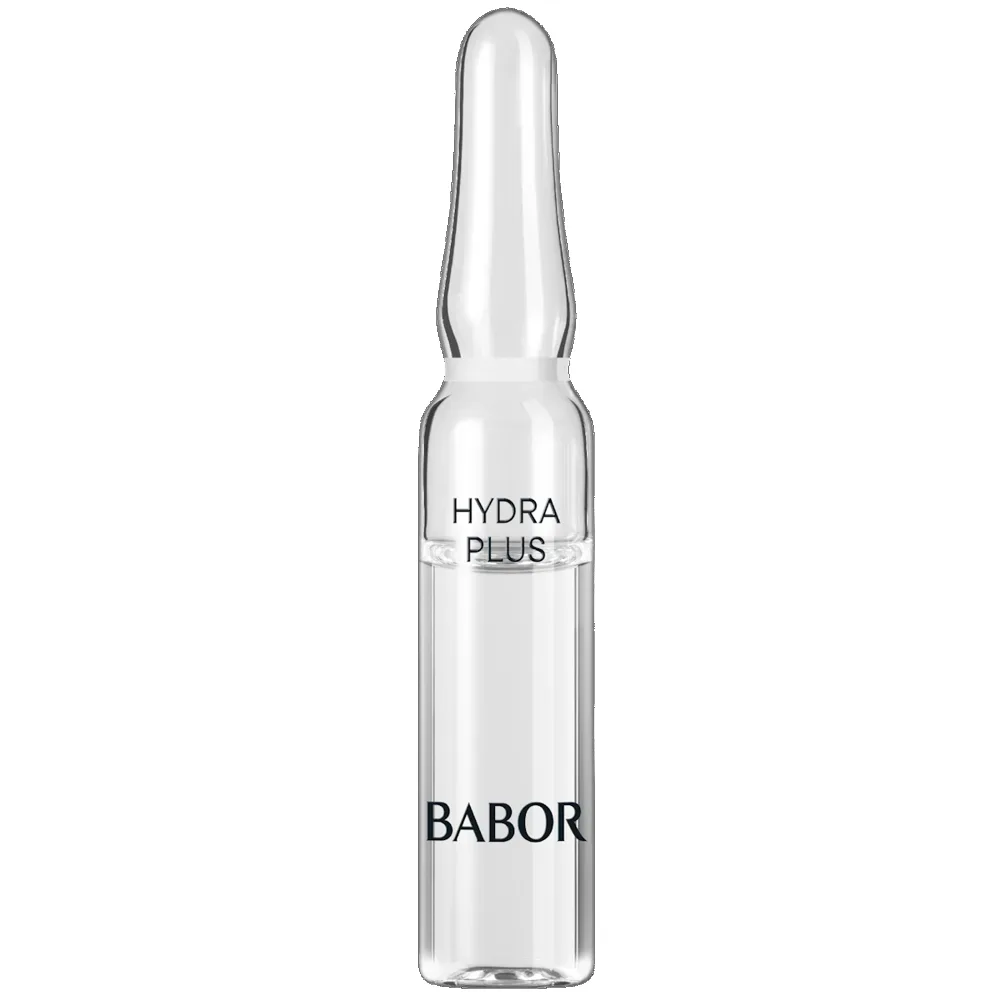
Most hydrating serums rely on one or two star humectants (typically hyaluronic acid and glycerin). Babor's approach is to layer a skin-identical NMF complex with multiple humectants and algae-derived polysaccharides, then package it in a single-use glass ampoule that preserves the formula without preservative load. The packaging is half the product — the fresh-dose experience is part of the brand's 60-year signature.
A well-crafted European spa-style hydration ampoule with a thoughtful NMF-mimicking humectant complex and the ritual of single-dose glass delivery. The formulation is solid, the branding is impressive, and the price is set for people who value the European professional skincare experience.
Good choicefor DehydrationIn your profileYou chose · Hyaluronic Acid is a reference standard by mechanism for dehydration; this ampoule carries it.Moderate evidenceGentleNo reviews collected yet
The case for it
Sodium Hyaluronate has trial-supported standing for this concern.
It is plausibly present at a working level, though the concentration is not declared.
The formula carries none of the triggers this concern is sensitive to.
What would change this: A declared concentration would move this to a firmer reading of the dose.
Same rule for everyone. “Good choice” is the verdict on 9,564 of 45,024 concern verdicts across the catalog; rule R5 decided 9,072 of them.
Unchanged since September 5, 2026, engine 5.1.1.
R5 — Trial-supported or guideline-supported active, adequately or plausibly dosed. · the full register
Carrying active
Sodium Hyaluronate
Standing
supported — its mechanism is established
Form
plausible — studied range 0.1%, from the trials on the row; needs leave-on contact; judge it after ~1 weeks
Tolerability
gentle
Row checked
against its sources on July 17, 2026 (evidence table ev-2026.09-r228)
The studies behind the evidence row
Draelos ZD, Cosmetic Dermatology: Products and Procedures — hyaluronic acid classified as a humectant water-binding agent holding many times its weight in water — reference work
Promisingfor DullnessIn your profileYou chose · Hyaluronic Acid has trial-level evidence for dullness but no guideline or regulatory standing yet — promising, short of a recommendation; the other actives here are not yet assessed for it.Moderate evidenceGentleNo reviews collected yet
The case for it
Sodium Hyaluronate has trial-level evidence for this concern but no guideline or regulatory standing yet.
It is present at an effective concentration, declared or high in the ingredient list.
The formula carries none of the triggers this concern is sensitive to.
What would change this: Guideline or regulatory standing for the active on this concern would move this from a promising bet to a recommendation.
Same rule for everyone. “Promising” is the verdict on 7,858 of 45,024 concern verdicts across the catalog; rule R9p decided 7,858 of them.
Unchanged since September 5, 2026, engine 5.1.1.
R9p — 0.5.0: 'Unproven' beside three filled dots read as one question answered twice with opposite words (7,018 rows). The chip measures standing, the dots measure trial volume; where the row carries at least one RCT or a tier-2 source (moderate dots) and the active is present at a working level, the honest word is Promising. Unproven is reserved for plausible-standing rows with limited or weak evidence, or an under-dosed form. Same rank as Unproven — a bet either way; the dots order them. · the full register
Carrying active
Sodium Hyaluronate
Standing
plausible — trials support it
Form
adequate
Tolerability
gentle
Row checked
against its sources on July 17, 2026 (evidence table ev-2026.09-r228)
Supporting rolefor DrynessIn your profileYou chose · Nothing here targets dryness directly; humectant hydration is the recognised companion to treating it, and this ampoule does that without known triggers.Not yet assessedGentleNo reviews collected yet
The case for it
Algae Extract has no evidence row yet for this concern — it is in the research queue.
The formula carries none of the triggers this concern is sensitive to.
What would change this: A researched evidence row for the lead active would replace this with a verdict.
Same rule for everyone. “Supporting role” is the verdict on 8,197 of 45,024 concern verdicts across the catalog; rule R8 decided 4,250 of them.
Unchanged since September 5, 2026, engine 5.1.1.
R8 — The category's job (barrier care, humectant hydration, gentle cleansing, photoprotection) is the documented supportive role for this concern. This is the honest verdict for a moisturizer on an acne page. · the full register
A verdict is DermApproved’s assessment of how well a product’s ingredients fit a concern — never a claim about what the product treats. Evidence dots and collected reviews sit beside it and are never blended in.
Rules 0.5.1 · evidence table ev-2026.09-r228 · how we decide
The glass ampoule is one of skincare's oldest packaging formats. It dates back to the late 1800s in pharmaceutical manufacturing, where sealed glass vials were the best available way to keep a single dose of medication sterile, oxygen-free, and preservative-minimal. When skincare brands adopted the format, they imported not just the packaging but the implied clinical seriousness — an ampoule looks like something a pharmacist or a doctor should hand you, not something you buy off a Sephora shelf.
Babor understood that semiotic weight when it launched its Ampoule Concentrates collection in 1963. The brand had been founded in Germany seven years earlier with a focus on supplying high-end spas and esthetic clinics, and the ampoule format fit perfectly into that positioning. A European spa treatment wasn't complete without a fresh, snapped-open glass vial and a ritualistic application — the ritual was half the point. Sixty-plus years later, that format and that ritual are still core to the brand's identity, and Hydra Plus is one of the longest-running variants in the lineup.
Let's talk about what's actually in the ampoule, because the packaging is only half the story. The formulation leads with glycerin and butylene glycol — standard humectant base — and then moves into the more interesting territory of algae extract (a marine-derived polysaccharide providing film-forming and humectant effects), sodium hyaluronate (the primary water-binder), and a cluster of NMF components: PCA, sodium PCA, lactic acid, sodium lactate, and urea. That cluster is the mechanically smart part of the formula. Natural moisturizing factor is what healthy stratum corneum produces itself — a blend of small humectants that pull water into the outer skin layer and hold it there. Dehydrated skin is often deficient in NMF, and topical application of these components can replace what's missing more effectively than any single humectant acting alone. Babor is essentially delivering a pre-assembled NMF cocktail in a ready-to-apply form.
Trehalose, further down the INCI, is another clever inclusion. It's a sugar-derived humectant that's particularly effective at protecting cellular membranes during dehydration stress — think dry cabin air, cold winter days, or jet lag skin. It's common in Japanese and European formulations but relatively rare in mainstream US skincare, and its presence here signals a formulation team that pays attention to beyond-the-basics humectant chemistry.
The experience of using it is the part that justifies the ritual. You snap the ampoule at the scored neck — which is either satisfying or slightly terrifying depending on your comfort with handling glass — and pour the 2ml contents onto your fingertips or directly onto clean skin. The texture is a clear, silky liquid that feels cooler than room temperature on application and absorbs within about 30 seconds. Skin looks immediately plumper, smoother, and slightly more luminous. It's the kind of effect that makes you understand why estheticians have been using these for six decades: they deliver a visible before-and-after in real time, which is satisfying in a way that a month-long retinol trial will never be.
The recommended use is a 7-day consecutive course — one ampoule per day, typically in the morning, followed by moisturizer and sunscreen. The logic is cumulative hydration building on itself, with skin progressively softening and feeling more supple across the week. Whether that cumulative effect is dramatically better than daily use of a good bottled hydration serum is debatable. What's less debatable is that the ritual itself changes how users engage with the treatment — the fresh ampoule each morning, the sound of the snap, the single focused dose. It feels like skincare that demands your attention, not another bottle on a cluttered shelf.
The cost is where this product gets complicated. At $49 for a box of seven ampoules, you're paying $7 per single-use application. For people who view skincare as a wellness ritual or who travel frequently and want reliable pre-event hydration prep, that cost calculus can work. For people who view skincare as a cost-efficiency problem, a $20 hyaluronic acid serum from The Ordinary or Hada Labo delivers comparable active content for pennies per use. The Babor product is not offering a vastly superior formulation — it's offering a vastly superior format and heritage for the same hydration result.
Sustainability is the other friction point. Single-use glass ampoules are, by design, waste-generating. Babor has initiated recycling programs in some markets, but the core format is inherently less environmentally sound than a refillable bottle. If ecological footprint is a priority in your skincare decisions, this product requires you to weigh that against the formulation and ritual benefits.
The audience for Hydra Plus is specific. Travelers who want TSA-friendly, break-resistant single doses (glass is breakable, but the small size and box packaging travels well). People planning events where pre-event skin prep matters. Users who appreciate European spa heritage and want that ritual in their at-home routine. Existing Babor loyalists working through the brand's extensive lineup. For those users, this is a legitimate product with real formulation substance. For everyone else, it's a premium experience that isn't strictly necessary for achieving well-hydrated skin.
Formula
Key Ingredients
The hero actives that drive this product's performance.
A marine-derived polysaccharide complex that provides both humectant and film-forming properties. Sits high on the INCI and contributes to the signature silky texture and immediate hydration effect that makes Babor ampoules feel distinct from standard hyaluronic acid serums.
The sodium salt form of hyaluronic acid, sitting fifth on the INCI. Provides primary water-binding for immediate hydration of the stratum corneum and supports the plumping effect that makes this ampoule effective as a pre-event skin prep.
Established mechanismfor Dehydration · established mechanism
A carefully composed cocktail of skin-identical humectants that mimics the natural moisturizing factor (NMF) found in healthy stratum corneum. This is what separates the formulation from a simple HA serum — it's replacing components that dehydrated skin has lost.
A sugar-derived humectant with particular effectiveness for protecting cellular membranes during dehydration. Common in European and Japanese hydrating formulations but less common in mainstream US skincare.
Pro-vitamin B5 providing additional hydration and barrier support. A supporting ingredient that rounds out the ampoule's moisture-delivery approach with a well-tolerated humectant.
Established mechanismfor Dehydration · established mechanism
Ingredient standings describe the active at treatment-level doses and
vehicles; this product's own condition grades weigh its actual formula.
Apply the contents of one ampoule to clean skin after toner, pat gently until absorbed, follow with serums and moisturizer. Use for 7 consecutive days as a hydration reset treatment, or as-needed for travel, pre-event, or weather stress.
Results Timeline
Immediate plumping and surface hydration within minutes of application. A 7-ampoule course is designed to produce a cumulative improvement in skin suppleness and surface dehydration over one week.
The formulation strategy here is based on what dermatological science calls natural moisturizing factor (NMF) replacement therapy. NMF is the collective term for the small, hygroscopic molecules that healthy corneocytes contain — including free amino acids, PCA, lactate, urea, and various salts — which together are responsible for a significant portion of the stratum corneum's water-holding capacity. When skin becomes dehydrated, NMF content typically drops, and topically replacing these components has been shown to restore surface hydration more effectively than single-humectant approaches.
Research on NMF-mimetic formulations has demonstrated measurable improvements in stratum corneum hydration, flexibility, and barrier recovery following application. The specific combination of PCA, urea, lactic acid, and amino acid derivatives in this product reflects a deliberate effort to match the composition of healthy skin's own humectant system.
Algae extracts — a category that includes various seaweed-derived polysaccharides — have been studied for humectant, anti-inflammatory, and antioxidant properties. The evidence base is moderate but supportive for their inclusion in hydration formulations.
Trehalose has documented effectiveness as an osmoprotectant in plant and microbial biology, and topical studies have suggested modest benefits for skin hydration and barrier protection under dehydration stress conditions.
The use of sterile glass ampoules for preservative minimization has a long history in pharmaceutical formulation. For water-based formulas specifically, single-dose glass delivery allows for lower preservative loads without compromising sterility, which can be relevant for sensitive users who react to phenoxyethanol and other common cosmetic preservatives.
Dermatologist Perspective
Dermatologists generally view hydration ampoules as a legitimate but non-essential category — effective for surface-level dehydration but not a substitute for daily moisturizer or barrier-supportive skincare. Working dermatologists frequently observe that the key benefits of hydration products come from consistent daily use of well-formulated moisturizers rather than occasional intensive treatments, though for specific use cases (travel, pre-event, acute dryness) a concentrated ampoule can provide meaningful short-term benefit. For patients deciding between professional-grade ampoules and drugstore hydration serums, dermatologists typically emphasize that the underlying humectant chemistry matters more than the packaging, and that comparable results can be achieved across a wide price range with appropriate product selection.
Guidance
Usage & Recommendations
How to Use
Hold the ampoule upright and wrap the top portion with the provided paper or a clean tissue. Snap sharply at the scored neckline. Pour the contents onto clean fingertips and pat gently into clean, toned skin. Follow with your usual serum and moisturizer. Use daily for 7 consecutive days as a hydration reset treatment, or use individual ampoules as-needed for travel, pre-event prep, or acute dehydration. Apply to the face, neck, and décolleté. Use the ampoule contents within a few minutes of opening — they cannot be stored.
Value Assessment
At $49 for 7 single-use ampoules (14ml total), the cost per ml comes to approximately $3.50 — significantly higher than bottled hydration serums at $0.30-$1.00 per ml. The formulation quality is good but not dramatically superior to well-formulated bottled alternatives. What you're paying for is the heritage, the single-dose format, and the ritual experience. For users who value those elements, the price can be justified; for pure hydration efficacy, more economical options achieve similar results. It's a premium experience product rather than a pure value play.
Who Should Buy
Skincare enthusiasts who enjoy European spa-style rituals, frequent travelers who want single-dose hydration, Babor loyalists expanding into the ampoule line, and users who specifically value glass-packaged, preservative-minimized formulations.
Who Should Skip
Budget-conscious users (a bottled HA serum delivers similar hydration for a fraction of the cost), those prioritizing sustainability in packaging, and anyone who finds the single-dose opening process frustrating or wasteful.
Ready to try Babor Ampoule Concentrates Hydra Plus?
Clear, watery-silky liquid that absorbs rapidly without tackiness
Scent
Fragrance-free
Packaging
Box of 7 individual 2ml sealed glass ampoules
Finish
lightweightfast-absorbingdewy
What to Expect on First Use
Immediate plumping, cooling, and silky finish on first application. Skin looks visibly more hydrated within a minute. No tingling or reactions — this is purely a hydration and surface-finishing treatment.
How Long It Lasts
One 7-ampoule box provides a one-week treatment course
Best Season
All Year
Background
The Story Behind This Product
Babor launched its ampoule concentrates format in 1963 as part of an effort to bring pharmaceutical-grade single-dose skincare to the European spa industry. The glass ampoule format was chosen because it protected active ingredients from oxidation and contamination without requiring heavy preservative systems. Hydra Plus is the hydration variant in the collection and has been a spa staple for decades, particularly in Germany, Austria, and Italy where Babor is a mainstream professional brand.
About Babor Legacy Brand (20+ years)
Babor was founded in 1956 in Germany and has operated for nearly seven decades as a professional spa and esthetic brand. The ampoule concentrates format has been a signature of the brand since 1963 and is widely used in European spas and clinical skincare settings. While not a dermatologist-developed brand, Babor has significant heritage in European professional skincare and formulates with a pharmaceutical-grade approach.
Brand founded: 1956 · Product launched: 1984
Myth vs. Reality
Common Myths
Myth
Ampoules are just serums with fancy packaging.
Reality
Single-dose glass ampoules do serve a real formulation purpose — they protect unstable or preservative-sensitive ingredients and ensure fresh delivery. However, for a stable water-based hydration formula like Hydra Plus, the benefit is partially aesthetic and ritualistic. A well-formulated bottled serum can provide similar results.
Myth
Hydration serums need to be expensive to work.
Reality
Basic hydration can be achieved with much cheaper products. What you're paying for with Babor is the European professional skincare heritage, the single-use delivery format, and the specific NMF complex composition. For pure hydration efficacy, cheaper options exist; for the ritual experience and trusted brand, this delivers.
FAQ
Frequently Asked Questions
Do I need to use all 7 ampoules in a row?
The brand recommends a 7-day consecutive course for cumulative benefits, but individual ampoules can be used as-needed — for travel, pre-event prep, or whenever skin feels especially dehydrated. The effect of a single ampoule is still immediate plumping and smoothing.
How do I open the glass ampoules without cutting myself?
Babor includes a plastic opener or you can use the provided paper wrapper. Hold the ampoule upright, wrap the top with the paper, and snap sharply at the scored line. The snap should be clean if done correctly. Keep fingers well below the break point.
Can I save leftover ampoule contents?
The ampoules are designed for single-dose use and contain no preservatives capable of protecting an opened sample for long. If you have leftover, use it on the neck, chest, or hands immediately — don't try to store it.
How does this compare to a bottled hyaluronic acid serum?
The active hydration effect is comparable to a well-formulated HA serum. The differences are in the additional NMF complex, the ritual of single-dose application, and the brand heritage. For pure hydration, a $15 HA serum will do similar work; for the ritual and the European spa experience, Babor delivers that specifically.
Is the single-use glass packaging wasteful?
Yes, there's an unavoidable sustainability concern with single-use glass. Babor has worked on recycling programs for the ampoules, but the format is inherently more wasteful than a bottle. If sustainability is a priority, a refillable or larger-format hydration serum is a more responsible choice.
Reviews
What Reviewers Tend to Say
Recurring themes our editors read across retailer reviews of this product — summaries in our words, not quotations, and not a substitute for your own patch test.
That headline is the story every brand tells about trehalose. It is also, as of a 2017 paper in Molecular Cell, not quite true — which turns out to be the most interesting thing about the ingredient.
The internet's favorite hydrator has a counterintuitive dark side — in dry air, a humectant with nothing to seal it can pull water out of your skin instead of into it.
Products, answers, therapy guides, tools and articles in one search. Brand names,
slang and abbreviations all work — accutane finds isotretinoin, bacne finds truncal acne.