


Hyaluronic Acid Can Actually Dehydrate Your Skin (Here's When)
The internet's favorite hydrator has a counterintuitive dark side — in dry air, a humectant with nothing to seal it can pull water out of your skin instead of into it.
Most $13 K-beauty HA ampoules rely on a single sodium hyaluronate entry and call it a day. This formula stacks at least four different HA molecular weights plus a crosspolymer, and supports them with trehalose, niacinamide and panthenol — a more considered hydration stack than the price bracket usually delivers.
A capable, no-drama multi-weight hyaluronic acid ampoule from a K-beauty brand better known for aloe gel. At around $13 it delivers a more considered HA stack than the price bracket usually justifies, layered with glycerin, trehalose, niacinamide and panthenol. Nothing revolutionary — but honestly priced and honestly dosed.
Note: The Good Skin Ampoule HA variant has moderate real-world review data, concentrated on Korean and international K-beauty retailers. Our scoring blends formulation analysis with the available feedback; we'll revisit this review as more long-term reviews accumulate.
The case for it
Same rule for everyone. “Good choice” is the verdict on 9,564 of 45,024 concern verdicts across the catalog; rule R5 decided 9,072 of them. Unchanged since September 5, 2026, engine 5.1.1.
Brand or formulator? Disclose a concentration or correct a fact →
The studies behind the evidence row
The case for it
Same rule for everyone. “Good choice” is the verdict on 9,564 of 45,024 concern verdicts across the catalog; rule R5 decided 9,072 of them. Unchanged since September 5, 2026, engine 5.1.1.
Brand or formulator? Disclose a concentration or correct a fact →
The studies behind the evidence row
The case for it
What would change this: Guideline or regulatory standing for the active on this concern would move this from a promising bet to a recommendation.
Same rule for everyone. “Promising” is the verdict on 7,858 of 45,024 concern verdicts across the catalog; rule R9p decided 7,858 of them. Unchanged since September 5, 2026, engine 5.1.1.
Brand or formulator? Disclose a concentration or correct a fact →
The studies behind the evidence row
The case for it
Same rule for everyone. “Good choice” is the verdict on 9,564 of 45,024 concern verdicts across the catalog; rule R5 decided 9,072 of them. Unchanged since September 5, 2026, engine 5.1.1.
Brand or formulator? Disclose a concentration or correct a fact →
The studies behind the evidence row
A verdict is DermApproved’s assessment of how well a product’s ingredients fit a concern — never a claim about what the product treats. Evidence dots and collected reviews sit beside it and are never blended in. Rules 0.5.1 · evidence table ev-2026.09-r228 · how we decide
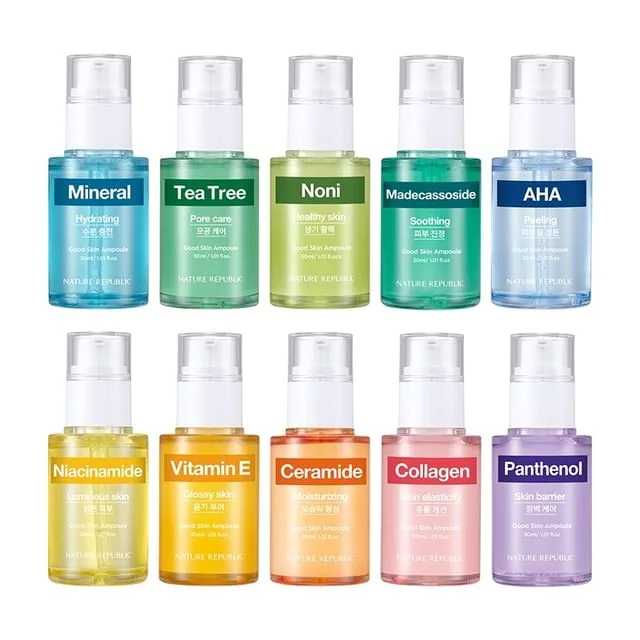
Nature Republic spent most of its first decade defined by a single product. The Aloe Vera 92% Soothing Gel turned into a mid-2010s cult object — a cheap, slightly goopy green tub that showed up in college dorms and travel bags across the world — and the brand's identity calcified around that kind of generalist, low-commitment K-beauty shelf staple. The Good Skin Ampoule line, launched in 2022, is the most visible attempt to reposition as something more technical. Each of the line's ten SKUs is built around a named active — niacinamide, madecassoside, ceramide, panthenol, AHA — and this Hyaluronic Acid variant is the hydration entry point.
What you get for around $13 is a 30ml frosted glass dropper bottle of a thin, essence-weight liquid that sits somewhere between a toner and a conventional serum in texture. The formula itself is the reason to consider it. Instead of a single sodium hyaluronate entry playing the hero role, Nature Republic has stacked at least four different hyaluronic acid derivatives: a standard sodium hyaluronate, a smaller hydrolyzed version, a hydroxypropyltrimonium hyaluronate (a cationic variant that has slight affinity for negatively charged skin surfaces), and a sodium hyaluronate crosspolymer that builds a film on the skin surface to extend moisture retention. Behind that HA complex is glycerin doing the small-molecule humectant work, trehalose — an osmolyte disaccharide that helps cells maintain water balance under dry conditions — and panthenol adding a barrier-support story. Niacinamide sits at a supporting level, not a headline one. The remaining rows read like a checklist of sensible extras: betaine and allantoin soothe, arginine balances, a token adenosine waves at anti-aging, and the whole thing rests at pH 5.5 with no fragrance and no alcohol — a genuinely unprovocative formula, which is exactly what a hydration layer should be. It's considered pregnancy-safe as well.
This kind of stack matters more than the HA percentage printed on a box would, because the marketing narrative around hyaluronic acid has gotten confused over the past few years. A single high-dose HA isn't automatically better than a multi-weight approach; what you actually want is for water to reach multiple depths of the upper skin, and for the surface to retain the hydration it pulls in. A well-composed HA formula solves both problems — small fractions carrying water down, large and cross-linked fractions holding a reservoir at the surface — and this one reasonably does, for a budget K-beauty product. The payoff arrives on the expected schedule: a mild plumping within minutes of the first damp-skin application, softened dehydration lines inside a week or two, and the fuller barrier-comfort benefit settling in around the one-month mark.
The texture is thin enough to layer under heavier products without any pilling, and the application experience is unremarkable in a good way — no stickiness, no tack, no weird residue. It plays well under sunscreen. The routine mechanics are simple: three or four drops pressed onto slightly damp skin after toner, then a cream on top — at that dose the bottle runs six to eight weeks of twice-daily use. Using it as a buffer layer before retinoids is a sensible move, especially if dryness is your main barrier to tolerating tretinoin or retinaldehyde. For people in humid climates, you may be able to wear it under a light gel moisturizer and be done; in drier winter conditions, you'll want to seal it in with something more substantial, because unsealed hyaluronic acid can actually pull water in the wrong direction when ambient humidity drops.
The honest limits. The Good Skin Ampoule line sits in a crowded K-beauty ampoule category full of brands with longer track records selling competing hydration ampoules at similar prices. This product isn't notably better than its peers; it's about on par. The dropper pipette is short and slightly awkward for dosing a full face, which means you end up reopening the bottle more than you'd like. Long-term English-language review data is still thin — a few hundred reviews averaging 4.1 so far, with early users praising the watery absorption and sunscreen compatibility while noting the hydration doesn't hold overnight without a cream on top — so if you're the kind of buyer who wants a deeply validated product, this line hasn't yet earned that particular stripe. And despite being made by a brand whose hero product is nothing but aloe, this ampoule isn't strictly fungal acne safe — PEG-60 hydrogenated castor oil in the formula rules it out for people with confirmed Malassezia reactivity.
What you're really paying for here is a well-composed hydration formula inside a mid-tier K-beauty package, from a brand trying to prove it can do something more than soothing gel. It's not going to be the ampoule people photograph for their Reddit skincare shelfies. But if you're building a routine on a budget and you need a hydration step that actually delivers, this one does its job without theatrics, without fragrance, and without making claims it can't back up. That's a reasonable definition of a good ampoule, and one this bottle meets without straining. At $13 it's a fair deal — not a category-beater, just quietly competent hydration money well spent.
The hero actives that drive this product's performance.
| Ingredient | Function | Evidence |
|---|---|---|
| Multi-Weight Hyaluronic Acid Complex (Sodium Hyaluronate, Hydrolyzed HA, HA Crosspolymer) | The reason this ampoule exists — the formula stacks several molecular weights of hyaluronic acid so the smaller fractions pull water deeper into the stratum corneum while the larger, cross-linked versions sit on the surface and build a hydration reservoir. It's the targeted hydration story Nature Republic is selling here. | Established mechanism for Dehydration · established mechanism |
| Glycerin | Sits high on the INCI to do the actual humectant work that any honest hydrating ampoule needs — HA alone is a marketing story without enough small-molecule humectants backing it up. | Established mechanism for Dehydration · established mechanism |
| Panthenol | Pro-vitamin B5 deepens the hydration story and quietly supports barrier repair, which matters when you're targeting people whose dehydration is a symptom of a compromised barrier rather than a simple water-drinking problem. | Established mechanism for Dehydration · established mechanism |
| Trehalose | A disaccharide humectant that acts as an osmolyte — it helps cells hold onto water under dehydrating conditions, which is a genuinely useful supporting mechanism in a formula built entirely around hydration. | Not yet assessed |
| Niacinamide | Sits at a supportive level in this formula — not the headline active, but enough to add a barrier-function and water-loss-reduction benefit that complements the HA stack. | Established mechanism for Compromised Skin Barrier · established mechanism |
Ingredient standings describe the active at treatment-level doses and vehicles; this product's own condition grades weigh its actual formula.
Water, Butylene Glycol, Glycerin, Dipropylene Glycol, Niacinamide, 1,2-Hexanediol, Sodium Hyaluronate, Hydrolyzed Hyaluronic Acid, Hydroxypropyltrimonium Hyaluronate, Hydrolyzed Sodium Hyaluronate, Sodium Hyaluronate Crosspolymer, Panthenol, Allantoin, Betaine, Trehalose, Carbomer, Arginine, Ethylhexylglycerin, Adenosine, Disodium EDTA, PEG-60 Hydrogenated Castor Oil, Pentylene Glycol, Tocopherol
serum
AM & PM
Apply on slightly damp skin after toner and before any emulsion or moisturizer. Hyaluronic acid needs ambient moisture to avoid pulling water out of skin in very dry climates — seal it in with a cream.
Immediate plumping and smoother texture on first use. Visible improvement in dehydration lines within 1-2 weeks. Full hydration benefits and barrier support around 4 weeks of consistent use.
Hyaluronic acid as a topical ingredient has one of the strongest evidence bases in cosmetic dermatology for hydration and fine-line smoothing. Multiple in vitro and in vivo studies have shown that molecular weight materially affects penetration depth and effect — lower molecular weight fragments (below about 50 kDa) can diffuse into the upper viable epidermis, while higher molecular weight versions (above 1000 kDa) tend to remain on the surface and form an occlusive-like film that reduces transepidermal water loss. Formulas that combine multiple weights, as this ampoule does, have been shown in several controlled studies to outperform single-weight HA formulations for short-term skin hydration and barrier recovery metrics, though the specific combinations vary. Glycerin, present high on the INCI here, is the gold standard humectant in dermatological research — its role in stratum corneum hydration and barrier function recovery is well documented across decades of literature. Trehalose is a more recent addition to cosmetic formulation: it functions as an osmolyte, with evidence supporting its ability to stabilize membrane structure under desiccation stress. Panthenol converts to pantothenic acid in the skin and has demonstrated measurable improvements in stratum corneum hydration and barrier repair after surfactant injury in multiple controlled studies. What this formula is doing, taken as a whole, is building redundancy into the hydration system: delivering water to multiple depths with the HA stack, binding it with glycerin and trehalose, and quietly supporting barrier function with panthenol and niacinamide. It's a reasonable application of the hydration-formulation research base at a price point where most competitors cut corners.
Dermatologists commonly recommend hyaluronic acid serums as a hydration step for patients with dehydrated or barrier-compromised skin, particularly those transitioning onto retinoids or chemical exfoliants. Multi-weight HA formulations are generally preferred over single-weight products for reasons of penetration depth and hydration persistence. Most dermatologists typically advise that HA serums should be applied to slightly damp skin and sealed under a moisturizer to avoid the paradoxical effect of pulling water out of deeper layers in low-humidity environments. For the dehydration-focused use case this product targets, dermatologists note that the ingredient category is effective but not brand-sensitive — most well-formulated HA ampoules perform similarly, so the purchase decision often comes down to texture, packaging preference, and price rather than dramatic clinical differences between products.
Use it as a serum step after cleansing and toning. Drop 3 to 5 drops into clean palms or directly onto slightly damp skin, then press gently across the face and neck. Do not rub aggressively — HA-heavy serums can ball up if over-worked. Wait 30 seconds for absorption, then layer a moisturizer on top to seal in the hydration. In dry climates, don't skip the moisturizer step. In the morning, finish with sunscreen. At night, you can use it as a buffer before retinoids if dryness is an issue. Applying on damp skin noticeably improves the plumping effect.
At $13 for 30ml, this ampoule is priced on the lower end of the K-beauty hydration category, which makes it fair but not unusually generous — it's within a couple of dollars of COSRX, Pyunkang Yul, and Some By Mi alternatives. The honest value story is the formulation stack: a multi-weight HA complex with trehalose and niacinamide support would typically cost more in a Western sensitive-skin brand. There's no larger-size option, which caps the value ceiling slightly, and the dropper format is less economical than a pump. For a buyer building a budget K-beauty routine who wants a hydration-focused serum without paying for luxury branding, this lands as a reasonable but not category-leading purchase.
Buy this if you want a budget K-beauty hydration serum built on a multi-weight HA stack, without fragrance or essential oils. It's especially useful as a daily hydration step for dehydrated skin, as a buffer under retinoids, or for anyone in transitional seasons when skin swings between normal and dry.
Skip this if your main skincare concern is anti-aging, hyperpigmentation, or active breakouts — this ampoule targets hydration only. It's also not for you if you have confirmed fungal acne, as the PEG-60 hydrogenated castor oil may be problematic, or if you need a more differentiated, category-leading HA serum and don't mind paying more for it.
Ready to try Nature Republic Good Skin Ampoule Hyaluronic Acid?
Buy at Amazon ♥Thin, watery, almost essence-like liquid that spreads without dragging.
Very mild, essentially scentless — no fragrance added.
30ml frosted glass dropper bottle, clean and functional but the dropper pipette is short and can be awkward for full-face dosing.
First use feels like a very thin serum — almost like water with a hint of slip. Expect a mild, pleasant plumping within minutes, especially if you apply on damp skin. No tingling, no adjustment period.
Roughly 6-8 weeks with daily twice-a-day use of 3-4 drops.
All Year
Nature Republic's Good Skin Ampoule line was launched in 2022 as a response to the K-beauty market's shift toward targeted, single-concern ampoules — a departure from the brand's earlier identity as a generalist road-shop staple. Each SKU in the 10-ampoule line is built around a named active; the HA variant was positioned as the hydration entry point.
Nature Republic launched in 2009 and became one of the mid-tier K-beauty road-shop staples, best known for its Aloe Vera 92% soothing gel. The brand has a broad track record across Asian markets but its Good Skin Ampoule line is a newer targeted-actives series, so long-term independent validation of individual SKUs in the line is still accumulating.
More hyaluronic acid always means better hydration.
What actually matters is the size distribution and supporting humectants. This formula stacks multiple HA weights with glycerin and trehalose — that's a better hydration story than a single high-concentration HA entry alone.
The formula stacks at least four hyaluronic derivatives — sodium hyaluronate, hydrolyzed hyaluronic acid, sodium hyaluronate crosspolymer, and hydroxypropyltrimonium hyaluronate — which together cover a wide molecular weight range so hydration is delivered at multiple depths of the stratum corneum.
Yes, especially in dry climates. Hyaluronic acid draws water and needs to be sealed in with an emulsion, cream, or occlusive — otherwise it can actually pull water out of deeper skin layers when ambient humidity is low.
Yes. It's a hydration-only ampoule with no conflicting actives, so it layers cleanly under vitamin C in the morning and under retinoids at night. In fact, using it as a buffer layer before retinoids is a common way to reduce dryness from tretinoin or retinaldehyde.
Yes — there is no added fragrance or essential oils in the formula. It has a very mild, almost water-like scent from the base ingredients.
If your main concern is not hydration — for example, if you're targeting wrinkles, hyperpigmentation, or active acne — this is a supporting product, not a headline one. It also isn't the best pick for confirmed fungal acne sufferers who prefer minimal-humectant formulas.
Different format for different jobs. The aloe gel is a cheap, mostly water soothing product; this ampoule is a more concentrated, hydration-focused serum step with a considered HA stack and a price tag to match.
Recurring themes our editors read across retailer reviews of this product — summaries in our words, not quotations, and not a substitute for your own patch test.
Genuinely watery, fast-absorbing
Plays well under sunscreen
Solid hydration at a budget price
No stickiness
Hydration doesn't last without a cream on top
Plastic dropper is fiddly
Limited standout features versus other K-beauty HA ampoules