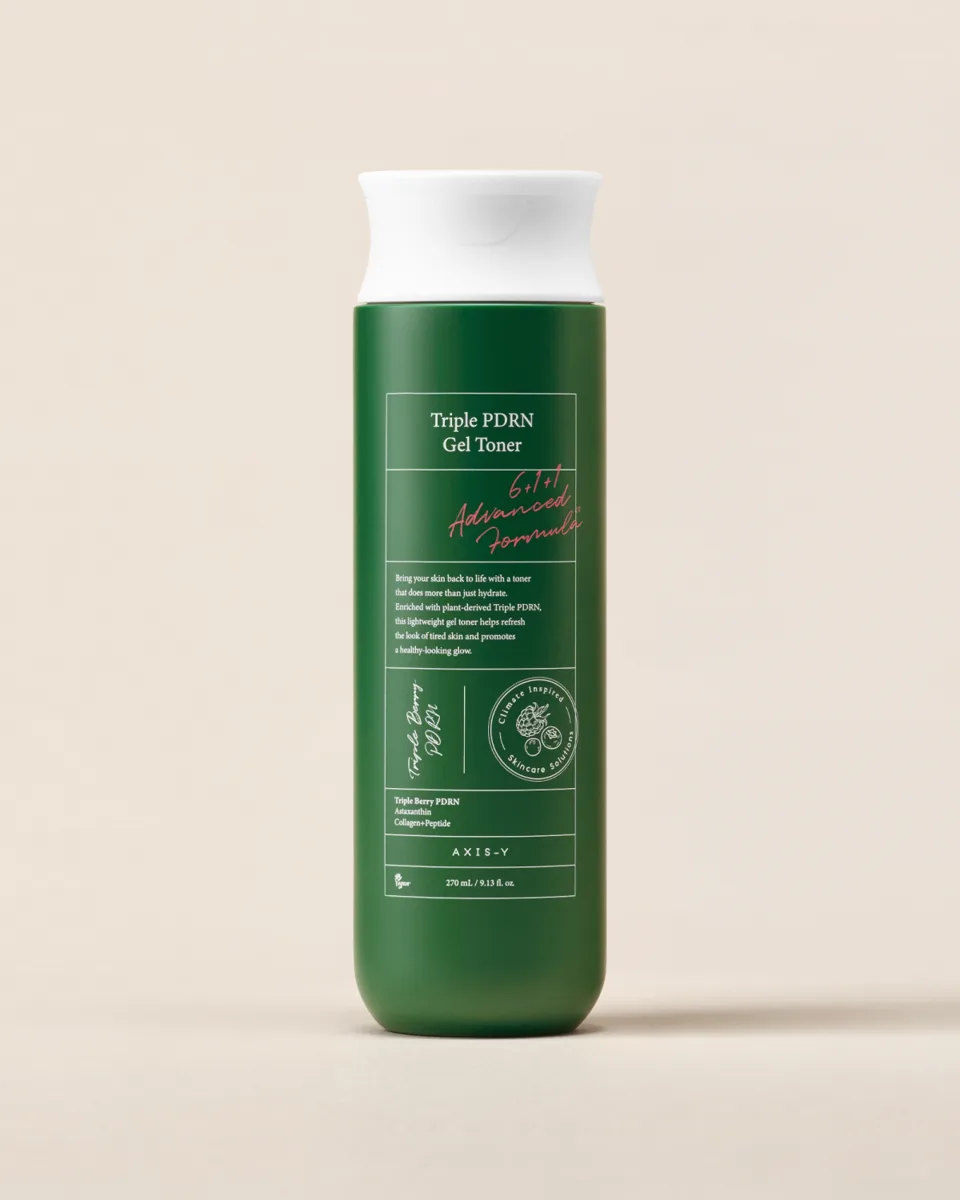
This is a barrier-soothing gel toner that rides the PDRN trend with a vegan twist — instead of salmon-derived polynucleotides, Axis-Y uses a plant-derived 'Triple Berry PDRN' (listed as Sodium DNA). The genuinely distinguishing feature is the cooling gel matrix itself, which behaves more like a hydrating essence than a typical splash toner, paired with a real soothing core of centella, coptis, ceramide, and astaxanthin.
A cooling, genuinely soothing gel toner with a real barrier-friendly core of centella, ceramide, and astaxanthin in a generous 270ml bottle. The headline 'plant PDRN' is more clever marketing than proven science, and the trace retinal is a name-drop — but as a calming hydration step, it quietly delivers.
A 2025 launch riding the PDRN trend — retailer ratings came fast, but independent long-term analysis is thin. Treat the grade as an early read.
Verdicts
How well it fits each concern
Verdict by concern tap a concern for the case
Supporting rolefor DehydrationIn your profileYou chose · Nothing here targets dehydration directly; humectant hydration is the recognised companion to treating it, and this gel does that without known triggers.Not yet assessedGentleNo reviews collected yet
The case for it
Centella Asiatica Extract has no evidence row yet for this concern — it is in the research queue.
The formula carries none of the triggers this concern is sensitive to.
What would change this: A researched evidence row for the lead active would replace this with a verdict.
Same rule for everyone. “Supporting role” is the verdict on 8,197 of 45,024 concern verdicts across the catalog; rule R8 decided 4,250 of them.
Unchanged since September 5, 2026, engine 5.1.1.
R8 — The category's job (barrier care, humectant hydration, gentle cleansing, photoprotection) is the documented supportive role for this concern. This is the honest verdict for a moisturizer on an acne page. · the full register
Good choicefor SensitivityIn your profileYou chose · No fragrance, drying alcohol, declarable allergens or sensitising preservatives in this gel — the profile sensitive skin looks for.Not yet assessedGentleNo reviews collected yet
The case for it
Centella Asiatica Extract has been researched for this concern and the evidence does not support it.
It is plausibly present at a working level, though the concentration is not declared.
The formula carries none of the triggers this concern is sensitive to.
What would change this: A declared concentration would move this to a firmer reading of the dose.
Same rule for everyone. “Good choice” is the verdict on 1,938 of 45,024 concern verdicts across the catalog; rule F2 decided 1,938 of them.
Unchanged since September 5, 2026, engine 5.1.1.
Good choicefor Compromised Skin BarrierIn your profileYou chose · Ceramides is a reference standard by mechanism for compromised skin barrier; this gel carries it.Moderate evidenceGentleNo reviews collected yet
The case for it
Ceramide NP has trial-supported standing for this concern.
It is plausibly present at a working level, though the concentration is not declared.
The formula carries none of the triggers this concern is sensitive to.
What would change this: A declared concentration would move this to a firmer reading of the dose.
Same rule for everyone. “Good choice” is the verdict on 9,564 of 45,024 concern verdicts across the catalog; rule R5 decided 9,072 of them.
Unchanged since September 5, 2026, engine 5.1.1.
R5 — Trial-supported or guideline-supported active, adequately or plausibly dosed. · the full register
Carrying active
Ceramide NP
Standing
supported — its mechanism is established
Form
plausible — studied range 0.5–1%, from the trials on the row; needs leave-on contact; judge it after ~4 weeks
Tolerability
gentle
Row checked
against its sources on July 17, 2026 (evidence table ev-2026.09-r228)
The studies behind the evidence row
Elias PM, Skin Barrier / Coderch et al., ceramides and skin barrier function — ceramides ~50% of SC intercellular lipid mass, essential to the permeability barrier — reference work
Also listed for Dullness — the actives here (Centella Asiatica, Ceramides, Gluconolactone, Retinal (Retinaldehyde) are in our research queue for that concern; there is no verdict until their evidence rows are written. That is a gap in our table, not a mark against the product.
Does the jobDoes what a toner is for: not alcohol-driven, adds something real. Not measured from the label: restores skin pH, plays well with what follows.
A verdict is DermApproved’s assessment of how well a product’s ingredients fit a concern — never a claim about what the product treats. Evidence dots and collected reviews sit beside it and are never blended in.
Rules 0.5.1 · evidence table ev-2026.09-r228 · how we decide
Assessment
Pros & Cons
Pros
✓ Cooling gel matrix hydrates longer than a typical watery toner
✓ Genuine soothing core of centella, coptis root, and astaxanthin
✓ Visibly calms redness and stressed, reactive skin
✓ Fragrance-free and alcohol-free — comfortable for sensitive skin
✓ Generous 270ml bottle offers honest value for the price
✓ Lightweight, non-sticky finish layers cleanly under serums
✓ Vegan-friendly and cruelty-free
Cons
✗ Headline 'plant PDRN' is marketing-led, not clinically proven
✗ Trace retinal is a label name-drop, too dilute to do real work
✗ Retinal content means it is not suitable during pregnancy
✗ Effects are gentle and subtle rather than transformative
✗ Olive oil and lecithin make it unsuitable for fungal-acne-prone skin
Review
Full Review
Here is a small puzzle to start with. PDRN — polydeoxyribonucleotide — is, by definition, a fragment of DNA, and the version that built its reputation in aesthetic clinics is extracted from salmon. It crossed over from injectables into the 2024 and 2025 K-beauty boom as the buzzword of the moment, with 'salmon DNA' serums everywhere. Axis-Y, however, is a vegan, cruelty-free brand. It cannot put salmon in a bottle. And yet here is a toner with PDRN in the name. So what is actually going on?
The answer is a piece of marketing footwork worth examining honestly. Axis-Y created what it calls 'Triple Berry PDRN,' a plant-derived ingredient that appears on the INCI list under the unglamorous name Sodium DNA. It is the brand's way of joining the most talked-about skincare trend of the year without abandoning its vegan identity. That is genuinely clever positioning. It is also a reminder that the word 'PDRN' on a label is doing a lot of borrowed work. Clinical PDRN is a specific salmon-sourced polynucleotide, usually injected, with its own research base. A plant-derived nucleotide fragment in a topical toner is a different ingredient wearing a famous name. None of this makes the toner bad — but it does mean you should not buy it expecting the regenerative effect that the PDRN name has come to imply.
So let us set the headline aside and look at what this toner actually is, because once you do, it turns out to be quite likeable. Strip away the trend, and what remains is a barrier-soothing gel toner with a real and sensible soothing core. Centella asiatica and coptis japonica root extract are the calming anchors, both with a track record for quieting visible redness and reactive skin. Astaxanthin — the carotenoid that gives the toner its faint pink tint — is a genuinely potent antioxidant from microalgae, and it works alongside vitamin E to address oxidative stress from UV and pollution. Ceramide NP and zinc PCA support the barrier-repair angle. Sodium hyaluronate and glycerin handle hydration. This is a thoughtfully assembled set of ingredients for stressed, sensitive skin.
The texture is the part that genuinely distinguishes it. Most toners are watery and disappear within seconds of hitting the skin. This one uses a cooling gel matrix that behaves much more like a lightweight hydrating essence. It feels substantial going on — cool, slightly cushioned — then melts in and absorbs without leaving any stickiness. The gel forms a soft moisture layer that lingers, so the hydration outlasts what a splash toner would give you. If you have ever found toners pointless because they evaporate before they seem to do anything, this format answers that complaint directly.
There is one more ingredient worth flagging plainly: retinal. It appears on the label, and retinaldehyde is a real, effective retinoid. But its position near the very bottom of a thirty-five-ingredient list tells you it is a trace amount — a name-drop, not a functional dose. It is far too dilute to resurface skin or smooth wrinkles the way a dedicated retinal serum would. This matters in two directions. First, do not buy this toner for anti-aging renewal; it will not deliver that. Second, because a retinoid is present at all, we flag the product as not pregnancy-safe, since dermatologists generally advise avoiding all topical retinoids during pregnancy as a precaution. For everyone else, the amount is too small to cause irritation, so it is a non-issue in practice — just an odd formulation choice.
In use, the toner does what its soothing core promises. Skin feels instantly cooler and more comfortable on application. Redness-prone skin often looks visibly calmer within the first few uses, and a tight, stressed feeling tends to ease over the first week or two. There is no tingle, no sting, no adjustment period. The gluconolactone — a polyhydroxy acid — adds a whisper of gentle surface exfoliation, the kind that builds slowly over weeks and never threatens to overwhelm sensitive skin. This is a gentle product through and through.
The value is one of its real strengths. At a list price around twenty-five dollars for a generous 270ml bottle, and frequently discounted below that, it will last most people four to six months of twice-daily use. For a K-beauty toner with a legitimate soothing formula, that is honest pricing. You are not paying a premium for an unproven brand — Axis-Y has roughly seven years and a solid independent following behind it — and you are not paying a luxury markup for the gel format.
The honest summary is this. The PDRN name will get this toner noticed, and the long tail of trendy actives — the berry PDRN, the trace retinal — is there largely to populate the label. But underneath the marketing is a real product: a cooling, comfortable, fragrance-free gel toner that hydrates well and genuinely calms stressed, reactive skin. Judge it as that, ignore the buzzwords, and it earns its place as a quiet, dependable early step in a sensitive-skin routine.
Formula
Key Ingredients
The hero actives that drive this product's performance.
Axis-Y's plant-derived take on the PDRN trend — listed on the INCI as Sodium DNA, a nucleotide fragment marketed here as a vegan alternative to the salmon-derived polynucleotides used in clinical PDRN. In this toner it acts mainly as a water-binding, conditioning agent that supports the formula's soothing and barrier claims, rather than delivering the regenerative effect associated with injected medical PDRN.
A potent carotenoid antioxidant from microalgae that gives the toner its faint pink tint. It pairs with the tocopherol and centella here to mop up free radicals from UV and pollution, supporting the formula's focus on calming environmentally stressed skin.
The soothing anchor of the formula, working alongside coptis japonica root extract to calm visible redness and quiet reactive skin. In a gel toner designed as an early routine step, it helps create a less inflamed canvas for the actives that follow.
A polyhydroxy acid that offers very mild surface exfoliation while also acting as a humectant and antioxidant. Its large molecular size means it works gently on the skin's surface, making it a low-risk way to add subtle smoothing to a toner aimed at sensitive, barrier-focused users.
Supplements the skin's own barrier lipids and works with the zinc PCA and hyaluronic acid to reinforce the 'barrier repair' angle of this toner. Its presence helps the gel matrix leave skin feeling cushioned rather than merely wet.
Established mechanismfor Compromised Skin Barrier · established mechanism
Retinaldehyde appears very low on the ingredient list, signaling a trace, marketing-led inclusion rather than a functional retinoid dose. It is far too dilute here to deliver meaningful renewal — this is a hydrating soothing toner with a retinoid name-drop, not a retinal treatment.
Not yet assessed
Ingredient standings describe the active at treatment-level doses and
vehicles; this product's own condition grades weigh its actual formula.
Apply after cleansing, either with hands or a cotton pad, before serums and moisturizer. The gel texture layers cleanly under heavier products. Because the formula contains a trace of retinal, pair it with a daytime SPF and avoid stacking it on the same night as a strong dedicated retinoid to keep total retinoid load comfortable.
Results Timeline
Skin feels instantly cooler, calmer, and more hydrated on application. Visible redness and a tight, stressed feeling typically ease within the first one to two weeks. Any subtle smoothing from the PHA builds gradually over 3-4 weeks of consistent use.
The most evidence-supported part of this toner is its soothing botanical core, not its headline ingredient. Centella asiatica and its actives have a substantial research base in dermatology for anti-inflammatory and wound-healing activity, and the related coptis japonica root contains berberine, studied for its antimicrobial and calming properties. Astaxanthin is the other genuinely interesting active: this microalgae-derived carotenoid is one of the more potent antioxidants used in topical skincare, with research indicating it neutralizes reactive oxygen species effectively and may help protect against UV-induced oxidative damage. Together with tocopherol, these ingredients give the formula a legitimate antioxidant and anti-redness rationale.
The 'Triple Berry PDRN' deserves a careful, honest look. PDRN — polydeoxyribonucleotide — is a well-defined molecule in the clinical literature, where the salmon-derived form has been studied for tissue regeneration and is used in injectable aesthetic treatments. The toner's INCI lists Sodium DNA, a nucleotide-based ingredient, and Axis-Y markets it as a plant-derived 'berry PDRN.' This is not the same as the studied clinical molecule, and topical nucleotide fragments in a leave-on toner do not have a comparable body of evidence for regeneration. Its realistic role here is as a humectant and skin-conditioning agent. Realistically, the ingredient is promising-sounding but unproven in this context.
Gluconolactone, the polyhydroxy acid, is better supported. PHAs exfoliate the skin surface like alpha-hydroxy acids but with larger molecules that penetrate more slowly, which research associates with a lower irritation profile — making gluconolactone a sensible choice for a toner aimed at sensitive users. Ceramide NP supplements the skin's barrier lipids, an approach with strong supporting evidence for reducing transepidermal water loss. The retinal is present but, given its position on the ingredient list, at a concentration too low for the renewal effects documented for functional retinaldehyde formulations. Overall, the formula is best understood as a soothing, antioxidant, hydrating toner whose strongest claims rest on its centella and astaxanthin content.
Dermatologists generally view soothing, antioxidant-rich toners like this one as low-risk additions to a routine for skin that runs reactive or red. The centella and astaxanthin content aligns with ingredients clinicians often point to for calming inflammation and supporting antioxidant defense, and the fragrance-free, alcohol-free base is the kind of formulation commonly suggested for sensitive or barrier-compromised skin. Clinical guidance tends to be more measured about the PDRN claim: the regenerative PDRN studied in dermatology is a salmon-derived, typically injected polynucleotide, and a plant-derived topical version in a toner should not be expected to replicate those results. The presence of even trace retinal is the reason caution is warranted in pregnancy, as avoiding topical retinoids during that period is a standard precautionary recommendation. As a gentle hydration and soothing step, the toner fits comfortably within conservative skincare advice.
Guidance
Usage & Recommendations
How to Use
After cleansing, dispense one to two pumps and press into the skin with your hands, or sweep on with a cotton pad if you prefer a light tidying step. Use morning and night, before serums and moisturizer. The gel layers cleanly under heavier products. In the morning, always follow your routine with a broad-spectrum SPF. To keep total retinoid exposure comfortable, avoid using this on the same night as a strong dedicated retinoid product. No build-up period is needed — the formula is gentle from the first use.
Value Assessment
At a list price of around $25 for 270ml — and often discounted to roughly $21 — this toner is fairly priced and frequently a small bargain. That large bottle lasts most users four to six months of twice-daily use, putting the monthly cost low for a formula with a legitimate soothing and antioxidant core. Axis-Y is an established brand with about seven years behind it, so you are not paying a premium for unproven novelty. The one caveat for value-minded buyers: part of what you are paying attention to — the 'plant PDRN' and the trace retinal — contributes more to the label than to measurable performance. Judged on its real soothing and hydrating function, the toner is good value; judged on its buzzwords, less so.
Who Should Buy
Anyone with sensitive, redness-prone, or environmentally stressed skin who wants a comfortable, hydrating toner that calms rather than tightens. The cooling gel format suits combination and oily skin especially well, and dry skin will appreciate the lasting moisture layer. It is a good pick for those who want a soothing, fragrance-free, vegan toner and are not chasing dramatic actives.
Who Should Skip
Look elsewhere if you are pregnant or breastfeeding, since it contains a trace of retinal. Those with fungal-acne-prone skin should be cautious due to the olive oil and lecithin. And if you are specifically seeking the regenerative effects associated with clinical PDRN, this plant-derived, topical version will not deliver that — look to dedicated treatments instead.
A lightweight, faintly pink cooling gel that feels more substantial than a watery toner but melts into skin quickly, leaving a soft, cushioned, non-sticky finish
Scent
No fragrance or essential oils; just a faint neutral trace from the botanical extracts
Packaging
A tall 270ml bottle with a pump dispenser, in Axis-Y's clean, pared-back branding. The pump is hygienic and convenient, though it can overdispense if pressed fully.
Finish
lightweightfast-absorbingnon-greasy
What to Expect on First Use
An immediate cooling, calming sensation arrives as the gel settles — skin feels instantly more comfortable and hydrated. There is no tingle, sting, or adjustment period despite the trace retinal and PHA, both of which are far too dilute to provoke a reaction. Redness-prone skin often looks visibly calmer within the first few uses.
PDRN — polydeoxyribonucleotide, traditionally extracted from salmon DNA — became one of K-beauty's biggest buzzwords in 2024 and 2025 after its crossover from injectable aesthetic treatments. As a long-standing vegan, cruelty-free brand, Axis-Y could not use salmon-derived PDRN, so it created a plant-derived 'Triple Berry PDRN' to join the trend on its own terms. The toner is the brand's bid to offer a buzzy, on-trend product without compromising its vegan identity.
About Axis-Y Established Brand (5–20 years)
Axis-Y launched in 2019 as a vegan, cruelty-free K-beauty brand built around plant-derived actives and barrier-friendly formulas. It has earned a solid independent following over roughly seven years, though like most K-beauty brands its products rest on ingredient sourcing and formulation rather than proprietary clinical research.
Brand founded: 2018 · Product launched: 2025
Myth vs. Reality
Common Myths
Myth
This toner's 'plant PDRN' delivers the same regenerative results as the salmon-derived PDRN used in clinics.
Reality
Clinical PDRN is a specific salmon-sourced polynucleotide, typically injected, with its own body of research. A plant-derived 'berry PDRN' applied topically in a rinse-adjacent toner step is a different ingredient making a borrowed name work hard. Treat this as a soothing, hydrating toner, not a regenerative treatment.
Myth
Because it contains retinal, this toner will smooth wrinkles and resurface skin.
Reality
The retinal sits near the very bottom of the ingredient list, meaning a trace amount. It is far too dilute to produce the renewal a dedicated retinal serum would. The real work here is done by humectants, ceramides, and soothing botanicals.
FAQ
Frequently Asked Questions
What is the 'PDRN' in the Axis-Y Triple PDRN Gel Toner?
It is a plant-derived ingredient Axis-Y calls 'Triple Berry PDRN,' listed on the INCI as Sodium DNA. It is the brand's vegan alternative to the salmon-derived polynucleotides used in clinical PDRN treatments. In this toner it functions as a water-binding, skin-conditioning agent rather than the injectable regenerative ingredient of the same name.
Is the Axis-Y Triple PDRN Gel Toner good for sensitive skin?
Yes. It is fragrance-free, alcohol-free, and built around soothing ingredients like centella, coptis japonica root, ceramide NP, and astaxanthin. The cooling gel texture is comfortable on reactive skin, and the trace amounts of retinal and PHA are too dilute to typically cause irritation.
Can I use this toner if I am pregnant?
Because the formula contains retinal, a retinoid, we flag it as not pregnancy-safe even though the amount is a trace inclusion. Many dermatologists advise avoiding all topical retinoids during pregnancy as a precaution, so a retinoid-free hydrating toner is the safer choice for that period.
Does the Axis-Y Triple PDRN Gel Toner exfoliate?
Only very mildly. It contains gluconolactone, a polyhydroxy acid, which provides gentle surface exfoliation. It is not a dedicated exfoliating toner — the smoothing effect is subtle and builds slowly, which makes it suitable even for skin that cannot tolerate stronger acids.
How does the gel texture differ from a regular toner?
Most toners are watery and evaporate fast. This one uses a cooling gel matrix that behaves more like a lightweight hydrating essence, forming a soft moisture layer on the skin. It still absorbs quickly and leaves no stickiness, but it delivers longer-lasting hydration than a splash toner.
Is the Axis-Y Triple PDRN Gel Toner fungal acne safe?
No. It contains olive fruit oil, hydrogenated lecithin, and other fatty components that can feed malassezia, the yeast linked to fungal acne. Those managing fungal acne should patch test carefully or choose a stricter humectant-only toner.
Reviews
What Reviewers Tend to Say
Recurring themes our editors read across retailer reviews of this product — summaries in our words, not quotations, and not a substitute for your own patch test.
Common Praise
Cooling gel texture feels hydrating without any stickiness
Noticeably calms redness and stressed, reactive skin
Generous 270ml bottle lasts for months
Absorbs quickly and layers well under other products
Fragrance-free formula sits comfortably on sensitive skin
Common Complaints
The 'plant PDRN' claim feels more like marketing than science
Gel pump can dispense more product than needed
Effects are subtle — it hydrates and soothes but does not transform
Contains a trace of retinal that some prefer to avoid in a toner
Western sensitive skincare works by subtraction — remove the fragrance, remove the alcohol, shorten the list. Japan's answer adds a designed molecule back in, and one of the two bets has a trial literature.
A wrecked barrier is the most common self-inflicted skin condition and the one with the clearest fix — the difficulty is that the routine which caused it feels productive and the one that repairs it feels like giving up.
'Barrier damage' has become the internet's all-purpose diagnosis. It's also a real, specific condition with a specific and slightly boring cure: mostly, stop doing things.
The K-beauty buzzword slaps a green leaf on half the shelf — but centella is one of the rare botanicals with genuine wound-healing data. The trick is knowing which molecule is doing the job.
Feb 27, 2026· 6 min
Questions people ask about sensitive skin
Verified answers from our questions library — the nuance a product page cannot carry.
Products, answers, therapy guides, tools and articles in one search. Brand names,
slang and abbreviations all work — accutane finds isotretinoin, bacne finds truncal acne.