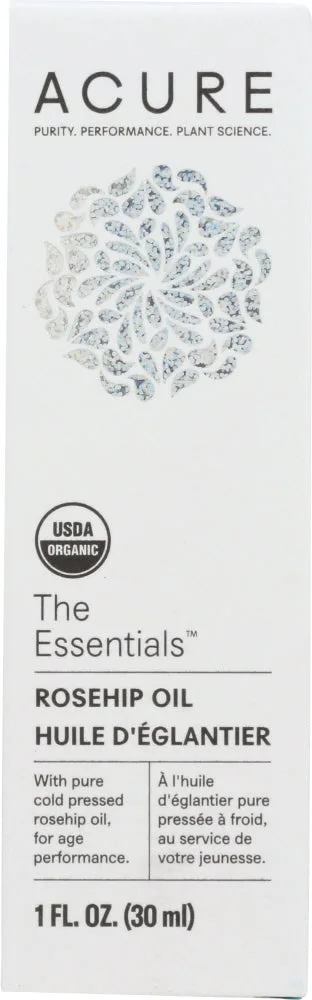
Most rosehip oils in the prestige category are either refined to remove the earthy scent and natural color, or blended with other carrier oils, vitamin E, and stabilizers — losing some of the unique nutrient profile in the process. Acure's version is unrefined, cold-pressed, single-ingredient, and sold in amber glass at a budget price point. For users who want the full cold-pressed profile and do not mind the earthy scent, the value-to-quality ratio is harder to beat in the mass market.
Acure's cold-pressed rosehip oil is the budget clean-beauty version of an ingredient that has earned its long reputation in dermatology. A single-ingredient amber-glass bottle of unrefined Rosa canina seed oil for under $20 — earthy in scent, real in bioactivity, and a reasonable starting point for anyone curious about adding a facial oil to a routine.
Supporting rolefor DrynessIn your profileYou chose · Nothing here targets dryness directly; occlusive emollience is the recognised companion to treating it, and this oil does that without known triggers.Not yet assessedGentleNo reviews collected yet
The case for it
Rosehip Seed Oil has no evidence row yet for this concern — it is in the research queue.
The formula carries none of the triggers this concern is sensitive to.
What would change this: A researched evidence row for the lead active would replace this with a verdict.
Same rule for everyone. “Supporting role” is the verdict on 8,197 of 45,024 concern verdicts across the catalog; rule R8 decided 4,250 of them.
Unchanged since September 5, 2026, engine 5.1.1.
R8 — The category's job (barrier care, humectant hydration, gentle cleansing, photoprotection) is the documented supportive role for this concern. This is the honest verdict for a moisturizer on an acne page. · the full register
Also listed for Dullness, Aging, Acne Scarring and Hyperpigmentation — the actives here (Rosehip Oil) are in our research queue for those concerns; there is no verdict until their evidence rows are written. That is a gap in our table, not a mark against the product.
As a oilNot judged: what a oil is for — fatty-acid profile, seals moisture, resists going rancid — cannot yet be measured from the ingredient list (only pore and malassezia risk can).
A verdict is DermApproved’s assessment of how well a product’s ingredients fit a concern — never a claim about what the product treats. Evidence dots and collected reviews sit beside it and are never blended in.
Rules 0.5.1 · evidence table ev-2026.09-r228 · how we decide
Assessment
Pros & Cons
Pros
✓ Single-ingredient cold-pressed unrefined rosehip seed oil with no fillers
✓ Sub-$20 price point makes facial oil accessible to budget-conscious users
✓ Amber glass packaging protects heat- and light-sensitive bioactives
✓ Vegan and Leaping Bunny cruelty-free certified
✓ Suitable for most skin types including some oily and combination users due to linoleic acid content
✓ Widely available at Whole Foods, Target, Amazon, and natural-products retailers
Cons
✗ Earthy natural scent is not universally loved and is the most common complaint
✗ Oil can darken with time, particularly if stored in heat or light
✗ Glass dropper is fragile and prone to chipping
✗ Batch-to-batch consistency varies more than refined commodity oils
✗ Not a strong stand-alone moisturizer for very dry skin without an additional cream
Review
Full Review
Walk into any Whole Foods skincare aisle and you will find a small amber glass bottle with brown and cream Acure branding, sold for somewhere between eighteen and twenty dollars depending on the week, containing exactly one ingredient: cold-pressed seed oil from the Rosa canina shrub, harvested from the wild rose populations that grow across the Patagonian regions of Chile. There are no preservatives, no carrier oils blended in, no added vitamin E for stability, and no fragrance to mask the earthy natural scent. It is, in a meaningful sense, a single-ingredient product — and that is the entire pitch.
Rosehip oil has had several waves of popularity over the past few decades in the skincare world, each driven by a slightly different angle. The current wave focuses on the oil's natural content of trans-retinoic acid — the same active form of vitamin A that prescription tretinoin delivers, present in cold-pressed rosehip oil at extremely low but measurable concentrations. The wave before that focused on the essential fatty acid profile — linoleic acid (omega-6) and alpha-linolenic acid (omega-3) at meaningful percentages, both of which are critical to skin barrier function and have been documented as deficient in acne-prone sebum. The wave before that focused on the antioxidant content — tocopherols and carotenoids that lend the oil its amber color and contribute to free-radical defense. All three waves are accurate, in the same way that a single ingredient can carry multiple legitimate benefits.
The Acure product enters this story not through prestige positioning but through accessibility. Where Pai's rosehip oil sells for forty dollars and Trilogy's certified-organic version sits around thirty, Acure's unrefined cold-pressed bottle sells for roughly half that. The supply-chain logic is straightforward: Acure sources from Chilean cooperatives, packages in amber glass to protect the heat-sensitive bioactives, and sells through the volume channels of natural-products retail and Amazon at a price point that does not require a prestige skincare budget. The product has been on the market for over a decade with thousands of reviews accumulated across retailers, which gives a useful real-world dataset for what users actually experience with it.
The experience on skin is what you would expect from a genuine cold-pressed rosehip oil. The oil is dry and lightweight — distinctly thinner than heavier facial oils like marula or argan — and absorbs into a soft, non-greasy finish on most skin types within a minute or two. The scent is earthy, slightly nutty, and characteristic of unrefined cold-pressed Rosa canina seed oil. Some users love it as a sign of authenticity; others find it a barrier to daily use. The scent fades within a few minutes of application but is noticeable on first contact, so reading the marketing claim that this is a 'pleasant' oil with managed expectations is worth doing.
Results arrive in the usual sequence for a facial oil. Immediate softness and a dewy finish on first application — the kind of result that makes you understand why people add a facial oil to their routine in the first place. Visible improvement in dryness and dullness within a week to two of consistent use. Subtler improvement in post-inflammatory marks, mild hyperpigmentation, and overall skin texture over six to eight weeks. The natural trans-retinoic acid content is too low to deliver tretinoin-level results, but it contributes meaningfully to the slow brightening and resurfacing that long-term rosehip-oil users report. Anyone expecting prescription-strength retinoid results from a cold-pressed seed oil is reading a marketing claim that does not match the actual potency, and Acure does not make that claim — but plenty of TikTok content does.
Who this works for is reasonably broad. Dry, normal, and combination skin generally do well with rosehip oil as an evening facial oil step. Sensitive skin tolerates the single-ingredient profile better than most blended oils, since there are no added fragrance, essential oils, or stabilizers to react to. Oily and combination-oily skin sometimes does surprisingly well because rosehip oil is high in linoleic acid, which acne-prone sebum is documented as being deficient in — restoring that balance can actually help rather than worsen oily skin. Acne-prone skin is more individual; some users do well, others find any facial oil triggers congestion. The non-comedogenic positioning in the marketing is supported by the linoleic-acid profile, but individual response varies.
The limitations are honest. The oil can darken over time, especially if stored in heat or light, which is why amber glass and a cool storage location matter. The glass dropper is fragile and prone to chipping at the rim with rough use. The natural scent is the most common stop-shipping complaint in user reviews — if you have a low tolerance for earthy plant-based scents, this is not the product for you, and refined rosehip oils that have been deodorized will serve you better. Batch-to-batch consistency in cold-pressed unrefined products is inherently more variable than in refined commodity oils; long-term users occasionally report that one bottle smells stronger or absorbs differently than another, which is the trade-off for an unrefined product.
For users wanting to try a facial oil without committing forty or fifty dollars to a prestige bottle, this is a reasonable entry point. For users who already love their prestige rosehip oil but want a more accessible everyday option, this delivers most of what the more expensive bottles offer at significantly less money. For users who specifically want a refined, deodorized rosehip oil with added vitamin E and stabilizers, this is the wrong product — go with a blended formulation instead. The Acure version exists for the clean-beauty consumer who reads ingredient lists, values cold-pressed processing, and considers the earthy scent of unrefined oil a feature rather than a flaw.
Formula
Key Ingredients
The hero actives that drive this product's performance.
The single ingredient in this product — cold-pressed oil from the seeds of the wild rose plant, sourced from Chile in the brand's supply chain. This is the active and the carrier in one, delivering essential fatty acids (predominantly linoleic and alpha-linolenic acid), natural vitamin A precursors in the form of trans-retinoic acid, and antioxidants including tocopherols and carotenoids. The cold-pressing method preserves these heat-sensitive components better than refined alternatives.
Apply 3-5 drops to clean, slightly damp skin after water-based serums and before your moisturizer for the AM, or as the final step in your PM routine. For oilier skin, use as a PM-only step. Can also be mixed into a moisturizer to boost hydration without changing the texture of an existing routine.
Results Timeline
Immediate softness and dewy finish on first use. Visible improvement in dryness and dullness within 1-2 weeks. Subtle improvement in hyperpigmentation, post-inflammatory marks, and overall texture after 6-8 weeks of consistent use.
Pairs Well With
hyaluronic acid serumsniacinamide serumsvitamin C serums (apply before this oil)
The dermatological evidence base for rosehip seed oil rests on three distinct components present in the cold-pressed unrefined oil. First, the essential fatty acid profile — predominantly linoleic acid (omega-6, typically 40-50% of the oil) and alpha-linolenic acid (omega-3, typically 30-40%). Linoleic acid is a critical component of ceramide synthesis and skin barrier integrity, and clinical research has documented that acne-prone sebum is characteristically deficient in linoleic acid relative to oleic acid. Topical supplementation with linoleic-acid-rich oils like rosehip has been studied as a non-pharmacological approach to supporting barrier function in compromised and acne-prone skin.
Second, the natural retinoid content. Cold-pressed unrefined rosehip seed oil contains naturally occurring trans-retinoic acid at very low concentrations — measurable but orders of magnitude lower than prescription tretinoin. The presence of this and other vitamin A precursors contributes to the gradual cell turnover, brightening, and resurfacing effects that long-term rosehip oil users report. Refined or hexane-extracted rosehip oils typically lose much of this bioactive content during processing, which is why cold-pressed processing matters for the retinoid effects.
Third, the antioxidant content. Tocopherols (vitamin E), carotenoids (including beta-carotene, which lends the amber color), and polyphenols all contribute to the antioxidant capacity of the oil. These compounds support skin defense against environmental free-radical damage and may contribute modestly to anti-aging outcomes with consistent use.
Clinical studies on topical rosehip oil have documented improvements in hyperpigmentation, post-inflammatory marks, surgical scar appearance, and skin elasticity with consistent use over 8-12 weeks. The effect sizes are modest compared with prescription actives, but the safety profile is excellent and the oil pairs well with most other skincare ingredients in a routine.
Dermatologist Perspective
Dermatologists generally view cold-pressed rosehip seed oil as a reasonable, low-risk addition to a skincare routine for users seeking a plant-based facial oil with documented bioactive content. Many dermatologists acknowledge that the linoleic-acid-rich fatty acid profile is well-suited to compromised barriers and even some acne-prone contexts, and that the natural retinoid content provides a gentle complementary effect to other actives in a routine — though it is not a substitute for prescription retinoids when those are clinically indicated. Dermatologists often recommend applying rosehip oil as the final step in an evening routine, where it can act as an occlusive layer over water-based serums and provide overnight nutrient delivery.
Guidance
Usage & Recommendations
How to Use
Apply 3-5 drops to clean, slightly damp skin. Warm the oil between your palms and press into the skin rather than rubbing aggressively. For the AM, apply after water-based serums and before moisturizer; for very oily skin, skip AM use. For PM, apply as the final step in your routine over moisturizer to act as an occlusive overnight layer. Can also be mixed into your moisturizer to add hydration without adjusting the rest of the routine. Store in a cool, dark place to preserve the heat-sensitive components. Use within 6 months of opening for best potency.
Value Assessment
At approximately $18.99 for 1 fl oz, this rosehip oil is one of the most affordable cold-pressed unrefined options on the market. Prestige rosehip oils from Pai, Trilogy, and Indie Lee can cost two to three times as much for similar single-ingredient or near-single-ingredient profiles. For users who want the bioactive benefits of cold-pressed rosehip oil without paying prestige pricing, the value is strong. The 1 fl oz bottle lasts roughly 3-4 months with nightly use, putting the cost-per-day in the cents range. The main value caveat is the batch-to-batch consistency variability inherent to unrefined cold-pressed products — occasional bottles may underperform expectations.
Who Should Buy
Budget-conscious users curious about adding a facial oil to their routine. Clean-beauty consumers who value single-ingredient transparency. Dry, normal, and combination skin types looking for a nighttime occlusive layer. Anyone with mild hyperpigmentation, post-inflammatory marks, or dullness who wants a gentle complementary ingredient alongside other actives.
Who Should Skip
Users sensitive to natural earthy plant scents — the unrefined cold-pressed character is the product's signature and not removable. Anyone needing a fragrance-free oil for severe sensitization should look at refined squalane instead. Severe acne-prone users who consistently break out from any facial oil. Users who want a prestige-positioned, batch-controlled, vitamin-E-stabilized rosehip oil.
Dry, lightweight oil that absorbs into a soft, non-greasy finish on most skin types. Distinctly thinner than heavier facial oils like marula or argan.
Scent
Natural earthy, slightly nutty scent characteristic of cold-pressed rosehip oil. Not perfumed.
Packaging
1 fl oz amber glass bottle with a glass dropper, brown branded label with The Essentials line design. Amber glass helps protect the heat- and light-sensitive components of the oil.
Finish
dewynon-greasylightweight
What to Expect on First Use
Immediate softness and a dewy finish on application. The earthy scent is noticeable for a few minutes after application but fades. Slight tackiness for the first minute as the oil absorbs, then a soft, comfortable skin feel.
How Long It Lasts
3-4 months with nightly facial application; longer if used selectively on dry patches or mixed sparingly into moisturizer.
Acure was founded in 2009 in Colorado as a clean-beauty brand focused on plant-based, vegan formulations sold through the natural-products retail channel. The Essentials line of single-ingredient oils was added to the lineup in the early 2010s as a budget-friendly entry point to facial oils, capitalizing on the growing consumer interest in transparency and minimal-formulation skincare. Rosehip oil became one of the line's bestsellers as the broader skincare community rediscovered the ingredient's natural retinoic acid content and essential fatty acid profile.
About Acure Established Brand (5–20 years)
Acure is a US clean-beauty brand founded in 2009, distributed widely through Whole Foods, Target, Amazon, and natural-products retailers. The brand emphasizes vegan, cruelty-free formulations and is part of the Acure Organics group. Its single-ingredient oils in The Essentials line are positioned as budget-friendly entry points to facial oils for the clean-beauty consumer.
Brand founded: 2009 · Product launched: 2013
Myth vs. Reality
Common Myths
Myth
All rosehip oils are the same.
Reality
Rosehip oil varies significantly by sourcing, harvest, and processing. Cold-pressed unrefined rosehip oil — like this one — retains more of the natural vitamin A precursors, fatty acids, and antioxidants than refined or hexane-extracted versions. The earthy scent and amber color of cold-pressed rosehip oil are signs of the unrefined nutrient content; refined versions may smell neutral and look pale gold but have lost much of what makes the oil bioactive.
Myth
Rosehip oil is a substitute for prescription retinoids.
Reality
Rosehip oil contains naturally occurring trans-retinoic acid at very low concentrations — enough to contribute mildly to cell turnover and brightness over months of use, but nowhere near the potency of prescription tretinoin or even over-the-counter retinaldehyde. Think of it as a gentle complementary ingredient, not a replacement for a clinical retinoid.
FAQ
Frequently Asked Questions
Is Acure The Essentials Rosehip Oil cold-pressed?
Yes, this is unrefined cold-pressed rosehip seed oil. The cold-pressing method preserves the heat-sensitive bioactive components including natural trans-retinoic acid, essential fatty acids, tocopherols, and carotenoids that are partially lost in refined or hexane-extracted rosehip oils. The earthy scent and amber color are signs of the unrefined cold-pressed character.
Can Acure Rosehip Oil replace a retinol or tretinoin product?
No. Cold-pressed rosehip oil contains naturally occurring trans-retinoic acid, but at concentrations far below prescription tretinoin or even over-the-counter retinaldehyde. It can act as a gentle complementary ingredient that contributes mildly to cell turnover and brightening over months, but it is not a substitute for a clinical retinoid when one is indicated.
Is rosehip oil safe for acne-prone skin?
Generally yes. Rosehip oil is high in linoleic acid, which acne-prone sebum is documented as being deficient in — restoring that balance can actually support rather than worsen oily and acne-prone skin. That said, individual response varies, and some acne-prone users find any facial oil triggers congestion. Patch test on a small area before incorporating into your full routine.
What does Acure Rosehip Oil smell like?
It has a natural earthy, slightly nutty scent characteristic of cold-pressed unrefined Rosa canina seed oil. Some users love this as a sign of authenticity, others find it off-putting. The scent fades within a few minutes of application. If you have low tolerance for natural plant-based scents, a refined deodorized rosehip oil will serve you better.
How long does a bottle of Acure Rosehip Oil last?
A 1 fl oz (30 ml) bottle typically lasts 3-4 months with nightly facial application of 3-5 drops. Longer if used selectively on dry patches or mixed into a moisturizer. For best potency, use within 6 months of opening and store in a cool, dark place.
Is Acure The Essentials Rosehip Oil safe during pregnancy?
Yes. Rosehip seed oil at the levels found in this single-ingredient product is considered safe during pregnancy and breastfeeding. The natural trans-retinoic acid content is far too low to raise the systemic concerns associated with prescription retinoids during pregnancy. As with any product during pregnancy, consult your physician if you have specific concerns.
Reviews
What Reviewers Tend to Say
Recurring themes our editors read across retailer reviews of this product — summaries in our words, not quotations, and not a substitute for your own patch test.
Common Praise
Affordable entry point to rosehip oil
Single-ingredient transparency — what you see is what you get
Visibly improves dryness and dullness with consistent use
Absorbs faster than most heavier facial oils
Pleasant earthy natural scent
Reduces appearance of post-inflammatory marks over time
Common Complaints
Natural scent is earthy and not universally loved
Color can darken with time or storage in heat
Glass dropper bottle is fragile
Not a strong stand-alone moisturizer for very dry skin
Quality consistency varies between batches according to long-term reviewers
Notable Endorsements
Long-running bestseller in the clean-beauty single-ingredient oil categoryWidely stocked at Whole Foods, Target, and natural-products retailersVegan and cruelty-free certifications
The squeeze feels productive. Under the skin, it's rupturing the follicle wall and driving inflammation deeper — which is exactly how a three-day blemish becomes a three-month mark.
Topically, the molecule the argument tells you to avoid is one the stratum corneum is structurally built from — and in acne-prone skin the documented finding is a shortage of it.
Products, answers, therapy guides, tools and articles in one search. Brand names,
slang and abbreviations all work — accutane finds isotretinoin, bacne finds truncal acne.