Two Milligrams per Square Centimetre: The Sunscreen Dose Nobody Applies
SPF is a number generated under laboratory conditions you have almost certainly never reproduced on your own face.
Read the preview
From the DermApproved blog, in Sun Protection: the dose behind the number. SPF is measured at two milligrams per square centimetre. Nobody applies that much — and protection doesn't fall in a straight line when you skimp. Halve the layer and you don't halve the SPF. You do something worse — and the fix isn't a higher number. For the full breakdown, visit dermapproved.com/blog.
The number is a measurement, and measurements have conditions
An SPF value is not a property of a formula the way a boiling point is a property of water. It is the output of a specific, tightly-specified experiment, and the experiment includes a dose.
Under the FDA's testing rules for over-the-counter sunscreens, the product and the reference standard are applied at 2 milligrams per square centimetre to a test site on the subject's back measuring at least 30 square centimetres. A finger cot is used to spread the layer as evenly as possible. At least fifteen minutes pass before the site sees any ultraviolet light. Then a solar simulator delivers graded doses, and a technician returns roughly a day later to find the smallest dose that produced a just-perceptible redness. SPF is the ratio of that dose on protected skin to the same dose on bare skin.
Everything about that procedure is designed to remove variance — flat back skin, controlled spreading, a measured mass. Which is exactly why the number travels so badly. The lab controls the one variable that you, standing at a bathroom mirror at 7:40 in the morning, control worst of all: how much you put on.
Two milligrams per square centimetre is thicker than it sounds. It is not a sheen. It is a visible, slightly-too-much layer that most people instinctively rub away, because the cosmetic instinct — blend until it disappears — is the precise opposite of the dosing instinct.
Half the layer is not half the protection
The intuitive assumption is that sunscreen behaves proportionally. Apply half as much of an SPF 50 and you'd expect something like an SPF 25 — annoying, but survivable, and still far more protection than nothing.
That is not how the physics works, and the in vivo data is unusually clean about it. Faurschou and Wulf marked five areas on the backs of twenty volunteers, treated four of them with the same sunscreen at 0.5, 1, 2 and 4 mg/cm², and phototested each. The resulting curve fit exponential growth closely (r² = 0.903). Their summary of the consequence is the sentence worth memorising: applying 1 mg/cm² makes the measured SPF fall toward the square root of its labelled value, 0.5 mg/cm² toward the fourth root, and 4 mg/cm² produces something close to the square.
Run that arithmetic on a bottle sitting in most bathrooms. An SPF 50 applied at half the tested density lands nearer the square root of 50 — somewhere around seven — than it does anywhere near 25. At a quarter of the tested density, the fourth root of 50 is under three.
Two honest caveats. The study used a low-SPF product, so extrapolating the relationship up to SPF 50 is a model, not a measurement, and real formulas differ in how their films behave as they thin. And a thin, uneven film fails partly for a geometric reason rather than a purely chemical one: light finds the gaps. But the direction of the error is not in dispute, and it is the direction that matters. Under-application does not cost you a proportional slice of protection. It collapses it.
What under-dosing does over a week in the sun
The most useful evidence on this question is not a bench measurement. It is a holiday.
Narbutt and colleagues sent holidaymakers to Tenerife for a week under a very high UV index. One group used their own sunscreens with no instruction — typical use, which the authors put at roughly 0.8 mg/cm². Another group was given SPF 15 sunscreen along with instruction on how to apply enough of it to actually achieve the labelled figure. Personal UV exposure was measured electronically and did not differ meaningfully between the groups.
The outcomes did. The typical-use group showed daily erythema across five sun-exposed body sites, significantly increased cyclobutane pyrimidine dimers — direct UV damage to epidermal DNA — and complete suppression of the contact hypersensitivity response in twenty of twenty-two people. In the group applying at 2 mg/cm² or more, erythema was virtually absent.
Read that comparison again, because it reframes the entire shelf. A modest SPF applied properly outperformed higher-SPF products applied the way people actually apply them. The label is not the variable doing the work. The layer is.
This is also the honest answer to the perennial question of whether very high SPF numbers are marketing. They aren't meaningless — a product like La Roche-Posay Anthelios Melt-In Milk SPF 100 is best understood as buying headroom against your own under-application rather than as a promise of near-total blockage. But headroom is a hedge, not a plan. Buying a bigger number to compensate for a thin layer is paying for insurance against a habit you could simply change.
Teaspoons, fingers, and how well the shortcuts hold
Nobody weighs sunscreen, so the field invented proxies. Two have stuck.
The first is Schneider's teaspoon rule, published in Archives of Dermatology in 2002, which maps the medical rule of nines onto sunscreen volume: roughly half a teaspoon each for the face and neck and for each arm, and roughly a teaspoon each for each leg, the front of the torso, and the back. That totals in the region of seven teaspoons — about 35 millilitres — for a full body in swimwear. The second, a 2002 letter to the BMJ from Taylor and Diffey, is the two-finger rule: two strips of product squeezed from the palmar crease to the tip of the index and middle fingers, applied to each of eleven body regions.
Both are calibrated to land near 2 mg/cm², and both are far better than eyeballing it. Both also have a known weakness: they assume an average adult body, average fingers, and a product whose density and spreadability resemble the one the rule was built around. A very light, watery formula and a thick mineral paste do not deposit the same mass over the same area from the same two strips.
The practical fix is to stop treating the heuristic as an answer and start treating it as a starting point you calibrate once. Our sunscreen amount calculator does the arithmetic against your own coverage area, so you can measure a dose into a spoon a single time, see what it looks like on your face, and then use fingers forever after with a reference image in your head. And for the face specifically, the two-layer approach — apply, wait, apply again — is the most reliable way to reach a target density without having to judge thickness at all.
This is where product texture stops being a preference and becomes a dosing variable. A cosmetically heavy cream you apply sparingly protects worse than a fluid you apply generously without hesitating. Fluid, cushioned textures like The INKEY List Polyglutamic Acid Dewy Sunscreen SPF 30 or the sheer mineral finish of Cetaphil Sheer Mineral Face Sunscreen SPF 50 earn their place less through filter selection than through the simple fact that a full dose of them is tolerable to wear. If you are still hunting for one you'll use at volume, our oily-skin sunscreen ranking and the drugstore shortlist both filter on wearability rather than on filter novelty alone.
Reapplication is a dosing correction, not a durability one
The standard advice — reapply every two hours — is quietly built on a misunderstanding of what reapplication is for. Most people hear it as a statement about the product wearing off, as if sunscreen has a shelf life on skin that expires on a timer.
Diffey modelled it differently, and the result is genuinely counterintuitive. Taking into account how much people actually apply and how well modern water-resistant films bind to skin, the lowest total UV exposure comes from reapplying early in the exposure period rather than at the two-hour mark. Reapplying at twenty minutes results in roughly 60 to 85 percent of the ultraviolet exposure you'd receive by waiting the conventional two hours. The recommendation that falls out of the model is to apply fifteen to thirty minutes before going out, then apply again fifteen to thirty minutes after exposure begins, with further reapplication after swimming, towelling, or heavy sweating.
The logic is clear once you see it. If your first coat was thin — and it almost certainly was — then the second coat isn't replacing a degraded film. It is completing the dose you failed to apply the first time. Doing that at twenty minutes fixes the deficit while the sun is still climbing; doing it at two hours means you spent the highest-UV stretch of the day under a quarter-dose film.
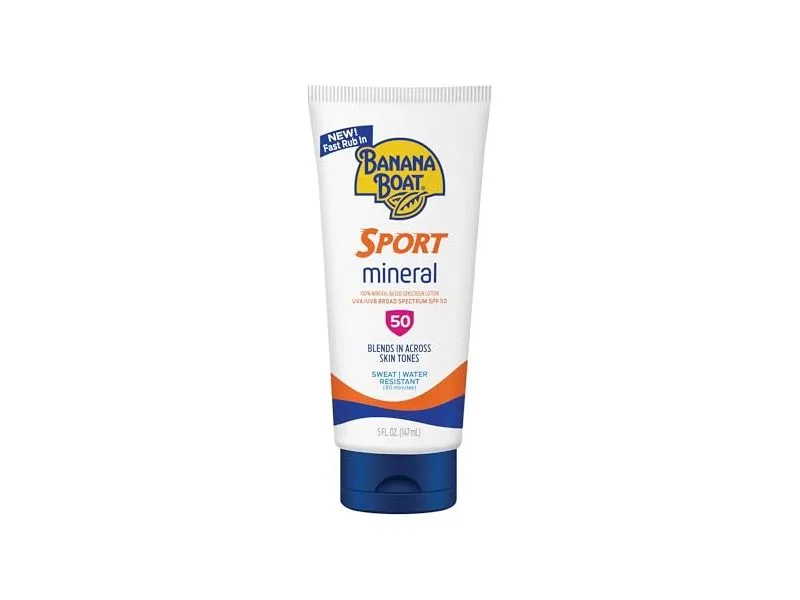
The two-hour cadence is still worth keeping for a long day outdoors, and a large, unfussy body product like Banana Boat Sport Mineral Sunscreen Lotion SPF 50 exists precisely so that reapplying at volume never feels like a decision. Sprays such as Blue Lizard Sport Mineral Sunscreen Spray SPF 50 are a harder case: they are the easiest format to reapply and the hardest to dose, because a spray gives you no visual feedback on film thickness. If you use one, spray until the skin is visibly wet and then rub it in — treating it as a lotion dispenser rather than a mist.
The map of what you miss
Dose is not only about mass. It is about where the mass lands, and there is a reproducible map of the places it doesn't.
Pratt and colleagues photographed 57 participants with a UV-sensitive camera before and after they applied sunscreen, once with minimal instruction and once after reading a public-health statement. The eyelid and periorbital region was missed at roughly double the rate of the rest of the face — a median of 14 percent missed versus 7 percent elsewhere. Giving people the health information improved eyelid coverage significantly, and the medial canthus, the inner corner where the lid meets the nose, was still routinely skipped anyway. A related analysis found SPF moisturisers performed worse than dedicated sunscreens on whole-face coverage, at around 16.6 percent of the face missed versus 11.1 percent.
That second finding deserves more attention than it gets. An SPF moisturiser is applied with a moisturising motion — a small amount, blended thin, worked around the features rather than over them. The number on the jar may be honest; the gesture is not the same gesture.
The periorbital gap is also the strongest argument for accepting that some skin is not a sunscreen problem at all. Eyelid skin is thin, mobile, close to the eye, and prone to stinging, so the realistic answer for that zone is UV-blocking sunglasses and a brim rather than a heroic attempt to coat it — a point our answer on hats and physical protection makes in more detail. Our sun safety planner is built around the same idea: layering shade, timing and clothing over sunscreen rather than asking one bottle to carry an entire day.
For pigment conditions the stakes are higher again, because visible-light and UV exposure both drive relapse. Anyone managing melasma is running a treatment where under-dosed sunscreen doesn't merely fail to prevent damage — it actively undoes topical work already paid for. Tinted formulas earn their keep there for a reason that has nothing to do with cosmetics, and choosing an opaque mineral filter such as zinc oxide alongside iron oxides is a targeted decision rather than a preference. If you're rebuilding your shelf from scratch, our sunscreen finder filters on skin type and finish first, which is the correct order of operations, because the sunscreen you will apply thickly is the one that works.
Products mentioned
Independently reviewed and scored — the real products behind this piece.



- Therapy guide Melasma Under-dosed sunscreen actively undoes topical pigment work
- Ranked list Best Sunscreens for Oily Skin Filtered on wearability, which is what determines applied dose
- Ranked list Best Drugstore Sunscreens Affordable options people are willing to use at volume
- Ingredient Zinc Oxide Opaque mineral filter paired with iron oxides for pigment conditions
- Question Do hats and clothing actually help more than sunscreen? Physical protection is the realistic answer for the periorbital gap
References
- The relation between sun protection factor and amount of suncreen applied in vivo — British Journal of Dermatology, 2007
- Sunscreen applied at ≥ 2 mg cm-2 during a sunny holiday prevents erythema, a biomarker of ultraviolet radiation-induced DNA damage and suppression of acquired immunity — British Journal of Dermatology, 2019
- When should sunscreen be reapplied? — Journal of the American Academy of Dermatology, 2001
- UV imaging reveals facial areas that are prone to skin cancer are disproportionately missed during sunscreen application — PLoS One, 2017
- Application of SPF moisturisers is inferior to sunscreens in coverage of facial and eyelid regions — PLoS One, 2019
- The teaspoon rule of applying sunscreen — Archives of Dermatology, 2002
- Simple dosage guide for suncreams will help users — BMJ, 2002
- Application of sunscreen — theory and reality — Photodermatology, Photoimmunology & Photomedicine, 2014
Every cited link is verified to resolve to the paper named. Where a source could not be independently confirmed, it is listed without a link rather than pointing you somewhere wrong.
Frequently asked
If I apply half as much SPF 50, am I getting SPF 25?
No — the relationship is exponential rather than proportional. In vivo testing found that applying 1 mg/cm² instead of the tested 2 mg/cm² drops measured SPF toward the square root of the labelled value, which for SPF 50 is closer to seven than to twenty-five. The extrapolation from a low-SPF test product to a high-SPF one is a model rather than a direct measurement, but the shape of the curve is not in dispute.
How much sunscreen is 2 mg/cm² on a face?
Roughly half a teaspoon for face and neck together under Schneider's teaspoon rule, or two full finger-lengths of product under the two-finger rule. Both heuristics assume an average adult and a mid-weight formula, so measure it into a spoon once to see what that volume actually looks like on your own face, then use fingers from there.
Should I really reapply sunscreen after only twenty minutes?
For a day where you are going to be outdoors, yes — modelling shows the lowest total UV exposure comes from a second coat fifteen to thirty minutes after exposure begins rather than at two hours. That early coat is completing a dose you almost certainly under-applied, not replacing a film that has worn off. Continue reapplying after swimming, towelling, or heavy sweating.
Does an SPF moisturiser count as sunscreen?
It counts, but it covers worse in practice. UV photography found around 16.6 percent of the face missed with SPF moisturiser versus 11.1 percent with a dedicated sunscreen, largely because people apply a moisturiser with a moisturiser's gesture — a small amount, blended thin. If an SPF moisturiser is what you will genuinely use every day, use it, but apply it as a deliberate second layer rather than as skincare.
Which parts of the face get missed most often?
The eyelids and the area immediately around the eyes, at roughly double the miss rate of the rest of the face, with the medial canthus at the inner corner persistently skipped even after people are told about it. Because that skin is thin and prone to stinging, UV-blocking sunglasses and a brim are a more realistic solution there than trying to coat it.
Is a very high SPF worth buying?
It buys headroom against your own under-application rather than a meaningfully higher ceiling of protection. A holiday study found that an SPF 15 applied at the tested density prevented erythema, while higher-SPF products applied the ordinary way did not — so a bigger number is a hedge against a habit, and fixing the habit is the better investment.