At-Home Patch Testing Is Not Allergy Patch Testing, and the Difference Is Three Days
Two completely different procedures share a name — which is why people confidently clear a product they are, in fact, allergic to.
Read the preview
From the DermApproved blog, in Sensitive and Reactive Skin: patch testing. The dab behind your ear and the test a dermatologist runs share a name and nothing else. The clinic reads at two days and four — because the reaction it hunts hasn't started yet. That gap is why people clear a product they're allergic to. For the full breakdown, visit dermapproved.com/blog.
Same name, different immunology
Two things are called patch testing and they are not related procedures. One is what you do at home: a dab of a new product behind the ear or on the inner forearm, left overnight, checked in the morning. The other is a clinical diagnostic run over a week, using standardized allergen concentrations in petrolatum under aluminium chambers, read on a schedule.
The reason they diverge is that skin has two entirely separate ways of objecting to something. Irritant contact dermatitis is chemical injury: dose-dependent, immediate to a few hours, and available to everyone — apply anything at a high enough concentration for long enough and you will produce it. No immune memory is involved, which is why the same person tolerates the same substance at a lower dose the following week.
Allergic contact dermatitis is a delayed type IV hypersensitivity reaction. It requires prior sensitization — a first exposure that taught the immune system to recognize a hapten — and then, on re-exposure, T cells have to be recruited, activated and trafficked to the skin. That takes time. The visible reaction typically appears at 24 to 48 hours and often does not peak until 72 or 96. It is not proportional to dose in the same way, and it does not fade with familiarity; it gets worse.
So a home test checked the next morning is a reasonably good screen for the first thing and close to blind to the second. This is the mechanism behind a story that gets told constantly: tested it, was fine, used it for three weeks, woke up with a rash. Nothing went wrong with the test. It answered a different question.
Why the clinic reads at 48 hours and again at 96
The two-reading schedule is not administrative convenience. It is the diagnostic instrument.
Allergens are applied under occlusion and left for 48 hours. The chambers come off and the first reading is taken. Then the patient returns at 72, 96 or sometimes 120 hours for a second reading, and the comparison between the two is what separates the two kinds of reaction. An irritant response is usually maximal at removal and fading by the later reading — a decrescendo pattern. A true allergic response is often still building: weaker at 48, stronger at 96. That crescendo is the signature.
Some allergens declare themselves later still. Neomycin, corticosteroids, gold and para-phenylenediamine are all recognized for producing reactions that only surface at day seven, which is why some centres schedule a delayed reading rather than closing the case at 96 hours.
A home test has exactly one reading and no comparison. Whatever you see, you cannot tell whether it is fading or building, and you have no vehicle-only control on the adjacent skin to tell you whether the reaction belongs to the active ingredient or the occlusion itself. That is the structural gap, and no amount of care at home closes it.
The home version is a real method — when you run it properly
None of this makes home testing worthless. Done correctly it is a published technique with a name, the repeated open application test, and it has been in the contact dermatitis literature since 1986.
The original study applied common vehicle ingredients twice daily for seven days to the flexor aspect of the forearm near the antecubital fossa in 86 patients with contact dermatitis, stopping early if dermatitis appeared. Among patients with a clearly positive clinical patch test, 80% also reacted to the repeated open application. Among patients whose clinical patch test had been merely doubtful, 44% turned frankly positive under repeated open application — which is the more interesting number, because it means the home-style method sometimes resolves ambiguity the clinic left hanging.
What separates that from a dab behind the ear is not fussiness, it is three variables. Repetition: twice daily, not once. Duration: seven days minimum, and closer to ten to fourteen for a leave-on product you intend to use every day. Consistency of site: the same marked patch of skin every time, with nothing else applied to it. Our Patch Test tool walks the schedule and gives a defined stop-or-proceed verdict at the end, which matters more than it sounds — the most common failure is not a wrong protocol but an abandoned one, checked on day two and forgotten.
The honest reading of that 80% figure is the other way round: one in five people with a confirmed allergy did not react. A clean home test is genuinely reassuring and it is not proof.
The thing a home test structurally cannot tell you
Even a perfectly executed home test answers a question about a product. Allergy is a fact about an ingredient. That gap is the whole problem.
Suppose your new moisturizer produces a reaction on day five. You now know to stop using it. You do not know which of its thirty-odd ingredients did it, so you cannot avoid that ingredient in your cleanser, your shampoo, your sunscreen, your partner's hand cream, or the wet wipes at work — all of which may contain it. People in this position typically respond by buying progressively gentler products and reacting to those too, because the allergen followed them.
The scale of that is documented. In the most recent published series from the North American Contact Dermatitis Group, 4,121 patients were tested against a standardized screening panel of 80 allergens; 69.7% had at least one positive reaction and 51.2% received a primary diagnosis of allergic contact dermatitis. The leading culprits were nickel (18.2%), methylisothiazolinone (13.8%), fragrance mix I (12.8%), hydroperoxides of linalool (11.1%) and benzisothiazolinone (10.4%).
Look closely at the fourth one. Hydroperoxides of linalool are oxidation products — linalool is a common fragrance material that becomes allergenic as it ages in contact with air. No ingredient list will ever declare them; the label says 'Linalool', and whether it has oxidized depends on how old your bottle is and how it has been stored. There is no consumer-side test for that. Reading an INCI list carefully — which our Ingredient Decoder is built for — narrows the field considerably, but it cannot identify what a label does not contain the vocabulary to describe.
The label will not do this job for you
It is tempting to route around the whole problem by buying products marketed for sensitive skin. The evidence on how well that works is not flattering.
An analysis of best-selling moisturizers found that only 12% were free of allergens from the standard North American screening series. The most frequent were fragrance mix, paraben mix and tocopherol — the last of which is vitamin E, an ingredient nobody thinks of as risky. Most striking: among products carrying a 'fragrance free' claim, 45% contained at least one fragrance cross-reactor or botanical ingredient. 'Hypoallergenic' is not a regulated term in the United States and carries no testing requirement at all.
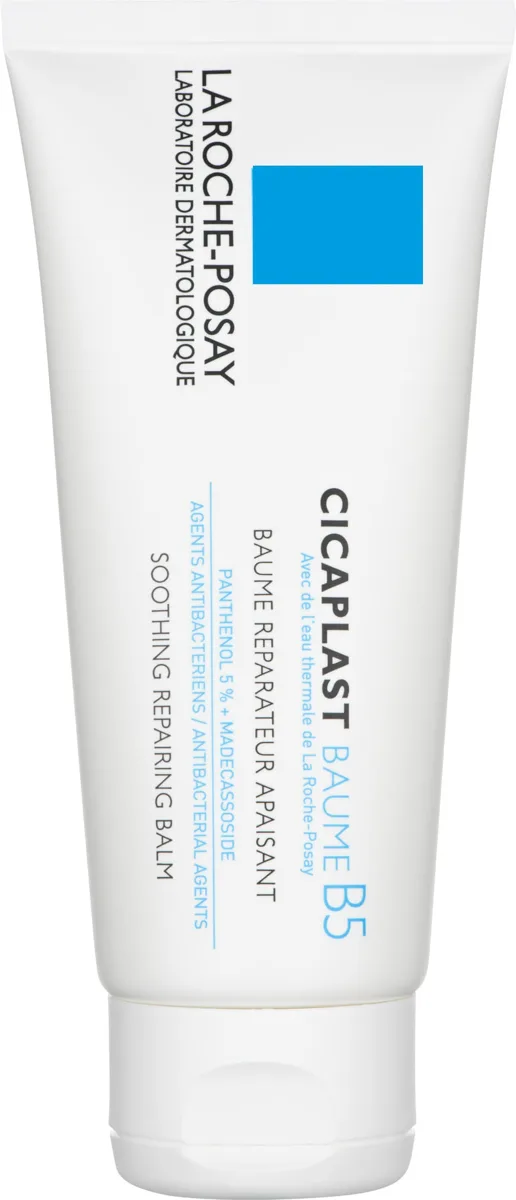
What does help is a genuinely short ingredient list from a formulator that treats brevity as the product. Vanicream Moisturizing Skin Cream and Vanicream Gentle Facial Cleanser exist for exactly this reason — no fragrance, no dye, no lanolin, no formaldehyde releasers — which does not make them allergen-proof but does mean a reaction leaves you with a much shorter list of suspects. For a site that is already inflamed, a near-inert occlusive like Vanicream Moisturizing Ointment or a petrolatum-and-panthenol repair balm such as La Roche-Posay Cicaplast Baume B5 gives the barrier something to heal under while you work out what caused it. Petrolatum is one of the very few things in cosmetic chemistry with a genuinely negligible sensitization rate, which is why it is also the vehicle allergens are suspended in for clinical testing. A short course of 1% hydrocortisone settles a mild reaction, though it is worth knowing that corticosteroids themselves are a recognized contact allergen class — one of the ones that shows up on the delayed reading.
When to stop testing yourself
There is a point where continuing to run experiments on your own forearm becomes a way of avoiding the diagnosis. The signals are fairly clear: dermatitis that keeps recurring at the same site, particularly eyelids, hands or the face; a rash that spreads beyond where you applied anything; a pattern that tracks your job; or the increasingly common situation in which every gentle product you try seems to fail. That last one is not bad luck. It is usually a shared ingredient.
Clinical patch testing is what resolves it, and the referral route is more accessible than most people expect — the referral question and the preparation requirements cover the logistics, and the contact dermatitis pathway sets out where testing sits relative to everything else. Pregnancy is the notable exception, since testing is commonly deferred; in that window, careful ingredient avoidance and our Pregnancy-Safe checker carry more of the weight, and the timing question is worth reading before you schedule anything.
And the gold standard has its own ceiling, which is worth knowing before you invest a week in it. In that same North American series, roughly one in five patients — 20.3% — had at least one clinically relevant reaction to a substance that was not on the 80-allergen screening panel at all. A separate analysis of supplemental testing found that among patients whose standard-series results were entirely negative, 12% to 20% still had relevant reactions on supplemental panels, and most of the frequently-positive supplemental allergens are absent from the common screening series. Testing negative is informative. It is not the same as being told nothing is wrong.
How to read your own result honestly
A negative home test licenses one narrow claim: this product, on forearm skin, applied repeatedly for a week, produced no visible reaction. It does not establish that the product is safe on your eyelids, where the stratum corneum is a fraction as thick and absorption is correspondingly higher. It does not cover the version of the product you buy in eighteen months, after a reformulation you were never told about. And it does not extend indefinitely forward, because sensitization is something you acquire — a new allergy can appear to something you have used comfortably for a decade.
A positive home test is more informative, but read it for pattern rather than presence. Stinging within minutes on intact skin, without redness that outlives it, is usually irritation and often dose-related — a lower concentration or a buffered application may be perfectly fine. Itchy, spreading redness with small vesicles that develops over days and worsens after you stop is behaving like allergy, and that is the result that should send you toward a clinic rather than toward the next product.
Both procedures are worth doing. The home test is a cheap, fast filter that catches the irritation problems, which are the more common ones. Clinical testing is the only thing that names an allergen, and naming it is what lets you actually avoid it. What causes the damage is not doing one instead of the other — it is believing the first one already did the second one's job.
Products mentioned
Independently reviewed and scored — the real products behind this piece.



- Therapy guide Contact dermatitis Where clinical patch testing sits relative to treatment and avoidance.
- Ingredient Petrolatum (Petroleum Jelly) Negligible sensitization rate — which is why it's the vehicle clinical allergens are suspended in.
- Question How do I actually get referred for patch testing? The referral route, which is more accessible than most people assume.
- Question What do I need to do before patch testing? What to stop and when before the appointment, so the test isn't wasted.
- Question Can I have patch testing while pregnant? Why testing is usually deferred in pregnancy and what to do instead.
- Question Can I develop a second contact allergy later? Why a clean result today doesn't cover you indefinitely.
References
- The repeated open application test (ROAT) — Contact Dermatitis, 1986
- North American Contact Dermatitis Group Patch Test Results: 2019-2020 — Dermatitis, 2023
- Supplemental Patch Testing Identifies Allergens Missed by Standard Screening Series — Dermatitis, 2024
- Consumer Preferences, Product Characteristics, and Potentially Allergenic Ingredients in Best-selling Moisturizers — JAMA Dermatology, 2017
- Allergic or Not: Final Interpretation of Doubtful Patch Test Reactions From the North American Contact Dermatitis Group, 2019-2020 — Dermatitis, 2024
Every cited link is verified to resolve to the paper named. Where a source could not be independently confirmed, it is listed without a link rather than pointing you somewhere wrong.
Frequently asked
How long should I actually leave a new product on before deciding it's safe?
Long enough to see a delayed reaction, which means days rather than hours. The published repeated open application protocol is twice daily for seven days on the same forearm site; for a leave-on product you plan to use permanently, ten to fourteen days is more informative. Checking once the next morning tests only for immediate irritation, which is the less consequential of the two problems.
If nothing happened when I tested it, can I rule out an allergy?
Not entirely. In the original study of the method, 80% of patients with a confirmed positive clinical patch test also reacted to repeated open application — so roughly one in five confirmed allergics produced no home reaction. Forearm skin is also thicker and less permeable than eyelid or neck skin, so a clean forearm result does not automatically transfer to the areas where reactions are most common.
Why can't a home test tell me which ingredient I'm reacting to?
Because you are testing a finished product containing dozens of ingredients, and a reaction implicates all of them equally. Clinical patch testing solves this by applying individual allergens at standardized concentrations, which is what allows an actual avoidance list. Without that, people typically keep switching to gentler products and keep reacting, because the responsible ingredient is in those too.
Does 'fragrance free' on the label mean it's safe for reactive skin?
Less often than it should. In an analysis of best-selling moisturizers, 45% of products claiming to be fragrance free still contained at least one fragrance cross-reactor or botanical ingredient, and only 12% of the products studied were free of standard-series allergens altogether. 'Hypoallergenic' carries no regulatory definition or testing requirement in the US at all.
What signs mean I should ask for clinical patch testing instead of testing at home?
Dermatitis that recurs at the same site — especially eyelids, hands or face — a rash spreading beyond where you applied anything, a pattern that tracks your work, or the experience of reacting to product after product marketed as gentle. That last pattern almost always means a shared ingredient rather than unusually fragile skin, and only individual allergen testing will name it.