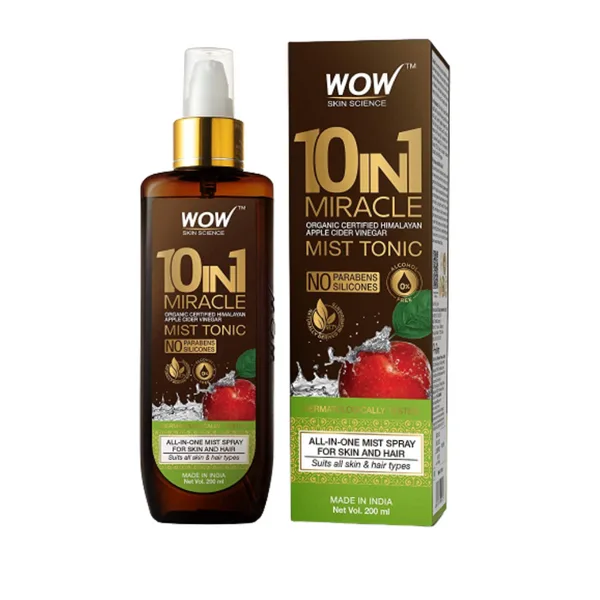
It bundles a hydrating rose-and-aloe base with niacinamide, green tea, and the brand's signature apple cider vinegar into a single 'do-everything' facial mist pitched for face and hair. The genuine value is a refreshing, lightly hydrating niacinamide toner-mist; the '10-in-1 miracle' framing is marketing around an otherwise simple, pleasant spritz.
WOW's 10-in-1 ACV Mist is a pleasant, refreshing facial spritz with a genuinely useful niacinamide-and-hydration base wrapped in some serious marketing hyperbole. It hydrates, refreshes, and offers mild niacinamide benefits — but it is not ten miracles in a bottle, the apple cider vinegar does little, and the lavender, tea tree, and fragrance make it a skip for sensitive skin. Judged as a simple toner-mist, it's fine.
This rating draws on the well-understood evidence behind niacinamide and humectant hydration plus a large but mostly online, reseller-based review pool. The headline apple cider vinegar, witch hazel, and sweeping '10-in-1' benefits are largely unsupported marketing, and WOW's limited independent clinical record, together with discontinued listings at some retailers, places more weight on formulation analysis than durable real-world data.
Verdicts
How well it fits each concern
Verdict by concern tap a concern for the case
Promisingfor Excess OilinessIn your profileYou chose · Niacinamide has trial-level evidence for excess oiliness but no guideline or regulatory standing yet — promising, short of a recommendation; the other actives here are not yet assessed for it.Moderate evidenceStandard tolerabilityNo reviews collected yet
The case for it
Niacinamide has trial-level evidence for this concern but no guideline or regulatory standing yet.
It is plausibly present at a working level, though the concentration is not declared.
The formula carries no trigger this concern is sensitive to, with the cautions noted.
What would change this: A declared concentration would move this to a firmer reading of the dose.
Same rule for everyone. “Promising” is the verdict on 7,858 of 45,024 concern verdicts across the catalog; rule R9p decided 7,858 of them.
Unchanged since September 5, 2026, engine 5.1.1.
R9p — 0.5.0: 'Unproven' beside three filled dots read as one question answered twice with opposite words (7,018 rows). The chip measures standing, the dots measure trial volume; where the row carries at least one RCT or a tier-2 source (moderate dots) and the active is present at a working level, the honest word is Promising. Unproven is reserved for plausible-standing rows with limited or weak evidence, or an under-dosed form. Same rank as Unproven — a bet either way; the dots order them. · the full register
Carrying active
Niacinamide
Standing
plausible — trials support it
Form
plausible — studied range 2%, from the trials on the row; needs leave-on contact; judge it after ~8 weeks
Tolerability
standard
Row checked
against its sources on July 17, 2026 (evidence table ev-2026.09-r228)
Good choicefor DehydrationIn your profileYou chose · Glycerin is a reference standard by mechanism for dehydration; this mist carries it.Moderate evidenceStandard tolerabilityNo reviews collected yet
The case for it
Rose Hydrosol + Aloe + Glycerin + Sodium PCA has trial-supported standing for this concern.
It is plausibly present at a working level, though the concentration is not declared.
The formula carries no trigger this concern is sensitive to, with the cautions noted.
What would change this: A declared concentration would move this to a firmer reading of the dose.
Same rule for everyone. “Good choice” is the verdict on 9,564 of 45,024 concern verdicts across the catalog; rule R5 decided 9,072 of them.
Unchanged since September 5, 2026, engine 5.1.1.
R5 — Trial-supported or guideline-supported active, adequately or plausibly dosed. · the full register
Carrying active
Rose Hydrosol + Aloe + Glycerin + Sodium PCA
Standing
supported — its mechanism is established
Form
plausible — studied range 20%, from the trials on the row; needs leave-on contact; judge it after ~1 weeks
Tolerability
standard
Row checked
against its sources on July 17, 2026 (evidence table ev-2026.09-r228)
The studies behind the evidence row
USP glycerin monograph / Fluhr et al., glycerol and the skin (review) — glycerin is the reference humectant, drawing and holding water in the stratum corneum — reference work
Promisingfor DullnessIn your profileYou chose · Glycerin has trial-level evidence for dullness but no guideline or regulatory standing yet — promising, short of a recommendation; the other actives here are not yet assessed for it.Moderate evidenceStandard tolerabilityNo reviews collected yet
The case for it
Rose Hydrosol + Aloe + Glycerin + Sodium PCA has trial-level evidence for this concern but no guideline or regulatory standing yet.
It is plausibly present at a working level, though the concentration is not declared.
The formula carries no trigger this concern is sensitive to, with the cautions noted.
What would change this: A declared concentration would move this to a firmer reading of the dose.
Same rule for everyone. “Promising” is the verdict on 7,858 of 45,024 concern verdicts across the catalog; rule R9p decided 7,858 of them.
Unchanged since September 5, 2026, engine 5.1.1.
R9p — 0.5.0: 'Unproven' beside three filled dots read as one question answered twice with opposite words (7,018 rows). The chip measures standing, the dots measure trial volume; where the row carries at least one RCT or a tier-2 source (moderate dots) and the active is present at a working level, the honest word is Promising. Unproven is reserved for plausible-standing rows with limited or weak evidence, or an under-dosed form. Same rank as Unproven — a bet either way; the dots order them. · the full register
Carrying active
Rose Hydrosol + Aloe + Glycerin + Sodium PCA
Standing
plausible — trials support it
Form
plausible — studied range 2–20%, from the trials on the row; needs leave-on contact; judge it after ~1 weeks
Tolerability
standard
Row checked
against its sources on July 17, 2026 (evidence table ev-2026.09-r228)
The studies behind the evidence row
Harry's Cosmeticology / Baran & Maibach Textbook of Cosmetic Dermatology — humectant, emollient and occlusive classification — standard reference text
Promisingfor Large PoresIn your profileYou chose · Niacinamide has trial-level evidence for large pores but no guideline or regulatory standing yet — promising, short of a recommendation; the other actives here are not yet assessed for it.Moderate evidenceStandard tolerabilityNo reviews collected yet
The case for it
Niacinamide has trial-level evidence for this concern but no guideline or regulatory standing yet.
It is plausibly present at a working level, though the concentration is not declared.
The formula carries no trigger this concern is sensitive to, with the cautions noted.
What would change this: A declared concentration would move this to a firmer reading of the dose.
Same rule for everyone. “Promising” is the verdict on 7,858 of 45,024 concern verdicts across the catalog; rule R9p decided 7,858 of them.
Unchanged since September 5, 2026, engine 5.1.1.
R9p — 0.5.0: 'Unproven' beside three filled dots read as one question answered twice with opposite words (7,018 rows). The chip measures standing, the dots measure trial volume; where the row carries at least one RCT or a tier-2 source (moderate dots) and the active is present at a working level, the honest word is Promising. Unproven is reserved for plausible-standing rows with limited or weak evidence, or an under-dosed form. Same rank as Unproven — a bet either way; the dots order them. · the full register
Carrying active
Niacinamide
Standing
plausible — trials support it
Form
plausible — studied range 4%, from the trials on the row; needs leave-on contact; judge it after ~8 weeks
Tolerability
standard
Row checked
against its sources on July 17, 2026 (evidence table ev-2026.09-r228)
Does the jobDoes what a toner is for: adds something real, not alcohol-driven. Not measured from the label: restores skin pH, plays well with what follows.
A verdict is DermApproved’s assessment of how well a product’s ingredients fit a concern — never a claim about what the product treats. Evidence dots and collected reviews sit beside it and are never blended in.
Rules 0.5.1 · evidence table ev-2026.09-r228 · how we decide
Assessment
Pros & Cons
Pros
✓ Genuinely refreshing, lightly hydrating spritz
✓ Credible dose of well-evidenced niacinamide
✓ Soothing rose, aloe, and green tea base
✓ Versatile multi-use for face and hair
✓ Affordable and vegan
✓ Pleasant rose-herbal scent
Cons
✗ '10-in-1 miracle' claims are heavily exaggerated
✗ Apple cider vinegar contributes little
✗ Lavender, tea tree, witch hazel, and fragrance can irritate
✗ Not suitable for sensitive or reactive skin
✗ Listed as discontinued by some retailers
Review
Full Review
Promise ten benefits and a miracle in a single product name, and you have invited scrutiny that it would be a disservice not to deliver. WOW's 10-in-1 Miracle Apple Cider Vinegar Mist Tonic is, to be fair about it from the outset, a perfectly pleasant facial mist. But the distance between what the label vows and what the bottle actually does is wide enough that the most useful thing a review can do is sort the real promises from the decorative ones, because that gap is precisely where buyers get disappointed.
Start with the parts that hold up, because there is genuine substance amid the hype. The single most credible ingredient is niacinamide, a thoroughly well-evidenced active that supports the skin barrier, helps regulate oil and offers a mild tone-evening benefit. It is the one component that gives the "10-in-1" framing a leg to stand on, even if its effect from a brief, watery, leave-on spritz is gentler than what you would get from a higher-concentration serum that sits on the skin. Supporting it is a genuinely agreeable hydrating base: rose hydrosol and aloe to soothe, glycerin and the natural-moisturizing-factor component sodium PCA to draw in light humectant moisture. Spritzed onto freshly cleansed skin, this delivers exactly the cool, dewy, refreshed sensation you buy a facial mist for, and there is nothing wrong with wanting that. Green tea polyphenols add a small measure of antioxidant defense and panthenol calms and conditions, rounding out the comfortable character. As a hydrating niacinamide toner-mist, it is a competent little product, and at fourteen dollars it is an easy one to reach for. The texture is exactly right for the format too, a lightweight watery spray that lands as a fine mist rather than a heavy splash, non-sticky and quick to settle, so it slots into a routine without leaving a tacky film for the next step to fight through. Beyond the face, it doubles as a hair refresher and a general pick-me-up, which is where the versatility argument earns a bit of honest credit.
Now the parts that lean more on marketing than mechanism. The apple cider vinegar, the namesake hero, sits in a leave-on watery mist where its mild acidity does very little of consequence; it is brand identity far more than functional active. Paired with witch hazel, the "toning and balancing" story is mostly the vocabulary of gentle astringency, and witch hazel, with its tannins and sometimes-associated drying character, can actually irritate the wrong skin rather than balance it. So of the advertised ten benefits, you can reasonably credit hydration, refreshment and niacinamide's modest effects; the rest are gentle, temporary or simply generous. No watery mist delivers ten meaningful treatments at once, and a product that pretends otherwise sets its buyer up for a letdown when the miracle fails to arrive.
The more practical concern, and the real reason to be selective about who reaches for this, is the irritation profile. The formula carries lavender essential oil, tea tree essential oil, witch hazel and added fragrance, a stack of potential sensitizers that brings along the common allergens linalool and limonene. For something you mist directly onto your face, sometimes repeatedly through the day, that is a meaningful consideration for sensitive, rosacea-prone or barrier-compromised skin. It smells genuinely lovely, all rose and herbal freshness, but that pleasantness is purchased at the cost of being a poor fit for reactive complexions, so a patch test is the sensible first move. It is worth flagging, too, that some retailers now list this particular mist as discontinued, so availability may be patchy depending on where you shop.
A fair word on the brand. WOW Skin Science, founded in India around 2014, grew quickly online with affordable, plant-powered formulas, and there is nothing wrong with accessible, budget-friendly skincare done well. This product, though, is a textbook example of the brand's habit of wrapping a simple, decent formula in oversized claims, and its established status reflects commercial reach more than independent clinical validation. Judged honestly, the formula's evidence-backed value is narrower than its name implies, and that mismatch is the whole story.
As for results, the timeline is short and modest by design. You get instant refreshment and a light hydrated feel the moment you spritz, and niacinamide's tone and oil benefits build subtly over weeks of consistent use, though a mist supports a routine rather than transforming skin. To make the hydration last beyond the initial cool-down, follow with a moisturizer to seal it in, otherwise the water simply evaporates and takes the dewiness with it.
The recommendation falls out cleanly. If you want a cheap, refreshing, lightly hydrating mist with a real dose of niacinamide, and your skin is untroubled by fragrance and essential oils, this is a pleasant enough buy: spritz it, enjoy the lift, and moisturize on top. Mentally discard the "10-in-1 miracle" framing entirely, because it is a nice toner-mist, not a routine in a bottle, and it is decidedly not the safe choice for delicate or reactive skin that the soothing rose-and-aloe imagery might suggest. Bought with eyes open, for what it actually is rather than what the name shouts, it is a small, affordable, agreeable thing, and there is room in plenty of routines for exactly that, just not for the miracle it advertises on the front.
Formula
Key Ingredients
The hero actives that drive this product's performance.
The most credible active in this mist — niacinamide supports the barrier, helps regulate oil, and lends a mild tone-evening benefit, the ingredient that gives the '10-in-1' claims their one genuinely evidence-backed leg to stand on.
The hydrating, refreshing base that makes this pleasant to spritz — rose hydrosol and aloe soothe while glycerin and the NMF sodium PCA add light humectant moisture, the part of the formula that delivers the instant fresh-skin feel a facial mist is bought for.
Established mechanismfor Dehydration · established mechanism
The 'toning' duo and the brand's signature — both mildly astringent, marketed to balance and tighten, though their real effect in a leave-on mist is modest and witch hazel can be drying on sensitive skin, so this is more brand identity than potent active.
A soothing-antioxidant pair — green tea polyphenols add light antioxidant defense while panthenol calms and conditions, reinforcing the refreshing, comforting character of the mist alongside the hydrating base.
Limitedfor Excess Oiliness
Ingredient standings describe the active at treatment-level doses and
vehicles; this product's own condition grades weigh its actual formula.
Spritz onto cleansed skin and pat in before serums and moisturizer, or use throughout the day for a refresh. Follow with a moisturizer to seal in the light hydration. Avoid spraying directly into the eyes given the essential oils.
Results Timeline
Immediate refreshment and a light hydrated feel; niacinamide's tone and oil benefits build subtly over weeks, though a mist supports rather than transforms skin.
WOW Skin Science 10-in-1 Miracle Apple Cider Vinegar Mist Tonic
Serum
Moisturizer
Sunscreen
Sample PM Routine
Cleanser
WOW Skin Science 10-in-1 Miracle Apple Cider Vinegar Mist Tonic
Serum
Moisturizer
Evidence
Science & Expert Perspective
The Science
The mist's worthwhile activity is concentrated in two areas. Niacinamide is a well-evidenced active with documented benefits for barrier support, sebum regulation, and mild improvement of uneven tone, though its effect from a brief, leave-on watery mist is gentler than from a leave-on serum at higher concentration. The hydrating base — rose hydrosol, aloe, glycerin, and sodium PCA — provides genuine light humectant moisture and a refreshing feel, with the caveat that without an occlusive follow-up the hydration is short-lived. The marketed apple cider vinegar and witch hazel are mildly astringent but have limited evidence of meaningful benefit in a leave-on mist; witch hazel, often associated with tannins and (in some forms) alcohol, can be drying or irritating. Green tea polyphenols add modest antioxidant support, and panthenol soothes. The principal concern is the irritant load: lavender and tea tree essential oils plus added fragrance contribute the allergens linalool and limonene, a notable consideration in a face mist applied directly and repeatedly. Overall, a simple, pleasant formula whose evidence-backed value (niacinamide, hydration) is narrower than its '10-in-1' marketing implies.
Dermatologist Perspective
Dermatologists generally view facial mists as pleasant for a quick refresh and light hydration but caution that they don't substitute for a proper moisturizer, since watery humectants evaporate without an occlusive to seal them. Niacinamide is well regarded, though its benefit is greater in leave-on serums than in a brief mist. On apple cider vinegar and witch hazel, clinicians tend to be skeptical of meaningful leave-on benefit and note witch hazel's potential to dry or irritate. A consistent point of caution is that essential oils such as lavender and tea tree, along with added fragrance, are common sensitisers, making fragranced mists a poor choice for sensitive, rosacea-prone, or barrier-compromised skin; fragrance-free hydrating mists are usually preferred there. As always, follow with moisturizer and daytime sunscreen.
Guidance
Usage & Recommendations
How to Use
After cleansing, hold the bottle a short distance from your face and spritz evenly, then pat the mist in before applying serums and moisturizer. You can also use it throughout the day for a quick refresh, and on hair if you like. Always follow with a moisturizer to seal in the light hydration, as a mist alone won't keep skin hydrated for long. Avoid spraying directly into the eyes, and patch test first if your skin is sensitive given the essential oils and fragrance.
Value Assessment
At its budget price the mist is fair value for a refreshing, lightly hydrating niacinamide spritz, and you're not overpaying. The value caveat is the marketing: the '10-in-1 miracle' and apple cider vinegar framing add perceived but not real worth, and a simple fragrance-free hydrating mist would deliver the genuine benefits with less irritation risk. With some retailers listing it as discontinued, availability and consistent pricing may also be a factor. For value shoppers who tolerate fragrance and want an affordable refresher, it's reasonable; sensitive skin should put the money toward a gentler option.
Who Should Buy
Normal, combination, or oily skin wanting an affordable, refreshing, lightly hydrating mist with a real dose of niacinamide, and who enjoy a rose-herbal scent. It suits those who like a multi-use spritz for face and hair and aren't sensitive to fragrance or essential oils.
Who Should Skip
Sensitive, rosacea-prone, or barrier-compromised skin should skip it given the lavender, tea tree, witch hazel, and fragrance. Anyone expecting the '10-in-1 miracle' claims or the apple cider vinegar to deliver real treatment results will be disappointed — it's a simple refreshing mist, not a routine replacement.
Ready to try WOW Skin Science 10-in-1 Miracle Apple Cider Vinegar Mist Tonic?
A fine watery spritz that instantly refreshes and lightly hydrates, with a noticeable rose-and-herbal aroma. Skin feels cool and dewy; the essential oils and witch hazel mean sensitive skin should patch test before regular use.
WOW Skin Science made apple cider vinegar a signature across its fast-growing online range, and this mist packages that theme into a multi-use tonic marketed with sweeping benefits. It rode the popularity of facial mists and ACV as a wellness trend, aiming to be an all-purpose refresher for value-focused shoppers.
About WOW Skin Science Established Brand (5–20 years)
WOW Skin Science, founded in India around 2014, grew quickly online with affordable, plant-powered formulas. Its apple cider vinegar range is a signature line, though its marketing leans on bold multi-benefit claims and trend ingredients, and the brand carries limited independent clinical validation.
Brand founded: 2014 · Product launched: 2019
Myth vs. Reality
Common Myths
Myth
A '10-in-1 miracle' mist can replace most of your skincare routine.
Reality
No single watery mist delivers ten meaningful treatments at once. This one offers genuine light hydration and a credible dose of niacinamide, but the rest of the '10 benefits' are gentle, temporary, or marketing. It's a nice refreshing toner-mist, not a routine in a bottle.
FAQ
Frequently Asked Questions
What does the '10-in-1' in this mist actually mean?
It's marketing for a list of claimed multi-benefits. In reality the mist provides genuine light hydration and a credible dose of niacinamide, with milder or temporary effects from rose, aloe, green tea, and apple cider vinegar. Treat it as a refreshing niacinamide toner-mist, not ten separate treatments.
Does the apple cider vinegar in this mist do much?
Not a great deal. ACV and witch hazel are mildly astringent and central to the brand's identity, but their real effect in a leave-on mist is modest, and witch hazel can be drying. The mist's worthwhile benefits come more from niacinamide and the hydrating rose-aloe base.
Can I use this mist on my hair too?
Yes — it's marketed as multi-use for face and hair, and the lightweight, watery formula can be spritzed on hair for a refresh. On skin, its main role is a hydrating, refreshing toner step you can also use throughout the day.
Is the WOW ACV mist good for sensitive skin?
Not ideal. It contains lavender and tea tree essential oils, witch hazel, and added fragrance, all of which can irritate sensitive or reactive skin. If your skin is delicate, patch test first or choose a fragrance-free, alcohol-free hydrating mist instead.
How should I use the mist in my routine?
Spritz it onto cleansed skin and pat in before your serums and moisturizer, or use it any time for a refresh. Always follow with a moisturizer to seal in the light hydration, since a mist alone won't keep skin hydrated for long. Avoid spraying near the eyes.
Is it safe to use while pregnant?
It contains no retinoids or high-strength acids, so it's generally considered pregnancy-friendly. If you're sensitive to essential oils during pregnancy, the lavender and tea tree are worth noting; check with your doctor if unsure.
Reviews
What Reviewers Tend to Say
Recurring themes our editors read across retailer reviews of this product — summaries in our words, not quotations, and not a substitute for your own patch test.
Common Praise
Refreshing and hydrating spritz
Pleasant rose-and-herbal scent
Versatile multi-use mist
Affordable
Light and non-sticky
Common Complaints
Essential oils and witch hazel can irritate
'10-in-1' claims feel exaggerated
Fragrance not for sensitive skin
Effects are mild and temporary
Notable Endorsements
Signature ACV mistMulti-use face and hair mistAffordable refreshing toner
The supplier specification for standard witch hazel water caps the tannin content — the fraction all the research is about — at a level indistinguishable from none. The tightness you feel is the solvent.
Nearly every trial that made this ingredient famous ran at 2–5%. The double-digit numbers on the shelf are answering a question the biology never asked.
Pore size is mostly genetic and you can't permanently shrink it — but you can dramatically change how visible pores look, and the products that do it aren't the ones labeled 'pore-minimizing.'
Products, answers, therapy guides, tools and articles in one search. Brand names,
slang and abbreviations all work — accutane finds isotretinoin, bacne finds truncal acne.