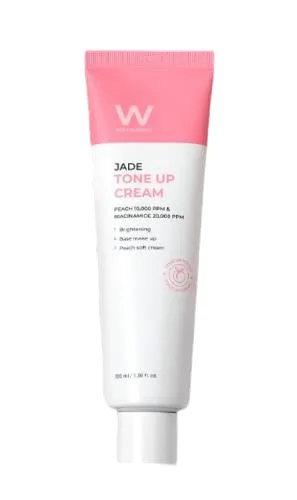
It combines a titanium dioxide tone-up veil with a declared 2% niacinamide and 1% peach extract in a silicone primer base, so one step gives an instant optical lift and a modest long-term brightening active.
A pleasant, well-textured tone-up primer that brightens the face instantly with titanium dioxide pigment and adds a useful 2% niacinamide. The jade, collagen and glutathione on the label are trace-level, there is no SPF, and the single white shade suits fair to light skin far better than deeper tones.
Few English-language reviews exist for the 2023 niacinamide version, and many online reviews refer to the older White Jade formula. The ingredient list comes from a retailer's translation of the Korean label, so one or two ingredient names may differ slightly on the physical tube.
Verdicts
How well it fits each concern
Verdict by concern none yet
Listed for Dullness — the actives here (Titanium Dioxide, Niacinamide, Peach, Panthenol (Vitamin B5) are in our research queue for that concern; there is no verdict until their evidence rows are written. That is a gap in our table, not a mark against the product.
Does the jobDoes what a moisturizer is for: draws in water, softens and smooths.
A verdict is DermApproved’s assessment of how well a product’s ingredients fit a concern — never a claim about what the product treats. Evidence dots and collected reviews sit beside it and are never blended in.
Rules 0.5.1 · evidence table ev-2026.09-r228 · how we decide
Assessment
Pros & Cons
Pros
✓ Instant, even brightening from a titanium dioxide pigment veil
✓ Declared 2% niacinamide adds a genuine long-term tone active
✓ Satiny silicone finish works well as a makeup primer
✓ Generous 100ml tube lasts several months in thin layers
✓ Humectant base with panthenol and betaine stays comfortable
✓ Spreads far and turns sheer within seconds
Cons
✗ No SPF despite titanium dioxide near the top
✗ White cast can look chalky on medium and deep skin
✗ Jade, collagen and glutathione present only at trace levels
✗ Added fragrance may bother fragrance-sensitive skin
✗ Oils and polysorbates make it unsuitable for fungal acne
Review
Full Review
Read the ingredient list of this cream all the way to the bottom and you reach its namesake: nephrite powder, the mineral sold as jade, declared by the brand's own retail listing at 0.01 parts per billion. That is not a typo and it is not a secret. It is a concentration so small that the jade is closer to a mood than an ingredient, and it tells you exactly how to read the rest of the tube. The Jade Tone-Up Cream is a cosmetic primer-moisturizer that brightens the face optically, the moment it goes on, and asks a modest dose of niacinamide to do any longer-term work. Judged as that, it is a pleasant, competent product. Judged as a jade treatment, there is nothing to judge.
Wonjin Effect is the retail skincare line connected to Wonjin Beauty Medical Group in Seoul, and its catalogue leans on the vocabulary of the clinic: brightening, tone, recovery. This cream sits in a well-loved Korean category, the tone-up cream, which exists to give bare skin an even, lifted, slightly luminous cast before sunscreen or makeup. The current version arrives in a soft pink-and-white squeeze tube labelled with two numbers, peach at 10,000 ppm and niacinamide at 20,000 ppm. Translated out of parts per million, that is one percent peach extract and two percent niacinamide. The earlier White Jade version sold in a different pack had no niacinamide at all, so the niacinamide is the meaningful upgrade in this renewal.
The instant effect comes from titanium dioxide, fourth on the list. This is the same white mineral used in mineral sunscreens, but here it is working as a pigment, not a filter. The tube carries no SPF claim and no sun protection factor was tested or declared, so the white cast you see is purely cosmetic. It softens redness, blurs the grey undertone of tired skin, and lays a thin, even veil over the face. On fair to light skin tones that veil reads as brightness. On medium and deeper skin it can read as chalk, and that is the single biggest limitation of the product: there is one shade, and it is white.
Behind the pigment sits a conventional, well-built base. Water, glycerin and butylene glycol hydrate; phenyl trimethicone and dimethicone give the slip and the smooth, faintly silky finish that lets foundation glide on top; a sodium acrylates copolymer and sodium polyacrylate thicken it into a soft cream. Panthenol, betaine and trehalose add humectant comfort, and a sprinkle of plant oils, including sunflower, meadowfoam, rosehip, argan and canola, keeps it from feeling dry once the water flashes off. Ceramide NP appears, but well down the list after urea, adenosine and the oils, which places it in the supporting cast rather than the lead.
Then there is the peach. Prunus persica fruit extract is declared at one percent, which is respectable for a botanical extract, and peach extracts do contain antioxidant polyphenols. What the evidence does not show is that a peach extract visibly brightens skin on its own. It is the charming part of the story and the least proven part of the formula. The niacinamide is the opposite: less romantic, much better studied. At two percent it sits below the four-to-five percent concentrations used in most of the published pigmentation trials, but it is still a legitimate dose for barrier support, oil balance and gradual evening of tone with patient daily use.
The tail of the list is where the marketing lives. Glutathione, the antioxidant beloved in brightening products, appears after the ceramide, alongside milk extract, evening primrose, elm root, longleaf pine and kudzu root extracts, a cluster of collagen ingredients, and finally the jade. None of these are present in quantities that would plausibly change your skin. They are not harmful; they simply do not carry the weight the packaging implies. Collagen applied to the skin, in any form, sits on the surface as a film-forming humectant. It does not top up the collagen in your dermis.
Texture is where this cream earns its following. It squeezes out as a soft, pinkish-white cream that spreads further than you expect, turns sheer within a few seconds, and dries down to a smooth, satiny finish rather than a greasy one. The silicones make it an agreeable primer: makeup sits evenly, and on days when you skip foundation, it gives the face that rested, lit-from-within cast that tone-up creams are built for. There is a light added fragrance, and fragrance is listed near the end of the formula. People sensitive to fragrance should patch-test before using it daily.
Its honest weaknesses are easy to name. The white cast limits it to lighter complexions. There is no SPF, and some shoppers assume there is because titanium dioxide appears near the top of the list, so sunscreen remains a separate, non-negotiable morning step. The ingredients that give the product its name, jade and collagen, are present at trace levels. It is not suitable for anyone avoiding animal-derived ingredients, since collagen and milk extract are both in the formula. And it contains polysorbates, oils and a triglyceride, which rules it out for people managing fungal acne.
Tone-up creams are also sometimes misunderstood as brightening treatments. The effect you see in the mirror is the pigment, and it washes off at night. Any genuine, lasting change in tone comes from the niacinamide over eight to twelve weeks and, more than anything, from wearing sunscreen every single day. If you understand the product as makeup-adjacent skincare, you will be satisfied. If you buy it expecting the jade and the glutathione to fade dark spots, you will be disappointed, and the label's small print explains why.
On value, the cream is reasonable. Around thirty dollars for a generous 100 ml tube is fair for a primer-moisturizer hybrid that most people use in a thin layer, and a tube lasts several months at that rate. You are paying for a pleasant, even, luminous finish plus a two percent niacinamide moisturizer. That is a sensible purchase. You are not paying for jade or clinically relevant collagen, whatever the name suggests.
The brand's clinic connection gives it a credible origin story, but it should not be over-read. Wonjin Effect products are made by Korean contract manufacturers, as most K-beauty is, and no peer-reviewed study of this cream has been published. Reviews in English are scarce and scattered across marketplaces and older versions of the formula, so there is little reliable real-world data on the current tube. The assessment here rests on the ingredient list and on what is known about niacinamide and titanium dioxide.
So who is it for? Someone with fair to light skin who likes a bare-faced, even, softly bright look, who wants a moisturizer that doubles as a primer, and who already owns a sunscreen they love. It suits normal, combination and dry skin well, and its fragrance is light enough that many sensitive-skin users will tolerate it after a patch test. It is not for deeper skin tones, oily or fungal-acne-prone skin that dislikes oils and polysorbates, or anyone hoping for a clinically meaningful brightening treatment. Buy it for the glow in the mirror, not for the jade.
Formula
Key Ingredients
The hero actives that drive this product's performance.
Declared on the tube at 20,000 ppm, it is the one active in this formula able to even tone gradually with daily use, and it is the main change from the older White Jade version.
Declared at 10,000 ppm, the peach extract gives the renewal its theme and adds antioxidant polyphenols, but it has little direct evidence as a brightener.
Smooth a thin, even layer over serum as the last skincare step, let it set for a minute, then add sunscreen; build a second layer only where more brightening is wanted.
Results Timeline
The brightening veil is visible straight away and lasts until cleansed; any gradual evening of tone from the 2% niacinamide needs roughly eight to twelve weeks of daily use alongside sunscreen.
Pairs Well With
Hydrating tonerBroad-spectrum sunscreenLight foundation
The immediate effect of this cream is optical, not biological. Titanium dioxide is a high-refractive-index white pigment; dispersed in a cream, it scatters light and masks redness and uneven tone, which is why the face looks brighter the second it is applied. In this formula it is used as a colorant, not as a UV filter, and no sun protection factor has been declared, so it should not be relied on for sun protection.
The longer-term active is niacinamide, declared on the tube at 20,000 ppm, or 2%. Niacinamide has a solid evidence base: controlled trials have shown it reduces the transfer of pigment packages from melanocytes to surrounding skin cells, and it supports barrier lipid synthesis and helps moderate oiliness. Most of the pigmentation trials used around 4 to 5%, so a 2% dose is best treated as a gentle, supportive level that may even tone modestly over two to three months with consistent sunscreen use.
Peach fruit extract, declared at 1%, contains polyphenols with antioxidant activity in laboratory studies, but there is little clinical evidence that a topical peach extract visibly brightens skin. Glutathione has some small studies behind it as a skin-lightening agent, mostly oral or at meaningful topical concentrations; here it appears late in the list, and its contribution is likely minimal. The collagen ingredients act as surface humectants and film-formers because the molecules are too large to reach the dermis. The nephrite (jade) powder is declared at 0.01 ppb, which is not a biologically meaningful quantity. The science supports this product as a pigment-based cosmetic primer with a low-dose niacinamide, not as a jade or collagen treatment.
Dermatologist Perspective
Tone-up creams sit in an interesting space from a clinical viewpoint because most of their effect is cosmetic camouflage. Titanium dioxide pigment evens the look of redness and dullness immediately, which many patients find satisfying, but it should never be mistaken for sun protection when no SPF is declared. Dermatology guidance on uneven tone and dark marks consistently puts daily broad-spectrum sunscreen first, followed by proven actives. Niacinamide is one of those actives, and a 2% level is gentle and well tolerated, though higher concentrations are typically used for pigmentation. Ingredients present at trace levels, such as the jade powder and the collagen group, do not change clinical outcomes. For patients with reactive skin, the added fragrance merits a patch test, and for those prone to fungal acne, the polysorbates and plant oils are a reason to choose something simpler.
Guidance
Usage & Recommendations
How to Use
Use in the morning after serum as the final skincare step. Squeeze a pearl-sized amount, dot it across the forehead, cheeks, nose and chin, and blend outward in thin layers until the white cast disappears into an even brightness. Let it set for about a minute, then apply a broad-spectrum sunscreen, because this cream provides no SPF. It can be worn alone on bare-faced days or under foundation as a primer. Build a second light layer only where extra brightening is wanted, as heavy layers increase the white cast. Remove it thoroughly at night with your usual cleanser.
Value Assessment
At about thirty dollars for 100ml, the Jade Tone-Up Cream is fairly priced for what it genuinely delivers: a primer-moisturizer with an instant brightening veil and a modest 2% niacinamide. Because it goes on in a thin layer, one tube lasts four months or more for most users, which keeps the per-use cost low. The brand's clinic connection adds some credibility, but no peer-reviewed data on this cream exists, and the premium ingredients in its name are present at trace levels. Buy it for the finish and the niacinamide, and it is good value; buy it for jade and collagen, and it is not.
Who Should Buy
People with fair to light skin who like a bare, even, softly luminous look and want one step that moisturizes and primes. It suits normal, dry and combination skin, and people who already wear a separate sunscreen every morning.
Who Should Skip
Anyone with medium to deep skin who dislikes a white cast, people with fungal acne or very oily skin, and anyone avoiding fragrance or animal-derived ingredients. If you want a treatment to fade dark spots, a higher-strength active serum is a better choice.
Wonjin Effect first sold a White Jade tone-up cream without niacinamide; the renewed pink tube added niacinamide and a peach theme while keeping the jade and collagen names on the list.
About Wonjin Established Brand (5–20 years)
Wonjin Effect is the retail skincare line linked to Seoul's Wonjin Beauty Medical Group, which gives the brand its clinic-derived positioning; its products are made by Korean contract manufacturers. No peer-reviewed study of this tone-up cream has been published.
Brand founded: 2018 · Product launched: 2023
Myth vs. Reality
Common Myths
Myth
The titanium dioxide makes this cream a sunscreen.
Reality
Here it works as a white pigment; the cream carries no SPF, so a separate sunscreen is still needed.
Myth
Jade powder brightens the skin.
Reality
The nephrite powder is declared at 0.01 ppb, far too little to do anything; the brightening seen is pigment plus niacinamide.
Myth
Collagen in a cream replaces lost collagen.
Reality
Topical collagen stays on the surface as a humectant film and cannot rebuild dermal collagen.
FAQ
Frequently Asked Questions
Does the Wonjin Jade Tone-Up Cream contain SPF?
No. Its titanium dioxide is used as a pigment for the tone-up effect and no SPF is claimed, so it should always be followed by a real sunscreen.
How much niacinamide is in the Jade Tone-Up Cream?
The tube declares 20,000 ppm, or 2% niacinamide, alongside 10,000 ppm (1%) of peach extract.
Will the Jade Tone-Up Cream leave a white cast on darker skin?
Likely. The titanium dioxide pigment comes in a single white shade that reads as brightness on light skin but can look chalky on medium and deep tones.
Is there real jade in Wonjin's tone-up cream?
Nephrite powder is listed, but only at 0.01 parts per billion, so it contributes to the name rather than the results.
Can this tone-up cream be used as a makeup primer?
Yes. Phenyl trimethicone and dimethicone give it a smooth, satiny finish that foundation sits on evenly.
Is the Wonjin Jade Tone-Up Cream vegan?
No. It contains several collagen ingredients and milk extract.
Reviews
What Reviewers Tend to Say
Recurring themes our editors read across retailer reviews of this product — summaries in our words, not quotations, and not a substitute for your own patch test.
Five brands that own the feed, judged on their ingredient lists rather than their view counts — including the one active all five suddenly added at once, and what that tells you.
Topically, the molecule the argument tells you to avoid is one the stratum corneum is structurally built from — and in acne-prone skin the documented finding is a shortage of it.
Western sensitive skincare works by subtraction — remove the fragrance, remove the alcohol, shorten the list. Japan's answer adds a designed molecule back in, and one of the two bets has a trial literature.
A wrecked barrier is the most common self-inflicted skin condition and the one with the clearest fix — the difficulty is that the routine which caused it feels productive and the one that repairs it feels like giving up.
Products, answers, therapy guides, tools and articles in one search. Brand names,
slang and abbreviations all work — accutane finds isotretinoin, bacne finds truncal acne.