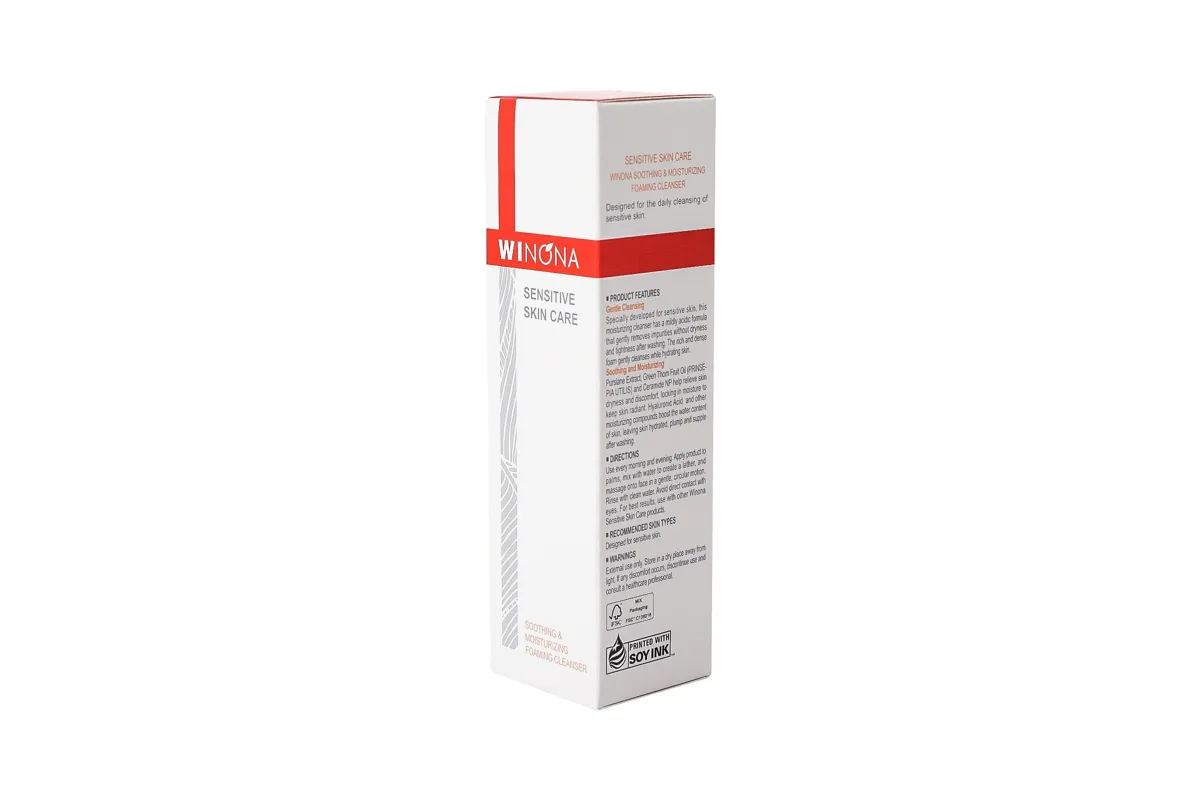
Foaming cleansers for sensitive skin usually achieve gentleness by subtraction. This one subtracts the sulfate and then adds: a hydrolyzed starch to lower the surfactant's irritation potential, and a ceramide NP, phytosphingosine and hydrogenated lecithin trio that tries to deposit a trace of barrier lipid on the way out. It is the rare pump foam formulated with a leave-on's priorities.
The gentler of Winona's two soothing cleansers by a clear margin: a sulfate-free pump foam with a starch mildness modifier and a small ceramide, phytosphingosine and lecithin deposit that leaves reactive skin clean and calm rather than tight. It will not shift heavy makeup and the 50ml bottle is gone in a month, but as a daily wash for sensitive, dry or barrier-compromised skin it is quietly excellent.
The surfactant chemistry supporting this foam's mildness is well documented, but the brand's specific tolerance figures are in-house, and this assessment is built on the box's printed ingredient list rather than on trials of the product. English-language feedback was essentially absent from the brand's storefront in September 2026, and the substantial Chinese review base for the foam cannot be independently verified from outside.
Verdicts
How well it fits each concern
Verdict by concern tap a concern for the case
Good choicefor SensitivityIn your profileYou chose · No fragrance, drying alcohol, declarable allergens or sensitising preservatives in this foam — the profile sensitive skin looks for.Not yet assessedGentleNo reviews collected yet
The case for it
Cocamidopropyl Betaine & Sodium Lauryl Glucose Carboxylate has no evidence row yet for this concern — it is in the research queue.
The formula carries none of the triggers this concern is sensitive to.
What would change this: A researched evidence row for the lead active would replace this with a verdict.
Same rule for everyone. “Good choice” is the verdict on 1,938 of 45,024 concern verdicts across the catalog; rule F2 decided 1,938 of them.
As of September 25, 2026, engine 5.1.1.
Supporting rolefor DrynessIn your profileYou chose · Rinse-off foam: Ceramides gets seconds of contact, so this supports a routine for dryness rather than treating it.Moderate evidenceGentleNo reviews collected yet
The case for it
Ceramide NP, Phytosphingosine & Hydrogenated Lecithin has trial-supported standing for this concern.
It is in a rinse-off product, so it gets seconds of contact rather than the leave-on exposure the evidence assumes.
The formula carries none of the triggers this concern is sensitive to.
What would change this: The same active in a leave-on form would be judged on its evidence rather than its contact time.
Same rule for everyone. “Supporting role” is the verdict on 8,197 of 45,024 concern verdicts across the catalog; rule R6 decided 2,017 of them.
As of September 25, 2026, engine 5.1.1.
R6 — Contact time cannot deliver a leave-on claim; the product is judged on its job (cleansing without aggravating). Explicit exceptions (BPO wash, SA cleanser, medicated shampoos) never reach this rule because their rows set rinse_off_ok. · the full register
against its sources on July 17, 2026 (evidence table ev-2026.09-r228)
The studies behind the evidence row
Elias PM, Feingold KR (eds), Skin Barrier — stratum corneum ceramides are the principal intercellular lamellar lipid; their depletion is the biochemical signature of dry/xerotic skin — reference work
Supporting rolefor Compromised Skin BarrierIn your profileYou chose · Rinse-off foam: Ceramides gets seconds of contact, so this supports a routine for compromised skin barrier rather than treating it.Moderate evidenceGentleNo reviews collected yet
The case for it
Ceramide NP, Phytosphingosine & Hydrogenated Lecithin has trial-supported standing for this concern.
It is in a rinse-off product, so it gets seconds of contact rather than the leave-on exposure the evidence assumes.
The formula carries none of the triggers this concern is sensitive to.
What would change this: The same active in a leave-on form would be judged on its evidence rather than its contact time.
Same rule for everyone. “Supporting role” is the verdict on 8,197 of 45,024 concern verdicts across the catalog; rule R6 decided 2,017 of them.
As of September 25, 2026, engine 5.1.1.
R6 — Contact time cannot deliver a leave-on claim; the product is judged on its job (cleansing without aggravating). Explicit exceptions (BPO wash, SA cleanser, medicated shampoos) never reach this rule because their rows set rinse_off_ok. · the full register
contact limited — studied range 0.5–1%, from the trials on the row; needs leave-on contact; judge it after ~4 weeks
Tolerability
gentle
Row checked
against its sources on July 17, 2026 (evidence table ev-2026.09-r228)
The studies behind the evidence row
Elias PM, Skin Barrier / Coderch et al., ceramides and skin barrier function — ceramides ~50% of SC intercellular lipid mass, essential to the permeability barrier — reference work
Supporting rolefor RosaceaIn your profileYou chose · Nothing here targets rosacea directly; gentle cleansing is the recognised companion to treating it, and this foam does that without known triggers.Not yet assessedGentleNo reviews collected yet
The case for it
Cocamidopropyl Betaine & Sodium Lauryl Glucose Carboxylate has no evidence row yet for this concern — it is in the research queue.
The formula carries none of the triggers this concern is sensitive to.
What would change this: A researched evidence row for the lead active would replace this with a verdict.
Same rule for everyone. “Supporting role” is the verdict on 8,197 of 45,024 concern verdicts across the catalog; rule R8 decided 4,250 of them.
As of September 25, 2026, engine 5.1.1.
R8 — The category's job (barrier care, humectant hydration, gentle cleansing, photoprotection) is the documented supportive role for this concern. This is the honest verdict for a moisturizer on an acne page. · the full register
Also listed for Dehydration — the actives here (Cocamidopropyl Betaine, Starches & Absorbent Powders, Carnosine, Purslane Extract) are in our research queue for that concern; there is no verdict until their evidence rows are written. That is a gap in our table, not a mark against the product.
Does the jobDoes what a cleanser is for: surfactant mildness, rinses clean without stripping. Not measured from the label: pH match to skin.
A verdict is DermApproved’s assessment of how well a product’s ingredients fit a concern — never a claim about what the product treats. Evidence dots and collected reviews sit beside it and are never blended in.
Rules 0.5.1 · evidence table ev-2026.09-r228 · how we decide
Assessment
Pros & Cons
Pros
✓ Sulfate-free surfactant system of betaine, glucosides and an amino-acid glutamate
✓ Hydrolyzed corn starch placed high as a genuine mildness modifier
✓ Ceramide NP, phytosphingosine and lecithin leave a trace of barrier lipid behind
✓ Fine, dense pump foam that rinses clean with no tightness
✓ Fragrance-free, alcohol-free and free of essential oils and colourants
✓ Purslane and Prinsepia soothers suit flaring or post-procedure skin
✓ Full English ingredient list printed on the box
Cons
✗ Fifty millilitres lasts about a month at twice-daily use
✗ Low cleansing power will not remove heavy or water-resistant makeup
✗ Cocamidopropyl betaine leads the list and is a known allergen for some
✗ Ceramide deposit is small and no substitute for a barrier cream
✗ Pump tends to sputter as the bottle runs low
Review
Full Review
Winona sells two cleansers called Soothing & Moisturizing, a cream in a tube and this foam in a pump, and if you read their boxes side by side the difference is on the second line. The cream lists sodium laureth sulfate straight after water. The foam does not list a sulfate at all. It starts with cocamidopropyl betaine and sodium lauryl glucose carboxylate, then hydrolyzed corn starch, glycerin, lauryl glucoside and disodium cocoyl glutamate, and by the time it reaches the soothers it has already made its case. Of the two, this is the cleanser the name was written for, and it is worth saying so plainly because a shopper picking between them on the brand's site has nothing but the names to go on.
The brand's background explains why the distinction matters. Yunnan Botanee launched Winona in 2008 as a dermatologist-developed line for sensitive skin, sold it through hospital dermatology departments and pharmacies, and built one of China's largest skincare followings on a promise of not making reactive skin worse. The Soothing & Moisturizing series is the founding range. Its cream cleanser dates from an era when creamy lather was the expectation; the foam came later, as Chinese consumers turned toward amino-acid pump washes, and it was formulated with the gentleness the series name implies. The 50ml pump reached the English storefront in 2025 at ten dollars.
The formula rewards a slow read. The surfactant system is betaine, a glucose carboxylate, a glucoside and an amino-acid glutamate, all mild, none sulfated. Fourth on the list, ahead of glycerin, is hydrolyzed corn starch, which is not a filler: starch derivatives in cleansers thicken the surfactant solution and lower its irritation potential, and their placement this high is a formulation choice, not decoration. Then phenoxyethanol, a yeast ferment, butylene glycol, carnosine, purslane and Prinsepia oil, the brand's two Yunnan botanicals, and then something unusual for a rinse-off: ceramide NP, phytosphingosine and hydrogenated lecithin, a barrier-lipid trio with a phospholipid carrier to help it deposit. Sodium hyaluronate, citric acid and sorbic acid close it out. No fragrance, no alcohol, no essential oils, no sulfate.
In use it is as soft as the list predicts. The pump produces a fine, dense foam with a faint cushion, which sits on the skin instead of collapsing into water, and it rinses in two or three splashes. The afterfeel is the whole point. Skin that has been tightening after every wash for years comes out of this one feeling clean and nothing else, and the small lipid deposit the ceramide trio leaves is perceptible as a softness that lasts until the moisturizer goes on. There is no tingle, no warmth, no film. For a face mid-flare, or in the week after a laser, or simply reactive by nature, that experience is rare in a foam. It is also, in a small way, a pleasure: the foam has enough body to feel like a proper wash, which is where many amino-acid cleansers fall down, dissolving into thin water the moment they touch the face and leaving the user unsure whether anything happened. Here the starch gives it structure and the rinse is decisive.
Honesty requires saying what it cannot do. It is a low-power cleanser by design, and heavy or water-resistant makeup defeats it; those nights want an oil or balm first. Cocamidopropyl betaine leads the surfactant list, and while it is mild as foamers go, it is a recognised contact allergen for a minority through its manufacturing impurities, so anyone with a history of cleanser reactions should patch-test rather than assume. The ceramide story is real but small: most of the lipid rinses away, and a reader who expects a wash to substitute for a ceramide cream will be disappointed. Purslane and Prinsepia, the brand's signatures, are here more for identity than for the twenty seconds they spend on the face, though purslane's small clinical literature on inflamed skin makes its inclusion more than a gesture.
The format is the other limitation. Fifty millilitres at two pumps twice a day is a month's supply, and ten dollars for a month of cleanser is drugstore-plus pricing for what is, in practice, a travel bottle. Winona sells a larger pump at home; the English storefront did not carry it as of 2026, and that storefront also carried no customer reviews of the foam in September 2026, which leaves English-language feedback close to nil. The brand's domestic reviews for the product exist in volume and cannot be audited from outside, so the confidence here rests on the ingredient list and on how surfactant chemistry is known to behave.
That is enough to recommend it. For sensitive, dry, rosacea-prone or barrier-compromised skin, this is a well-constructed sulfate-free foam that goes further than most in trying not to take anything away, and it succeeds. It is the cleanser to choose over its cream sibling if gentleness is why you came to Winona, and the one to keep by the sink through a flare. Buy the small bottle to test tolerance, and hope the big one crosses the border.
Formula
Key Ingredients
The hero actives that drive this product's performance.
A sulfate-free surfactant pair leading the list: an amphoteric betaine and a sugar-derived anionic that, with the lauryl glucoside and amino-acid glutamate behind them, generate the fine, dense foam the pump produces without the lipid-stripping of a sulfate. The absence of sodium laureth sulfate is the meaningful difference between this foam and the brand's cream cleanser of the same name.
An unusual barrier-lipid trio for a rinse-off: a skin-identical ceramide, its sphingoid precursor and a phospholipid carrier that helps them deposit on skin during the wash. The quantities are small and most rinses away, but the intent is to leave a trace of barrier lipid behind rather than remove it, which is why the foam finishes soft instead of tight.
Established mechanismfor Dryness · established mechanism
Placed fourth, ahead of glycerin, this starch derivative is the mildness modifier: it thickens the surfactant solution and reduces its irritation potential, which is what lets a betaine-led foam claim tolerance on skin that reacts to most washes. It also gives the foam its slightly cushioned, creamy feel.
Winona's two signature Yunnan botanicals, here in the soothing role: purslane calms the flush that washing provokes on reactive skin, and the Prinsepia seed oil adds a whisper of fatty acid alongside the ceramide. In a foam their contact is brief, so they are brand identity as much as function.
A dipeptide antioxidant and a fermentation extract that add a conditioning, faintly hydrating quality to the rinse. Neither does much in twenty seconds of contact, but their presence signals a formula built with leave-on sensibilities rather than a bare surfactant blend.
Not yet assessed
Ingredient standings describe the active at treatment-level doses and
vehicles; this product's own condition grades weigh its actual formula.
It works as a stand-alone morning cleanse and as the second step after an oil or balm at night, and it is gentle enough for twice-daily use on reactive or barrier-compromised skin. Follow with a hydrating toner and a ceramide or barrier cream; there is nothing in it that needs spacing from any active.
Results Timeline
The first wash tells the story: fine foam, clean rinse, soft skin with no tightness. There is no cumulative result to expect from a cleanser; the measure is that skin stays calm and comfortable over the first fortnight, which for people used to sulfate washes often shows as less evening redness and less need for heavy moisturizer.
Pairs Well With
Barrier creamsCeramide moisturizersHydrating tonersPost-procedure care
The formula's mildness follows established cleansing science. Surfactant irritation tracks with how strongly the surfactant binds stratum corneum protein and extracts intercellular lipid, and the 2004 Dermatologic Therapy review by Ananthapadmanabhan and colleagues describes how amphoteric surfactants such as betaines and non-ionic sugar-derived surfactants such as glucosides bind far less protein than sulfates, and how combining them, adding polymers that raise viscosity and reduce free surfactant monomer, and including lipids that deposit during rinsing all lower the damage a wash does to the barrier. This foam applies each of those levers: a betaine and glucose-carboxylate lead, glucoside and glutamate co-surfactants, a hydrolyzed starch as the mildness polymer placed ahead of glycerin, and a ceramide, phytosphingosine and hydrogenated lecithin combination as the depositing lipid.
The ceramide inclusion deserves a precise reading. Ceramide NP and phytosphingosine are skin-identical barrier components, and hydrogenated lecithin is used in rinse-off products as a carrier that improves deposition of lipophilic ingredients onto skin during washing; the quantities that remain after rinsing are small, and no published trial measures barrier lipid retention from this cleanser. The expectation supported by the literature is a softer afterfeel and marginally less post-wash lipid loss, not barrier repair. Purslane, the brand's signature botanical, has a 2024 randomized, double-blind, placebo-controlled trial in Explore reporting benefit as a leave-on for mild to moderate chronic hand eczema, which supports its anti-inflammatory role even though contact time in a foam is brief. Carnosine and yeast ferment are conditioning agents without meaningful rinse-off evidence. Cocamidopropyl betaine's status as a contact sensitiser, attributed mainly to the impurities amidoamine and dimethylaminopropylamine, is documented in the patch-test literature and is the reason it is flagged here despite being one of the milder foaming surfactants.
When a patient with atopic dermatitis, rosacea or a retinoid-compromised barrier asks about a foaming cleanser, the usual clinical answer is a cautious one, because foams have historically meant sulfates. A sulfate-free pump foam built on betaine, glucosides and an amino-acid surfactant, with a starch mildness modifier and a small barrier-lipid addition, is the kind of exception dermatology practices are comfortable naming, and it aligns with the standing advice of fragrance-free, non-stripping cleansing followed promptly by a moisturizer. Two points would be raised alongside it: cocamidopropyl betaine is on the standard patch-test series and a known trigger for a minority, so a history of cleanser reactions warrants testing; and no cleanser's ceramide content replaces a leave-on barrier cream, which remains the treatment step for compromised skin.
Guidance
Usage & Recommendations
How to Use
Dampen the face with lukewarm water, dispense one or two pumps of foam into the palm, and press and glide it over the face for twenty to thirty seconds without scrubbing; the foam does the lifting and friction only irritates. Rinse until the skin feels clean, pat dry, and apply a hydrating toner and moisturizer within a minute or two to seal in the softness the lipid deposit leaves. It is gentle enough for morning and evening use on sensitive skin, and during a flare or after a procedure it can be the only cleanser in the routine. On nights with heavy or water-resistant makeup, remove that first with a cleansing oil or balm and use this foam as the second step.
Value Assessment
Ten dollars for 50ml is the price of a travel size, and per millilitre it is near the top of the mass-market range. What that buys is more than the usual amino-acid foam: a sulfate-free surfactant stack, a starch mildness polymer and a ceramide-lipid deposit are costlier to formulate than a plain betaine wash, and they come from an established dermatology-channel brand rather than a new label. The catch is duration; at two pumps twice a day the bottle lasts about a month, so the running cost is around ten dollars monthly and a larger size was not available on the English storefront as of 2026. For reactive or barrier-compromised skin that has struggled to find a foam it can use daily, that is fair; for skin that tolerates ordinary cleansers, it is an expensive way to wash.
Who Should Buy
People with sensitive, dry, rosacea-prone or barrier-compromised skin who want a foaming cleanser that never tightens or stings. Anyone using retinoids, acids or acne treatments who needs a wash that does not add to the dryness. Readers choosing between Winona's two soothing cleansers who want the sulfate-free one.
Who Should Skip
Anyone allergic to cocamidopropyl betaine, which leads the surfactant list. People who wear heavy makeup and want a single-step cleanse. Those who need a full-size bottle rather than a 50ml pump, or who expect a cleanser's ceramides to do the work of a moisturizer.
Ready to try Winona Soothing & Moisturizing Foaming Cleanser?
Dispensed as a fine, dense, creamy foam with a slight cushion from the starch; it stays airy on the skin rather than collapsing into liquid, and rinses with two or three splashes.
Scent
Completely unscented; nothing is added and the surfactant base has no smell of its own.
Packaging
A slim white 50ml foamer-pump bottle with a clear cap and the red cross-band, in an FSC-certified card box printing the full English ingredient list.
Finish
naturalnon-greasylightweight
What to Expect on First Use
For skin that has been stinging after every wash, the first use is quietly notable: nothing tingles, nothing tightens, and the face feels clean rather than scrubbed. There is no adjustment period. People switching from heavy-lather cleansers sometimes need a week to trust that a foam this soft has done the job.
How Long It Lasts
Around a month at two pumps twice a day; closer to two months if used once daily.
The Soothing & Moisturizing series is Winona's founding range for sensitive, moderately dry skin, and for years its wash step was a cream. The foaming version arrived later as Chinese consumers moved toward amino-acid pump foams, and it was built without the sulfate its cream sibling carries. The 50ml bottle reached the brand's English storefront in 2025.
About Winona Established Brand (5–20 years)
Yunnan Botanee launched Winona in 2008 as a dermatologist-developed brand for sensitive skin and built it through Chinese hospital dermatology and pharmacy channels into one of the country's largest skincare names. The brand's purslane and Prinsepia actives carry clinical support mostly in Chinese-language journals; product-specific claims are generated in-house and are not independently replicated.
Brand founded: 2008
Myth vs. Reality
Common Myths
Myth
A cleanser cannot deliver ceramides because everything rinses off.
Reality
Most of it does rinse away, which is why the quantity here is small. But hydrogenated lecithin acts as a carrier that helps ceramide NP and phytosphingosine deposit on the skin surface during the wash, and the goal is modest: leave the barrier with slightly more lipid than a plain surfactant would, not to replace a moisturizer.
Myth
Winona's foaming cleanser and cream cleanser are the same formula in different textures.
Reality
They share a name and most of the soothing agents, but the cream version leads with sodium laureth sulfate and the foam does not. For reactive or barrier-compromised skin, the foam is the meaningfully milder of the two.
FAQ
Frequently Asked Questions
Is the Winona Soothing & Moisturizing Foaming Cleanser sulfate-free?
Yes. The printed list runs cocamidopropyl betaine, sodium lauryl glucose carboxylate, lauryl glucoside and disodium cocoyl glutamate, with no sodium laureth or lauryl sulfate. That distinguishes it from the brand's cream cleanser of the same name, which does contain sodium laureth sulfate.
What do the ceramides in the Winona foaming cleanser actually do?
Ceramide NP, phytosphingosine and hydrogenated lecithin are there to leave a trace of barrier lipid on the skin rather than strip it, with the lecithin helping the lipids deposit during the wash. The effect is a softer, less tight afterfeel; it does not replace a ceramide moisturizer.
Can I use the Winona foaming cleanser on eczema-prone or post-procedure skin?
It is one of the better foams for that purpose: sulfate-free, fragrance-free, alcohol-free, with a starch mildness modifier and calming purslane. The one ingredient to note is cocamidopropyl betaine, which a minority of people are allergic to; if you have reacted to it before, choose a betaine-free wash.
Does the Winona Soothing & Moisturizing Foaming Cleanser remove makeup?
It clears sebum, light sunscreen and tinted moisturizer, but the foam is deliberately low on cleansing power and does not lift heavy or water-resistant makeup. Use a cleansing oil or balm first on those days and this foam as the second step.
How is this Winona foam different from the Anti-Sensitive cleansing foam sold on Amazon?
The Amazon listing is a squeeze-tube foam from the brand's Anti-Sensitive (舒敏) line. This product is the pump foam from the Soothing & Moisturizing (舒缓保湿) line with a ceramide and phytosphingosine addition. They are different formulas and should not be treated as interchangeable.
How long does the 50ml Winona foaming cleanser last?
About a month at two pumps twice daily, which makes the ten-dollar bottle a travel size in practice. The brand's home market sells a larger pump; the English storefront listed only the 50ml as of 2026.
Reviews
What Reviewers Tend to Say
Recurring themes our editors read across retailer reviews of this product — summaries in our words, not quotations, and not a substitute for your own patch test.
Western sensitive skincare works by subtraction — remove the fragrance, remove the alcohol, shorten the list. Japan's answer adds a designed molecule back in, and one of the two bets has a trial literature.
A wrecked barrier is the most common self-inflicted skin condition and the one with the clearest fix — the difficulty is that the routine which caused it feels productive and the one that repairs it feels like giving up.
'Barrier damage' has become the internet's all-purpose diagnosis. It's also a real, specific condition with a specific and slightly boring cure: mostly, stop doing things.
Piling on richer cream treats the symptom. The reason the dryness keeps coming back is a leaky barrier and a broken lipid ratio — and you fix those differently.
Jan 9, 2026· 6 min
Questions people ask about sensitive skin
Verified answers from our questions library — the nuance a product page cannot carry.
Products, answers, therapy guides, tools and articles in one search. Brand names,
slang and abbreviations all work — accutane finds isotretinoin, bacne finds truncal acne.