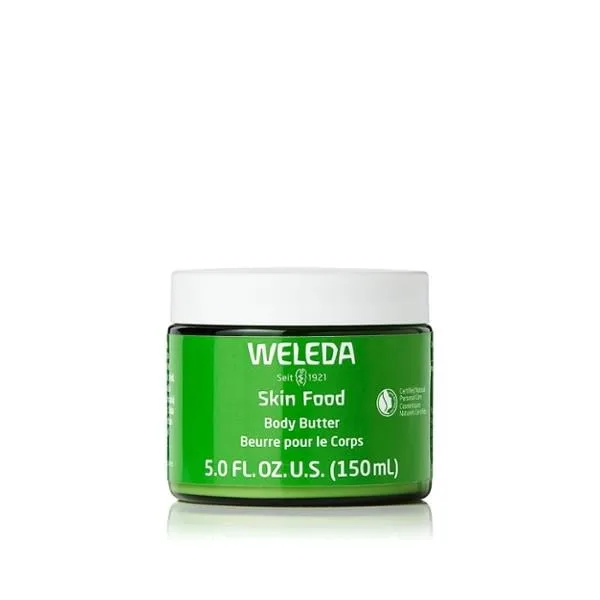
It is the Skin Food botanicals and scent scaled up to a full-body butter with sunflower oil, cocoa and shea as the first three ingredients, a water-in-oil richness that most body butters approximate with lighter emulsions, and it manages to sink in on damp skin without the greasy wait. The strong essential-oil fragrance and the alcohol preservative are the same trade-offs as the rest of the line.
body carecreamclean beautyParaben FreeCruelty FreeVegan
A rich, vegan sunflower-cocoa-shea butter that seals dry body skin for a day, smells powerfully of Skin Food and sinks in faster than its density suggests when applied to damp skin. It is the most sensible place in the Skin Food line for the scent and the alcohol to live, since body skin tolerates both better than the face, and eight thousand-odd reviews agree. Eczema-prone, fragrance-sensitive and hot-climate users should pass; everyone else with dry shins will be pleased.
Good choicefor DrynessIn your profileYou chose · Shea Butter is a reference standard by mechanism for dryness; this cream carries it high in the ingredient list.Moderate evidenceStandard tolerabilityNo reviews collected yet
The case for it
Theobroma Cacao has trial-supported standing for this concern.
It is present at an effective concentration, declared or high in the ingredient list.
The formula carries no trigger this concern is sensitive to, with the cautions noted.
Cautions: fragrance.
Same rule for everyone. “Good choice” is the verdict on 9,564 of 45,024 concern verdicts across the catalog; rule R5 decided 9,072 of them.
As of September 25, 2026, engine 5.1.1.
Supporting rolefor Keratosis PilarisIn your profileYou chose · Nothing here targets keratosis pilaris directly; emollient hydration is the recognised companion to treating it, and this cream does that without known triggers.Not yet assessedStandard tolerabilityNo reviews collected yet
The case for it
Helianthus Annuus has no evidence row yet for this concern — it is in the research queue.
The formula carries no trigger this concern is sensitive to, with the cautions noted.
What would change this: A researched evidence row for the lead active would replace this with a verdict.
Same rule for everyone. “Supporting role” is the verdict on 8,197 of 45,024 concern verdicts across the catalog; rule R8 decided 4,250 of them.
As of September 25, 2026, engine 5.1.1.
R8 — The category's job (barrier care, humectant hydration, gentle cleansing, photoprotection) is the documented supportive role for this concern. This is the honest verdict for a moisturizer on an acne page. · the full register
Also listed for Winter Skin and Rough Texture — the actives here (Sunflower Oil, Shea Butter, Glycerin, Essential Oils) are in our research queue for those concerns; there is no verdict until their evidence rows are written. That is a gap in our table, not a mark against the product.
As a body productNot judged: what a body product is for — real substance, not just slip, realistic to use daily — cannot yet be measured from the ingredient list (only fragrance load can).
A verdict is DermApproved’s assessment of how well a product’s ingredients fit a concern — never a claim about what the product treats. Evidence dots and collected reviews sit beside it and are never blended in.
Rules 0.5.1 · evidence table ev-2026.09-r228 · how we decide
Assessment
Pros & Cons
Pros
✓ Sunflower oil, cocoa butter and shea are the first three ingredients, ahead of water
✓ Seals dry body skin for a full day and rescues winter shins and elbows within days
✓ Sinks in faster than most cocoa-heavy butters, especially on damp skin
✓ Vegan, with no beeswax or lanolin, unlike the original Skin Food
✓ Glycerin and betaine add humectancy the 1926 balm lacked
✓ Roughly eight and a half thousand ratings averaging 4.5 stars across eight years
✓ NATRUE-certified natural in a recyclable glass jar at a fair price
Cons
✗ Strong essential-oil fragrance with four declared allergens lingers for hours
✗ Alcohol preservative stings on freshly shaved or broken skin
✗ Too rich and scented for the face and for warm weather
✗ Not suitable for eczema-prone or fragrance-sensitive skin
✗ Heavy glass jar with a wide mouth is awkward to travel with and scoop from
✗ Amazon listing still names almond oil the current formula does not contain
Review
Full Review
Every Weleda product carries the same two compromises, an alcohol preservative and an essential-oil fragrance, because the brand's natural certification forbids the synthetic alternatives, and on the face those compromises are the reason a good many people cannot use the range. On the body they matter less. Body skin is thicker, less reactive and further from the eyes, a body butter is applied once rather than layered under actives, and a strong scent that would be too much on a cheek is, on a pair of freshly moisturised legs, the entire point for a lot of customers. The Skin Food Body Butter is the product where Weleda's habits and the job finally agree, and it shows in the reviews, which are warmer for this jar than for almost anything else the brand sells.
The formula is a proper butter. Sunflower oil is the first ingredient, cocoa butter the second and shea the third, all ahead of water, which makes this a water-in-oil emulsion far richer than the lotions most brands sell under the same name; glycerin at fifth and betaine further down give it a humectant side the original Skin Food never had. The four botanicals, rosemary, chamomile, calendula and wild pansy, sit mid-list as they do in every Skin Food product, and the emulsifier and thickener system, a citrate ester, stearic and palmitic acids, carrageenan and xanthan, holds the whole thing as a dense ivory butter that softens the moment a finger touches it. It contains no beeswax and no lanolin, so unlike the original balm and Skin Food Light it is vegan, which for a Skin Food product is a quiet novelty.
On skin it does what a butter should. Scooped onto damp shins after a shower it spreads much further than its density in the jar suggests, melts in with a little friction, and leaves a velvety, lightly sealed finish that keeps dry skin comfortable through a working day; elbows, knees and heels respond within a few days of daily use, and rough winter skin smooths out. It sinks in faster than most cocoa-heavy butters, which reviewers notice and are grateful for, though in warm weather or on humid skin it is more than most people want. On dry skin it does not clear the plugs, because it contains no exfoliant; it softens them and seals whatever a urea or lactic acid lotion has done underneath.
The scent is the product's signature and its dividing line. This is the full Skin Food herbal-citrus fragrance, stronger than in the face products and lingering on the body for hours; the label declares limonene, linalool, benzyl benzoate and geraniol, and rosemary extract adds its own small sensitising note. Thousands of reviews call it heavenly and a steady minority call it overpowering, and both are describing the same jar. For fragrance-sensitive or eczema-prone skin it is a reason not to buy, and the alcohol, fourteenth on the label and offset by all that oil and butter, is a second: it stings briefly on freshly shaved legs, which is the one complaint that appears in almost every review thread.
One label matter deserves a mention. Amazon's listing title still advertises sweet almond oil, which the original Skin Food balm contains and the current Body Butter ingredient list, read on Weleda's own site, does not; the lipids are sunflower, cocoa and shea. It is a small discrepancy, probably a holdover, and a reminder to read the jar rather than the retailer, a habit worth keeping with any brand that revises quietly.
The review record is enormous and unambiguous. Across the older plastic-tub listing and the glass-jar listing that replaced it in 2021, roughly eight and a half thousand Amazon ratings average 4.5 stars, with Dermstore and natural retailers in agreement: velvety skin, lasting comfort, winter rescue, a lovely or a loud scent, a heavy jar, a sting on shaved skin. Eight years of that is as clear a picture as a body product gets, and nothing in it suggests the formula has drifted.
At around twenty-three dollars for 150ml the butter costs roughly eleven dollars a month used daily head to toe, and much less used on dry zones only, which is fair for a NATRUE-certified vegan butter with sunflower, cocoa and shea as its first three ingredients; Amazon, Dermstore and the brand's site sit within a couple of dollars, and a 30ml mini exists for trial. The glass jar is handsome, recyclable and a poor travelling companion.
The recommendation is warm and specific. Dry or normal body skin, particularly in winter, that wants a rich natural butter with a strong herbal scent and lasting protection will find this among the better ones on the shelf, and the best-suited product in the Skin Food line to the brand's own formulating rules. Eczema-prone, fragrance-sensitive and very oily skin should choose an unscented emollient, and anyone in a hot climate should wait for autumn.
Formula
Key Ingredients
The hero actives that drive this product's performance.
The first ingredient, ahead of water, which makes this a water-in-oil butter rather than a lotion; organic sunflower oil supplies the linoleic acid that reinforces barrier lipids and the slip that lets a butter this rich spread across a shin. It is the Skin Food constant, here at its largest share of any product in the line.
Second and third on the label, the two butters that give the product its name and its body: cocoa butter is solid at room temperature and melts on skin into a long-lasting occlusive film, shea adds a softer emollience and unsaponifiables with mild anti-inflammatory activity. Together they are why elbows, shins and heels stay comfortable for a day after application.
Established mechanismfor Dryness · established mechanism
Glycerin fifth and betaine fifteenth supply the humectant side of the formula, drawing water into skin the butters then seal; glycerin's high placement is what keeps a cocoa-heavy butter from feeling purely waxy and what gives the immediate softness reviewers describe.
Established mechanismfor Dryness · established mechanism
The Skin Food botanicals, positions ten to thirteen, unchanged from the 1926 recipe; calendula and chamomile bring a mild soothing note, wild pansy the heritage, and rosemary an antioxidant with a small sensitising risk. On body skin, thicker and less reactive than the face, they are a scent and a story more than an effect.
The natural essential-oil blend that ends the label with four declared allergens, giving the butter its strong, herbal-citrus Skin Food scent that lingers on the body for hours; it is the feature most reviewers mention first and the reason fragrance-sensitive skin should look elsewhere.
Not yet assessed
Ingredient standings describe the active at treatment-level doses and
vehicles; this product's own condition grades weigh its actual formula.
Smooth a generous amount over damp skin after a shower, when the butters spread furthest and seal the most water in, concentrating on shins, elbows, knees and heels; give it a few minutes before dressing. It is too rich and too scented for the face and should stay below the neck. It layers over a body exfoliant or a urea lotion on rough patches.
Results Timeline
Soft, sealed, faintly glowing skin within minutes and comfort that lasts most of a day. Dry, flaky shins and rough elbows improve within a few days of daily use; it contains no exfoliant, so keratosis pilaris bumps are softened rather than cleared.
A body butter's value is in its occlusive and emollient load, and this formula's is unusually high. Placing sunflower seed oil, cocoa seed butter and shea butter ahead of water on the label indicates a lipid-dominant emulsion, closer to a water-in-oil butter than to the oil-in-water lotions most body moisturizers are, and the three lipids complement one another: sunflower oil is roughly two-thirds linoleic acid, an essential fatty acid that reinforces the lamellar organisation of barrier lipids and reduces transepidermal water loss in controlled studies; cocoa butter is a saturated, room-temperature-solid triglyceride mix that melts near skin temperature into a durable occlusive film; and shea butter supplies triglycerides plus a high unsaponifiable fraction of triterpene esters and phytosterols with documented emollient and mild anti-inflammatory activity. Glycerin at fifth position and betaine add humectancy, drawing water into the stratum corneum that the butters then hold, which is the mechanism behind the lasting softness reviewers describe and the reason application to damp skin works best. Stearic and palmitic acids with a citrate emulsifier and two gums structure the butter and contribute further occlusion. The four botanicals have in-vitro and traditional anti-inflammatory data, including a 2013 rat sunburn model in the Journal of Ethnopharmacology in which a Viola tricolor gel reduced inflammation, but no clinical evidence at cosmetic doses in a body butter, and rosemary extract is a minor contact sensitiser. Ethanol at fourteenth position is the natural-certification preservative; buffered by this much lipid its barrier effect is small on intact skin but it accounts for stinging on freshly shaved or abraded skin. The fragrance is a natural essential-oil blend with four constituents declared under European allergen-labelling rules, limonene, linalool, benzyl benzoate and geraniol, and on the body its long contact time and large application area make repeated exposure meaningful for sensitisation-prone individuals. The butter contains no keratolytic, so its effect on keratosis pilaris is limited to softening. The science supports it as a highly effective occlusive-emollient for dry body skin whose fragrance and alcohol are its tolerability limits.
For plain dry body skin, dermatologists recommend rich emollients applied to damp skin after bathing, and a butter with sunflower oil, cocoa and shea ahead of water fits that advice well; clinicians would regard it as an effective occlusive for shins, elbows and heels in winter. The reservations are the standard Weleda ones and, on the body, they are milder but not absent. Four declared fragrance allergens over a large skin area with hours of contact is a meaningful exposure, so the butter would not be recommended for patients with atopic dermatitis, a history of fragrance allergy or any active rash, for whom a fragrance-free emollient is the standard. Alcohol as a preservative would be noted as a cause of stinging on shaved, abraded or fissured skin. For keratosis pilaris the advice would be to pair it with a urea or lactic acid lotion, since a butter alone softens without exfoliating, and for acne-prone backs and chests the cocoa butter would be a reason to choose something lighter. Kept off the face and away from eczema, it is a reasonable natural body moisturizer with no clinical objection.
Guidance
Usage & Recommendations
How to Use
After a shower or bath, while the skin is still damp, scoop a walnut-sized amount from the jar with clean fingers, warm it briefly between the palms until it softens, and massage it over the body in long strokes, concentrating on shins, elbows, knees, heels and any rough patches; damp skin lets the butter spread further and seals more water in. Give it a few minutes to absorb before dressing. Use daily in cold or dry weather and as needed in summer, when a lighter lotion may suit. Avoid freshly shaved, waxed or broken skin, where the alcohol and essential oils sting, and keep it off the face. For keratosis pilaris, apply it over a urea or lactic acid lotion rather than instead of one. Patch test on the inner forearm if fragrance-sensitive. Keep the lid closed, store at room temperature and use within a year of opening.
Value Assessment
Around twenty-three dollars for 150ml is fair for a NATRUE-certified, vegan butter whose first three ingredients are sunflower oil, cocoa and shea, and because the dense formula spreads well on damp skin the jar lasts about two months of daily full-body use and much longer on dry zones alone, putting the cost between five and eleven dollars a month. The premium over a drugstore body butter buys natural-origin lipids, the certification, the Skin Food scent and the glass jar rather than any active or evidence, and it is cheaper per millilitre than most natural butters of similar richness. The value holds for anyone who likes the scent and has dry body skin; it collapses for fragrance-sensitive or eczema-prone users who will react, and it is a poor buy in summer when the richness goes unused. Amazon, Dermstore and the brand's site price it within a couple of dollars, and a 30ml mini allows a trial of the fragrance before committing to the jar.
Who Should Buy
People with dry or normal body skin, especially in winter, who want a rich, vegan, certified-natural butter that seals for a day, spreads well on damp skin and carries the full Skin Food scent, and existing Skin Food users who want the balm's comfort scaled to the whole body without the lanolin.
Who Should Skip
Anyone with eczema, a fragrance allergy or reactive skin, for whom four declared allergens, rosemary and an alcohol preservative are avoidable risks, oily or acne-prone backs and chests that cocoa butter may congest, and anyone in a hot climate who will find it too rich until autumn.
A dense, ivory butter with the give of cold cocoa butter that softens instantly under the fingers, spreads with a faint drag over dry skin and glides over damp skin, and settles to a velvety, lightly sealed finish.
Scent
The full Skin Food herbal-citrus fragrance, calendula and chamomile over a bright top note, stronger here than in the face products and lingering on the body for hours.
Packaging
A 150ml green glass jar with a wide white screw lid, replacing the earlier plastic tub in 2021; substantial and recyclable, awkward to travel with, and the wide mouth means fingers in the product.
Finish
velvetyglowy
What to Expect on First Use
The first scoop is firmer than a lotion and melts quickly, and on damp post-shower skin it spreads further than its density suggests, leaving legs and arms velvety and scented for the day. Dry skin feels rescued within minutes. The brief alcohol tingle on freshly shaved legs is the one early surprise, and the scent is the thing everyone notices.
How Long It Lasts
About two months of daily full-body use, longer if kept to dry zones.
Weleda added the Body Butter in 2018 as the first body extension of Skin Food, answering customers who had been using the original balm on their whole bodies at some expense, and moved it from a plastic tub to a green glass jar in 2021 as part of a packaging sustainability push. It has since become one of the brand's best-selling body products in the United States.
About Weleda Legacy Brand (20+ years)
Weleda has made NATRUE-certified natural skincare in Switzerland and Germany since 1921, and Skin Food, its 1926 balm, anchors a body and face line that has grown steadily since 2018. The brand uses alcohol and essential oils in place of synthetic preservatives and fragrance and publishes no clinical trials; the Body Butter, launched in 2018 and moved to a glass jar in 2021, is one of its most-reviewed body products.
Brand founded: 1921 · Product launched: 2018
Myth vs. Reality
Common Myths
Myth
The Body Butter contains sweet almond oil, as the Amazon listing says.
Reality
The current ingredient list on Weleda's site names sunflower oil, cocoa butter and shea butter as its lipids and no almond oil. The Amazon title appears to describe an earlier formula or to borrow from the original Skin Food, which does contain almond oil.
Myth
Natural body butters are safe for eczema-prone skin.
Reality
This one declares four fragrance allergens plus rosemary extract and uses alcohol as a preservative, all of which are common triggers on eczema-prone skin. Eczema needs a fragrance-free emollient; this is a butter for ordinary dry skin.
Myth
A body butter will clear keratosis pilaris.
Reality
It softens the bumps by moisturising the surrounding skin but contains no exfoliant, so the plugs remain. A urea or lactic acid lotion does the clearing; this butter is a good seal over it.
FAQ
Frequently Asked Questions
What are the main ingredients in Weleda Skin Food Body Butter?
Organic sunflower seed oil, cocoa seed butter and shea butter are the first three ingredients, ahead of water, with glycerin fifth; the four Skin Food botanicals, wild pansy, rosemary, chamomile and calendula, follow mid-list. It is a rich water-in-oil butter rather than a lotion.
Does Weleda Skin Food Body Butter contain almond oil?
Not according to the current ingredient list on Weleda's own site, which names sunflower oil, cocoa butter and shea butter and no almond oil. Amazon's listing title still mentions sweet almond oil, which appears to be a holdover from an earlier formula or the original Skin Food balm.
Is Weleda Skin Food Body Butter good for eczema or sensitive skin?
It is not the right choice. The butter declares four fragrance allergens, includes rosemary extract and uses alcohol as a preservative, all common triggers for eczema-prone and reactive skin. A fragrance-free emollient suits those conditions; this is a butter for ordinary dry skin.
Can I use Weleda Skin Food Body Butter on my face?
It is not intended for the face and is too rich, too scented and too cocoa-heavy for most faces; Weleda's Skin Food Light and the face-care range exist for that. Very dry skin might use a trace on cheeks in winter, but the fragrance load argues against it.
Is the Skin Food Body Butter vegan?
Yes. Unlike the original Skin Food and Skin Food Light, which contain beeswax and lanolin, the Body Butter uses only plant lipids, cocoa and shea butters and sunflower oil, and is NATRUE-certified natural and vegan.
How much does a jar of Weleda Skin Food Body Butter last?
About two months of daily full-body use, or considerably longer if applied only to dry zones such as shins, elbows and heels. Applying it to damp skin after a shower stretches the jar further because the butter spreads more easily.
Reviews
What Reviewers Tend to Say
Recurring themes our editors read across retailer reviews of this product — summaries in our words, not quotations, and not a substitute for your own patch test.
Common Praise
Velvety soft skin that lasts all day
Rich but sinks in faster than expected
The Skin Food scent on the whole body
Rescues winter shins and elbows
Glass jar feels and looks good
Common Complaints
Scent is strong and lingers
Jar is heavy for travel and awkward to scoop
Too rich for warm weather
Can sting on freshly shaved skin
Amazon listing still mentions almond oil the label does not
Essential oils are declared by botanical name rather than as fragrance, which is why the most heavily perfumed products in the natural aisle can carry the reassuring word — and why the bottle gets more sensitising the longer you own it.
The speckling isn't dirt trapped in your pores, which is exactly why scrubbing harder makes it worse — the real fix looks a lot like acne care, moved south.
The fourth most frequent positive patch test in North America is an oxidation product of a molecule that occurs naturally in lavender. Nobody synthesised it into your face cream.
Products, answers, therapy guides, tools and articles in one search. Brand names,
slang and abbreviations all work — accutane finds isotretinoin, bacne finds truncal acne.