Glycolic vs Lactic Acid: Which AHA Is Actually Right for You
Glycolic gets the hype and the higher numbers. But lactic acid does something glycolic can't — and for a lot of skin, that changes the whole calculation.
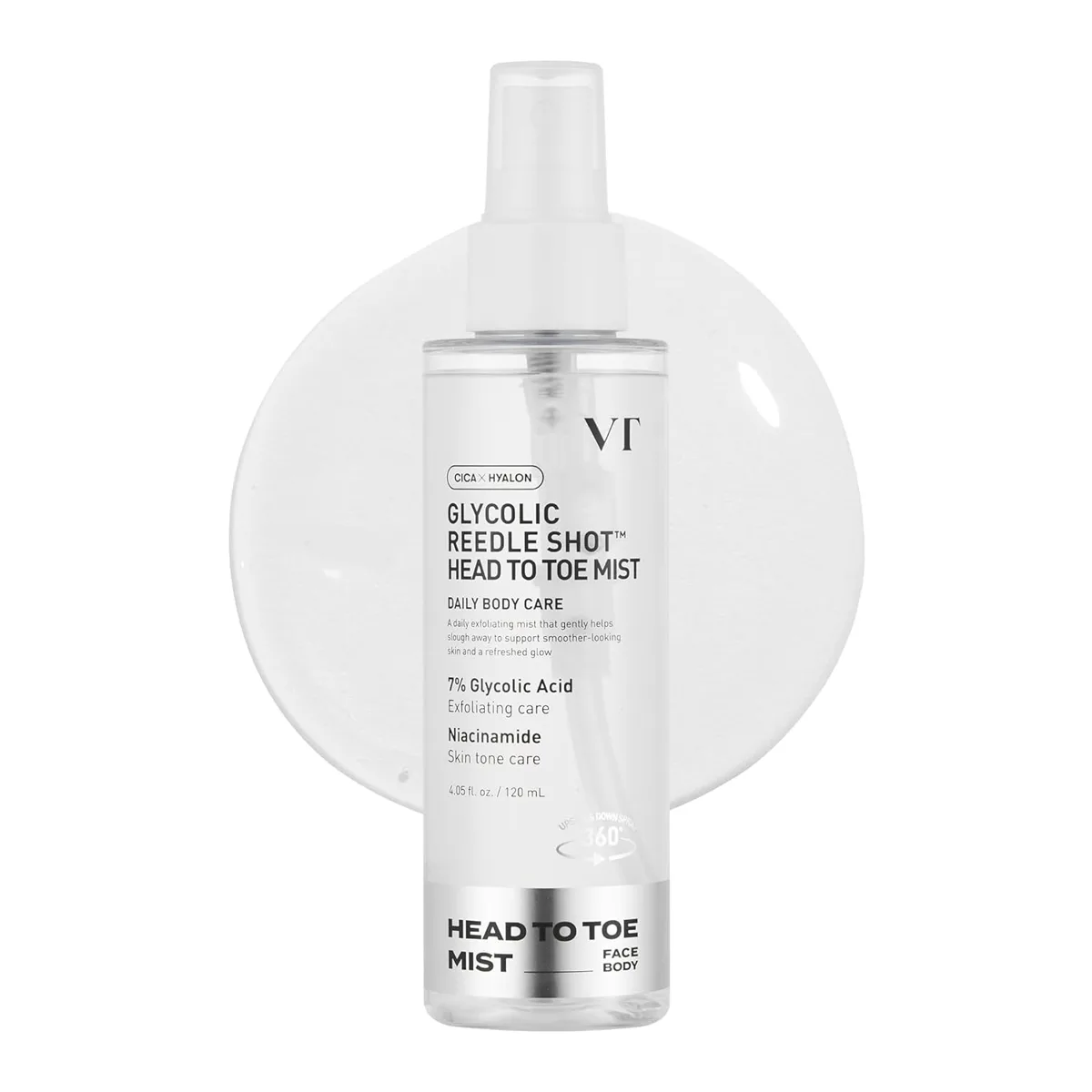
It puts a declared seven percent glycolic acid, buffered and cushioned with niacinamide, panthenol, beta-glucan, ectoin and sodium PCA, into a 360-degree spray so that the back, shoulders and backs of the thighs get a leave-on exfoliant without a helping hand, which is a real solution to a real problem for keratosis pilaris and body breakouts. The Reedle Shot in the name is a trace of silica a mist cannot press in; the acid and the nozzle are the product.
A sensible seven percent glycolic acid body mist, buffered and cushioned with niacinamide, panthenol, beta-glucan and ectoin, in a rotating spray that reaches the back, which makes it a genuinely useful tool for keratosis pilaris and rough, bumpy body skin at nineteen dollars. The spicules in the name are a trace a mist cannot press in, arnica and spearmint are allergen notes, and the face-and-body label should be read as body.
No reviews of this mist could be verified and VT has published no testing since it reached the global store in March 2026, so the assessment applies the keratosis pilaris and glycolic acid literature to a disclosed thirty-three-ingredient list with a declared seven percent; the smoothing effect and the sting on shaved skin are predictable from that, and how well the humectant cushion holds up under nightly whole-body use is what a review record will eventually show.
The case for it
What would change this: Trial evidence for the active on this concern would move this from a bet to a recommendation.
Same rule for everyone. “Unproven” is the verdict on 1,111 of 45,024 concern verdicts across the catalog; rule R9 decided 1,111 of them. As of September 25, 2026, engine 5.1.1.
Brand or formulator? Disclose a concentration or correct a fact →
The studies behind the evidence row
The case for it
Same rule for everyone. “Good choice” is the verdict on 9,564 of 45,024 concern verdicts across the catalog; rule R5 decided 9,072 of them. As of September 25, 2026, engine 5.1.1.
Brand or formulator? Disclose a concentration or correct a fact →
The studies behind the evidence row
The case for it
Cautions: known irritants.
What would change this: A declared concentration would move this to a firmer reading of the dose.
Same rule for everyone. “Promising” is the verdict on 7,858 of 45,024 concern verdicts across the catalog; rule R9p decided 7,858 of them. As of September 25, 2026, engine 5.1.1.
Brand or formulator? Disclose a concentration or correct a fact →
The studies behind the evidence row
The case for it
Cautions: a photosensitising active — use sun protection.
What would change this: Trial evidence for the active on this concern would move this from a bet to a recommendation.
Same rule for everyone. “Unproven” is the verdict on 1,111 of 45,024 concern verdicts across the catalog; rule R9 decided 1,111 of them. As of September 25, 2026, engine 5.1.1.
Brand or formulator? Disclose a concentration or correct a fact →
The studies behind the evidence row
The case for it
Same rule for everyone. “Good choice” is the verdict on 9,564 of 45,024 concern verdicts across the catalog; rule R5 decided 9,072 of them. As of September 25, 2026, engine 5.1.1.
Brand or formulator? Disclose a concentration or correct a fact →
The studies behind the evidence row
A verdict is DermApproved’s assessment of how well a product’s ingredients fit a concern — never a claim about what the product treats. Evidence dots and collected reviews sit beside it and are never blended in. Rules 0.5.1 · evidence table ev-2026.09-r228 · how we decide
The back is the part of the body most likely to need a chemical exfoliant and least likely to get one. Keratosis pilaris lives on the backs of arms and thighs, body breakouts live on shoulders and shoulder blades, and every glycolic lotion and pad ever sold has assumed a person can reach them, which most cannot. The spray answers that, and VT's Head To Toe Mist answers it well: a clear 120 ml bottle with a 360-degree nozzle that works upside down, so that seven percent glycolic acid lands on the middle of the back from a hand's length without a helper or a contortion. It is the first VT product in a while where the format is the idea, and the Reedle Shot name on the front, for once, is the least important thing about it.
The formula is a body acid done properly. Glycolic acid is second at a declared seven percent, with sodium hydroxide three places later to buffer it into the range where it exfoliates without burning, and it is the smallest alpha hydroxy acid, the one that penetrates best and the one dermatology has recommended for keratosis pilaris since the 1990s, because it dissolves the keratin plugs that make the bumps. Niacinamide is third, at a level that partners the acid on exactly the skin this is for: bodies prone to keratosis pilaris and breakouts are prone to the dark dots both leave, and niacinamide slows the pigment transfer that makes them while tempering the redness the acid raises. Then the cushion that makes a seven percent acid sprayable every night: panthenol, sodium PCA, glycerin and propanediol for water, beta-glucan and ectoin to calm and protect the barrier, and centella extract with its four triterpenes at the tail. There is no fragrance, no alcohol, no oil and no silicone, and the mist dries in a minute or two to nothing, so a body lotion goes straight over it. The label's Streptococcus thermophilus ferment, apple juice, glutathione, loquat and two Korean botanicals are VT's usual decoration.
What it does follows from the acid. Sprayed on towel-dried upper arms and thighs after a shower, it tingles for a minute, sharper on anything freshly shaved, and dries; by the third or fourth evening the skin feels smoother as the surface dead cells lift, and over four to eight weeks the bumps flatten, rough backs and heels soften, and the dark dots begin, more slowly, to fade. That is the well-documented arc of glycolic acid on keratosis pilaris, and the mist delivers it with a comfort that a fragranced or alcohol-based body acid would not. What it does not do is cure anything: keratosis pilaris is a genetic tendency, the plugs return within weeks of stopping, and the mist is a management habit rather than a treatment course, which the bottle's Daily Body Care phrasing at least gets right.
The cautions are the ones that go with a seven percent acid. It should not touch freshly shaved, waxed, sunburnt, broken or eczema-flaring skin, and anything treated in the evening that will see sun the next day needs sunscreen, because the acid raises sun sensitivity and the dark dots darken without it. Sensitive skin should start every other night and may stay there. Arnica flower extract at twenty-seventh and spearmint at twenty-fifth are the two botanicals a reactive user should note, both recognised sensitisers, and propolis is a bee-product note. The face-and-body line on the bottle is worth a firm correction: a seven percent glycolic acid spray is a body strength in a body format, aerosolised acid near the eyes is a poor idea, and VT's own Reedle Shot essences and any measured facial acid serve the face better.
The Reedle Shot itself is where honesty about the name is due. Silica sits twenty-sixth of thirty-three, a trace of the brand's spicules in a liquid that is sprayed on and left to dry; spicules need to be pressed into skin to prickle or open channels, and at this level in this format they do neither. The exfoliation is chemical, and it is enough. The name is the family's, the nozzle and the acid are the product, and a buyer who understands that will not be disappointed.
Nineteen dollars on the brand's global store for 120 ml, discounted from a list price near twenty-one, is fair for a buffered seven percent glycolic body product with a real humectant cushion, and a few sprays over arms and thighs nightly stretch the bottle to six or eight weeks, less if the back and legs are covered too. Against the drugstore glycolic body lotions it is easier to apply and lighter under moisturiser; against the other Korean acid body sprays it is comparably priced and better cushioned than most. It reached the global store in March 2026, has no reviews anywhere that could be verified and comes with no published testing, and for a glycolic acid product at a declared percentage those gaps matter less than usual.
For a person with keratosis pilaris, rough or bumpy body skin or back breakouts who has never found a way to treat the areas they cannot reach, this is a well-made answer with a name that does not describe it. Spray it on after the shower, keep it off the face and off fresh shaves, wear sunscreen on what shows, and let the acid do the work the spicules cannot.
The hero actives that drive this product's performance.
| Ingredient | Function | Evidence |
|---|---|---|
| Glycolic Acid 7% (7%) | Second on the list at a declared seven percent, partly neutralised by the sodium hydroxide three places later, the smallest and most penetrating alpha hydroxy acid at a strength that genuinely dissolves the keratin plugs of keratosis pilaris, smooths bumpy upper arms and thighs and lifts the dead-cell buildup on backs, shoulders and heels over weeks; sprayed rather than swiped, it covers the areas a hand cannot reach, which is the point of the format and also the reason it needs sunscreen and care near the face. | Established mechanism for Rough Texture · established mechanism |
| Niacinamide | Third, directly behind the acid, at a level that partners glycolic acid usefully on a body prone to post-inflammatory marks: it slows pigment transfer into the dark dots that keratosis pilaris and body breakouts leave behind, supports the barrier the acid loosens and tempers the redness, and it is the evidence-backed half of the tone claim on the bottle. The glutathione at twenty-first is the label half. | Limited for Acne |
| Silica (Cica Reedle micro-spicules) | Twenty-sixth of thirty-three, a trace of VT's spicule silica in a mist that is sprayed and left rather than pressed in, which cannot deliver the prickle or the micro-channels the Reedle Shot name promises on the face; the exfoliation here is entirely chemical, and the silica is the family badge. | Not yet assessed |
| Panthenol, Beta-Glucan, Ectoin and Sodium PCA | Ninth, seventeenth, twentieth and tenth, a set of humectants and soothers that keep a seven percent acid mist from leaving body skin tight and stinging: panthenol and beta-glucan calm, ectoin protects the barrier under stress, and sodium PCA holds water, which together make the difference between an acid that can be sprayed daily and one that cannot. | Not yet assessed |
| Centella Asiatica Extract, Arnica and Spearmint Extracts | Centella extract at twenty-second with its four triterpenes at the tail, arnica flower at twenty-seventh and spearmint at twenty-fifth, the botanical calming set; the centella is a reasonable soothing note for acid-treated skin, and arnica and spearmint are the two extracts a sensitive user should notice, since both are recognised sensitisers, spearmint through its menthol-family compounds and arnica as a documented contact allergen. | Not yet assessed |
Ingredient standings describe the active at treatment-level doses and vehicles; this product's own condition grades weigh its actual formula.
Water, Glycolic Acid, Niacinamide, Pentylene Glycol, Sodium Hydroxide, Glycerin, Propanediol, Streptococcus Thermophilus Ferment, Panthenol, Sodium PCA, Butylene Glycol, Ethylhexylglycerin, Adenosine, Sodium Phytate, 1,2-Hexanediol, Pyrus Malus (Apple) Juice, Beta-Glucan, Cynanchum Atratum Extract, Althaea Rosea Flower Extract, Ectoin, Glutathione, Centella Asiatica Extract, Tocopherol, Eriobotrya Japonica Leaf Extract, Mentha Viridis (Spearmint) Extract, Silica, Arnica Montana Flower Extract, Sodium Hyaluronate, Asiatic Acid, Asiaticoside, Madecassic Acid, Madecassoside, Propolis Extract
treatment
PM
After a shower on towel-dried skin, sprayed over the upper arms, thighs, back, shoulders, chest or heels from a hand's length and left to dry, then a body lotion over it; start every other evening and move to nightly as the skin allows. The rotating nozzle reaches the back without help. It should not go on the face, which VT's Reedle Shot essences and a facial acid serve better, nor on freshly shaved, waxed, sunburnt, broken or eczema-flaring skin, and any area treated in the evening needs sunscreen if it will see sun the next day. Skip other acids, retinoids and scrubs on the same patch of skin.
A brief tingle on application that settles within a minute, smoother-feeling skin after the first few uses as surface dead cells lift, and visibly flatter keratosis pilaris bumps and less rough texture on arms, thighs and backs over four to eight weeks of consistent evening use, with the dark dots left behind fading more slowly over two to three months from the niacinamide. Seven percent glycolic acid does not clear keratosis pilaris permanently, the bumps return within weeks of stopping, and stinging that persists or redness the next day means the skin needs a slower schedule.
Glycolic acid on body skin has a longer and more consistent clinical record than most of what VT sells, and the mist's declared seven percent sits inside it. Keratosis pilaris is a genetic disorder of follicular keratinisation in which keratin plugs block hair follicles on the upper arms, thighs and cheeks, and the treatment literature, summarised in a 2025 systematic review in the European Journal of Dermatology, supports keratolytic agents, alpha and beta hydroxy acids and urea, as the first-line home management, with improvement over weeks of use and relapse on stopping because the underlying tendency is unchanged. Glycolic acid is the smallest alpha hydroxy acid and penetrates best; a 2021 report in the World Journal of Clinical Cases followed patients treated for keratosis pilaris with high-concentration glycolic acid peels and found sustained improvement over a five-year follow-up, which is a stronger intervention than a seven percent leave-on but the same mechanism, dissolution of the keratin plug and normalisation of follicular shedding. At seven percent, buffered by sodium hydroxide, a daily leave-on delivers a gentler, cumulative version of that effect, and the format's contribution is compliance: a spray reaches the back and the backs of the thighs, which lotions and pads cannot. Niacinamide at third adds the leave-on evidence for reduced pigment transfer, barrier lipid synthesis and lower water loss that applies directly to the post-inflammatory dots and the acid-induced dryness of treated body skin. Panthenol, beta-glucan and ectoin have data for reducing irritation and protecting the barrier under stress, which is why a seven percent acid can be used nightly here. The silica spicules have laboratory support for enhancing delivery only when pressed into skin from a leave-on essence, and at twenty-sixth in a sprayed liquid they have no mechanism. Arnica montana is a documented contact allergen and spearmint extract carries menthol-family sensitisers, both relevant on reactive skin. Glycolic acid measurably increases sun sensitivity, which is the basis for the sunscreen advice. Nothing has been published on the mist itself, and the assessment applies the keratosis pilaris and alpha hydroxy acid literature to a disclosed list with a declared percentage.
Keratosis pilaris and body breakouts are two of the commonest reasons patients ask about body exfoliants, and the guidance given in clinic is consistent: a leave-on alpha or beta hydroxy acid or urea used regularly, a bland moisturiser over it, sun protection on exposed areas, no scrubbing, and realistic expectations, since the condition is managed rather than cured. A buffered seven percent glycolic acid mist with niacinamide and a humectant cushion fits that guidance well, and the spray format solves the adherence problem of the back better than anything a dermatologist can prescribe. The cautions raised are the standard acid ones: no use on eczematous, broken, sunburnt or freshly shaved skin, a slower schedule for sensitive patients, sunscreen on treated skin that sees sun, and no facial use of a body-strength spray near the eyes. Arnica and spearmint would be noted for patients with a history of botanical contact allergy. Clinicians would treat the spicule name as irrelevant to a sprayed liquid and would remind patients with truncal acne that a leave-on acid helps comedones but that inflammatory or scarring body acne needs prescription treatment.
In the evening after a shower, pat the skin dry and hold the bottle a hand's length from the upper arms, thighs, chest, shoulders, back or heels, spraying an even layer over the areas to be treated; the nozzle rotates and works upside down for the back. Let it dry for a minute or two without rubbing, then apply a body lotion over it. Begin every other evening for two weeks and move to nightly as the skin allows, dropping back if it stings beyond a minute or is pink the next morning. Keep it off the face and eyes, off freshly shaved, waxed, sunburnt, broken or eczema-flaring skin, and do not combine it with retinoids, other acids or scrubs on the same area; apply sunscreen to any treated skin that will be exposed to sun the next day.
Nineteen dollars on the brand's global store for 120 ml, discounted from a list price near twenty-one, is fair for a buffered seven percent glycolic acid body product with a real humectant cushion and a rotating nozzle, and a few sprays over arms and thighs nightly stretch the bottle to six to eight weeks; covering the back and legs as well shortens that to a month, which makes it moderately expensive as a whole-body habit. The money buys a declared acid percentage, niacinamide, a fragrance-free formula, a nozzle that reaches the back and VT's twelve years of competent formulating; it buys nothing from the spicules, the glutathione or the ferment. Against drugstore glycolic body lotions it costs more and applies far more easily; against other Korean acid body sprays it is comparably priced and better cushioned. Good value for the areas a hand cannot reach.
People with keratosis pilaris on the arms and thighs, rough or bumpy body texture, body breakouts on the back and shoulders, or hard, flaky heels, who want a buffered seven percent glycolic acid they can apply to the areas they cannot reach, and whose body skin is not sensitive or eczema-prone. It suits anyone who found glycolic lotions and pads impractical for the back.
Sensitive, eczema-prone or rosacea-affected skin, anyone with an arnica, mint or bee-product allergy, and anyone who cannot commit to sunscreen on treated areas. People who want to use it on the face, which a body-strength acid spray does not suit. And anyone buying for the spicules, which are a trace in a mist and do nothing.
Ready to try VT Cosmetics Glycolic Reedle Shot Head To Toe Mist?
Buy at Amazon ♥A clear, watery liquid that sprays in a fine, even cone from a rotating nozzle, feels cool and slightly slick on the skin from the glycerin and propanediol, tingles briefly, and dries in a minute or two to a barely-there, non-tacky finish that takes a body lotion cleanly.
None added; a faint sour note from the acid and a whisper of spearmint on application, gone once dry.
A tall, clear 120 ml plastic bottle with a white 360-degree rotating spray nozzle and a white label reading Cica Hyalon, Glycolic Reedle Shot Head to Toe Mist, Daily Body Care, 7% Glycolic Acid, Niacinamide and Head to Toe Mist for face and body, with the VT logo; the nozzle sprays upside down for the back and the clear bottle shows the level.
The first spray after a shower is cool, slightly slick and tingles for a minute on the upper arms and more sharply on anything freshly shaved, then dries to nothing and takes lotion; the skin feels marginally smoother by the third or fourth evening as the top layer of dead cells lifts. Over the following weeks bumpy patches flatten and rough backs and heels soften, and the fragrance-free, alcohol-free base keeps the daily habit comfortable for most body skin, while sensitive spots may show pinkness the next morning and need every other night instead.
About six to eight weeks at a few sprays over arms and thighs nightly; a month if the back and legs are covered too.
All Year
Glycolic acid body products have been the standard home treatment for keratosis pilaris since dermatology started recommending alpha hydroxy acids for it in the 1990s, but they came as lotions and pads that a person cannot apply to their own back; the spray format that Korean brands adopted in the mid-2020s solved that, and VT joined in March 2026 with a mist that carries the Reedle Shot name of its face essences and a trace of their silica. The bottle says face and body; the formula is a body exfoliant that the brand's own facial products make unnecessary on the face.
VT Cosmetics, a Seoul brand founded in 2014 and known globally for its Reedle Shot spicule essences, sells in USD through its own global store and Amazon and prints full ingredient lists; this seven percent glycolic acid body mist, listed on the global store in March 2026, is the brand's first leave-on chemical exfoliant for the body and carries no published testing and no verifiable review record.
The Reedle Shot spicules exfoliate the body physically as well as chemically.
Silica is twenty-sixth of thirty-three ingredients in a liquid that is sprayed on and left to dry; spicules need to be pressed into skin to do anything, and at a trace in a mist they neither prickle nor open channels. The exfoliation is the seven percent glycolic acid, and it is enough.
A daily glycolic mist cures keratosis pilaris.
Alpha hydroxy acids flatten the keratin plugs and smooth the bumps while they are used, with visible improvement over four to eight weeks, and the bumps return within weeks of stopping, because keratosis pilaris is a genetic tendency rather than a buildup to be cleared; the mist manages it well and cures nothing, and the dark dots it leaves fade slowly with the niacinamide and sunscreen.
The label says face and body, but a seven percent glycolic acid spray is a body strength and a body format, and spraying acid near the eyes is a poor idea; the face does better with a measured facial acid or the brand's own Reedle Shot essences. Keep the mist for arms, thighs, back, chest and heels.
Yes; seven percent glycolic acid is the standard home strength for dissolving the keratin plugs of keratosis pilaris, and used nightly on towel-dried skin under a body lotion it flattens the bumps over four to eight weeks, with the niacinamide easing the dark dots more slowly. The bumps return when the mist stops, because the condition is genetic and managed rather than cured.
Silica is twenty-sixth on the list, a trace of the brand's spicule silica in a spray that is left to dry rather than pressed in, so there is no prickle and no physical exfoliation; the Reedle Shot in the name is a family badge and the work is done by the acid.
A brief tingle for a minute is normal on intact skin, and a sharper sting is expected on freshly shaved, waxed, sunburnt or very dry skin, where it should not be used; persistent stinging or redness the next morning means the schedule should drop to every other night. Arnica and spearmint extracts are the two botanicals that reactive skin may also feel.
Yes on any treated skin that will see sun the next day; glycolic acid increases sun sensitivity, and post-inflammatory dark dots on arms and legs darken further without protection. Evening use under a lotion, and sunscreen on exposed arms and shoulders in the morning, is the safe pattern.
Every other evening for the first fortnight, then nightly on tolerant body skin, always on towel-dried skin after a shower and under a body lotion; skip retinoids, other acids and scrubs on the same area, and pause after shaving, waxing or sunburn. Sensitive or eczema-prone skin should keep to two or three nights a week or avoid it.
Recurring themes our editors read across retailer reviews of this product — summaries in our words, not quotations, and not a substitute for your own patch test.
Rotating nozzle reaches the back
Smoother arms and thighs within weeks
Fragrance-free and quick to dry
Declared seven percent glycolic acid
No reviews to consult
Stings on freshly shaved or dry skin
Spicules are a trace in a mist
Arnica and spearmint on reactive skin