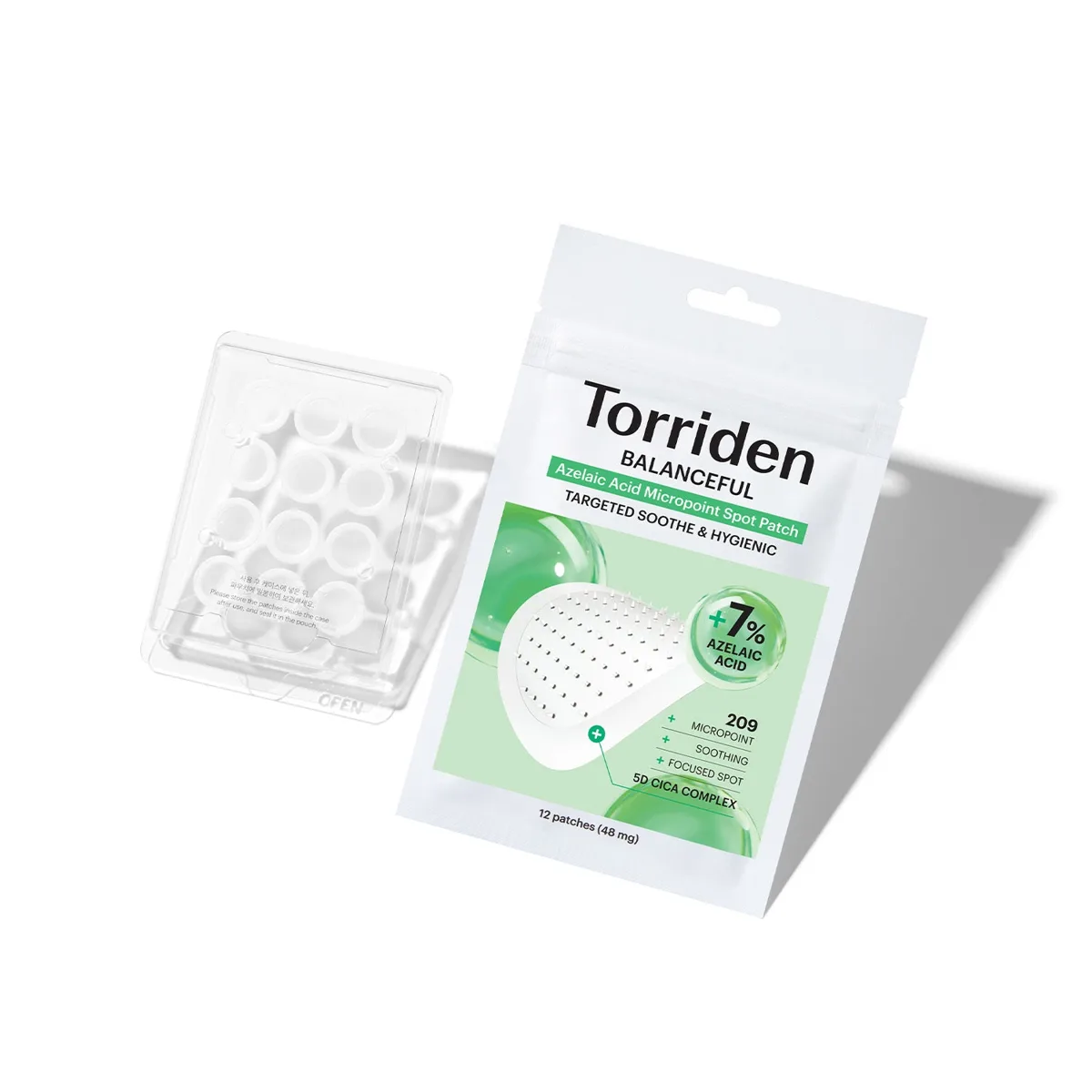
A dissolving microneedle patch whose 209 hyaluronate points carry a stated seven percent azelaic acid and glycinate derivative, wrapped in cyclodextrin, together with a full five-cica set placed high, into the upper skin over an early blemish for four hours. It is the one product in Torriden's 2026 azelaic pair where the acid is at a stated dose and in a format that can use it, and it is for closed, forming spots only.
The better half of Torriden's 2026 azelaic pair, because the format finally suits the ingredient: 209 dissolving hyaluronate points carry a stated seven percent azelaic synergy and a high-placed five-cica set into a closed, forming blemish for four hours, which is the one way a cosmetic azelaic dose can plausibly reach a spot. Early bumps come out calmer and flatter by morning; open spots get nothing, acne as a condition gets nothing, and the evidence is a 20-person soothing survey. Weeks old, fairly priced for the technology, and worth learning to use at the right stage.
Launched on the US site in August 2026 with no reviews there and only early, unverified Amazon feedback, and a 20-person, 12-day brand study released as two percentages; the assessment rests on the established mechanics of dissolving hyaluronate microneedles, on azelaic acid's and centella's evidence, and on the format's known stage limits rather than on owners.
Verdicts
How well it fits each concern
Verdict by concern tap a concern for the case
Good choicefor AcneIn your profileYou chose · Azelaic Acid is an approved or monograph active for acne, but this pad carries it at 7% — below the 10% the evidence and approvals rest on.Moderate evidenceGentleNo reviews collected yet
The case for it
Azelaic Acid and Potassium Azeloyl Diglycinate is a first-line active — approved, monograph-listed or named in current guidelines — for this concern.
It is present below the studied range.
The formula carries none of the triggers this concern is sensitive to.
What would change this: A concentration inside the studied range would raise this a step.
Same rule for everyone. “Good choice” is the verdict on 9,564 of 45,024 concern verdicts across the catalog; rule R4 decided 84 of them.
As of September 25, 2026, engine 5.1.1.
R4 — Right molecule, weak dose: still a reasonable choice, not the strong one. · the full register
Carrying active
Azelaic Acid and Potassium Azeloyl Diglycinate
Standing
first line — a regulator recognises it for this use; trials support it · per AZELEX® (azelaic acid cream) 20% (US Food and Drug Administration prescribing information, via DailyMed (National Library of Medicine)), opened July 27, 2026
Form
sub threshold (declared 7%) — studied range 10%, from the OTC monograph or label; needs leave-on contact; judge it after ~12 weeks
Tolerability
gentle
Row checked
against its sources on July 27, 2026 (evidence table ev-2026.09-r228)
Also listed for Excess Oiliness — the actives here (Hyaluronic Acid, Azelaic Acid, Trehalose, Centella Asiatica) are in our research queue for that concern; there is no verdict until their evidence rows are written. That is a gap in our table, not a mark against the product.
A verdict is DermApproved’s assessment of how well a product’s ingredients fit a concern — never a claim about what the product treats. Evidence dots and collected reviews sit beside it and are never blended in.
Rules 0.5.1 · evidence table ev-2026.09-r228 · how we decide
Assessment
Pros & Cons
Pros
✓ Dissolving hyaluronate micropoints deliver ingredients into the upper skin rather than onto it
✓ Stated seven percent azelaic synergy, a real dose for a cosmetic spot product
✓ Full five-cica set placed eighth through twelfth, where it can calm inflammation
✓ Cyclodextrin carrier keeps azelaic acid dissolved in the matrix
✓ Fragrance-free and alcohol-free, with a barrier-lipid gesture
✓ Turns white when spent, so timing is obvious
✓ Resealable pouch and case keep the remaining patches hygienic
Cons
✗ Useless on open, picked or whitehead-stage spots, where hydrocolloid belongs
✗ Does not treat acne as a condition or prevent new blemishes
✗ Evidence is a 20-person, 12-day brand survey of soothing and evenness
✗ Azelaic acid can tingle on rosacea-prone skin
✗ $1.13 a patch, several times a hydrocolloid dot
✗ Weeks old on US shelves with no verified review record
Review
Full Review
In August 2026 Torriden released two azelaic acid products at once, a sheet mask and this micropoint spot patch, and reading them side by side is a small lesson in why format matters more than ingredient. Azelaic acid earned its reputation at 15 to 20 percent, applied daily for months, and neither product comes near that; but the sheet mask sits a cosmetic dose on the whole face for ten minutes and rinses it away, while the patch presses a stated seven percent into one forming blemish through 209 dissolving hyaluronate points and leaves it there for four hours. One is a name on a pouch. The other is a delivery system, and it is the reason the patch is the more interesting of the two by a distance.
The technology is the Korean dissolving microneedle, and it is genuinely clever. The patch has no water on its ingredient list because it is the dried essence itself: sodium hyaluronate and a crosslinked hyaluronate, first and second, are moulded into a field of fine, firm points stabilised with trehalose, and everything else on the list is dissolved into that matrix. Pressed onto clean, dry skin for ten seconds, the points penetrate the outer layers a fraction of a millimetre, prickle faintly for a second, soften within an hour as they take up water from the skin and dissolve over four, releasing what they carry where a cream could not put it and turning the patch white when spent. What they carry here is azelaic acid at third and its water-soluble glycinate derivative at seventh, together the brand's seven percent azelaic synergy, held in solution by a cyclodextrin carrier; the full five-cica set of centella extract and all four triterpenes at eighth through twelfth, placed higher than in most leave-ons let alone masks; hollyhock, swertia, blue lotus and a lactobacillus ferment as soothing colour; and a small barrier-lipid gesture of ergosterol, phosphatidylcholine and a triglyceride near the end. There is no fragrance and no alcohol.
What that does, on the right spot, is real and modest. A closed, early bump, the kind that is red and tender and has not come to a head, is calmer and often flatter by morning, which is centella and azelaic delivered into inflamed skin plus the hydration of the dissolving matrix; the brand's study, 20 people over 12 days, reports a 47 percent improvement in soothing and a 22 percent improvement in tone evenness on treated areas, released as percentages without methods, and those numbers describe redness and comfort rather than lesion counts, which is honest about what the product is. On the wrong spot it does nothing: an open, picked or weeping blemish is a job for a hydrocolloid dot, and microneedles pressed into broken skin sting and should not be there. The patch does not treat acne as a condition, does not prevent the next spot and does not replace a daily leave-on for skin that breaks out regularly; it is a one-night intervention on one bump, and the twelve in the case last as long as twelve such bumps.
The practical rules are the format's. Clean, completely dry skin, before any serum or moisturiser, or the patch will not stick; a firm ten-second press; four hours or overnight; off when white; the rest kept in the case inside the zip pouch, which the brand includes for exactly the hygiene reason that matters when fingers meet needles. Timing is the other skill: the window is the evening a bump is felt before it is seen, and by the second or third day, once a spot is visibly heading for a head, the patch has missed its moment and the hydrocolloid has arrived at its own. Rosacea-prone skin may feel the azelaic tingle briefly; eczema, broken skin and skin fresh from a procedure should not meet microneedles at all.
The price is the going rate for the technology. Thirteen fifty for twelve patches is $1.13 each, or 90 cents at the launch discount, which is what Korean dissolving microneedle patches cost and several times what a hydrocolloid dot does; a month or two of early bumps for most people. What the money buys is a delivery method that a cosmetic azelaic dose actually needs and a cica set placed where it can act; what it does not buy is a track record, since the product is weeks old on US shelves, or a treatment for acne.
So: if you get closed, tender early bumps and want them calmer and flatter by morning without a prescription, this is a well-made patch and the one azelaic product of Torriden's pair worth the name. If your spots come to a head, a hydrocolloid is cheaper and better; if you break out regularly, a daily leave-on does the work no patch can; and if you press this onto an open spot, the sting is the patch telling you it was made for a different night.
Formula
Key Ingredients
The hero actives that drive this product's performance.
The first two ingredients and the structure of the patch itself: the 209 micropoints are moulded from dried hyaluronate, which is firm enough to press into the upper skin and dissolves in a few hours, carrying whatever is mixed into it a fraction of a millimetre deeper than a cream would go. There is no water on the list because the patch is the dried essence.
Third and seventh, the acid and its soluble glycinate derivative, together the brand's stated seven percent, wrapped in cyclodextrin to keep the acid dissolved in the hyaluronate matrix; seven percent is a real if sub-treatment dose, and delivering it through dissolving points into an early blemish for four hours is the one plausible way a cosmetic azelaic could do something a cream at this dose would not.
Eighth through twelfth, the five-cica set at high positions in a small matrix, which is where the patch's soothing claim actually lives; delivered into the skin rather than sitting on it, the triterpenes have a better chance here than in any sheet mask of calming the redness around a forming spot.
Fifth, the sugar that stabilises the dried hyaluronate points, keeps them from becoming brittle and adds humectancy as the matrix dissolves; a structural ingredient in a microneedle patch rather than a skincare one, and the reason the points survive the peel from the film.
Not yet assessed
Ergosterol
Seventeenth, a fungal sterol and vitamin D2 precursor placed as a barrier-lipid gesture alongside phosphatidylcholine and a triglyceride; a trace, and an unusual one, with laboratory data and no clinical role in a spot patch.
Not yet assessed
Ingredient standings describe the active at treatment-level doses and
vehicles; this product's own condition grades weigh its actual formula.
On a cleansed, fully dry, unbroken early blemish, pressed firmly for ten seconds and left four hours or overnight until the points have dissolved and the patch turns white, before any serum or moisturiser touches the area; not on an open or picked spot, and not with a leave-on acid or retinoid under it.
Results Timeline
Four to eight hours: the points dissolve, the redness around an early, closed blemish is calmer and the bump is often flatter by morning, which is the centella, the azelaic and the hyaluronate delivered into the upper skin. It does not treat acne as a condition or prevent new spots; the brand's 20-person, 12-day figures describe soothing and evenness, not lesion counts.
Pairs Well With
A hydrocolloid patch on the next night once a spot has openedA daily leave-on azelaic or BHA for the skin around it
Serums, oils or moisturiser applied before the patch, which stop it adheringOpen, picked or weeping blemishes, where microneedles do not belongA leave-on acid or retinoid under the patch
THIS PRODUCT on an early spot, before anything else
Serum and moisturiser around it
Evidence
Science & Expert Perspective
The Science
Dissolving microneedle patches are a transdermal delivery format with a real literature. Micropoints moulded from sodium hyaluronate and a crosslinked hyaluronate, stabilised with trehalose, are stiff enough when dry to penetrate the stratum corneum to a depth of a few hundred micrometres on firm pressure, then absorb interstitial water, soften and dissolve over several hours, releasing their payload into the viable epidermis; studies of hyaluronate microneedle patches show delivery of small and mid-sized molecules across the barrier at rates topical creams cannot match, which is why the format has moved from clinics to consumer skincare in Korea. The patch therefore carries its actives into inflamed skin rather than leaving them on its surface, and the absence of water on the list reflects that the patch is the dried formulation itself.
The payload's evidence is graded. Azelaic acid at third position, with potassium azeloyl diglycinate at seventh and the pair stated at seven percent combined, is solubilised by hydroxypropyl cyclodextrin; azelaic acid's randomised-trial evidence for acne and rosacea is at 15 to 20 percent applied twice daily for months, acting on Cutibacterium acnes, keratinocyte proliferation and inflammatory mediators, and a seven percent dose delivered into a single early lesion for four hours is a plausible anti-inflammatory and mildly antibacterial intervention on that lesion without being acne therapy. Potassium azeloyl diglycinate has supplier data on sebum and erythema and no independent clinical record. Centella asiatica extract and its four triterpenes at eighth through twelfth have clinical data on reduced erythema and accelerated recovery, and intradermal delivery is the most favourable exposure they receive in any cosmetic format. Swertia, hollyhock and blue lotus extracts and a lactobacillus ferment are trace soothing botanicals; ergosterol, hydrogenated phosphatidylcholine and a triglyceride are trace lipids. The brand's study of 20 subjects over 12 days reporting 46.94 percent improved soothing and 22.27 percent improved tone uniformity on treated areas is a small uncontrolled evaluation of redness and evenness, not of lesion count or resolution time, and is released without methods.
Tolerability is the format's: microneedle pressure on intact skin is well tolerated with a transient prick, and on open, excoriated or inflamed-to-weeping skin it is painful and inappropriate; azelaic acid causes transient stinging in a minority; cetearyl alcohol is a rare contact allergen. Azelaic acid is considered acceptable in pregnancy. The patch is not marked vegan, since hyaluronate and ergosterol sources are unstated.
Dermatologist Perspective
Dermatologists would regard dissolving hyaluronate microneedle patches as a legitimate consumer delivery format and would judge this one as a reasonable single-lesion intervention for early, closed inflammatory papules, with the standard clarification that it is not acne treatment. Azelaic acid's evidence is at 15 to 20 percent applied daily across the affected area for months, and a seven percent dose delivered into one lesion for four hours would be expected to calm that lesion's inflammation somewhat and to do nothing for the disease process, the comedones forming elsewhere or the next breakout; patients with regular acne would be directed to a daily leave-on azelaic acid, benzoyl peroxide, a retinoid or a prescription, with this patch as an optional adjunct for the occasional early bump. Clinicians would stress the stage distinction the brand's own instructions imply, microneedles on closed lesions and hydrocolloid on open ones, and would advise against use on excoriated, eczematous or post-procedure skin and caution rosacea-prone patients about transient stinging. The centella placement would be noted as sensible, and the brand's 20-person survey would be given little weight.
Guidance
Usage & Recommendations
How to Use
The night a closed, tender bump first appears, cleanse the area and let it dry completely, before any toner, serum or moisturiser touches it. Peel off the white backing, lift the patch from the clear film without touching the points, centre it on the spot and press firmly for at least ten seconds; a faint prickle is normal. Leave it for four hours or overnight, until the points have dissolved and the patch has turned white, then peel it off gently and apply the rest of the routine around the area. Do not use it on an open, picked or weeping spot, on eczema or broken skin, or after a procedure, and do not reuse a patch. Store the remaining patches in the case inside the resealed zip pouch and use them within a year.
Value Assessment
At $13.50 for twelve patches, $1.13 each, or 90 cents each at the $10.80 the brand has charged since launch, the Micropoint Spot Patch costs what Korean dissolving microneedle patches generally cost and roughly four to six times a hydrocolloid dot; twelve patches last a month or two for someone who gets an early bump a week. What the price buys is a delivery format that a cosmetic azelaic dose genuinely needs, a stated seven percent, a high-placed cica set and a hygienic case, which for people prone to closed, tender early bumps is fair value and better than the sheet mask that shares its name. What it does not buy is acne treatment, any effect on open spots, or a track record, since the product is weeks old on US shelves. Whitehead-prone skin should spend the money on hydrocolloid; regular breakouts on a daily leave-on.
Who Should Buy
People with oily, combination or normal skin who get occasional closed, tender early blemishes and want them calmer and flatter by morning without a prescription, who understand the difference between a microneedle patch and a hydrocolloid dot, and who use a daily leave-on for the skin around the spot.
Who Should Skip
Anyone whose spots come to a head quickly, for whom hydrocolloid is cheaper and better; people with regular or inflammatory acne, which a spot patch does not treat; eczema-prone, broken or post-procedure skin, where microneedles do not belong; rosacea-prone skin without a patch test, since the azelaic can tingle; and anyone wanting a track record, since the patch is weeks old.
Ready to try Torriden BALANCEFUL Azelaic Acid Micropoint Spot Patch?
A small clear hydrocolloid-style disc with a central field of 209 firm, fine hyaluronate micropoints that prick faintly on pressing, soften within an hour and dissolve over four hours, leaving a smooth patch that turns white when spent.
Scent
None; fragrance-free, with no detectable odour on the patch or in the pouch.
Packaging
A white-and-green resealable zip pouch holding a clear plastic case with 12 patches on a backed film, the case meant for hygienic storage of the rest once opened.
Finish
invisible
What to Expect on First Use
The first patch pricks faintly for a second on pressing, then is forgotten, and by morning the points have dissolved, the patch has turned white and the early bump beneath is usually calmer and flatter; a spot that had already opened is unchanged, because the format is for closed, forming blemishes. Learning to apply it to fully dry skin before any serum is the first-week lesson.
How Long It Lasts
One patch per spot; twelve patches last as long as twelve early blemishes, a month or two for most.
Dissolving hyaluronate microneedle patches are a Korean invention that moved from cosmetic clinics to drugstore shelves in the early 2020s, and Torriden added azelaic acid, the year's blemish ingredient, to the format in 2026 alongside a matching sheet mask for its oily-skin BALANCEFUL line. The patch arrived on the brand's US site in August 2026 with a small 20-person soothing study and a launch discount, and it is weeks old on American shelves.
About Torriden Established Brand (5–20 years)
Torriden launched in 2018 and built the DIVE IN hyaluronic line into one of the most-reviewed K-beauty ranges on Amazon and at Sephora; its BALANCEFUL line is the oily and blemish-prone counterpart, and the brand publishes full ingredient lists and small consumer tests for its launches, here a 20-person, 12-day study released as percentages. This dissolving microneedle patch reached the US site in August 2026 and is weeks old on American shelves.
Brand founded: 2018 · Product launched: 2026
Myth vs. Reality
Common Myths
Myth
A microneedle spot patch works like a hydrocolloid patch and can go on any pimple.
Reality
Hydrocolloid absorbs fluid from an open spot; dissolving microneedles push ingredients into the skin over a closed, forming one, and on an open or picked blemish they sting, do nothing and should not be used. The two formats are for different stages of the same spot, and this patch is for the night a bump first appears.
Myth
Seven percent azelaic acid in a patch treats acne.
Reality
Azelaic acid's acne evidence is for 15 to 20 percent applied daily over months across the whole affected area; a seven percent synergy of the acid and a derivative in a patch on one spot for four hours calms that spot's inflammation and may flatten it faster, which is useful and not the same thing. The brand's 20-person, 12-day study measured soothing and evenness, not acne.
FAQ
Frequently Asked Questions
How do you use the Torriden BALANCEFUL Azelaic Acid Micropoint Spot Patch?
On a cleansed, completely dry, closed early blemish, before any serum or moisturiser: peel the white backing, lift the patch from the clear film, press it onto the spot firmly for ten seconds and leave it four hours or overnight until the points dissolve and the patch turns white. Store the rest in the case inside the zip pouch, and never reuse a patch.
What is the difference between the Torriden micropoint patch and a hydrocolloid pimple patch?
Hydrocolloid draws fluid out of an open, whitehead-stage spot; the micropoint patch pushes azelaic acid, centella and hyaluronate into a closed, forming bump through 209 dissolving points. Use this one the night a bump first appears and a hydrocolloid once it has come to a head; using either at the wrong stage wastes it.
Does the Torriden azelaic spot patch really have 7 percent azelaic acid?
The brand states a seven percent azelaic synergy, meaning azelaic acid plus its potassium azeloyl diglycinate derivative combined, dissolved in a cyclodextrin carrier within the hyaluronate points. That is a real, if sub-treatment, dose, and the microneedle format is the one place a cosmetic azelaic can plausibly reach a blemish.
Does the Torriden azelaic micropoint patch hurt?
A faint prickle for a second or two on pressing, then nothing; the hyaluronate points soften within an hour and dissolve over four. It stings on an open or picked spot, which is a sign the patch is being used at the wrong stage.
Is the Torriden azelaic micropoint patch safe for sensitive skin?
It is fragrance-free and alcohol-free with a full centella set, and most reactive skin tolerates it; the azelaic acid can tingle briefly on rosacea-prone skin, and microneedles do not belong on eczema, broken skin or skin fresh from a procedure. Test one patch on a quiet spot first.
Is the Torriden BALANCEFUL Azelaic Acid Micropoint Spot Patch worth $13.50?
At $1.13 a patch, or 90 cents at the launch price, it costs what Korean dissolving microneedle patches generally cost and several times a hydrocolloid dot; it is worth it for people who get closed, early bumps they want flattened by morning and less so for whitehead-prone skin, where hydrocolloid is cheaper and better. Twelve patches last a month or two for most.
Reviews
What Reviewers Tend to Say
Recurring themes our editors read across retailer reviews of this product — summaries in our words, not quotations, and not a substitute for your own patch test.
Common Praise
Early bumps flatter and calmer by morning
Points dissolve cleanly and the patch stays put overnight
The bulbous nose everyone thinks they can read is a late structural stage of an inflammatory disease — and the reading itself is why men arrive years too late to prevent it.
Flushing, bumps, and visible vessels are three different problems hiding under one word, and treating them the same way is how most people make their skin angrier.
One quietly brilliant ingredient treats acne, rosacea, and dark spots — and you can buy it two ways. Whether the stronger version earns the appointment depends entirely on what you're treating.
Mar 10, 2026· 6 min
Questions people ask about Acne
Verified answers from our questions library — the nuance a product page cannot carry.
Products, answers, therapy guides, tools and articles in one search. Brand names,
slang and abbreviations all work — accutane finds isotretinoin, bacne finds truncal acne.