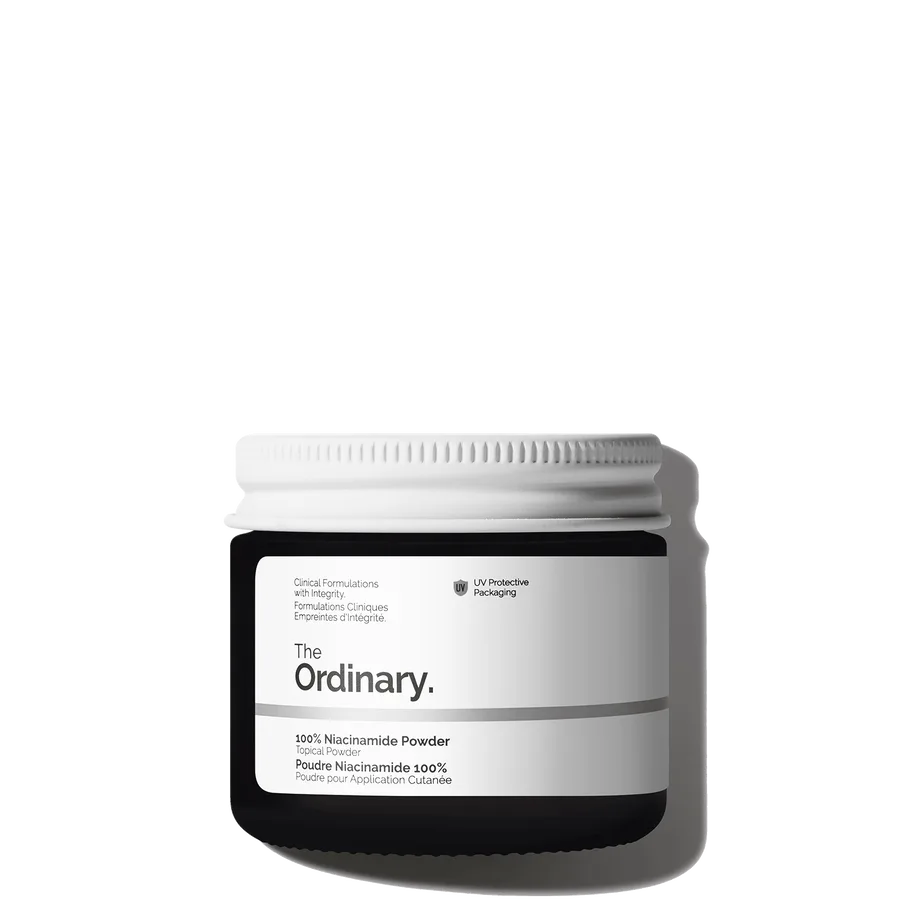
A pure-ingredient powder that puts concentration control entirely in the user's hands. Unlike pre-formulated niacinamide serums (including The Ordinary's own 10% Niacinamide + Zinc), this powder lets you add niacinamide to any compatible product and adjust the amount based on your skin's response. It's essentially a raw ingredient sold directly to consumers — the most literal expression of The Ordinary's transparency philosophy.
The most cost-effective way to add niacinamide to your skincare routine — six dollars for what amounts to a year's supply of one of the most well-studied actives in dermatology. The DIY format demands a bit of skincare literacy, but rewards those who have it with unmatched flexibility and value.
Promisingfor Excess OilinessIn your profileYou chose · Niacinamide has trial-level evidence for excess oiliness but no guideline or regulatory standing yet — promising, short of a recommendation.Moderate evidenceGentleNo reviews collected yet
The case for it
Niacinamide has trial-level evidence for this concern but no guideline or regulatory standing yet.
It is present at an effective concentration, declared or high in the ingredient list.
The formula carries none of the triggers this concern is sensitive to.
What would change this: Guideline or regulatory standing for the active on this concern would move this from a promising bet to a recommendation.
Same rule for everyone. “Promising” is the verdict on 7,858 of 45,024 concern verdicts across the catalog; rule R9p decided 7,858 of them.
Unchanged since September 5, 2026, engine 5.1.1.
R9p — 0.5.0: 'Unproven' beside three filled dots read as one question answered twice with opposite words (7,018 rows). The chip measures standing, the dots measure trial volume; where the row carries at least one RCT or a tier-2 source (moderate dots) and the active is present at a working level, the honest word is Promising. Unproven is reserved for plausible-standing rows with limited or weak evidence, or an under-dosed form. Same rank as Unproven — a bet either way; the dots order them. · the full register
Carrying active
Niacinamide
Standing
plausible — trials support it
Form
adequate (declared 100%) — studied range 2%, from the trials on the row; needs leave-on contact; judge it after ~8 weeks
Tolerability
gentle
Row checked
against its sources on July 17, 2026 (evidence table ev-2026.09-r228)
Promisingfor Large PoresIn your profileYou chose · Niacinamide has trial-level evidence for large pores but no guideline or regulatory standing yet — promising, short of a recommendation.Moderate evidenceGentleNo reviews collected yet
The case for it
Niacinamide has trial-level evidence for this concern but no guideline or regulatory standing yet.
It is present at an effective concentration, declared or high in the ingredient list.
The formula carries none of the triggers this concern is sensitive to.
What would change this: Guideline or regulatory standing for the active on this concern would move this from a promising bet to a recommendation.
Same rule for everyone. “Promising” is the verdict on 7,858 of 45,024 concern verdicts across the catalog; rule R9p decided 7,858 of them.
Unchanged since September 5, 2026, engine 5.1.1.
R9p — 0.5.0: 'Unproven' beside three filled dots read as one question answered twice with opposite words (7,018 rows). The chip measures standing, the dots measure trial volume; where the row carries at least one RCT or a tier-2 source (moderate dots) and the active is present at a working level, the honest word is Promising. Unproven is reserved for plausible-standing rows with limited or weak evidence, or an under-dosed form. Same rank as Unproven — a bet either way; the dots order them. · the full register
Carrying active
Niacinamide
Standing
plausible — trials support it
Form
adequate (declared 100%) — studied range 4%, from the trials on the row; needs leave-on contact; judge it after ~8 weeks
Tolerability
gentle
Row checked
against its sources on July 17, 2026 (evidence table ev-2026.09-r228)
Good choicefor HyperpigmentationIn your profileYou chose · Niacinamide is a trial-supported active for hyperpigmentation; this powder carries it at 100%.Moderate evidenceGentleNo reviews collected yet
The case for it
Niacinamide has trial-supported standing for this concern.
It is present at an effective concentration, declared or high in the ingredient list.
The formula carries none of the triggers this concern is sensitive to.
Same rule for everyone. “Good choice” is the verdict on 9,564 of 45,024 concern verdicts across the catalog; rule R5 decided 9,072 of them.
Unchanged since September 5, 2026, engine 5.1.1.
Promisingfor AcneIn your profileYou chose · Niacinamide has trial-level evidence for acne but no guideline or regulatory standing yet — promising, short of a recommendation.Moderate evidenceGentleNo reviews collected yet
The case for it
Niacinamide has trial-level evidence for this concern but no guideline or regulatory standing yet.
It is present at an effective concentration, declared or high in the ingredient list.
The formula carries none of the triggers this concern is sensitive to.
What would change this: Guideline or regulatory standing for the active on this concern would move this from a promising bet to a recommendation.
Same rule for everyone. “Promising” is the verdict on 7,858 of 45,024 concern verdicts across the catalog; rule R9p decided 7,858 of them.
Unchanged since September 5, 2026, engine 5.1.1.
R9p — 0.5.0: 'Unproven' beside three filled dots read as one question answered twice with opposite words (7,018 rows). The chip measures standing, the dots measure trial volume; where the row carries at least one RCT or a tier-2 source (moderate dots) and the active is present at a working level, the honest word is Promising. Unproven is reserved for plausible-standing rows with limited or weak evidence, or an under-dosed form. Same rank as Unproven — a bet either way; the dots order them. · the full register
Carrying active
Niacinamide
Standing
plausible — trials support it
Form
adequate (declared 100%) — studied range 4–5%, from the OTC monograph or label; needs leave-on contact; judge it after ~8 weeks
Tolerability
gentle
Row checked
against its sources on July 17, 2026 (evidence table ev-2026.09-r228)
Promisingfor Dark SpotsIn your profileYou chose · Niacinamide has trial-level evidence for dark spots but no guideline or regulatory standing yet — promising, short of a recommendation.Moderate evidenceGentleNo reviews collected yet
The case for it
Niacinamide has trial-level evidence for this concern but no guideline or regulatory standing yet.
It is present at an effective concentration, declared or high in the ingredient list.
The formula carries none of the triggers this concern is sensitive to.
What would change this: Guideline or regulatory standing for the active on this concern would move this from a promising bet to a recommendation.
Same rule for everyone. “Promising” is the verdict on 7,858 of 45,024 concern verdicts across the catalog; rule R9p decided 7,858 of them.
Unchanged since September 5, 2026, engine 5.1.1.
R9p — 0.5.0: 'Unproven' beside three filled dots read as one question answered twice with opposite words (7,018 rows). The chip measures standing, the dots measure trial volume; where the row carries at least one RCT or a tier-2 source (moderate dots) and the active is present at a working level, the honest word is Promising. Unproven is reserved for plausible-standing rows with limited or weak evidence, or an under-dosed form. Same rank as Unproven — a bet either way; the dots order them. · the full register
Carrying active
Niacinamide
Standing
plausible — trials support it
Form
adequate (declared 100%)
Tolerability
gentle
Row checked
against its sources on July 17, 2026 (evidence table ev-2026.09-r228)
Also listed for Dullness and Rough Texture — the actives here (Niacinamide) are in our research queue for those concerns; there is no verdict until their evidence rows are written. That is a gap in our table, not a mark against the product.
Where our review and the verdict differ. The review below was written on the formulation and the published trials; the verdicts above apply the stricter standing test in our methodology — an active earns a recommendation only with guideline or regulatory standing for the concern. Where the two disagree, the verdict is DermApproved’s position.
A verdict is DermApproved’s assessment of how well a product’s ingredients fit a concern — never a claim about what the product treats. Evidence dots and collected reviews sit beside it and are never blended in.
Rules 0.5.1 · evidence table ev-2026.09-r228 · how we decide
Assessment
Pros & Cons
Pros
✓ Extraordinary value at $6.40 for a 6-12 month supply of pure niacinamide
✓ Complete concentration control from gentle (2%) to intensive (5%+) dosing
✓ Can be added to any compatible water-based product in your existing routine
✓ Single-ingredient purity with zero potential irritants, allergens, or fillers
✓ Niacinamide is backed by decades of dermatological research for multiple skin concerns
✓ Vegan, cruelty-free, fragrance-free, and fungal acne safe
Cons
✗ Included scoop is oversized and awkward for the narrow jar opening
✗ Requires thorough mixing to avoid gritty texture on skin
✗ User-controlled dosing means risk of over-concentration and niacinamide flushing
✗ Incompatible with pure L-ascorbic acid vitamin C products
✗ DIY format lacks the convenience and optimized delivery of pre-formulated serums
Review
Full Review
A jar of pure niacinamide powder for six dollars and forty cents. No water. No preservatives. No emulsifiers, thickeners, or fragrance. Just the active ingredient, a scoop, and your own judgment about how much to use. It sounds like something you would order from a laboratory supply catalog, and that is essentially what The Ordinary has done — sold you a raw cosmetic ingredient in consumer packaging with instructions on how to use it.
This is The Ordinary's transparency philosophy taken to its logical extreme. Rather than formulating another niacinamide serum to sit alongside the already-popular Niacinamide 10% + Zinc 1%, the brand made the bold decision to skip the formulation entirely and give consumers the pure ingredient. Mix it yourself. Dose it yourself. Be your own cosmetic chemist. It is either brilliantly empowering or slightly terrifying, and the fact that it is both is what makes The Ordinary so fascinating as a brand.
Niacinamide itself needs no introduction to anyone who has paid attention to skincare in the past decade. Vitamin B3 is one of the most versatile and well-studied topical ingredients available. At concentrations as low as two percent, it reduces sebum production, minimizes the appearance of pores, improves skin barrier function, brightens uneven tone, and reduces inflammation. At higher concentrations, those benefits intensify — up to a point. Research generally shows diminishing returns above five percent, and higher concentrations increase the risk of the characteristic niacinamide flush: a temporary, harmless vasodilation that makes your face turn red and feel warm for thirty to sixty minutes.
The powder format's great advantage is dosing flexibility. With a pre-formulated serum, you get whatever concentration the brand decided on — ten percent, in the case of The Ordinary's liquid version. With the powder, you can start with a tiny pinch (roughly two to three percent when mixed into a full pump of serum) and gradually increase as your skin demonstrates tolerance. This makes it accessible to niacinamide newcomers who might find ten percent too aggressive, and to experienced users who want to precisely calibrate their dose.
The practical experience, however, is where the product's DIY nature introduces friction. The included scoop is universally criticized as too large for the narrow jar opening. Getting a precise, small amount of powder onto the scoop and out of the jar without spilling requires more dexterity than it should. Once scooped, the powder needs to be thoroughly mixed into a water-based product — insufficiently dissolved niacinamide leaves a gritty texture on the skin that is distinctly unpleasant. The learning curve is real. After a few days of practice, most users develop a technique that works for them, but those first few applications can be clumsy.
Compatibility is another consideration the user must manage. The powder dissolves properly only in water-based products with a pH between five and seven. Oil-based serums, anhydrous products, and very acidic formulations are out. The Ordinary specifically warns against mixing with pure vitamin C (L-ascorbic acid), as niacinamide can reduce its efficacy and the combination may cause flushing. It's not a set-and-forget product — it requires some ingredient literacy to use correctly.
For those willing to invest the small effort, the value proposition is staggering. Twenty grams of pure niacinamide, used at recommended amounts, can last six months to a year. At six dollars and forty cents, this works out to roughly one to two cents per application. No other niacinamide product in the market comes remotely close to this cost efficiency. Even The Ordinary's own liquid niacinamide serum, already aggressively priced, costs more per unit of active ingredient.
The results, when the powder is used correctly, mirror what the published literature on niacinamide predicts. Oil production noticeably decreases within one to two weeks. Pores appear tighter and less visible. Skin develops a smoother, more even-toned appearance over four to eight weeks. The brightening effect is gradual but genuine — niacinamide inhibits melanosome transfer, the mechanism by which pigment is distributed through the skin, and consistent use produces visible results.
What this product is not is a replacement for a well-formulated niacinamide serum for everyone. The serum format delivers a tested concentration in an optimized base with humectants, pH buffers, and a delivery system designed to enhance penetration. The powder is the ingredient without the delivery system — you are relying entirely on whatever product you mix it into for the formulation quality. For someone mixing it into a well-made hyaluronic acid serum or a quality moisturizer, this is a non-issue. For someone mixing it into a poorly formulated product, the niacinamide is only as good as its vehicle.
The product also highlights an interesting philosophical question about The Ordinary's approach. By selling raw ingredients directly to consumers, the brand implies that formulation — the art and science of combining ingredients into an effective, stable, pleasant-to-use product — is either overvalued by the rest of the industry or simply not necessary. The truth is somewhere in between. Formulation matters enormously for unstable ingredients, complex delivery systems, and products where ingredient interactions are critical. For a stable, robust, pH-insensitive ingredient like niacinamide, the DIY approach genuinely works.
For the skincare enthusiast who enjoys customization, who appreciates control over their routine, and who finds satisfaction in the process of mixing and adjusting — this is one of the smartest products in the market. For the person who wants to pump a serum, apply it, and move on with their morning, the liquid version is a better fit. Both deliver the same ingredient. The difference is entirely about how much you want to be involved in the process.
Formula
Key Ingredients
The hero actives that drive this product's performance.
Pure niacinamide powder that, when mixed into a compatible product, delivers vitamin B3's full range of benefits — sebum regulation, pore minimization, barrier strengthening, brightening, and anti-inflammatory action. The powder format gives the user complete control over concentration, allowing customization from gentle (a small pinch) to intensive (a full scoop) depending on skin tolerance and goals.
Emergingfor Hyperpigmentation
Ingredient standings describe the active at treatment-level doses and
vehicles; this product's own condition grades weigh its actual formula.
Mix a small amount (a quarter to half scoop) into any water-based serum, moisturizer, or treatment with a pH between 5.0 and 7.0. Do NOT mix with pure vitamin C (L-ascorbic acid) products. Stir or rub between palms until fully dissolved before applying.
Results Timeline
Oil reduction and pore-minimizing effects visible within 1-2 weeks. Brightening and tone-evening improvements at 4-6 weeks. Barrier strengthening benefits cumulative over 8-12 weeks.
Mix Niacinamide Powder into hydrating serum or moisturizer, apply
Sunscreen
Sample PM Routine
Cleanser
Exfoliant (2-3x/week)
Mix Niacinamide Powder into treatment or moisturizer, apply
Evidence
Science & Expert Perspective
The Science
Niacinamide (nicotinamide, vitamin B3) is one of the most extensively researched topical skincare ingredients, with a body of evidence that spans multiple dermatological applications. A pivotal study published in the British Journal of Dermatology (2000) demonstrated that topical niacinamide at 4% concentration significantly reduced sebum production in Japanese and Caucasian subjects over an eight-week period, with visible improvements in oiliness and pore appearance.
The brightening mechanism of niacinamide operates through inhibition of melanosome transfer from melanocytes to keratinocytes. A study in the British Journal of Dermatology (2002) showed that 5% topical niacinamide significantly reduced hyperpigmentation and increased skin lightness compared to vehicle control over eight weeks. Importantly, this mechanism does not inhibit melanin production itself but rather its distribution, making it a gentler approach to brightening than ingredients that target tyrosinase directly.
Barrier function improvements from topical niacinamide are well-documented. A study reported in Clinical, Cosmetic and Investigational Dermatology (2015) demonstrated that niacinamide stimulates ceramide synthesis, increases free fatty acid production, and reduces transepidermal water loss. These barrier-enhancing effects explain why niacinamide often improves overall skin resilience and tolerance to other active ingredients.
The niacinamide flush — a transient vasodilation causing facial redness and warmth — is a prostaglandin-mediated response that occurs more frequently at higher concentrations. Published research in Skin Pharmacology and Applied Skin Physiology suggests this effect is dose-dependent and typically subsides with continued use as the skin develops tolerance. Starting at lower concentrations and gradually increasing is the standard recommendation to minimize this response.
A comprehensive review in the Journal of Clinical and Aesthetic Dermatology (2017) summarized niacinamide's benefits across acne reduction, anti-aging, pigmentation correction, and barrier support, concluding that concentrations of 2-5% are most effective for most applications.
Dermatologists widely endorse niacinamide as one of the safest and most versatile active ingredients available in consumer skincare. Dermatology guidance holds that while pure powder formats require more user education, niacinamide's stability and wide effective pH range make it one of the few ingredients well-suited to the DIY approach. Dermatologists commonly recommend niacinamide at 2-5% concentration for sebum regulation, pore minimization, and brightening — the powder format allows patients to start at the lower end and titrate up based on tolerance. The ingredient's excellent safety profile, compatibility with most other actives, and pregnancy safety make it a recommendation dermatologists feel comfortable extending broadly.
Guidance
Usage & Recommendations
How to Use
Using the included scoop, measure approximately a quarter to half scoop of powder. Add it to your palm along with your water-based serum or moisturizer (pH 5.0-7.0). Rub your palms together or stir with a finger until the powder is completely dissolved — no grittiness should remain. Apply the mixture to your face as you normally would. Start with a smaller amount and increase gradually over 1-2 weeks. Do not mix with pure vitamin C (L-ascorbic acid) products. Use morning and/or evening.
Value Assessment
At six dollars and forty cents for twenty grams of pure niacinamide, this may be the single best value in all of consumer skincare. A quarter-scoop per application means the jar delivers hundreds of uses — pennies per application for an ingredient backed by decades of published research. Even compared to The Ordinary's already budget-friendly liquid Niacinamide 10% + Zinc 1% ($6.20 for 30mL), the powder delivers significantly more niacinamide per dollar. The value is unmatched by any competing product at any price point.
Who Should Buy
Skincare enthusiasts who want maximum control over their niacinamide concentration. Budget-conscious buyers who want the most cost-effective way to add niacinamide to their routine. Those who already have a favorite serum or moisturizer and want to boost it with niacinamide without buying a separate product. Anyone who enjoys the DIY aspect of customizing their skincare.
Who Should Skip
Those who prefer the simplicity of a pump-and-apply serum. Skincare beginners who might over-dose and experience niacinamide flushing. Anyone who doesn't want to think about pH compatibility or mixing technique. If you already use The Ordinary's Niacinamide 10% + Zinc serum and are happy with it, switching to the powder adds effort without necessarily improving results.
Ready to try The Ordinary 100% Niacinamide Powder?
Ultra-fine white powder with a silky feel. Dissolves readily in water-based products when mixed. If not fully dissolved, can leave a slightly gritty texture on the skin.
Scent
Odorless — pure niacinamide has no scent.
Packaging
Small amber glass jar with a screw-top lid and a plastic scoop included. The jar size is compact and the opening is narrow, which can make scooping awkward.
Finish
matteinvisible
What to Expect on First Use
No standalone experience — this is mixed into other products. When properly dissolved, the receiving product's texture is minimally changed. On first use, skin may experience mild flushing if too much powder is used, as niacinamide can trigger a prostaglandin-mediated flush at higher concentrations. Starting with a quarter scoop per application is recommended.
How Long It Lasts
6-12 months depending on usage frequency and amount per application
Launched in 2020, the 100% Niacinamide Powder was part of The Ordinary's expansion into powder-format actives — a category the brand pioneered in mainstream skincare. The concept was characteristically radical: instead of formulating another niacinamide serum, give consumers the pure ingredient and let them be their own formulators. It attracted both seasoned skincare enthusiasts who appreciated the control and newcomers who were drawn to the price point.
About The Ordinary Established Brand (5–20 years)
The Ordinary, launched in 2016 under parent company DECIEM, disrupted the skincare industry with its radical transparency model — naming products after their active ingredients and concentrations, and pricing them at a fraction of competitors. The brand has built massive consumer trust through its no-nonsense approach, though its formulations prioritize accessibility and price over luxury or clinical exclusivity.
Brand founded: 2016 · Product launched: 2020
Myth vs. Reality
Common Myths
Myth
You can't mix niacinamide with vitamin C — they cancel each other out.
Reality
The Ordinary advises against combining this powder with L-ascorbic acid products because niacinamide can reduce the efficacy of unstable vitamin C forms and cause flushing. However, niacinamide is compatible with stable vitamin C derivatives like ascorbyl glucoside. The conflict is formula-specific, not absolute — The Ordinary's recommendation is a safety precaution for their product ecosystem.
Myth
Pure niacinamide powder is more effective than a pre-formulated niacinamide serum.
Reality
Effectiveness depends on concentration, pH, and the vehicle it's mixed into. A well-formulated serum delivers niacinamide at a tested concentration in a stable, optimized base. The powder gives you flexibility but also responsibility — if you over-dose or mix into an incompatible product, results can be worse, not better. Both formats deliver niacinamide; the difference is control versus convenience.
FAQ
Frequently Asked Questions
How do I use The Ordinary 100% Niacinamide Powder?
Scoop a small amount (start with a quarter of the included scoop) and mix it into any water-based serum, cream, or moisturizer with a pH between 5.0 and 7.0. Rub or stir until fully dissolved — no grittiness should remain. Apply the mixture as you normally would. Start with a small amount and increase gradually as your skin acclimates to avoid flushing.
Can I mix this with The Ordinary Hyaluronic Acid serum?
Yes — hyaluronic acid serums are one of the best mixing partners for this powder. The water-based, neutral-pH formula dissolves the niacinamide easily, and the combination delivers both hydration and niacinamide's oil-regulating, brightening benefits in one step.
How much niacinamide powder should I use per application?
Start with approximately a quarter of the included scoop mixed into one application's worth of serum or moisturizer. This delivers roughly 2-5% niacinamide depending on the volume of your base product. Research shows benefits at 2-5% concentration with limited additional benefit above 5%. Using too much can cause niacinamide flushing — a harmless but uncomfortable temporary redness.
Is this better than The Ordinary Niacinamide 10% + Zinc 1% serum?
They serve different purposes. The serum is convenient, pre-formulated at a fixed 10% concentration, and includes zinc for additional oil control. The powder gives you concentration control and can be added to any compatible product, but requires more effort. If you want simplicity, choose the serum. If you want customization and extreme value, the powder is unbeatable.
Why does niacinamide cause flushing and how do I prevent it?
Niacinamide at higher concentrations can trigger a prostaglandin-mediated vasodilation — essentially a temporary widening of blood vessels that causes redness and warmth. It is harmless and subsides within 30-60 minutes. Prevent it by starting with a very small amount of powder (quarter scoop), gradually increasing as your skin builds tolerance. Most people can use moderate amounts without flushing after a few weeks of acclimation.
How long does this powder last?
At recommended usage (a small pinch to quarter scoop per application, once or twice daily), the 20g jar can last six months to a year — making the $6.40 price point effectively pennies per use. This is one of the best value propositions in all of skincare.
Reviews
What Reviewers Tend to Say
Recurring themes our editors read across retailer reviews of this product — summaries in our words, not quotations, and not a substitute for your own patch test.
Common Praise
Incredible value for pure niacinamide
Noticeable reduction in oiliness and pore appearance
Love the ability to customize concentration
Mixes easily into most products
Lasts an extremely long time
Common Complaints
Included scoop is oversized and awkward for the small jar
Can leave gritty texture if not fully dissolved
Easy to accidentally use too much
Some users experience flushing at higher concentrations
Removing water from a serum is a genuine formulation upgrade and a shaky sustainability claim at the same time — and the refill pouch in your drawer only helps if you actually keep using it.
Five brands that own the feed, judged on their ingredient lists rather than their view counts — including the one active all five suddenly added at once, and what that tells you.
Nearly every trial that made this ingredient famous ran at 2–5%. The double-digit numbers on the shelf are answering a question the biology never asked.
Aug 1, 2026· 8 min
Questions people ask about Hyperpigmentation
Verified answers from our questions library — the nuance a product page cannot carry.
Products, answers, therapy guides, tools and articles in one search. Brand names,
slang and abbreviations all work — accutane finds isotretinoin, bacne finds truncal acne.