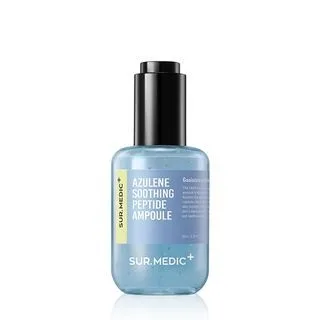
It suspends blue azulene capsules and white ceramide capsules in a soothing centella base, then layers in a ten-peptide complex, for a calm-and-condition ampoule with a striking visual format. The combination of a higher azulene dose, a ceramide, and a broad peptide blend distinguishes it from a plain centella ampoule.
A soothing capsule ampoule that suspends blue azulene and white ceramide capsules in a centella base, with a ten-peptide complex layered on top. It genuinely calms redness and supports the barrier as a treatment step, with the trace-level peptides more marketing than substance and lavender, tea tree, and alcohol the reasons the most reactive skin should patch test.
A popular Neogen Sur.Medic+ ampoule with broad availability and a moderate review base, this assessment combines that feedback with a read of its azulene-centella-and-peptide soothing formula. How well the lavender and tea tree oils are tolerated varies between individuals, a factor especially relevant for the sensitive skin this ampoule targets and one scattered reviews do not always isolate.
Verdicts
How well it fits each concern
Verdict by concern tap a concern for the case
Avoidfor SensitivityIn your profileYou chose · This formula carries fragrance — the kind of thing reactive skin flags first.Not yet assessedCarries a triggerNo reviews collected yet
The case for it
Centella Asiatica & Ceramide NP has been researched for this concern and the evidence does not support it.
It is plausibly present at a working level, though the concentration is not declared.
The formula carries a known trigger for this concern, which decides the verdict before any efficacy question.
Cautions: drying alcohol; known irritants.
What would change this: Removing the trigger named above would let the actives be judged on their own.
Same rule for everyone. “Avoid” is the verdict on 1,909 of 45,024 concern verdicts across the catalog; rule F1 decided 605 of them.
Unchanged since September 5, 2026, engine 5.1.1.
Avoidfor RosaceaIn your profileYou chose · This formula carries fragrance — a known trigger for rosacea — so it is not a fit however good its actives are.Moderate evidenceCarries a triggerNo reviews collected yet
The case for it
Centella Asiatica & Ceramide NP has early or mechanistic evidence for this concern, not trial-backed standing.
It is plausibly present at a working level, though the concentration is not declared.
The formula carries a known trigger for this concern, which decides the verdict before any efficacy question.
Cautions: drying alcohol; known irritants.
What would change this: Removing the trigger named above would let the actives be judged on their own.
Same rule for everyone. “Avoid” is the verdict on 1,909 of 45,024 concern verdicts across the catalog; rule R1 decided 1,304 of them.
Unchanged since September 5, 2026, engine 5.1.1.
R1 — Safety outranks praise (MASTER-PLAN §1.7). A condition-weighted trigger (multiplier ≥ 2 in condition-fit-matrix) decides the verdict before any efficacy question. · the full register
Carrying active
Centella Asiatica & Ceramide NP
Standing
plausible — trials support it
Form
plausible
Tolerability
harsh — fragrance load
Row checked
against its sources on July 17, 2026 (evidence table ev-2026.09-r228)
Avoidfor Compromised Skin BarrierIn your profileYou chose · This formula carries fragrance — a known trigger for compromised skin barrier — so it is not a fit however good its actives are.Not yet assessedCarries a triggerNo reviews collected yet
The case for it
Adenosine has no evidence row yet for this concern — it is in the research queue.
The formula carries a known trigger for this concern, which decides the verdict before any efficacy question.
Cautions: drying alcohol; known irritants.
What would change this: Removing the trigger named above would let the actives be judged on their own.
Same rule for everyone. “Avoid” is the verdict on 1,909 of 45,024 concern verdicts across the catalog; rule R1 decided 1,304 of them.
Unchanged since September 5, 2026, engine 5.1.1.
R1 — Safety outranks praise (MASTER-PLAN §1.7). A condition-weighted trigger (multiplier ≥ 2 in condition-fit-matrix) decides the verdict before any efficacy question. · the full register
Promisingfor AgingIn your profileYou chose · Adenosine has trial-level evidence for aging but no guideline or regulatory standing yet — promising, short of a recommendation; the other actives here are not yet assessed for it.Moderate evidenceStandard tolerabilityNo reviews collected yet
The case for it
Adenosine has trial-level evidence for this concern but no guideline or regulatory standing yet.
It is plausibly present at a working level, though the concentration is not declared.
The formula carries no trigger this concern is sensitive to, with the cautions noted.
What would change this: A declared concentration would move this to a firmer reading of the dose.
Same rule for everyone. “Promising” is the verdict on 7,858 of 45,024 concern verdicts across the catalog; rule R9p decided 7,858 of them.
Unchanged since September 5, 2026, engine 5.1.1.
R9p — 0.5.0: 'Unproven' beside three filled dots read as one question answered twice with opposite words (7,018 rows). The chip measures standing, the dots measure trial volume; where the row carries at least one RCT or a tier-2 source (moderate dots) and the active is present at a working level, the honest word is Promising. Unproven is reserved for plausible-standing rows with limited or weak evidence, or an under-dosed form. Same rank as Unproven — a bet either way; the dots order them. · the full register
Carrying active
Adenosine
Standing
plausible — trials support it
Form
plausible — studied range 1%, from the trials on the row; needs leave-on contact
Tolerability
standard
Row checked
against its sources on July 17, 2026 (evidence table ev-2026.09-r228)
Supporting rolefor DehydrationIn your profileYou chose · Nothing here targets dehydration directly; humectant hydration is the recognised companion to treating it, and this ampoule does that without known triggers.Not yet assessedStandard tolerabilityNo reviews collected yet
The case for it
Adenosine has no evidence row yet for this concern — it is in the research queue.
The formula carries no trigger this concern is sensitive to, with the cautions noted.
Cautions: drying alcohol.
What would change this: A researched evidence row for the lead active would replace this with a verdict.
Same rule for everyone. “Supporting role” is the verdict on 8,197 of 45,024 concern verdicts across the catalog; rule R8 decided 4,250 of them.
Unchanged since September 5, 2026, engine 5.1.1.
R8 — The category's job (barrier care, humectant hydration, gentle cleansing, photoprotection) is the documented supportive role for this concern. This is the honest verdict for a moisturizer on an acne page. · the full register
A verdict is DermApproved’s assessment of how well a product’s ingredients fit a concern — never a claim about what the product treats. Evidence dots and collected reviews sit beside it and are never blended in.
Rules 0.5.1 · evidence table ev-2026.09-r228 · how we decide
Assessment
Pros & Cons
Pros
✓ Higher 75ppm azulene dose calms redness
✓ Full centella complex plus a ceramide for soothing and barrier repair
✓ Adenosine adds a genuine gentle smoothing dimension
✓ Deep soothing botanical roster, fragrance-free
✓ Striking, stable blue-and-white capsule format
✓ Calms sensitive, reactive skin over weeks
✓ Pairs with the rest of the Azulene line
Cons
✗ Ten-peptide complex is trace-level marketing
✗ Lavender and tea tree oils plus alcohol can irritate
✗ Contains propolis, a bee-derived allergen
✗ Capsule format is mostly visual and stability
✗ Fungal-acne-prone users should approach with caution
Review
Full Review
This ampoule is built to be looked at. Suspended in the bottle are little blue capsules of azulene and white capsules of ceramide, which disperse as you apply it, a genuinely striking visual and a big part of the product's appeal. And alongside the capsules, the marketing trumpets ten peptides. Both the capsules and the peptide count are doing a lot of promotional work, so the useful exercise here is to separate the show from the substance, because underneath the theatrics is a perfectly good soothing ampoule, just not for the reasons the front of the box emphasizes.
Start with the genuine strengths. The azulene, here at 75ppm, a meaningfully higher dose than the matching mousse toner, is the chamomile-derived blue compound prized for calming redness, and it anchors the soothing. Backing it is the full centella complex, all four triterpenes, plus a ceramide (the white capsules), beta-glucan, allantoin, panthenol, and a deep roster of soothing botanicals from aloe and calendula to chamomile and licorice. There is even a touch of calamine and zinc oxide. For sensitive, redness-prone, barrier-stressed skin, that is a legitimately well-stocked calming-and-barrier formula, and it is what the ampoule actually delivers: calmer, more comfortable, steadier skin over a few weeks.
Now the marketing. The ten-peptide complex sounds impressive, copper tripeptide-1, the palmitoyl Matrixyl peptides, acetyl hexapeptide-8, and more, but the brand's own ingredient breakdown lists them at parts-per-billion levels. That is vanishingly small, far below where peptides have demonstrated meaningful effects, so the anti-aging contribution is essentially negligible. This is not unique to Sur.Medic, peptide-count marketing is rampant in K-beauty, but it is worth naming clearly: buy this for the soothing, not the peptides, which are a label flourish rather than a treatment. Adenosine, higher in the formula, does provide a genuine if gentle smoothing dimension, so the ampoule is not entirely without an anti-aging angle, just not a peptide-driven one.
The caveats sit, as with the toner, in the soothing-versus-irritant tension of the botanical list. The ampoule contains lavender oil, tea tree oil, a mint extract, and a small amount of denatured alcohol, all of which carry sensitization or drying potential and are slightly at odds with a product aimed at sensitive skin. It also contains propolis, a bee-derived allergen for some. For most people these are minor, especially as the formula is otherwise fragrance-free and richly soothing, but genuinely reactive, rosacea-prone, or eczema-prone skin should patch test carefully, and bee-allergic users should note the propolis. It is also not fungal-acne-safe.
It is worth being clear about the capsule format too: it is largely a stability-and-spectacle feature. Encapsulating the azulene and ceramide can help keep them stable until use, which is a small genuine benefit, but the dispersing capsules do not penetrate deeper or work harder than a well-formulated liquid would. Enjoy the visual, but judge the ampoule on its dispersed-out actives.
The brand context is the same as the toner's: Sur.Medic+ is Neogen's derma-leaning sub-brand, a younger label focused on accessible sensitive-skin care, sensibly formulated and sitting under an established parent. No deep clinical dossier, but well-chosen soothing actives.
It is worth stepping back to the broader lesson this ampoule illustrates, because it is one that recurs across K-beauty: ingredient counts on the front of a box are marketing, not efficacy. Ten peptides sounds like ten times the benefit, but a peptide at parts-per-billion does essentially nothing, and a long list of them at trace levels is a list, not a treatment. The same scrutiny applies to the capsule spectacle, which looks like technology but is mostly stability and show. None of this makes the ampoule bad, it is genuinely soothing thanks to its azulene, centella, and ceramide, but it does mean the honest reason to buy it is the calming, not the peptides or the capsules. Learning to read past the label theatrics to the actives that are actually present at working levels is the single most useful habit a skincare shopper can build, and this product is a tidy case study in why.
In the end, it is a likable, genuinely soothing treatment ampoule for sensitive, dry, and redness-prone skin, as long as you buy it for what it actually does. Go in understanding that the azulene, centella, and ceramide do the real calming and barrier work, that the ten peptides are trace-level marketing, that adenosine adds the modest smoothing, and that the lavender, tea tree, and alcohol warrant a patch test for the most reactive skin, and it delivers calm, comfortable, steadier skin for a fair price. The most reactive and the bee-allergic should be cautious, and no one should expect peptide miracles, but for the broad sensitive-skin audience wanting a soothing, barrier-supporting ampoule with a bit of visual flair, it is a sound pick from a brand that knows calming skincare.
Formula
Key Ingredients
The hero actives that drive this product's performance.
At 75ppm, a higher dose than the matching toner, the chamomile-derived blue azulene is the calming heart of the ampoule, suspended in blue capsules; it is the anti-inflammatory that settles redness so the peptides can work on calmed skin.
A roster of ten peptides, copper tripeptide-1, the palmitoyl Matrixyl series, acetyl hexapeptide-8, and more, aims to support the barrier and firmness; though present at trace ppb levels, the blend gives the ampoule a peptide-conditioning angle layered onto the soothing.
The four centella triterpenes plus a ceramide do the dependable soothing and barrier-repair work behind the azulene and peptides; in ceramide capsules, they calm irritation and reinforce the barrier for stressed, sensitive skin.
A well-studied skin-conditioning and anti-wrinkle active, high in the formula, that reinforces the peptide firming angle; it adds a gentle smoothing dimension so the ampoule does light anti-aging alongside its calming focus.
Shake to disperse the blue and ceramide capsules, apply after toner and before moisturizer, all over or on stressed areas. It pairs naturally with the rest of the Azulene line, and works morning and night for calming, barrier-supporting care.
Results Timeline
Skin feels calmer and more comfortable soon after use; steadier, less reactive skin and a smoother feel build over 4-6 weeks of consistent use.
The ampoule's real actives are well chosen for soothing. Guaiazulene (azulene) at 75ppm, a chamomile-derived compound, has anti-inflammatory and antioxidant evidence and a long calming history, and this dose is meaningful for a leave-on. The full centella triterpene complex carries robust anti-inflammatory and barrier evidence, ceramide NP supports the barrier, and beta-glucan, allantoin, panthenol, and a broad botanical roster (aloe, calendula, chamomile, licorice) add documented soothing. Adenosine is a well-evidenced skin-conditioning and anti-wrinkle active at the levels used. The headline ten-peptide complex, however, is listed at parts-per-billion concentrations, far below thresholds where peptides such as copper tripeptide-1 or the palmitoyl Matrixyl series show measurable effects, so their contribution is negligible, a marketing inclusion rather than a functional one. The encapsulation aids stability of the azulene and ceramide but does not enhance penetration. The irritant considerations are lavender and tea tree oils, a mint extract, denatured alcohol, and propolis (a bee allergen), which carry sensitization potential at odds with the sensitive-skin positioning. The fair reading is that the azulene-centella-ceramide soothing and adenosine smoothing are well supported, while the peptide claim is essentially promotional and the fragrant oils are the main irritation variable.
Dermatologist Perspective
Azulene, centella, and ceramides are sensible, well-regarded choices for calming and barrier support, and at a meaningful azulene dose this ampoule is a reasonable soothing treatment for sensitive, redness-prone skin. Clinically, the ten-peptide complex at parts-per-billion levels would be considered negligible, so the product should be valued for its soothing, not its peptides. The cautions are the lavender and tea tree oils, the mint extract, the small alcohol content, and propolis, all potential sensitizers that make this less ideal for the most reactive or bee-allergic skin, who should patch test. Used as a calming step alongside a moisturizer and daily sunscreen, it is a sound addition for sensitive skin that tolerates the botanical oils.
Guidance
Usage & Recommendations
How to Use
Shake the bottle to disperse the blue azulene and white ceramide capsules, then apply after toner and before moisturizer, smoothing it all over or onto stressed, reddened areas, morning and night. Follow with a moisturizer and, in the daytime, sunscreen. It pairs naturally with the rest of the Azulene line for a coordinated calming routine. Because it contains lavender and tea tree oils and propolis, patch test on the inner arm first if your skin is reactive or you have a bee allergy.
Value Assessment
On value, the ampoule is fair. A genuinely soothing azulene-centella-ceramide treatment with adenosine, in a generous 80ml bottle at a budget-to-mid price, offers real calming substance for the money. The qualifier is that part of what you are paying for, the ten-peptide complex and the capsule spectacle, adds little functional value, so judge it on the soothing actives, which are good. The 80ml size lasts a couple of months of regular use, and prices vary across Neogen's channels and resellers, so comparing helps. For sensitive skin wanting an azulene-and-ceramide calming ampoule, it is a reasonable buy, minus the peptide hype.
Who Should Buy
Sensitive, dry, normal, and redness-prone skin wanting a soothing, barrier-supporting treatment ampoule with azulene, centella, and a ceramide, who appreciates a striking capsule format. It suits anyone building a calming routine, especially fans of the broader Azulene line, who can tolerate the botanical oils.
Who Should Skip
The most lavender-, tea-tree-, or bee-product-reactive skin should patch test carefully or choose a plainer fragrance-and-essential-oil-free ampoule, given the lavender oil, tea tree oil, and propolis. Anyone buying for the peptides will be disappointed by their trace levels, and fungal-acne sufferers should check the oils.
Ready to try Sur.Medic Azulene Soothing Peptide Ampoule?
A lightweight, slightly milky ampoule dotted with blue azulene and white ceramide capsules that disperse on application to a soft, fast-absorbing finish.
Scent
Fragrance-free, with only a faint natural herbal note from the botanicals.
Packaging
A dropper or pump bottle that shows the suspended blue and white capsules, in the brand's clinical styling.
Finish
lightweightfast-absorbingnatural
What to Expect on First Use
On first use the blue and white capsules disperse into a light ampoule that sinks in quickly to a soft finish; skin feels calmed, with no fragrance, though those sensitive to lavender or tea tree should patch test.
How Long It Lasts
About 2-3 months when used once or twice daily from the 80ml bottle.
The Azulene Soothing Peptide Ampoule is the treatment step of Sur.Medic+'s Azulene line, Neogen's range for sensitive skin. It builds on the line's chamomile-derived azulene and centella soothing, adding a ten-peptide complex and ceramide capsules for barrier and firmness support.
About Sur.Medic Established Brand (5–20 years)
Sur.Medic+ is a derma-leaning Korean skincare brand from Neogen, focused on accessible, ingredient-driven care for sensitive and barrier-stressed skin. It is a younger label without the deep clinical literature of a medical house, but it sits under an established parent and leans on well-studied soothing and peptide actives.
Brand founded: 2017 · Product launched: 2020
Myth vs. Reality
Common Myths
Myth
Ten peptides means powerful anti-aging.
Reality
The peptides here are present at trace ppb levels, so their effect is minimal; the ampoule's real value is its azulene, centella, and ceramide soothing, with the long peptide list functioning more as marketing than meaningful treatment.
FAQ
Frequently Asked Questions
What do the blue and white capsules do?
The blue capsules carry azulene, a chamomile-derived soothing compound, and the white capsules carry a ceramide; they disperse on application. The capsule format is a striking visual that also keeps these ingredients stable, but the calming comes from the actives, not the bubbles themselves.
Are the ten peptides actually effective?
They are present at trace ppb levels, so their anti-aging contribution is minimal. The ampoule's real strength is its azulene, centella, and ceramide soothing and barrier support; treat the long peptide list as a marketing flourish rather than a meaningful treatment.
Can sensitive skin tolerate the Azulene Soothing Peptide Ampoule?
Its azulene, centella, ceramide, and broad soothing botanicals make it calming and fragrance-free, suiting sensitive and redness-prone skin. However, it contains lavender oil, tea tree oil, and a little alcohol, so the most reactive skin should patch test first.
Does it contain fragrance or alcohol?
It has no added parfum, but it contains lavender and tea tree oils and a small amount of denatured alcohol, which give a faint natural scent and some sensitization potential. Fragrance-reactive or very sensitive skin should approach cautiously.
How should I use it?
Shake to disperse the capsules, then apply after toner and before moisturizer, all over or on stressed areas, morning and night. It pairs naturally with the rest of the Azulene line for a coordinated calming, barrier-supporting routine.
Reviews
What Reviewers Tend to Say
Recurring themes our editors read across retailer reviews of this product — summaries in our words, not quotations, and not a substitute for your own patch test.
Western sensitive skincare works by subtraction — remove the fragrance, remove the alcohol, shorten the list. Japan's answer adds a designed molecule back in, and one of the two bets has a trial literature.
A wrecked barrier is the most common self-inflicted skin condition and the one with the clearest fix — the difficulty is that the routine which caused it feels productive and the one that repairs it feels like giving up.
'Barrier damage' has become the internet's all-purpose diagnosis. It's also a real, specific condition with a specific and slightly boring cure: mostly, stop doing things.
May 15, 2026· 5 min
Questions people ask about sensitive skin
Verified answers from our questions library — the nuance a product page cannot carry.
Products, answers, therapy guides, tools and articles in one search. Brand names,
slang and abbreviations all work — accutane finds isotretinoin, bacne finds truncal acne.