Menopause Changes the Skin You Are Treating, Not Just How It Looks
The collagen number is real. It is also the wrong thing to fix first — because the substrate your routine was built on has quietly been replaced.
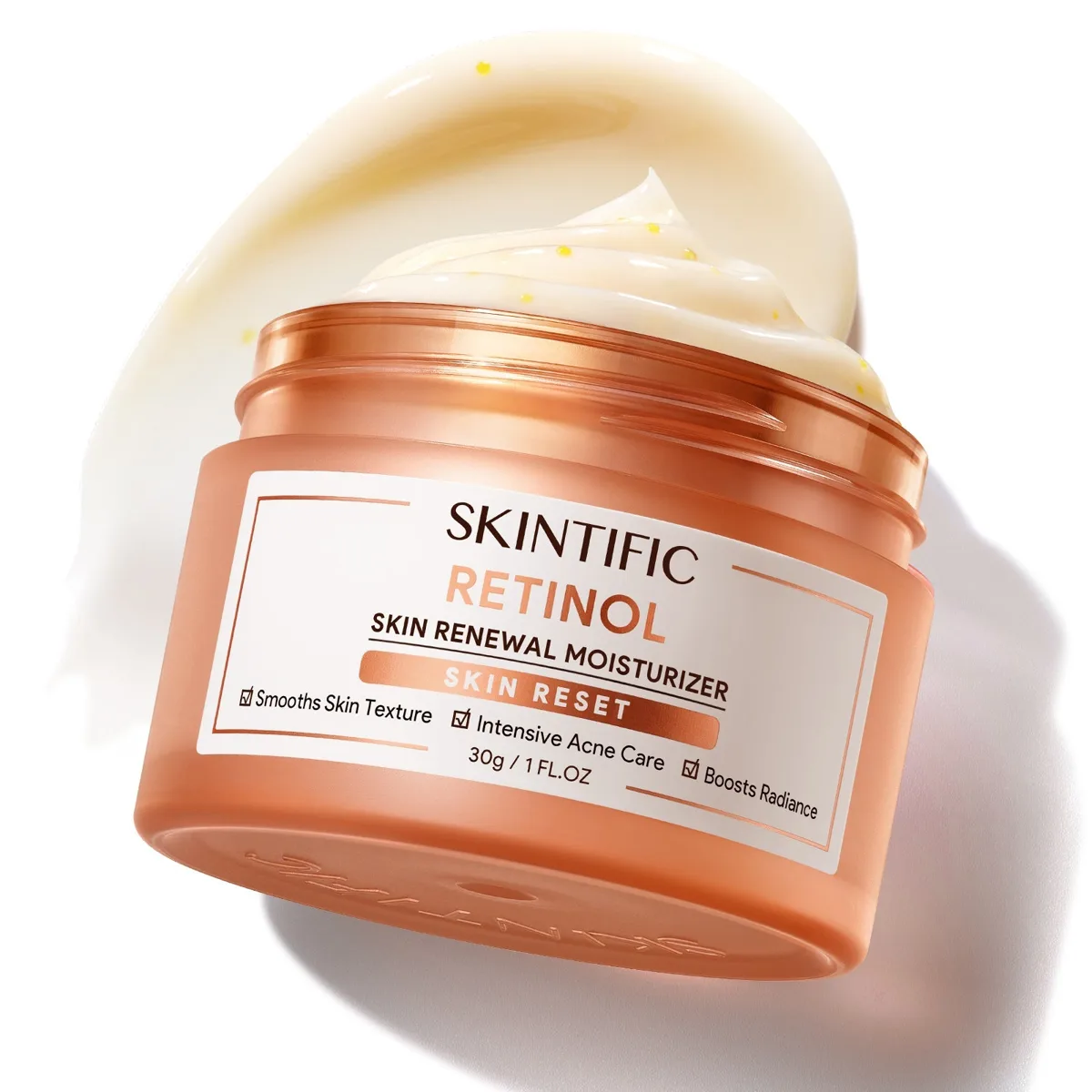
Most retinol creams either dilute the active until it is decorative or ask you to layer a moisturizer over them. This one folds a stated 0.1% encapsulated retinol into Skintific's five-ceramide, squalane-rich moisturizer base and adds zinc PCA and niacinamide for oil, so it is pitched at oily, acne-prone twenty-somethings rather than the usual mature-skin retinol audience. The visible yellow retinol pearls are a genuine encapsulation cue, not just a marketing gimmick.
A rare retinol cream aimed squarely at oily, breakout-prone skin rather than at wrinkles, and it earns that positioning: a stated 0.1% encapsulated retinol buffered by five ceramides, squalane and zinc PCA at under fifteen dollars. The small jar and the brand's short track record are the honest caveats; the formula is not.
Skintific's US store went live in May 2026 and shows about a dozen reviews of this cream, so the score leans on the ingredient list, the brand's encapsulated-retinol serum and Southeast Asian marketplace feedback that could not be independently counted. Long-term performance and irritation rates for this exact formula remain unconfirmed.
The case for it
Cautions: fungal-acne triggers.
What would change this: A declared concentration would move this to a firmer reading of the dose.
Same rule for everyone. “Supporting role” is the verdict on 8,197 of 45,024 concern verdicts across the catalog; rule R8a decided 1,489 of them. As of September 25, 2026, engine 5.1.1.
Brand or formulator? Disclose a concentration or correct a fact →
The studies behind the evidence row
The case for it
Same rule for everyone. “Good choice” is the verdict on 9,564 of 45,024 concern verdicts across the catalog; rule R5 decided 9,072 of them. As of September 25, 2026, engine 5.1.1.
Brand or formulator? Disclose a concentration or correct a fact →
The studies behind the evidence row
The case for it
What would change this: Guideline or regulatory standing for the active on this concern would move this from a promising bet to a recommendation.
Same rule for everyone. “Promising” is the verdict on 7,858 of 45,024 concern verdicts across the catalog; rule R9p decided 7,858 of them. As of September 25, 2026, engine 5.1.1.
Brand or formulator? Disclose a concentration or correct a fact →
The studies behind the evidence row
The case for it
What would change this: Trial evidence for the active on this concern would move this from a bet to a recommendation.
Same rule for everyone. “Unproven” is the verdict on 1,111 of 45,024 concern verdicts across the catalog; rule R9 decided 1,111 of them. As of September 25, 2026, engine 5.1.1.
Brand or formulator? Disclose a concentration or correct a fact →
The studies behind the evidence row
Also listed for Rough Texture and Dullness — the actives here (Niacinamide, Acetyl Glucosamine, phytol, Retinol) are in our research queue for those concerns; there is no verdict until their evidence rows are written. That is a gap in our table, not a mark against the product.
Excellent at the jobDoes what a moisturizer is for, on every measure we can take from the label: supplies barrier lipids, draws in water.
A verdict is DermApproved’s assessment of how well a product’s ingredients fit a concern — never a claim about what the product treats. Evidence dots and collected reviews sit beside it and are never blended in. Rules 0.5.1 · evidence table ev-2026.09-r228 · how we decide
Retinol night creams are usually pitched at one customer: someone in their forties who wants fine lines softened and is willing to pay for a heavy, cocooning jar to do it. Skintific has quietly aimed this one somewhere else. The label leads with acne care, the packaging is the same frosted plastic as the brand's viral moisture gel, and the price is what a drugstore charges for a basic moisturizer. The question worth asking is not whether it is a good retinol cream in the usual sense, but whether a retinoid folded into an oil-controlling moisturizer is a sensible product for the twenty-somethings it is actually selling to. Having gone through the ingredient list line by line, I think it mostly is.
Start with the retinoid itself. The brand states 0.1% retinol, wrapped in hydrogenated lecithin, and you can see the encapsulation because the cream is speckled with small yellow pearls that dissolve as you rub. Retinol sits fourteenth on the INCI list, just after phytol and dimethicone, which is consistent with a fraction of a percent. That is a meaningful dose. It is roughly where most dermatologist-recommended starter retinols land, and it is enough to change how pores shed over eight to twelve weeks, which is the mechanism by which any retinoid prevents comedones. It is not enough to compete with prescription adapalene on inflamed acne, and the label's promise of intensive acne care oversells what a cosmetic retinol can do on its own.
What makes the cream work as a stand-alone moisturizer for oily skin is everything around the retinol. The emulsifier system is cetearyl olivate and sorbitan olivate, an olive-derived pair known for a light, non-tacky skin feel, with squalane and a couple of fast-spreading esters rather than heavy plant butters. Niacinamide is sixth on the list, high enough to matter, and zinc PCA appears in the middle of the formula. That combination is the oil-control argument, and it has decent support: niacinamide has published data on sebum reduction and on post-acne redness, and the zinc salt is a common addition for the same reason. Then there is the brand's signature five-ceramide complex, with NP, NS, AS, EOP and AP all listed. Ceramides do not treat acne, but they are precisely what a retinoid strips out as it speeds turnover, and having them built into the moisturizer means a beginner does not need to buy a second cream to survive the adjustment.
The supporting cast is more interesting than it needs to be at this price. Acetyl glucosamine sits seventh, and its pairing with niacinamide has some evidence for fading post-inflammatory marks, which is the claim on the jar most likely to matter to an acne-prone buyer. Ectoin and bisabolol are the calming pair. Acetyl hexapeptide-8 and ubiquinone are the anti-aging garnish, present at concentrations that are unlikely to do much but which also do no harm. Phytol is the odd one out: the brand calls it a retinol booster, and while there is laboratory work suggesting it interacts with retinoid signalling, I would not count on it for anything in a finished product. Treat it as a curiosity rather than a reason to buy.
In use, the texture is the surprise. It looks like a jar cream and applies like a lotion, thinning out within a few seconds and leaving a soft satin finish that combination skin can wear without waking up shiny. There is no fragrance, only the faint waxy note of the olivate emulsifiers, which fades fast. I would not call it hydrating enough for genuinely dry skin in winter without something on top, but that is the correct trade-off for the audience.
The adjustment period is real, and Skintific's own instructions are more honest than the front label. They tell you to start at two or three nights a week, use it only at night, avoid mixing it with vitamin C and go easy on exfoliation. Follow that. Among the small number of US reviews so far, the pattern is familiar to anyone who has used a retinoid: some flaking around the nose in the second week, a few extra spots, then a smoother stretch from week four. Sensitive or rosacea-prone skin should not read the encapsulation claim as a free pass. Slow release means slower irritation, not none.
The things I would change are practical. Thirty grams in an open-mouth jar is a poor format for retinol, which degrades with air and light; a tube or an airless pump would have served the active better and lasted longer. Nightly face use empties the jar in five or six weeks, so the low sticker price is a little less low over a year. And the brand's track record is short. Skintific launched in 2019, exploded on TikTok Shop across Indonesia and its neighbours, and only reached the US directly in 2026. Its formulas are sensible, but there is no independent testing of this cream, and the enormous review counts you will see on Southeast Asian marketplaces cannot be checked from here.
Still, judged on what is in the jar, this is a well-constructed beginner retinol cream for oily and combination skin that breaks out. It does the job a starter retinoid should, it buffers itself, and it does not ask for a second product. For under fifteen dollars, that is a fair deal. Buy it if you have wanted to start retinol but every cream you have tried felt made for a different, drier face. Skip it if your skin is reactive, or if your acne is inflamed enough that a pharmacist would already be pointing you toward adapalene.
The hero actives that drive this product's performance.
| Ingredient | Function | Evidence |
|---|---|---|
| Retinol (lecithin-encapsulated) (0.1%) | The brand states 0.1% retinol wrapped in hydrogenated lecithin so it releases gradually through the night; in a cream this rich in olivate emulsifiers and squalane, that slow release is what keeps a true retinoid tolerable enough to be used as the moisturizer itself rather than a step under one. | Emerging for Aging |
| Niacinamide + Zinc PCA | Niacinamide sits sixth on the list and, with zinc PCA further down, gives the cream its oil-control and post-acne-mark angle; it also blunts the redness a retinoid can provoke, which matters more here than on a serum because this product has no moisturizer layered over it. | Limited for Acne |
| 5-Ceramide Complex (NP, NS, AS, EOP, AP) | Skintific's house barrier-lipid blend, here doing the job of a buffer cream: the five ceramides plus squalane and cetearyl olivate replace the lipids retinol turnover strips, so peeling stays mild even when nothing else is applied on top. | Not yet assessed |
| Phytol | A diterpene alcohol from chlorophyll that the brand positions as a retinol booster; it appears just ahead of retinol on the label, and while the pairing has some mechanistic logic around retinoid-receptor signalling, it is the least evidenced claim in the formula. | Not yet assessed |
| Ectoin + Bisabolol | The calming pair that lets the cream advertise itself to acne-prone beginners: ectoin binds water around stressed cells while bisabolol quiets the inflammatory response that both breakouts and retinoid adjustment produce. | Not yet assessed |
| Acetyl Glucosamine | Placed unusually high for a night cream, it partners with niacinamide on the dark-mark claim, since the two together have more support for fading post-acne pigment than either alone. | Not yet assessed |
Ingredient standings describe the active at treatment-level doses and vehicles; this product's own condition grades weigh its actual formula.
Aqua, Butylene Glycol, Glycerin, Cetearyl Olivate, Cetearyl Alcohol, Niacinamide, Acetyl Glucosamine, Squalane, Sorbitan Olivate, Caprylic/Capric Triglyceride, Coco-Caprylate/Caprate, Dimethicone, Phytol, Retinol, 1,2-Hexanediol, Hydroxyacetophenone, Ammonium Acryloyldimethyltaurate/VP Copolymer, Zinc PCA, Hydrolyzed Hibiscus Esculentus Extract, Ectoin, Portulaca Oleracea Extract, Lactobacillus/Soymilk Ferment Filtrate, Ceramide NP, Ceramide NS, Ceramide AS, Ceramide EOP, Ceramide AP, Tocopheryl Acetate, Hydrogenated Lecithin, Acetyl Hexapeptide-8, Olea Europaea Fruit Extract, Piper Methysticum Root Extract, Adansonia Digitata Seed Extract, Bisabolol, Sodium Hyaluronate, Ubiquinone, Theobroma Cacao Seed Extract, Dimethyl Isosorbide, Xanthophyll, Hydroxyethylcellulose, Phenoxyethanol, Ethylhexylglycerin, Chlorphenesin
moisturizer
PM
This is the last step of a night routine, not a serum to cover — cleanse, apply any hydrating toner, then a pea-and-a-half of this cream. Keep vitamin C and acid exfoliants for the mornings or for nights you skip it.
Expect a stretch of mild dryness or a few extra spots in the first two to three weeks as turnover speeds up. Oil and pore appearance tends to settle by week four; texture and post-acne marks need eight to twelve weeks, and fine lines longer than that.
The formula's logic rests on three interacting pieces rather than one hero. First, the retinoid: retinol must be converted in skin to retinaldehyde and then to retinoic acid before it acts on the receptors that normalise follicular keratinisation, which is why cosmetic retinol prevents comedones more slowly than prescription adapalene and why the acne benefit here builds over two to three months. Encapsulating the retinol in hydrogenated lecithin serves two purposes: it protects the molecule from oxidation before use and it releases it gradually after application, which in comparative work on encapsulated versus free retinol has been associated with less transepidermal water loss and erythema at equivalent doses.
Second, the oil and mark control. Topical niacinamide has randomised, split-face evidence for lowering sebum excretion and for reducing the redness left after breakouts, and its combination with acetyl glucosamine has been studied for hyperpigmentation with a modest but measurable effect over eight weeks. Zinc PCA is included on the same rationale, though its clinical data as a topical is thinner than niacinamide's.
Third, the barrier. Retinoids increase epidermal turnover and thin the stratum corneum's lipid layer during the first weeks of use. Formulating the five ceramide subtypes alongside squalane and olivate emulsifiers is a direct attempt to replace those lipids in the same application, and ceramide-containing moisturizers have been shown to shorten and soften retinoid adjustment when used alongside a retinoid. The one poorly supported claim is phytol as a retinol enhancer; there is mechanistic laboratory literature on phytol and retinoid pathways, but no clinical demonstration that it boosts a topical retinol cream. I have not been able to open and confirm specific trial records for the exact combinations in this product, so no references are attached here; the evidence base described is for the individual actives, not for this finished formula.
Clinicians who see a lot of adult acne tend to like the idea behind this format: a low-dose retinoid delivered inside the moisturizer, so that the patient who forgets to buffer still gets buffered. The standard advice for a product like this mirrors the brand's own — alternate nights for the first month, a sunscreen every morning, and no acids or vitamin C in the same evening. Where dermatologists usually part company with the label is the acne claim. Cosmetic retinol is a reasonable maintenance and prevention step for comedonal, oily skin, but inflamed or nodular acne is treated with prescription retinoids and, where needed, antimicrobials, and a 0.1% cream should not delay that visit. It is generally regarded as unsuitable in pregnancy, and people with rosacea or eczema are typically steered toward a ceramide moisturizer without the retinoid.
Use at night only. After cleansing and any watery toner, take a pea-and-a-half of cream and press it over the whole face, rubbing until the yellow retinol beads have fully dissolved. Start on two or three non-consecutive nights a week for the first two to three weeks, then move to alternate nights and, if the skin stays calm, nightly. Keep it away from the immediate eye contour and the corners of the nose and mouth in the early weeks. Mornings need a broad-spectrum SPF 50. Do not layer it with vitamin C, acid exfoliants or another retinoid on the same evening, and pause it for a few days if peeling becomes uncomfortable rather than pushing through.
Fourteen ninety for thirty grams looks like a bargain next to encapsulated-retinol creams from prestige brands, and in ingredient terms it is: the retinoid is real, the buffering is thoughtful, and there is no filler fragrance or alcohol. The catch is the jar. Nightly use finishes it in five to six weeks, so a year of the cream costs more than one might assume from the sticker. There is only one size. For an oily-skinned beginner who wants to try retinol without committing to a serum plus a moisturizer, the price is fair and the risk is low. The premium for a brand with a longer clinical history buys you published testing rather than a better ingredient list.
Oily, combination or normal skin in its twenties and thirties that breaks out and wants to begin retinol without buying a separate serum and buffer cream. It also suits anyone who has found conventional retinol creams too heavy or too drying for their skin type.
Anyone pregnant or breastfeeding, and anyone with rosacea, eczema or easily reactive skin, for whom even slow-release retinol is likely to sting. Very dry skin in winter will want a richer base, and people with painful, inflamed acne should be seeing a prescriber rather than starting here.
Ready to try Skintific Retinol Skin Renewal Moisturizer Acne & Anti-Aging Night Cream?
Buy at Amazon ♥A pale, medium-weight cream shot through with tiny yellow retinol beads that burst as you spread it; it thins out quickly and leaves a soft, slightly cushioned feel rather than a film.
No added fragrance — a faint fatty, olive-wax note from the emulsifiers that is gone within a minute.
A 30 g frosted peach plastic jar with a screw lid and an inner disc; no spatula, so you scoop with a finger, and the wide opening exposes the retinol to air each time.
Nothing dramatic on night one — perhaps a little warmth. Around nights four to ten, oily and combination skin often notices a few purging spots along the jaw and some flaking at the nose; both fade by the third week if you hold to the every-other-night schedule.
About five to six weeks at nightly use on the face; closer to ten weeks if you keep to the brand's two-or-three-nights-a-week starting rhythm.
All Year
Skintific built its name on the 5X Ceramide Barrier Repair Moisture Gel, then extended the same base into actives one by one — niacinamide, SymWhite 377, retinol serum. This jar is the retinol range's moisturizer format, launched for Southeast Asian shoppers who wanted the anti-acne benefit of a retinoid without a separate serum step, and it reached the brand's US store in May 2026.
Skintific grew out of the TikTok Shop boom in Indonesia and Southeast Asia, where its ceramide barrier range sells in very large volumes. The brand reached the US direct-to-consumer market in 2026; its claims are ingredient-led and no published trials of this finished night cream exist.
A retinol cream marketed for acne will clear active breakouts within days.
Retinol normalises the way pores shed, which prevents new comedones from forming; in this cream that effect takes four to eight weeks, and the first fortnight can bring more spots to the surface, not fewer.
Encapsulated retinol means it cannot irritate.
The lecithin coating slows delivery and the ceramide base softens it, but 0.1% retinol is still a real dose; sensitive and rosacea-prone skin can flake and sting with this cream just as with any retinoid, only more slowly.
Skintific states 0.1% retinol, encapsulated in hydrogenated lecithin for slow release. That is a genuine beginner-to-intermediate dose — enough to change turnover over a couple of months, low enough that the ceramide and squalane base can keep most oily and combination skin comfortable.
Yes, and that is the audience it is built for: the retinol works on pore shedding while zinc PCA and niacinamide address oil and marks. Expect a purge in weeks one to three, and keep it to alternate nights until that passes. Skip it over open, inflamed lesions if they sting.
Not for combination or oily skin — the five-ceramide, olivate-based cream is the moisturizer. Dry skin in winter may want a thin layer of a plain occlusive on top, or can simply use the cream on fewer nights.
No. Retinol is a vitamin A derivative, and standard guidance is to avoid topical retinoids while pregnant or breastfeeding. The brand's ceramide moisture gel is the retinoid-free alternative in the same range.
Those are the encapsulated retinol pearls, which is why the cream is a night-only product and why you should rub it in until they disappear. They are not exfoliating beads and should never feel gritty after application.
Not on the same night. Retinol plus a 12% acid blend on skin that is already adjusting is a reliable recipe for a compromised barrier. Alternate: acids one night, this cream another, and give both a rest night in between while your skin is new to retinol.
Recurring themes our editors read across retailer reviews of this product — summaries in our words, not quotations, and not a substitute for your own patch test.
Lighter than expected for a jar cream
Fewer breakouts after a month
No sting on first use
Small 30 g jar runs out fast
Mild peeling in week two
Yellow beads need rubbing in