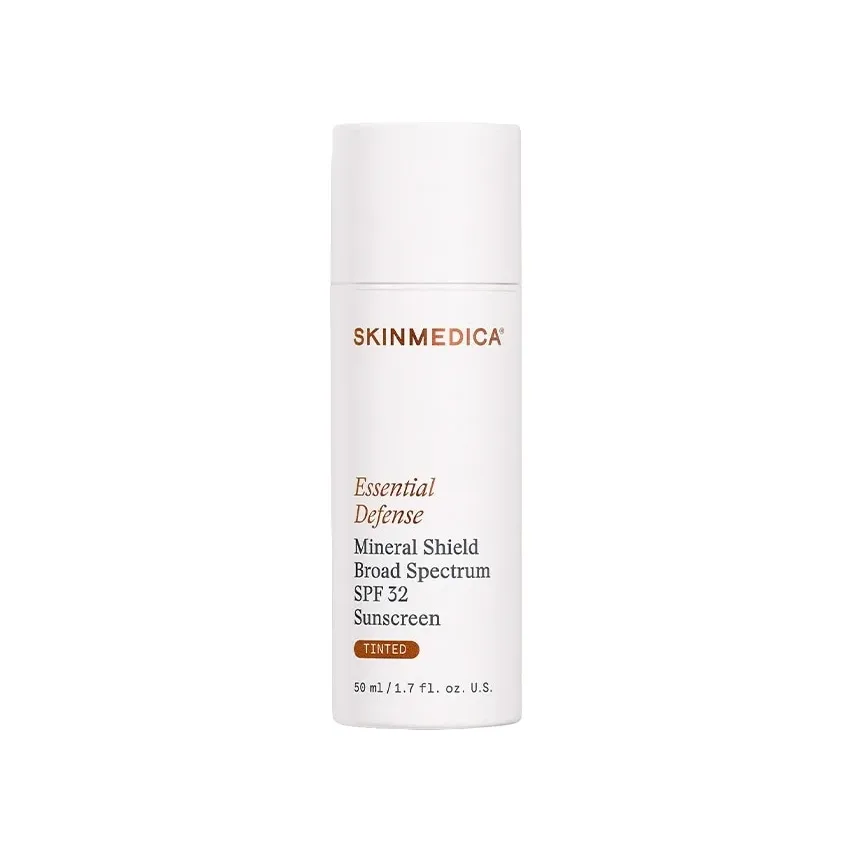
It is the tinted, lower-SPF sibling in SkinMedica's Essential Defense mineral line: titanium dioxide 5 percent and zinc oxide 6 percent with three iron oxides, formulated so the pigment is part of the protection, absorbing the visible light that a colourless mineral filter lets through and that drives melasma and post-inflammatory pigmentation in skin of colour. A silicone-primer base that behaves like light foundation, plus caffeine and tea-seed antioxidants, sets it apart from the plain zinc pastes it is often shelved beside.
The tinted version of SkinMedica's mineral sunscreen is the one to choose for melasma, dark spots and rosacea, because its iron oxides shield the visible light that colourless mineral filters let through, and its silicone-primer base wears like a light foundation that a great many reviewers use as their only makeup. It is SPF 32 without water resistance, comes in one warm-beige shade that runs light on deeper skin, feels dry on dry skin, and costs forty dollars for 1.7 ounces, but within those limits it is a well-judged daily sunscreen.
Full protectionfor Sun DamageIn your profileYou chose · Broad-spectrum SPF 32 with titanium dioxide, zinc oxide: the protection sun damage calls for.Moderate evidenceGentleNo reviews collected yet
The case for it
Titanium Dioxide 5% is a first-line active — approved, monograph-listed or named in current guidelines — for this concern.
It is present at an effective concentration, declared or high in the ingredient list.
The formula carries none of the triggers this concern is sensitive to.
Same rule for everyone. “Full protection” is the verdict on 2,288 of 45,024 concern verdicts across the catalog; rule P1 decided 2,232 of them.
As of September 25, 2026, engine 5.1.1.
P1 — Photoprotection standing is regulatory (M020 / Annex VI filters; 21 CFR 201.327 attaches the early-skin-aging claim to tested broad-spectrum SPF 15+). SPF 30 is the AAD daily-use bar. · the full register
Carrying active
Titanium Dioxide 5%
Standing
first line — a regulator recognises it for this use; trials support it · per § 352.10 Sunscreen active ingredients. (U.S. Food and Drug Administration — 21 CFR Part 352 (Sunscreen Drug Products for Over-the-Counter Human Use), Code of Federal Regulations via GovInfo), opened July 27, 2026
Form
adequate (declared 5%) — studied range up to 25%, from the OTC monograph or label; needs leave-on contact
Tolerability
gentle
Row checked
against its sources on July 27, 2026 (evidence table ev-2026.09-r228)
21 CFR 352.10 — Sunscreen active ingredients — US Food and Drug Administration / Electronic Code of Federal Regulations (retrieved 2026-07-16; note stayed effective date), opened July 16, 2026
Full protectionfor MelasmaIn your profileYou chose · Broad-spectrum SPF 32 with iron oxides for visible light — what melasma needs from a sunscreen.Not yet assessedGentleNo reviews collected yet
The case for it
Titanium Dioxide 5% has no evidence row yet for this concern — it is in the research queue.
The formula carries none of the triggers this concern is sensitive to.
What would change this: A researched evidence row for the lead active would replace this with a verdict.
Same rule for everyone. “Full protection” is the verdict on 2,288 of 45,024 concern verdicts across the catalog; rule P2 decided 56 of them.
As of September 25, 2026, engine 5.1.1.
Full protectionfor HyperpigmentationIn your profileYou chose · Broad-spectrum SPF 32 with titanium dioxide, zinc oxide: the protection hyperpigmentation calls for.Not yet assessedGentleNo reviews collected yet
The case for it
Titanium Dioxide 5% has no evidence row yet for this concern — it is in the research queue.
The formula carries none of the triggers this concern is sensitive to.
What would change this: A researched evidence row for the lead active would replace this with a verdict.
Same rule for everyone. “Full protection” is the verdict on 2,288 of 45,024 concern verdicts across the catalog; rule P1 decided 2,232 of them.
As of September 25, 2026, engine 5.1.1.
P1 — Photoprotection standing is regulatory (M020 / Annex VI filters; 21 CFR 201.327 attaches the early-skin-aging claim to tested broad-spectrum SPF 15+). SPF 30 is the AAD daily-use bar. · the full register
Supporting rolefor RosaceaIn your profileYou chose · Nothing here targets rosacea directly; photoprotection against a known trigger is the recognised companion to treating it, and this lotion does that without known triggers.Not yet assessedGentleNo reviews collected yet
The case for it
Titanium Dioxide 5% has no evidence row yet for this concern — it is in the research queue.
The formula carries none of the triggers this concern is sensitive to.
What would change this: A researched evidence row for the lead active would replace this with a verdict.
Same rule for everyone. “Supporting role” is the verdict on 8,197 of 45,024 concern verdicts across the catalog; rule R8 decided 4,250 of them.
As of September 25, 2026, engine 5.1.1.
R8 — The category's job (barrier care, humectant hydration, gentle cleansing, photoprotection) is the documented supportive role for this concern. This is the honest verdict for a moisturizer on an acne page. · the full register
Full protectionfor Post-ProcedureIn your profileYou chose · Broad-spectrum SPF 32 with titanium dioxide, zinc oxide: the protection post procedure calls for.Not yet assessedGentleNo reviews collected yet
The case for it
Titanium Dioxide 5% has no evidence row yet for this concern — it is in the research queue.
The formula carries none of the triggers this concern is sensitive to.
What would change this: A researched evidence row for the lead active would replace this with a verdict.
Same rule for everyone. “Full protection” is the verdict on 2,288 of 45,024 concern verdicts across the catalog; rule P1 decided 2,232 of them.
As of September 25, 2026, engine 5.1.1.
P1 — Photoprotection standing is regulatory (M020 / Annex VI filters; 21 CFR 201.327 attaches the early-skin-aging claim to tested broad-spectrum SPF 15+). SPF 30 is the AAD daily-use bar. · the full register
Full protectionfor AgingIn your profileYou chose · Broad-spectrum SPF 32 with titanium dioxide, zinc oxide: the protection aging calls for.Not yet assessedGentleNo reviews collected yet
The case for it
Titanium Dioxide 5% has no evidence row yet for this concern — it is in the research queue.
The formula carries none of the triggers this concern is sensitive to.
What would change this: A researched evidence row for the lead active would replace this with a verdict.
Same rule for everyone. “Full protection” is the verdict on 2,288 of 45,024 concern verdicts across the catalog; rule P1 decided 2,232 of them.
As of September 25, 2026, engine 5.1.1.
P1 — Photoprotection standing is regulatory (M020 / Annex VI filters; 21 CFR 201.327 attaches the early-skin-aging claim to tested broad-spectrum SPF 15+). SPF 30 is the AAD daily-use bar. · the full register
Does the jobDoes what a sunscreen is for: UVA coverage, kind to the skin wearing it. Not measured from the label: pleasant enough to actually use.
A verdict is DermApproved’s assessment of how well a product’s ingredients fit a concern — never a claim about what the product treats. Evidence dots and collected reviews sit beside it and are never blended in.
Rules 0.5.1 · evidence table ev-2026.09-r228 · how we decide
Assessment
Pros & Cons
Pros
✓ Iron oxides shield the visible light that drives melasma and dark spots
✓ Pure titanium dioxide and zinc oxide, fragrance-free and organic-filter-free
✓ Silicone-primer base glides on and wears like a light foundation
✓ Does not cake into lines in heat or humidity
✓ Sheer coverage evens redness enough to replace foundation for many
✓ Caffeine and tea-seed antioxidants placed high in the formula
✓ Airless pump keeps pigment and minerals evenly mixed
Cons
✗ One warm-beige shade runs light or off on deeper and olive skin
✗ No water-resistance claim, so daily wear only
✗ SPF 32 is lower than the untinted sibling
✗ Silicone base carries no humectants and feels dry on dry skin
✗ Forty dollars for 1.7 ounces lasts about six weeks
Review
Full Review
Put the two Mineral Shields side by side and the untinted one looks like the serious choice: SPF 35 against SPF 32, more zinc, no pigment to argue with. The numbers mislead. The tinted version carries three iron oxides, red, yellow and black, and iron oxides absorb visible light, the band of the spectrum that sits just past UVA and that colourless mineral filters do almost nothing about. For skin that tans easily and for anyone with melasma or the dark marks that follow a breakout, visible light is a documented trigger of pigmentation, and a sunscreen that blocks it does something the higher-numbered sibling cannot. The three SPF points are a rounding error; the pigment is the point. That inversion, where the cosmetic version is the clinical one, is not obvious from the boxes, and it is the thing a melasma patient most needs to know before choosing between them.
The filters themselves are modest and entirely mineral: titanium dioxide at 5 percent for UVB and zinc oxide at 6 percent for UVA, both silane-coated to disperse in a silicone base, with the iron oxides adding their own broad absorption. There is no octinoxate, no avobenzone, no fragrance, no alcohol, no oil, which is why the reviewer roll at one clinical retailer, 225 of them averaging 4.7, is so full of people with rosacea, reactive skin and a dermatologist's instruction to use mineral only. Several describe the tint as having retired their foundation, and one with rosacea centred on the nose says the goal of wearing only a tinted sunscreen is nearly reached. That is the product's real job, and it does it.
The base is the other half of the achievement. A mineral sunscreen with pigment has every excuse to be a paste, and this one is a smooth, medium-thin lotion with the slip of a silicone primer, built on dimethicone, a volatile silicone and three silicone emulsifiers with a little stearic acid and salt to structure it. It spreads outward like a tinted moisturiser, sets in a minute or two to a soft natural finish with light coverage, holds through humidity without gathering in lines, and grips whatever makeup goes over it. Caffeine and tea-seed leaf extract sit surprisingly high in the list with vitamin E acetate, an antioxidant layer that is welcome and unmeasured; caffeine has a laboratory record for blunting UV damage in skin cells, and while nobody has shown it does so from inside a sunscreen, it costs nothing to have there and the brand, to its credit, makes no claim for it. What the base does not do is hydrate: there is no glycerin, no hyaluronate, nothing emollient beyond the silicones, and the recurring note from dry and mature reviewers is a slightly tight, matte feel by afternoon that a moisturiser underneath resolves. Oily and combination skin, by contrast, find the finish exactly right. That dryness is worth understanding rather than resenting: a silicone-in-water base is chosen precisely because it will not move, crease or transfer, and the same properties that keep the tint in place on a humid afternoon are the ones that leave nothing behind to hydrate. A cream sunscreen would feel kinder at noon and look worse by four.
The shade is the honest limitation. There is one, a sheer warm beige that suits light to medium-tan skin and that some reviewers with fair skin find slightly off and some with deeper or olive skin find light or faintly pink. A universal tint in a mineral sunscreen is a compromise by design, and this one is more forgiving than most because the coverage is light, but anyone outside the middle of the range should test at the jaw in daylight before buying a second bottle. The other limits are on the label: SPF 32 is ample for a working day at the right dose, and there is no water-resistance claim at all, so a beach, a pool or a hard run needs a different sunscreen, which the label says in as many words. Reviewers who paddleboard and walk in it with a hat are using it within its design; anyone planning a day in the water is not.
Forty dollars for 1.7 ounces in an airless pump is a dermatology-counter price, and at a proper nickel-sized dose the bottle lasts about six weeks, which makes it a foundation-and-sunscreen budget line rather than a sunscreen one. Judged as both, which is how most of its reviewers use it, the price is reasonable; judged as a sunscreen alone it is a premium for the iron oxides, the elegance of the base and the mineral-only, fragrance-free discipline, all of which are the reason a melasma or rosacea patient chooses it over the pharmacy shelf. For that patient it is one of the better-designed tinted minerals at its price, and the number on the front is the last thing about it worth worrying over.
Formula
Key Ingredients
The hero actives that drive this product's performance.
The UVA half of a modest, all-mineral filter pair; at 6 percent it relies on the titanium dioxide beside it and on the pigment load of the iron oxides to reach SPF 32, and its low dose is exactly why this tint sits like a light foundation rather than a paste, at the cost of a lower SPF than the untinted sibling.
Regulator-approvedfor Sun Damage · limited certainty
Carries most of the UVB protection and, with the zinc, keeps the formula organic-filter-free for rosacea, post-procedure and reactive skin; silane-coated so that it disperses in the silicone base, and its inherent whiteness is folded into the tint rather than fought.
Regulator-approvedfor Sun Damage · limited certainty
The tint and the reason this version outperforms the untinted one for melasma and dark spots: red, yellow and black iron oxides absorb the visible light that mineral filters transmit, which in skin of colour is a documented trigger of pigmentation, so the sheer universal shade is doing protective work as well as evening the complexion.
A quiet addition high in the inactives with tea-seed extract and vitamin E acetate, giving the formula an antioxidant layer; caffeine has laboratory and animal data for reducing UV-induced damage in skin, and in a leave-on daily sunscreen it is a reasonable bonus rather than a claim the product rests on.
The base is a silicone-in-water emulsion built on dimethicone, volatile cyclopentasiloxane and three silicone emulsifiers, which is what lets a pigmented mineral lotion glide on like a primer, resist creasing into lines in humid weather and grip makeup without a separate base; it is also why the finish reads slightly dry on very dry skin.
Not yet assessed
Ingredient standings describe the active at treatment-level doses and
vehicles; this product's own condition grades weigh its actual formula.
Wear it as the last skincare step and the first makeup step: over a moisturiser that has fully set, dotted and blended outward like a tinted moisturiser, then powder or a little concealer where needed. The single sheer shade suits light to medium-tan skin; deeper skin should test the colour at the jaw, and dry skin should moisturise beneath because the silicone base does not hydrate.
Results Timeline
Even tone and UV protection are immediate on application; the visible-light shielding from the iron oxides shows its value over months of consistent wear as melasma and dark spots stop darkening through the summer, and any fading of existing pigment depends on the brightening products worn beneath it, which this sunscreen protects rather than replaces.
SkinMedica Essential Defense Mineral Shield Tinted Broad Spectrum SPF 32
Sample PM Routine
Cleanser
Azelaic Acid or Retinoid
Moisturizer
Evidence
Science & Expert Perspective
The Science
The formula's distinctive protection is in its colourants rather than its listed actives. Titanium dioxide at 5 percent and zinc oxide at 6 percent, both coated with triethoxycaprylylsilane so they disperse in the silicone phase, provide UVB and UVA attenuation to a tested SPF 32 with broad-spectrum status; the three iron oxides, red, yellow and black, absorb across the visible range that these two particulate filters largely transmit. Visible light has been shown to induce durable pigmentation in darker skin phototypes, and iron-oxide-containing sunscreens are the practical answer to it. A 2020 study in the Journal of Drugs in Dermatology by Dumbuya and colleagues exposed the backs of skin-of-colour volunteers to visible light and compared areas protected by an iron-oxide-containing tinted formulation against untinted SPF 50-plus and unprotected sites, finding that the iron-oxide formulation significantly reduced visible-light-induced pigmentation where the untinted sunscreen did not. That result is the basis for the standard dermatological advice that melasma and post-inflammatory hyperpigmentation patients, particularly those with darker skin, should wear a tinted sunscreen, and it is why the tinted Mineral Shield can be the more protective choice for those patients despite its lower SPF.
The vehicle is a silicone-in-water emulsion of dimethicone, cyclopentasiloxane and several polyglyceryl and PEG silicone emulsifiers, structured with aluminium hydroxide, stearic acid and sodium chloride, which explains the primer-like glide, the resistance to creasing and the dry, non-hydrating finish. Caffeine and Camellia oleifera leaf extract sit unusually high among the inactives with tocopheryl acetate; caffeine has laboratory and animal data suggesting it reduces UV-induced damage in keratinocytes, but its effect in a leave-on sunscreen at this concentration is not established and the brand makes no measured claim for it. The label carries no water-resistance rating, so the SPF applies to dry wear, and no study of this specific product has been published.
Among dermatologists who treat pigmentary disorders, a tinted mineral sunscreen with iron oxides is standard advice for melasma and post-inflammatory hyperpigmentation, because visible light drives both and only pigment blocks it; the tinted Mineral Shield is one of the products a SkinMedica-stocking practice hands over with a hydroquinone, tranexamic acid or azelaic acid regimen for exactly that reason, and its pure-mineral, fragrance-free formula makes it equally the default for rosacea and for skin healing after a peel or laser once the clinic clears sunscreen. Clinicians tend to add three notes: the single shade should be tested on darker skin before purchase, the absence of a water-resistance claim means a separate sport sunscreen for outdoor days, and a quarter teaspoon for face and neck is the dose that earns the labelled SPF. The caffeine and tea-seed extract are regarded as harmless extras rather than reasons to choose it, and the choice between this and the untinted SPF 35 is usually settled by whether pigment is the patient's problem.
Guidance
Usage & Recommendations
How to Use
After moisturiser has set, pump out about a nickel-sized amount, a quarter teaspoon, and dot it across the forehead, cheeks, nose, chin and neck, then blend outward with fingertips as with a tinted moisturiser, working in thin passes rather than one thick one so the shade stays even. Give it a minute or two to set before concealer or powder. Apply fifteen minutes before going out and reapply at least every two hours outdoors, using a water-resistant sunscreen instead for swimming or sweating, as the label directs. Dry skin should moisturise beneath every morning; oily skin may want a light powder over it in humid weather. Test the colour at the jawline in daylight before committing to a full face.
Value Assessment
Forty dollars for 1.7 ounces sits in the upper-mid band of tinted mineral sunscreens, above pharmacy tints and below the luxury bracket, and with no larger size the running cost at a proper daily dose is around seven dollars a week. Whether that is good value depends on what the bottle replaces: most of its reviewers wear it as foundation and sunscreen together, and against a foundation-plus-sunscreen budget it is fair. As a sunscreen alone the premium buys the iron-oxide visible-light protection, an unusually elegant silicone base, a mineral-only and fragrance-free formula and the dermatology channel, none of which the cheaper tints reliably match at once, and all of which matter to a melasma or rosacea patient. Someone without a pigment or sensitivity problem is paying for refinement rather than protection.
Who Should Buy
Anyone being treated for melasma, dark spots or post-inflammatory pigmentation who needs visible-light protection, rosacea and reactive skin that must avoid organic filters and fragrance, and light-to-medium complexions who want a mineral sunscreen that doubles as their only face makeup; dermatology patients using SkinMedica brighteners will find it the intended pairing.
Who Should Skip
Deeper and olive skin tones should test the single warm-beige shade before buying, and anyone who needs water resistance for sport or the beach should look elsewhere for those days. Very dry skin will find the silicone base tight without a moisturiser beneath, and anyone wanting a higher SPF or a colourless mineral should take the untinted Mineral Shield instead.
Ready to try SkinMedica Essential Defense Mineral Shield Tinted Broad Spectrum SPF 32?
A smooth, medium-thin tinted lotion with the silky slip of a silicone primer, in a sheer warm beige that blends outward without streaking, sets in a minute or two to a soft natural finish with light coverage, and stays put through heat without settling into lines.
Scent
No added fragrance; a faint, clean mineral-and-silicone note on application that vanishes once it sets.
Packaging
A slim white airless pump bottle with a white cap, the copper SkinMedica wordmark and 'Essential Defense' in copper italic, 'Mineral Shield Broad Spectrum SPF 32' below and a small copper 'TINTED' tag, 50 mL / 1.7 fl oz; the pump doses evenly and keeps the pigment and minerals from separating, and the bottle is small for its price.
Finish
naturalsatinlightweight
What to Expect on First Use
On first use most people are surprised that a mineral sunscreen spreads like a light tinted moisturiser and evens the complexion enough to skip foundation; the shade reads warm beige and suits light to medium skin best, so the first application is really a colour test, ideally at the jawline in daylight. There is no sting, no white cast and no adjustment period; dry skin notices a slightly tight, matte feel by mid-afternoon in the first week and learns to moisturise beneath, and oily skin may want a light powder over it in humid weather.
How Long It Lasts
Around six weeks of daily face-and-neck wear at a proper dose, or two to three months for those who use it as a light tinted moisturiser on lighter days.
SkinMedica built the Essential Defense line around 2015 as a pair of everyday sunscreens for dermatology patients, a pure-mineral Mineral Shield for reactive and post-procedure skin and a hybrid Everyday Clear for everyone else, and added this tinted mineral version so that patients being treated for melasma and hyperpigmentation could have iron-oxide protection in a formula that also replaced their foundation. It has stayed in the line unchanged and gathered a long record of reviews from rosacea and mature-skin users who wear it as their only face makeup.
About SkinMedica Established Brand (5–20 years)
SkinMedica, founded in 1999 by dermatologist Richard Fitzpatrick and owned by Allergan Aesthetics since 2012, sells through dermatology practices and medspas and lists its sunscreens as OTC drugs on DailyMed. The brand's clinical trials centre on its growth-factor and HA5 products; its Essential Defense sunscreens are judged on their filters, their iron-oxide content and a long, consistent record of patient feedback rather than on product-specific studies.
Brand founded: 1999 · Product launched: 2015
Myth vs. Reality
Common Myths
Myth
The tint is cosmetic, so the untinted SPF 35 protects better.
Reality
The untinted version scores three SPF points higher against UV, but the iron oxides in this one absorb visible light, which mineral filters transmit and which is a proven trigger of pigmentation in skin of colour and in melasma; for anyone treating dark spots, the tinted version is the more protective choice, not the vainer one.
Myth
A mineral sunscreen with only 11 percent total filters must be weak.
Reality
SPF is a tested result, and 5 percent titanium dioxide with 6 percent zinc oxide and a pigment load reached SPF 32 under the FDA protocol, which is ample for everyday exposure applied at the right dose; the limitation is the missing water-resistance claim, not the filter percentage.
FAQ
Frequently Asked Questions
What shade is SkinMedica Essential Defense Mineral Shield Tinted SPF 32?
It comes in one sheer, warm beige universal tint that suits light to medium-tan skin best; deeper and olive complexions sometimes find it runs light or slightly pink, so testing at the jawline in daylight before committing is sensible. The coverage is light, closer to a tinted moisturiser than a foundation.
Is the tinted SkinMedica Mineral Shield better for melasma than the untinted one?
For melasma and dark spots, yes: its iron oxides absorb visible light, which colourless mineral filters transmit and which has been shown to worsen pigmentation in skin of colour, so the tint is protective, not just cosmetic. The untinted SPF 35 has a slightly higher UV rating but no visible-light shielding.
Is SkinMedica Essential Defense Mineral Shield Tinted water-resistant?
No. The label makes no water-resistance claim and tells users to choose a water-resistant sunscreen for swimming or sweating, so this is a daily face sunscreen for ordinary days and needs a sport formula on beach and pool days.
Can I wear SkinMedica Mineral Shield Tinted SPF 32 with rosacea or after a procedure?
Yes; it is a pure titanium dioxide and zinc oxide formula with no organic filters, fragrance or alcohol, and rosacea users make up a large share of its reviewers because the tint also softens redness. After a procedure, follow the clinic's timing for when sunscreen may go on treated skin.
Does SkinMedica Mineral Shield Tinted dry out the skin?
Its silicone-in-water base carries no real humectants or emollients, so dry and mature skin can feel slightly tight by afternoon; reviewers with dry skin solve it by moisturising beneath, and oily and combination skin tend to find the finish just right.
How much SkinMedica Mineral Shield Tinted should I apply?
A nickel-sized amount, about a quarter teaspoon, for the face and neck to reach the labelled SPF 32, applied fifteen minutes before sun exposure and reapplied every two hours outdoors; at that dose the 1.7-ounce pump bottle lasts around six weeks of daily wear.
Reviews
What Reviewers Tend to Say
Recurring themes our editors read across retailer reviews of this product — summaries in our words, not quotations, and not a substitute for your own patch test.
Common Praise
Replaces foundation with a natural, even finish
Does not irritate rosacea or reactive skin
Glides on like a lotion and does not cake into lines in humidity
Good base for makeup
Reliable for everyday outdoor activity with a hat
Common Complaints
Single shade runs light or slightly off on some skin tones
Can leave skin feeling a bit dry
SPF 32 and no water resistance limit it to daily wear
Every pigment-fading active runs against a re-pigmenting stimulus, and for melasma part of that stimulus is visible light — which broad-spectrum sunscreen does essentially nothing about unless you can see it on your face.
We have spent years praising Japanese filter chemistry while ignoring that the filter is the last line of a system built out of fabric, shade and timing — the part that needs no importing and does not depend on you remembering to reapply.
Aug 28, 2026· 10 min
Questions people ask about Melasma
Verified answers from our questions library — the nuance a product page cannot carry.
Products, answers, therapy guides, tools and articles in one search. Brand names,
slang and abbreviations all work — accutane finds isotretinoin, bacne finds truncal acne.