Most ceramide creams carry their lipids in an oil phase; this one declares five ceramide subclasses plus cholesterol in a base with no oil at all, held by hydrogenated lecithin in 85 percent calendula distillate. That combination, barrier lipids for skin that cannot tolerate richness, is rarer than it sounds at under twenty dollars, and it is why the cream works for oily and sensitive faces that abandon every other barrier product.
A quietly clever oil-free barrier cream: five ceramides and cholesterol in lecithin liposomes, suspended in 85 percent calendula water, for skin that wants lipid repair without a drop of oil. Excellent for dehydrated combination, oily and reactive faces, too light alone for dry ones, and hard to buy outside Korean export shops. At under twenty dollars it is one of Sidmool's best arguments.
Sidmool sells this cream direct and through Korean export shops with no English-language review base that could be verified, so the assessment is built on the declared ingredient list, the established science of ceramide and cholesterol replacement and the brand's twenty-five-year record with botanical lines. The brand does not publish concentrations or independent tests, and its Korean review pool could not be counted for this entry.
Verdicts
How well it fits each concern
Verdict by concern tap a concern for the case
Supporting rolefor DehydrationIn your profileYou chose · Nothing here targets dehydration directly; humectant hydration is the recognised companion to treating it, and this gel cream does that without known triggers.Not yet assessedGentleNo reviews collected yet
The case for it
Calendula Officinalis Flower Water has no evidence row yet for this concern — it is in the research queue.
The formula carries none of the triggers this concern is sensitive to.
What would change this: A researched evidence row for the lead active would replace this with a verdict.
Same rule for everyone. “Supporting role” is the verdict on 8,197 of 45,024 concern verdicts across the catalog; rule R8 decided 4,250 of them.
As of September 25, 2026, engine 5.1.1.
R8 — The category's job (barrier care, humectant hydration, gentle cleansing, photoprotection) is the documented supportive role for this concern. This is the honest verdict for a moisturizer on an acne page. · the full register
Good choicefor SensitivityIn your profileYou chose · No fragrance, drying alcohol, declarable allergens or sensitising preservatives in this gel cream — the profile sensitive skin looks for.Not yet assessedGentleNo reviews collected yet
The case for it
Calendula Officinalis Flower Water has no evidence row yet for this concern — it is in the research queue.
The formula carries none of the triggers this concern is sensitive to.
What would change this: A researched evidence row for the lead active would replace this with a verdict.
Same rule for everyone. “Good choice” is the verdict on 1,938 of 45,024 concern verdicts across the catalog; rule F2 decided 1,938 of them.
As of September 25, 2026, engine 5.1.1.
Good choicefor Compromised Skin BarrierIn your profileYou chose · Ceramides is a reference standard by mechanism for compromised skin barrier; this gel cream carries it.Moderate evidenceGentleNo reviews collected yet
The case for it
Ceramides NP, EOP, NS, AS, AP has trial-supported standing for this concern.
It is plausibly present at a working level, though the concentration is not declared.
The formula carries none of the triggers this concern is sensitive to.
What would change this: A declared concentration would move this to a firmer reading of the dose.
Same rule for everyone. “Good choice” is the verdict on 9,564 of 45,024 concern verdicts across the catalog; rule R5 decided 9,072 of them.
As of September 25, 2026, engine 5.1.1.
R5 — Trial-supported or guideline-supported active, adequately or plausibly dosed. · the full register
Carrying active
Ceramides NP, EOP, NS, AS, AP
Standing
supported — its mechanism is established
Form
plausible — studied range 0.5–1%, from the trials on the row; needs leave-on contact; judge it after ~4 weeks
Tolerability
gentle
Row checked
against its sources on July 17, 2026 (evidence table ev-2026.09-r228)
The studies behind the evidence row
Elias PM, Skin Barrier / Coderch et al., ceramides and skin barrier function — ceramides ~50% of SC intercellular lipid mass, essential to the permeability barrier — reference work
Also listed for Excess Oiliness — the actives here (Calendula Extract, Phospholipids, Cholesterol, Licorice Root Extract) are in our research queue for that concern; there is no verdict until their evidence rows are written. That is a gap in our table, not a mark against the product.
Does the jobDoes what a moisturizer is for: supplies barrier lipids, draws in water.
A verdict is DermApproved’s assessment of how well a product’s ingredients fit a concern — never a claim about what the product treats. Evidence dots and collected reviews sit beside it and are never blended in.
Rules 0.5.1 · evidence table ev-2026.09-r228 · how we decide
Assessment
Pros & Cons
Pros
✓ Five declared ceramide subclasses plus cholesterol in an oil-free base
✓ Hydrogenated lecithin carries the lipids without any fat phase
✓ 85 percent calendula flower water replaces plain water for soothing
✓ Fragrance-free, alcohol-free and silicone-free
✓ Absorbs to a dewy, non-greasy finish that sits well under sunscreen
✓ Allantoin and licorice add calming for post-acid or post-retinoid skin
✓ Under twenty dollars for 80 ml, cheaper than clinical oil-free ceramide gels
Cons
✗ No meaningful free fatty acid component, so the barrier recipe is incomplete
✗ Too light on its own for dry skin, especially in winter
✗ Calendula is a daisy-family contact allergen despite its gentle reputation
✗ Ceramide concentrations are not disclosed
✗ Not fungal-acne-safe because of the lecithin and stearate
✗ Only available through Korean export retailers with variable pricing
Review
Full Review
There is a formulation problem that every oily, reactive face runs into eventually: the barrier is damaged, ceramides are what it needs, and every ceramide cream on the shelf carries its lipids in a fat phase that the skin will not forgive. Sidmool's Calendula Ampoule Moisture Cream is an answer to that problem, and a neat one. It declares five ceramide subclasses and cholesterol, and it contains no oil at all, because it carries the lipids in hydrogenated lecithin, a phospholipid that forms liposome-like structures in water, and it uses marigold distillate rather than plain water as the base. It is the kind of solution a brand that began as a DIY-formulating community would arrive at, and it is why this tube deserves more attention than its Korean-only packaging gets it.
The list tells the story cleanly. Calendula officinalis flower water leads at a stated 85 percent, then glycerin and butylene glycol as humectants, then the lecithin. Hexanediol preserves. Then ceramides NP, EOP, NS, AS and AP in a row, followed by cholesterol, which is a fuller ceramide roster than most drugstore barrier creams declare and a more honest one than the 'ceramide complex' shorthand many brands use. Quercetin, kaempferol and saponins are listed separately, which is Sidmool's way of declaring the flavonoids it credits to the calendula. Glyceryl stearate is the only fatty acid derivative. A run of Ayurvedic-style extracts, neem, turmeric, holy basil and a red algae, sits mid-list; water reappears late, then allantoin and dipotassium glycyrrhizate for calming, xanthan for body, and a trace of triglyceride and heptyl undecylenate at the end. No fragrance, no essential oils, no silicone, no alcohol.
On the skin it behaves like a thick lotion rather than a cream. It goes on cool and watery, spreads easily, and sinks in within a minute, leaving a dewy, faintly tacky finish that settles as it sets. Under sunscreen it disappears; at night it feels like enough for combination skin and like a first layer for dry skin. It also layers without complaint: a serum underneath does not pill it, a sunscreen on top does not slide, and a dab of oil pressed over it at night turns it into something dry skin can live with, which is the sensible way to use it in a cold month. The soothing is real and quick. Skin that has just been through an acid or a retinoid, or that flushes at the sight of a rich cream, tends to feel calmer within minutes, which is the calendula, allantoin and licorice doing their modest, well-supported work.
What the cream does over weeks is where the ceramides matter. Dehydrated combination skin, the kind that is oily by noon and tight by four, stops swinging so hard; the barrier holds water better and the T-zone overproduces less in compensation. It is not a dramatic transformation, and the brand does not publish concentrations, so there is no way to say how much ceramide is actually being delivered. But the placement ahead of the emulsifier and extracts suggests a functional level, and the effect on reactive skin is consistent with it.
The limitations are structural. An oil-free formula cannot supply the free fatty acid third of the barrier-lipid recipe in any meaningful amount, so the repair story is two-thirds complete. Dry skin will feel that within an hour, especially in winter, and will need an oil or a richer cream over the top. The lecithin and stearate mean it is not fungal-acne-safe despite the oil-free label. And calendula, for all its reputation, is a daisy-family plant and a recognized contact allergen; a cream that is 85 percent marigold water should be patch tested by anyone who reacts to chamomile or ragweed. The neem and turmeric extracts are the other ingredients a very reactive user might eye, though at their positions they are unlikely to matter.
Then there is the practical problem, which is finding it. Sidmool has no US distributor, so the tube arrives via Korean export retailers at somewhere between eighteen and twenty-four dollars plus shipping, in Korean-only packaging, with no domestic review base to consult. The brand is twenty-five years old and well trusted in Korea, but an English-speaking buyer is taking that on faith and on the ingredient list. Fortunately the ingredient list is the strongest thing about the product.
For what it is, the price is good: a five-ceramide, cholesterol-containing, fragrance-free moisturizer at under twenty dollars for 80 millilitres would be a fair deal from any brand, and it is a genuine bargain against the oil-free ceramide gels from clinical labels that cost twice as much for less. If your skin is combination, oily or reactive and every barrier cream has felt like a mistake, this is the one to try. If your skin is dry, it is a good first layer and an incomplete last one. Either way, it is a smart piece of formulating hiding behind a yellow tube most people will never see on a shelf.
Formula
Key Ingredients
The hero actives that drive this product's performance.
Replaces plain water as the entire base of the cream at a stated 85 percent, so every other ingredient is dispersed in marigold distillate rather than added to it. It is the source of the soothing claim and of the cream's faint herbal scent; the flavonoids quercetin and kaempferol listed separately are its declared actives.
Five ceramide subclasses listed sixth through tenth, ahead of cholesterol, in an oil-free base where they are carried by hydrogenated lecithin rather than by a fat phase. That is a more complete ceramide profile than most drugstore barrier creams declare, though the concentrations are not given.
Established mechanismfor Compromised Skin Barrier · established mechanism
Sits directly after the ceramides to complete two of the three stratum corneum lipid classes; the free fatty acid third is only nominally present via glyceryl stearate, which is the gap an oil-free formula leaves in the barrier-lipid recipe.
Fourth on the list and the reason five ceramides can be suspended in a water-based gel with no oil: it forms liposome-like structures that hold the lipids and help them deposit on the skin, and it gives the cream its light, slightly tacky slip.
The licorice-derived anti-irritant near the end of the list, paired with allantoin, which together give the cream a calming edge on reactive skin that goes beyond what the calendula water alone would do.
Not yet assessed
Ingredient standings describe the active at treatment-level doses and
vehicles; this product's own condition grades weigh its actual formula.
Light enough to sit under sunscreen in the morning and to double as a soothing layer after acids or retinoids at night. Dry skin can seal it with a drop of oil or a richer cream on top; the brand's own Calendula Ampoule Toner is the intended pairing beneath it.
Results Timeline
Immediate: a cool, watery cream that calms tightness and sets to a dewy, non-greasy finish. 1-2 weeks: dehydrated combination skin stops feeling tight by midday and redness around the nose settles. 4-8 weeks: consistent ceramide and cholesterol delivery leaves the barrier more resilient, though a dry-skin user will still want an occlusive over it in winter.
The barrier-repair logic rests on the composition of the stratum corneum's intercellular lipids, which are roughly equimolar ceramides, cholesterol and free fatty acids, and on the finding that topical replacement works best when it respects that mix. Man, Feingold, Thornfeldt and Elias showed in barrier-disrupted skin that an equimolar mixture of the three lipid classes permitted normal repair while incomplete mixtures could actually delay it, and that increasing any one class up to threefold accelerated recovery (Journal of Investigative Dermatology, 1996). This cream delivers two of the three classes convincingly, five ceramide subclasses spanning the NP, EOP, NS, AS and AP structures, plus cholesterol, but supplies fatty acids only indirectly through glyceryl stearate, which is the formula's principal scientific gap and the reason dry skin finds it incomplete. The five-subclass declaration is worth noting: ceramide EOP in particular is the long-chain, linoleate-esterified species most depleted in atopic and barrier-impaired skin, and its inclusion is more than cosmetic if the concentration is meaningful, which the brand does not state.
The delivery system is the interesting part. Hydrogenated lecithin, listed fourth, is a saturated phospholipid that self-assembles into bilayer vesicles in water and is widely used to disperse ceramides in oil-free formulas; such liposomal carriers improve the deposition of lipids into the upper stratum corneum compared with simple suspensions, and they explain how a cream with no oil phase can carry a full ceramide roster. Glycerin and butylene glycol provide humectancy under that lipid layer.
The botanical claims are more modest. Calendula officinalis extracts contain triterpenoids, flavonoids such as quercetin and kaempferol, and saponins with anti-inflammatory and wound-healing activity in laboratory and small clinical studies, chiefly in wound and radiation-dermatitis settings; evidence for calendula water as a daily soothing agent in cosmetics is limited to that mechanism and to brand testing. Allantoin and dipotassium glycyrrhizate are well-established anti-irritants. The neem, turmeric, holy basil and Corallina extracts are trace inclusions without meaningful topical evidence at these levels. Calendula's status as an Asteraceae contact allergen is documented, with cross-reactivity to chamomile and related plants, and a base that is 85 percent calendula distillate represents a real, if low-frequency, sensitization exposure.
For oily or acne-prone patients with a compromised barrier, the usual clinical difficulty is that recommended ceramide creams are too rich to be tolerated, and an oil-free ceramide-and-cholesterol gel-cream of this type is the format clinicians reach for in that situation, typically alongside a retinoid or acid regimen that needs buffering. It is regarded as a maintenance moisturizer rather than a treatment, and for atopic or very dry skin the standard advice remains a cream that also supplies fatty acids or petrolatum, with a product like this used as an under-layer. Calendula would be noted for any patient with a history of Asteraceae or chamomile allergy, where patch testing before regular use is the sensible course. The formula contains nothing of concern in pregnancy. The absence of published concentrations is a limitation clinicians would flag when comparing it with brands that disclose their ceramide levels.
Guidance
Usage & Recommendations
How to Use
After cleansing and toning, take a fingertip-sized amount and spread it over the face and neck while the skin is still slightly damp, pressing rather than rubbing so the gel sets evenly; it absorbs within a minute. Use morning and evening. In the morning follow with sunscreen once it has set. At night it can go directly over a retinoid or acid once that has absorbed, where its calming ingredients help. Dry skin should apply a facial oil or a richer cream over it, particularly in winter. Patch test on the inner arm first if you have any daisy-family allergy, since the base is calendula water. Keep the cap closed; the gel dries at the nozzle if left open.
Value Assessment
At roughly nineteen dollars for 80 millilitres through Korean export retailers, with eBay listings running from about eighteen to twenty-four dollars before shipping, this cream costs less per millilitre than the oil-free ceramide gels sold by clinical and dermatological brands in the US, while declaring a fuller ceramide profile than most of them. The value is strong for combination, oily and reactive skin that will use it as its only moisturizer, and weaker for dry skin that must buy an occlusive to finish the job. Sidmool's direct-sale model and lack of a US distributor mean shipping adds several dollars and stock can be intermittent, which is the real cost of buying a small Korean brand. There is one size.
Who Should Buy
Combination, oily, dehydrated or sensitive skin that needs barrier support without oil, anyone buffering a retinoid or acid routine who finds ceramide creams too heavy, and fans of Sidmool's Calendula Ampoule Toner looking for the matching moisturizer. A strong pick for humid climates and summer.
Who Should Skip
Dry and very dry skin will find it incomplete on its own and should pair it with an occlusive or choose a cream with a fat phase. Anyone with an Asteraceae or chamomile allergy should patch test or avoid a product that is mostly calendula water, and those managing fungal acne should note the lecithin and stearate.
Ready to try Sidmool Calendula Ampoule Moisture Cream?
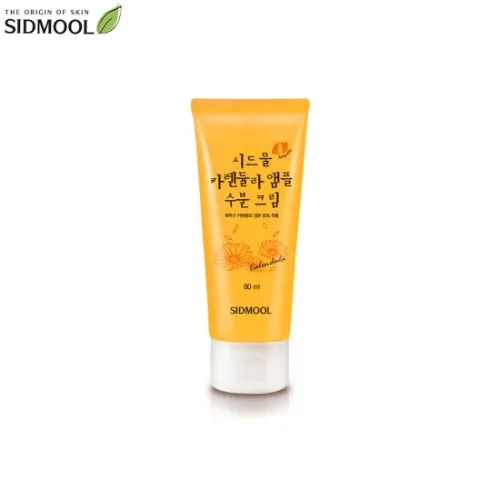
A translucent, pale yellow gel-cream that feels like a thick lotion, spreads cool and watery, and sets within a minute to a soft, faintly tacky, dewy finish.
Scent
No added fragrance; a mild green, hay-like note from the calendula water that fades on absorption.
Packaging
An 80 ml marigold-yellow squeeze tube with a white flip cap, printed in Korean; hygienic and easy to dose, with no outer box on export orders.
Finish
dewylightweightfast-absorbing
What to Expect on First Use
The first application feels closer to a gel than a cream, cool on contact and quick to sink in, with a brief tackiness that disappears as it sets. Reactive skin tends to feel calmer within minutes rather than stung. Very dry skin notices immediately that there is no oil and may want a second layer or something over it.
How Long It Lasts
About two months at twice-daily face application; longer if used only at night under a richer cream.
Sidmool has built lines around single botanicals since its DIY-community beginnings in 2000, and the Calendula series was its answer to users who found centella too trendy or too astringent. The Ampoule Moisture Cream arrived around 2020 to sit above the Calendula Ampoule Toner, taking the brand's ceramide-liposome technology from the Dr. Troub range and dropping it into a marigold base for dehydrated, reactive skin.
About Sidmool Established Brand (5–20 years)
Sidmool grew out of a Korean DIY-cosmetics community in 2000 and has spent twenty-five years selling high-concentration, minimalist formulas direct from its own site, with in-house irritation tests on some lines but no independent clinical publications. It reaches US buyers mainly through Korean export retailers rather than any domestic distributor.
Brand founded: 2000 · Product launched: 2020
Myth vs. Reality
Common Myths
Myth
An oil-free cream cannot repair the skin barrier.
Reality
Barrier repair depends on delivering ceramides, cholesterol and fatty acids, not on oil. This cream carries five ceramides and cholesterol in lecithin liposomes with no oil phase; what it lacks is a meaningful free fatty acid component, which is a real but partial gap, not a disqualification.
Myth
Calendula is universally soothing and safe for sensitive skin.
Reality
Calendula is a member of the daisy family and a recognized, if uncommon, contact allergen. Most reactive skin tolerates it well, but anyone with a known Asteraceae allergy, to chamomile, ragweed or arnica, should patch test a cream that is 85 percent marigold water.
FAQ
Frequently Asked Questions
Is Sidmool Calendula Ampoule Moisture Cream suitable for oily skin?
It is one of the better ceramide creams for oily skin precisely because it has no oil phase: the ceramides and cholesterol are carried by hydrogenated lecithin in a calendula-water gel, so it hydrates and supports the barrier without adding shine or weight.
Does the Sidmool Calendula cream contain real ceramides?
Yes, five declared subclasses, NP, EOP, NS, AS and AP, plus cholesterol, listed sixth through eleventh. Concentrations are not stated, which is typical of Sidmool, but the placement ahead of the emulsifier and extracts suggests a functional rather than token level.
Is the Sidmool Calendula Ampoule Moisture Cream fungal-acne safe?
Not by the usual lists. Hydrogenated lecithin, glyceryl stearate and the trace of caprylic/capric triglyceride are fatty ingredients that Malassezia can use, so people managing fungal acne generally avoid it despite the oil-free label.
Can I use Sidmool Calendula cream with retinol or acids?
Yes, and it is a sensible partner. There are no actives of its own to stack irritation, and the ceramides, allantoin and licorice help buffer retinoid or acid dryness. Apply the treatment first, let it absorb, then the cream.
Is Sidmool Calendula Ampoule Moisture Cream fragrance-free?
It has no added fragrance or essential oil. The faint green scent comes from the calendula flower water that makes up most of the formula, and it fades within a minute of application.
Where can I buy Sidmool Calendula Ampoule Moisture Cream in the US?
Sidmool has no US distributor, so it is sold through Korean export retailers such as Beauty Box Korea, StyleJolly and eBay sellers, typically for eighteen to twenty-four dollars plus shipping. Prices vary by seller and stock is intermittent.
Reviews
What Reviewers Tend to Say
Recurring themes our editors read across retailer reviews of this product — summaries in our words, not quotations, and not a substitute for your own patch test.
Western sensitive skincare works by subtraction — remove the fragrance, remove the alcohol, shorten the list. Japan's answer adds a designed molecule back in, and one of the two bets has a trial literature.
'Barrier repair' is the most over-used phrase in skincare, usually printed on products that contain none of the lipids a barrier is actually built from.
A wrecked barrier is the most common self-inflicted skin condition and the one with the clearest fix — the difficulty is that the routine which caused it feels productive and the one that repairs it feels like giving up.
Eczema care has quietly split into two worlds: the ceramide-and-occlusion basics that manage most cases, and a new class of drugs rewriting what's possible for severe disease. Knowing which world you're in changes the whole plan.
Jun 5, 2026· 6 min
Questions people ask about sensitive skin
Verified answers from our questions library — the nuance a product page cannot carry.
Products, answers, therapy guides, tools and articles in one search. Brand names,
slang and abbreviations all work — accutane finds isotretinoin, bacne finds truncal acne.