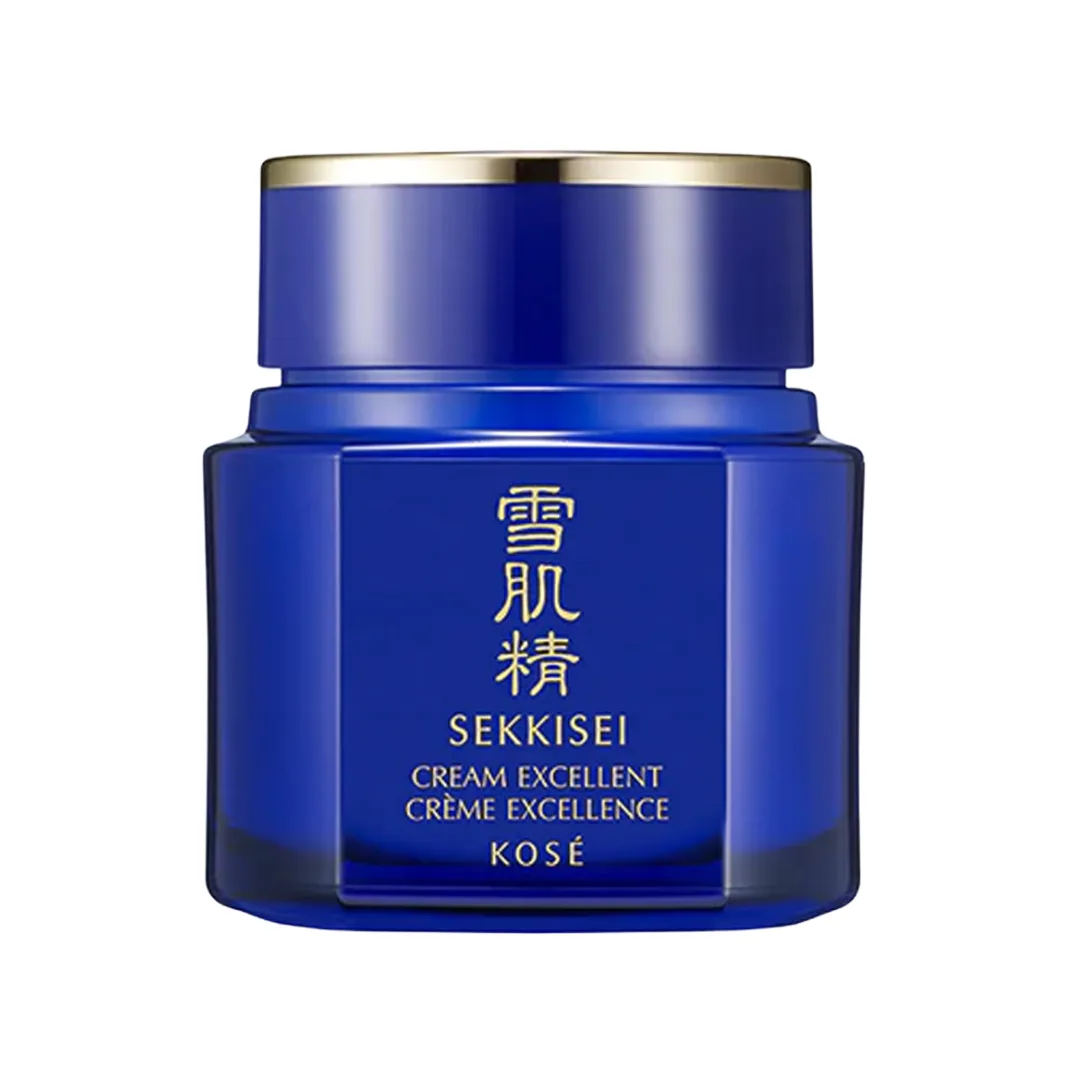
This is the most indulgent cream in Sekkisei's lineup, pairing a stable vitamin C derivative with skin-identical barrier lipids — cholesterol and lecithin — and a meadowfoam-and-squalane emollient base. It folds the brand's heritage herbal complex, expanded with ginseng and cordyceps, into a genuinely rich moisturizer aimed at mature, dry skin rather than the line's lighter lotions.
Sekkisei's richest cream pairs a stable vitamin C derivative and skin-identical barrier lipids with a meadowfoam-and-squalane base, delivering immediate cushion and gradual brightening for dry, mature skin. But at $88 for 50ml — and with menthol, alcohol, fragrance, and a paraben trio onboard — it's a comfort-and-heritage purchase more than a value one.
Supporting rolefor AgingIn your profileYou chose · Vitamin C has early evidence for aging, and hydration and barrier support is the recognised companion to treating it — a reasonable supporting choice, short of a recommendation.Moderate evidenceStandard tolerabilityNo reviews collected yet
The case for it
Ascorbyl Glucoside has early or mechanistic evidence for this concern, not trial-backed standing.
It is plausibly present at a working level, though the concentration is not declared.
The formula carries no trigger this concern is sensitive to, with the cautions noted.
Cautions: a photosensitising active — use sun protection.
What would change this: A declared concentration would move this to a firmer reading of the dose.
Same rule for everyone. “Supporting role” is the verdict on 8,197 of 45,024 concern verdicts across the catalog; rule R8a decided 1,489 of them.
Unchanged since September 5, 2026, engine 5.1.1.
R8a — A plausible-tier active in a category with a supportive job: the sentence names the active instead of saying nothing targets the concern (the AmLactin / CeraVe SA case for keratosis pilaris, where no guideline and single trials leave the keratolytics at early evidence). · the full register
Carrying active
Ascorbyl Glucoside
Standing
plausible — trials support it
Form
plausible — studied range 5%, from the trials on the row; needs leave-on contact; judge it after ~12 weeks
Tolerability
standard — photosensitization
Row checked
against its sources on July 17, 2026 (evidence table ev-2026.09-r228)
Good choicefor DrynessIn your profileYou chose · Squalane is a reference standard by mechanism for dryness; this cream carries it.Moderate evidenceStandard tolerabilityNo reviews collected yet
The case for it
Meadowfoam Seed Oil + Squalane has trial-supported standing for this concern.
It is plausibly present at a working level, though the concentration is not declared.
The formula carries no trigger this concern is sensitive to, with the cautions noted.
Cautions: fragrance.
What would change this: A declared concentration would move this to a firmer reading of the dose.
Same rule for everyone. “Good choice” is the verdict on 9,564 of 45,024 concern verdicts across the catalog; rule R5 decided 9,072 of them.
Unchanged since September 5, 2026, engine 5.1.1.
Also listed for Dullness — the actives here (Phospholipids, Vitamin C, Cordyceps, Squalane) are in our research queue for that concern; there is no verdict until their evidence rows are written. That is a gap in our table, not a mark against the product.
Does the jobDoes what a moisturizer is for: draws in water, softens and smooths.
A verdict is DermApproved’s assessment of how well a product’s ingredients fit a concern — never a claim about what the product treats. Evidence dots and collected reviews sit beside it and are never blended in.
Rules 0.5.1 · evidence table ev-2026.09-r228 · how we decide
Assessment
Pros & Cons
Pros
✓ Stable vitamin C derivative supports brightening and firmness
✓ Skin-identical barrier lipids reinforce the moisture barrier
✓ Rich meadowfoam-and-squalane base feels genuinely cushioning
✓ Immediate plumping comfort for dry, mature skin
✓ A small amount covers the face, stretching the jar
✓ Heritage herbal complex with a distinctive, beloved scent
Cons
✗ Steep $88 price for only 50ml
✗ Menthol adds a cooling tingle some skin won't tolerate
✗ Contains alcohol, fragrance, and a paraben trio
✗ Too rich and occlusive for oily or acne-prone skin
✗ Firming effect is gradual and modest, not dramatic
Review
Full Review
Sekkisei built its reputation on a thin blue lotion, so a dense, jar-bound anti-aging cream is the brand reaching for a different shelf entirely — the luxury moisturizer aisle, where the competition is fierce and the prices are unapologetic. Cream Excellent is that bid, and the interesting question is whether four decades of herbal-brightening heritage translate into a convincing rich cream, or whether it's the lotion's DNA squeezed into a heavier package at a heavier price.
The formula is genuinely more substantial than the brand's lighter offerings, and it's worth walking through. The emollient core arrives early: meadowfoam seed oil, prized for its stability and cushiony slip, sits third, with squalane just behind it. These give the cream its melt-on-skin richness and do the immediate work of softening and sealing. Then comes the part that earns the 'treatment' framing — ascorbyl glucoside, a stable vitamin C derivative that releases vitamin C gradually to support collagen and even out tone. It's the one ingredient here with real evidence behind the radiance-and-firmness promises, and its presence is what separates this from a purely comforting moisturizer.
More impressive, to my eye, are the barrier lipids. Cholesteryl hydroxystearate and hydrogenated lecithin are skin-identical or skin-mimicking lipids that help reinforce the moisture barrier rather than simply coat it. That's a thoughtful inclusion in a rich cream and the credible basis for its resilience claims — you're not just trapping water, you're giving the barrier components it recognizes. Layered on top is Sekkisei's signature herbal complex, expanded here with ginseng, cordyceps, and gynostemma alongside the usual angelica and Job's Tears. These are the soul of the brand and the source of the warm herbal scent, but I'd be doing you a disservice to call them proven anti-aging actives. They're heritage and sensory experience, not clinical firepower.
The menthol deserves an honest word, because it's the most divisive thing here. It's present at a low, sensory level — enough to register as a faint cooling tingle on application, not enough to be an active doing skincare work. For a lot of longtime Sekkisei users, that cool note is part of the pleasure and signals 'freshness'; for menthol-sensitive or genuinely reactive skin, it's an unnecessary irritant in a product that otherwise wants to position itself around barrier support. That tension — a barrier cream with a sensory irritant in it — is the formula's central contradiction, and where you land on it depends entirely on your own tolerance. Seasonally, this is a cold-weather cream. The richness that feels luxurious in winter can feel like too much in summer humidity, so most people will get the best mileage treating it as a fall-and-winter night cream. And because it comes in a jar, basic hygiene helps: use clean fingers or a small spatula to keep the antioxidants and vitamin C derivative from degrading faster than they should once air and fingertips get involved.
The texture is the selling point and delivers exactly as promised: dense in the jar, melting to a silky, faintly oily veil that leaves skin plumped and cushioned. Dry and mature skin will find it comforting, especially through winter. A little goes a long way, which matters at this price. But here's where the formula's choices become limitations. There's alcohol fairly high on the list, a low dose of menthol for that signature cooling tingle, added fragrance, and a trio of parabens. None of these are alarming in isolation, but stacked together they make this a poor match for sensitive, reactive, or barrier-compromised skin — which is a little ironic in a cream that markets barrier support. The menthol in particular catches people off guard; it's there for sensory effect, not benefit, and menthol-sensitive skin should steer clear.
Performance-wise, expect what the formula can actually deliver: immediate richness and softness, and a slow, modest improvement in brightness and the look of firmness over a couple of months from the vitamin C derivative. What it won't do is dramatically lift or resculpt — this is a nourishing brightening cream, not a peptide-and-retinoid powerhouse, and framing it honestly matters at $88.
That price is the crux. Eighty-eight dollars for 50ml is firmly luxury territory, and while the vitamin C derivative and barrier lipids justify part of it, a meaningful share is brand equity and the indulgent sensory ritual. If you have dry, mature skin, love the Sekkisei scent, and want the line's most nourishing format, it's a pleasant, well-made cream that earns a place on the vanity. If you're sensitive, oily, or value-driven — or you flinch at fragrance and menthol in a leave-on cream — there are gentler and more efficient ways to get vitamin C and barrier lipids onto your face. Go in for the richness and the heritage, with clear eyes about what the price is really buying.
Formula
Key Ingredients
The hero actives that drive this product's performance.
The stable vitamin C derivative that gives this cream its brightening-plus-firming angle — it releases vitamin C gradually to support collagen and even tone, the one ingredient here with real evidence behind the 'radiance and elasticity' claims.
The emollient core, sitting high in the formula — meadowfoam's stable long-chain oil and squalane create the rich, cushiony slip that defines this cream's feel and seal in the water-binding glycerin beneath them.
Established mechanismfor Dryness · established mechanism
Skin-identical barrier lipids that help reinforce the moisture barrier rather than just coat it — they're what let this cream make a firmness-and-resilience claim beyond simple occlusion, working with the emollients to reduce water loss.
Sekkisei's signature kampo-inspired botanical blend, expanded here with ginseng and cordyceps — traditional extracts credited with conditioning and 'metabolism' support, and the source of the cream's distinctive herbal scent rather than its measurable actives.
Not yet assessed
Ingredient standings describe the active at treatment-level doses and
vehicles; this product's own condition grades weigh its actual formula.
Smooth a small amount over serums as the last leave-on step at night, or under sunscreen in the morning. A little goes a long way given the rich texture — over-applying can leave a sticky film and increase the chance of pilling under SPF.
Results Timeline
Immediate softness and a plumped, cushioned feel; the brightening and firmness benefits from the vitamin C derivative build gradually over 6-8 weeks of consistent use.
The most defensible active in Cream Excellent is ascorbyl glucoside, a stabilized vitamin C derivative cleaved by skin enzymes to release ascorbic acid over time. Vitamin C's roles in collagen synthesis (as a cofactor for prolyl and lysyl hydroxylase) and in inhibiting tyrosinase to reduce melanin are well documented, which gives credible mechanistic support to the cream's radiance and firmness claims — with the caveat that derivatives act more gently and gradually than fresh ascorbic acid. The barrier-lipid story is the other scientifically interesting element: cholesteryl hydroxystearate and hydrogenated lecithin contribute cholesterol- and phospholipid-type lipids similar to those in the skin's own barrier. Research on barrier repair has shown that supplying skin-identical lipids — particularly cholesterol alongside ceramides and fatty acids — supports more effective barrier recovery than occlusion alone, lending plausibility to the cream's resilience positioning, though this specific blend hasn't been studied as a finished product. The emollients meadowfoam seed oil and squalane have solid evidence as stable, well-tolerated occlusive-emollient agents that reduce transepidermal water loss. Where the science thins is the herbal complex: angelica, ginseng, cordyceps, gynostemma, Job's Tears, and melothria carry extensive traditional use and scattered in-vitro antioxidant signals, but rigorous clinical evidence for anti-aging benefit from this combination is not publicly available. The alcohol and menthol serve sensory and texture roles rather than treatment functions. The honest read: a well-supported vitamin C derivative and a credible barrier-lipid strategy do the real work, while the celebrated botanicals are traditional rather than clinically demonstrated.
Dermatologist Perspective
Dermatologists generally regard vitamin C derivatives like ascorbyl glucoside as sensible, low-irritation options for gradual brightening and antioxidant support, and barrier-lipid moisturizers — those supplying cholesterol and phospholipids — are viewed favorably for supporting compromised or aging skin. On those grounds the core of this formula is sound. The reservations practitioners would raise concern the supporting ingredients: alcohol relatively high in the list, added fragrance, and especially menthol are all common triggers for irritant or allergic reactions, and a paraben trio, while not a safety concern at regulated levels, adds to the sensitizer count. For dry but resilient skin these are usually tolerated, but those with rosacea, eczema, or a reactive barrier are typically steered toward fragrance-free, menthol-free creams. Clinicians would also frame the firming benefit realistically: meaningful improvement in skin laxity generally requires sustained use of retinoids or peptides rather than a vitamin C cream alone.
Guidance
Usage & Recommendations
How to Use
Use a small amount — roughly a pea to two peas — as the final leave-on step. At night, smooth it over your serums and let it absorb; in the morning, apply a thin layer and follow with sunscreen, taking care not to over-apply so it doesn't pill under SPF. Warm the cream between fingertips and press it gently into the face and neck rather than dragging it across the skin. Because of the menthol and fragrance, patch test on the inner arm first if your skin tends to react, and consider reserving it for nighttime if daytime layering causes any rolling or stickiness.
Value Assessment
At $88 for 50ml with no larger size offered, this is unambiguously a luxury purchase, and the per-milliliter cost sits well above most vitamin C moisturizers. The price is partly earned — the stable vitamin C derivative, skin-identical barrier lipids, and rich emollient base are real assets — and partly brand equity and sensory indulgence. As a legacy brand with decades of track record, Sekkisei justifies a premium more easily than an unproven newcomer would, but the fragrance, menthol, alcohol, and parabens make it hard to call a smart value, especially for sensitive skin. A little goes a long way, which softens the cost-per-use somewhat. For dry-skinned devotees of the line it's a worthwhile splurge; for value-focused shoppers, more efficient barrier-and-vitamin-C creams exist at a fraction of the price.
Who Should Buy
This suits dry, normal, or mature skin that wants a rich, cushiony moisturizer with a brightening vitamin C derivative and barrier-supporting lipids, particularly through colder months. It's also for devoted Sekkisei fans who love the herbal scent and want the line's most indulgent, treatment-style format and aren't bothered by a cooling menthol note.
Who Should Skip
Oily and acne-prone skin will find it too rich and occlusive, and sensitive, rosacea-prone, or barrier-compromised skin should avoid the menthol, alcohol, and fragrance combination. Anyone seeking maximum firming results or the most vitamin C and barrier lipids per dollar will get further with a fragrance-free cream at a far lower price.
A dense, cushiony cream that melts into a silky, slightly oily veil as it warms on the skin
Scent
The warm Sekkisei herbal signature with a faint cooling note from menthol
Packaging
A weighty frosted jar with a screw lid, in the line's signature aesthetic
Finish
velvetydewy
What to Expect on First Use
First use delivers an immediate rich, comforting slip and a barely-there cooling tingle from the menthol. Skin feels plumped and cushioned right away; there's no purging, but the cooling note and herbal scent are noticeable and can surprise menthol-sensitive users.
How Long It Lasts
Roughly 2-3 months at nightly use, longer if reserved for evenings only, since a small amount covers the face
Sekkisei began in 1985 as a brightening lotion built on East Asian herbal tradition; Cream Excellent represents the line's move upmarket into richer anti-aging territory. It layers the signature botanical complex onto a modern lipid-and-vitamin-C base, aimed at customers who want the brand's heritage in a more nourishing, treatment-style format.
About Sekkisei Legacy Brand (20+ years)
Sekkisei has been Kose's flagship brightening line since 1985, and Cream Excellent is its richer anti-aging moisturizer. It blends a stable vitamin C derivative and barrier lipids with the brand's signature herbal complex; the heritage and sales history are deep, though the firming claims rest more on emollients and tradition than on published trials.
Brand founded: 1985
Myth vs. Reality
Common Myths
Myth
The menthol in this cream is a problem ingredient with no purpose.
Reality
The menthol is present at a low level for the cooling sensory effect the brand favors; it isn't an active and won't harm most skin, but those who are menthol-sensitive or have reactive skin should be aware it's there.
FAQ
Frequently Asked Questions
Is Sekkisei Cream Excellent good for dry skin?
Yes — its meadowfoam oil, squalane, and barrier lipids make it a rich, cushiony moisturizer well suited to dry and normal skin, especially in colder months. Oily skin will likely find it too heavy.
Why does Sekkisei Cream Excellent have a cooling sensation?
It contains a small amount of menthol, included for the brand's signature cooling sensory effect. It's not an active ingredient, and while harmless for most, menthol-sensitive or reactive skin should approach with caution.
Does Sekkisei Cream Excellent actually firm the skin?
Its ascorbyl glucoside supports collagen and can improve radiance and the look of elasticity over weeks, while the rich emollients plump skin immediately. The firming is gradual and modest rather than a dramatic lifting effect.
Is Sekkisei Cream Excellent worth the price?
At $88 for 50ml it's a premium buy, justified partly by the vitamin C derivative and barrier lipids and partly by brand heritage. Dry-skinned fans of the line will appreciate it, but it's hard to call it a value pick given the fragrance, menthol, and parabens.
Can you use Sekkisei Cream Excellent in the morning?
Yes, but use a thin layer under sunscreen, since the rich texture can cause pilling if over-applied. Many users prefer it at night and choose a lighter moisturizer for daytime.
Reviews
What Reviewers Tend to Say
Recurring themes our editors read across retailer reviews of this product — summaries in our words, not quotations, and not a substitute for your own patch test.
Common Praise
Rich, cushiony, comforting texture
Skin feels plumped and soft
Brightening over time
A little goes a long way
Common Complaints
Expensive for 50ml
Menthol and fragrance bother some
Too rich for oily skin
Contains parabens and alcohol
Notable Endorsements
Sekkisei's richest anti-aging creamVitamin C derivative plus barrier lipids
The standard product post opens with a percentage rather than a lifestyle photo, and the regulator makes brands publish their evidence. Both of those are ahead of the West. The metric they created is the problem.
The one home formulation with a genuinely coherent case, taken apart on its own terms: the pH window, the oxidation clock, and what a browning serum has actually become.
Vitamin C owns the morning. A different set of antioxidants gets pitched for the night shift. The 'PM antioxidant' idea is tidier than the biology, but there's a real thread worth pulling.
Pure vitamin C is the most-studied form and the hardest to keep alive in a bottle. The alphabet soup of derivatives isn't a downgrade — it's a series of trades, and some of them are the smarter buy.
Products, answers, therapy guides, tools and articles in one search. Brand names,
slang and abbreviations all work — accutane finds isotretinoin, bacne finds truncal acne.