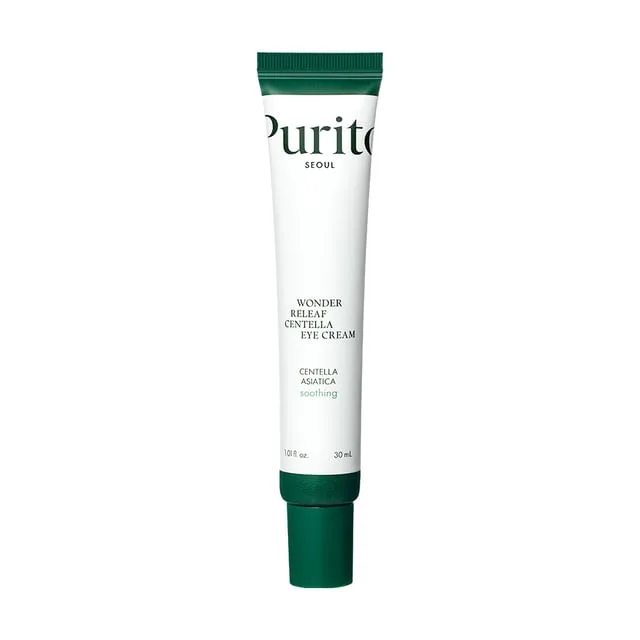
For $16, this eye cream is unusually loaded — a high 16,650 ppm dose of centella, a four-peptide complex, adenosine, ceramide NP, shea butter, and argan and macadamia oils. The catch is the scented formulation: this version adds bergamot and lavender oils next to the eyes, where thin, reactive skin makes that the least sensible place for essential oils. A fragrance-free version exists.
A genuinely loaded eye cream for $16 — high-dose centella, four peptides, adenosine, ceramide, and nourishing oils. But this scented version makes the least sensible choice possible, placing bergamot and lavender oils next to the delicate eye area. The unscented sibling is the cream this should have been.
Released in 2024 from Purito's centella line, this eye cream carries a moderate body of about 300 reviews. The grade pairs an ingredient read of its loaded peptide-and-centella core, set against the bergamot and lavender oils flanking the eye area, with that limited but consistent real-world feedback.
Verdicts
How well it fits each concern
Verdict by concern tap a concern for the case
Supporting rolefor Dark CirclesIn your profileYou chose · Peptides has early evidence for dark circles, and hydration of the periorbital area is the recognised companion to treating it — a reasonable supporting choice, short of a recommendation.Limited evidenceStandard tolerabilityNo reviews collected yet
The case for it
Four-Peptide Complex has early or mechanistic evidence for this concern, not trial-backed standing.
It is plausibly present at a working level, though the concentration is not declared.
The formula carries no trigger this concern is sensitive to, with the cautions noted.
Cautions: fragrance; a declarable fragrance allergen.
What would change this: A declared concentration would move this to a firmer reading of the dose.
Same rule for everyone. “Supporting role” is the verdict on 8,197 of 45,024 concern verdicts across the catalog; rule R8a decided 1,489 of them.
Unchanged since September 5, 2026, engine 5.1.1.
R8a — A plausible-tier active in a category with a supportive job: the sentence names the active instead of saying nothing targets the concern (the AmLactin / CeraVe SA case for keratosis pilaris, where no guideline and single trials leave the keratolytics at early evidence). · the full register
Carrying active
Four-Peptide Complex
Standing
plausible — trials support it
Form
plausible
Tolerability
standard — fragrance load, allergen count
Row checked
against its sources on July 17, 2026 (evidence table ev-2026.09-r228)
Promisingfor AgingIn your profileYou chose · Peptides has trial-level evidence for aging but no guideline or regulatory standing yet — promising, short of a recommendation; the other actives here are not yet assessed for it.Moderate evidenceStandard tolerabilityNo reviews collected yet
The case for it
Four-Peptide Complex has trial-level evidence for this concern but no guideline or regulatory standing yet.
It is plausibly present at a working level, though the concentration is not declared.
The formula carries no trigger this concern is sensitive to, with the cautions noted.
Cautions: a photosensitising active — use sun protection.
What would change this: A declared concentration would move this to a firmer reading of the dose.
Same rule for everyone. “Promising” is the verdict on 7,858 of 45,024 concern verdicts across the catalog; rule R9p decided 7,858 of them.
Unchanged since September 5, 2026, engine 5.1.1.
R9p — 0.5.0: 'Unproven' beside three filled dots read as one question answered twice with opposite words (7,018 rows). The chip measures standing, the dots measure trial volume; where the row carries at least one RCT or a tier-2 source (moderate dots) and the active is present at a working level, the honest word is Promising. Unproven is reserved for plausible-standing rows with limited or weak evidence, or an under-dosed form. Same rank as Unproven — a bet either way; the dots order them. · the full register
Carrying active
Four-Peptide Complex
Standing
plausible — trials support it
Form
plausible — studied range 0.0003%, from the trials on the row; needs leave-on contact
Tolerability
standard — photosensitization
Row checked
against its sources on July 17, 2026 (evidence table ev-2026.09-r228)
Good choicefor DrynessIn your profileYou chose · Ceramides is a reference standard by mechanism for dryness; this cream carries it.Moderate evidenceStandard tolerabilityNo reviews collected yet
The case for it
Ceramide NP has trial-supported standing for this concern.
It is plausibly present at a working level, though the concentration is not declared.
The formula carries no trigger this concern is sensitive to, with the cautions noted.
Cautions: fragrance.
What would change this: A declared concentration would move this to a firmer reading of the dose.
Same rule for everyone. “Good choice” is the verdict on 9,564 of 45,024 concern verdicts across the catalog; rule R5 decided 9,072 of them.
Unchanged since September 5, 2026, engine 5.1.1.
R5 — Trial-supported or guideline-supported active, adequately or plausibly dosed. · the full register
Carrying active
Ceramide NP
Standing
supported — its mechanism is established
Form
plausible
Tolerability
standard — fragrance load
Row checked
against its sources on July 17, 2026 (evidence table ev-2026.09-r228)
The studies behind the evidence row
Elias PM, Feingold KR (eds), Skin Barrier — stratum corneum ceramides are the principal intercellular lamellar lipid; their depletion is the biochemical signature of dry/xerotic skin — reference work
Also listed for Dehydration — the actives here (Centella Asiatica, Acetyl Glucosamine, Ceramides, Adenosine) are in our research queue for that concern; there is no verdict until their evidence rows are written. That is a gap in our table, not a mark against the product.
Does the jobDoes what a eye cream is for: targets a real eye concern, safe for eye skin. Not measured from the label: hydrates without heaviness, stays where it's put.
A verdict is DermApproved’s assessment of how well a product’s ingredients fit a concern — never a claim about what the product treats. Evidence dots and collected reviews sit beside it and are never blended in.
Rules 0.5.1 · evidence table ev-2026.09-r228 · how we decide
✓ High 16,650 ppm centella dose genuinely soothes the under-eye
✓ Four-peptide complex and adenosine support a firmer look over time
✓ Rich, cushiony texture nourishes dry under-eye skin well
✓ Generous 30ml tube lasts four to six months
✓ Both vegan and cruelty-free
Cons
✗ Bergamot and lavender oils placed right next to the delicate eye area
✗ Contains the fragrance allergens limonene and linalool
✗ Bergamot oil is a photosensitizer in a leave-on eye product
✗ Poorly matched to the sensitive eyes its marketing targets
✗ The unscented version is the clearly better choice for most
✗ Rich, oil-and-fatty-acid formula is not fungal-acne safe
Review
Full Review
Start with the good news, because there is a lot of it. At sixteen dollars, the Purito Wonder Releaf Centella Eye Cream is, on its ingredient list alone, an unusually generous product. Eye creams have a reputation — often deserved — for being small, expensive, and underwhelming, a tiny jar of barely-anything sold at a luxury markup because it says 'eye' on it. This one bucks that pattern hard. For the price of a sandwich and a coffee, you get a high 16,650 ppm dose of centella, a complex of four signaling peptides, adenosine, ceramide NP, shea butter, argan oil, macadamia oil, acetyl glucosamine, and green tea extract, in a generous 30ml tube. On paper, this is a steal. So it is genuinely frustrating to have to spend the rest of this review on a single avoidable problem.
The problem is at the very end of the ingredient list: bergamot fruit oil, lavender oil, and the fragrance allergens limonene and linalool. This is the scented version of the cream, and those ingredients are there purely to give it a light herbal-floral scent. And here is why it matters more for an eye cream than it would for almost any other product. The under-eye area is the thinnest, most delicate skin on the face. It is also, obviously, right next to the eye itself — eye creams migrate, and what you put beneath your eye can end up irritating the eye. If there is one single place in an entire skincare routine where essential oils make the least sense, it is here. An eye cream is the worst possible product to perfume, and bergamot oil — which is also a known photosensitizer — is close to the worst possible thing to perfume it with.
It's not a minor nitpick. Fragrance and essential oils are among the most common causes of allergic contact dermatitis, and the eye area is precisely where reactive skin reacts first and most visibly — stinging, watering, puffy lids. The cruel irony is that the cream is marketed with words like 'rapidly soothes,' 'reduces redness,' and 'hypoallergenic,' aimed squarely at people with delicate, easily-irritated eyes. Those are exactly the people who should not put bergamot and lavender oil near their eyes. A word on 'hypoallergenic,' too: it is a marketing term with no standardized legal definition, and a product can carry it while still containing disclosed fragrance allergens, as this one does. The label is a claim, not a promise.
Now, the genuinely good formula underneath all that, because it deserves its due. The centella content is high and legitimate, backed by the isolated TECA actives — asiaticoside, madecassic acid, asiatic acid — and centella is a well-supported soothing ingredient. The four-peptide complex sits relatively high on the ingredient list for an eye cream, and while peptides are a gentle, gradual sort of active rather than a dramatic one, four of them placed prominently is a real effort. Adenosine is the standout anti-aging inclusion — a South Korean–approved functional anti-wrinkle ingredient with solid evidence, doing the smoothing work more reliably than the peptides. Ceramide NP supports the barrier in an area prone to thinness and dryness. Shea butter, argan oil, and macadamia oil make the texture rich and nourishing without heaviness. Acetyl glucosamine adds a mild hydrating-and-brightening assist. This is, structurally, an excellent eye cream. If you covered up the last few ingredients, it would be an easy, enthusiastic recommendation.
In use, the cream is pleasant. The texture is rich but cushiony, it spreads smoothly, and it sinks into a soft finish without greasy heaviness — appropriate for dry under-eye skin. Patted on gently with the ring finger, it leaves the area feeling softer and more hydrated immediately, and the centella does deliver a genuine soothing effect. The hydration makes the under-eye look smoother, and over four to eight weeks the peptides and adenosine contribute a subtle firming-and-smoothing benefit. It will not erase structural or pigmented dark circles, and it will not remove puffiness that has a deeper cause — no eye cream does, and it is worth setting that expectation honestly. What it does is improve the comfort and the look of the area, which is the realistic job of an eye cream.
The solution to the whole dilemma is, thankfully, simple, and Purito has already provided it. As with the matching toner, this eye cream comes in two versions: this scented one and a fragrance-free 'Unscented' counterpart. The unscented version is the same loaded, bargain-priced formula minus the bergamot, the lavender, and the allergens. The mere existence of that version is the brand admitting the fragrance is optional — and for a product going next to your eyes, optional should mean omitted. If you have any reactivity at all in your eye area, or simply want to be sensible about it, buy the unscented version. There is almost no scenario where the scented one is the better choice for an eye cream specifically.
Who, then, is the scented version genuinely for? People with resilient, fragrance-tolerant skin and non-reactive eyes who have used scented products around their eyes for years without issue and like the light scent. That person exists, and for them this is a tremendous value. But it is a narrower audience than the marketing implies, and the cautious default for everyone else should be the unscented bottle.
On value, even with the caveat, this cream is a standout. Sixteen dollars for 30ml of a genuinely well-formulated centella-and-peptide eye cream is excellent, and a tube that size lasts four to six months. Purito has always been the affordable, ingredient-focused brand — though, fairly, not one beyond scrutiny, given the 2020 controversy when independent testing found one of its sunscreens fell short of its labeled SPF. The lesson there and here is the same: judge Purito on its ingredient lists, not its marketing. Do that with this eye cream and you reach a clear conclusion. The formula is a bargain. The scent was a mistake. Buy the version without it.
Formula
Key Ingredients
The hero actives that drive this product's performance.
The headline ingredient, dosed at a substantial 16,650 ppm and backed by the isolated TECA actives asiaticoside, madecassic acid, and asiatic acid. Centella's triterpenoids calm inflammation and support skin repair — in the thin, often-reactive under-eye area, this is the part of the formula doing the genuine soothing and redness-calming work.
A blend of four signaling peptides placed relatively high on the INCI for an eye cream. They are included to support the appearance of firmness and elasticity around the eyes, offering a gentle signaling nudge toward smoother-looking skin over consistent use.
A South Korean–approved functional anti-wrinkle active, and the most evidence-backed anti-aging ingredient in the formula. In an eye cream it supports the look of smoother skin and softened fine lines, complementing the peptide complex with a more firmly established mechanism.
Supplements the skin's own barrier lipids in an area where the skin is naturally thin and prone to dryness. It works with the plant oils and shea butter to keep the delicate under-eye comfortable and well-protected against moisture loss.
Established mechanismfor Dryness · established mechanism
A nourishing blend of shea butter with argan and macadamia seed oils, supplying fatty acids that soften and condition the under-eye skin. They give the cream its rich, cushioned feel and help lock in the hydration from the glycerin and hyaluronic acid.
Established mechanismfor Dryness · established mechanism
An amino-sugar that supports the skin's own hyaluronic acid production and has a mild role in evening tone. Around the eyes, it lends a subtle smoothing and brightening assist, complementing the hydration and anti-aging focus of the formula.
Not yet assessed
Ingredient standings describe the active at treatment-level doses and
vehicles; this product's own condition grades weigh its actual formula.
Pat a small amount gently around the orbital bone, after serums and before or alongside your face moisturizer. Use the ring finger to apply with minimal tugging, and keep it away from the lash line and inner eye. Because the formula contains bergamot oil, a photosensitizer, follow with sunscreen in the morning. If your eye area is reactive, the unscented version is the safer choice.
Results Timeline
Skin around the eyes feels softer and more hydrated immediately. A calmer, more comfortable under-eye and a smoother look from the hydration build over the first one to two weeks. Any subtle firming benefit from the peptides and adenosine develops gradually over 4-8 weeks of consistent use.
The eye cream's core actives have a reasonable to strong evidence base. Centella asiatica, dosed here at a substantial 16,650 ppm and supported by its isolated triterpenoid actives, has well-documented anti-inflammatory activity and a role in wound healing and collagen synthesis — a sound choice for soothing the thin, reactive under-eye area. Adenosine is a South Korean–approved functional anti-wrinkle ingredient, with research indicating it can improve the appearance of fine lines through effects on dermal signaling. Ceramide NP directly supplements the skin's barrier lipids, an approach with strong evidence for reducing transepidermal water loss, which is valuable in an area where skin is naturally thin. The four palmitoylated peptides each have their own literature as signaling peptides studied for firmness and expression-line benefits; peptide efficacy is concentration-dependent, and while their placement here is relatively high for an eye cream, their effects should be expected to be gradual and modest.
The formulation concern is the fragrance component. Fragrance, including naturally derived essential oils, is one of the most common causes of allergic contact dermatitis, which is the basis for the EU requirement to disclose specific fragrance allergens such as limonene and linalool — both present here. This is amplified by anatomy: the periorbital skin is the thinnest on the face and is immediately adjacent to the eye, making it both more prone to irritant and allergic reactions and more consequential when a reaction occurs. Bergamot oil additionally contains furocoumarins, documented photosensitizers, which is a recognized reason to advise sun protection with leave-on products that contain it. From an evidence standpoint, the cream's actives support its claims, but the decision to include sensitizing fragrance materials in a periorbital product works against its suitability for the sensitive users it targets — which is why the fragrance-free version is the formulation better supported for that audience.
Dermatologists generally consider the periorbital area to require extra caution in product selection, precisely because the skin there is thin, delicate, and adjacent to the eye itself. Fragrance-free formulations are the standard recommendation for eye products, and dermatologists routinely advise patients — particularly those with sensitive, reactive, or eczema-prone skin — to avoid essential oils around the eyes. By that standard, the inclusion of bergamot and lavender oils in this scented version would be viewed as a poor fit for an eye cream, with the photosensitizing potential of bergamot oil drawing additional concern in a leave-on product. The cream's actives themselves — centella, adenosine, ceramide, and peptides — align with ingredients clinicians regard as reasonable for soothing and supporting the under-eye area. The straightforward clinical recommendation is to choose the unscented version, which keeps the well-formulated core while removing the fragrance materials.
Guidance
Usage & Recommendations
How to Use
After serums, take a small amount and pat it gently around the orbital bone using your ring finger, which applies the least pressure. Avoid the lash line and the inner corner of the eye. Use morning and night, before or alongside your face moisturizer. Because the formula contains bergamot oil, a photosensitizer, always follow with sunscreen during the day, and consider keeping it to your evening routine if you prefer to be cautious. If your eye area stings or waters after use, discontinue — the unscented version is the better option.
Value Assessment
On price-to-ingredients, this eye cream is genuinely excellent value: $16 for 30ml of a formula carrying high-dose centella, a four-peptide complex, adenosine, ceramide NP, and nourishing plant oils far undercuts the typical eye-cream market, where small jars at luxury markups are the norm. A 30ml tube also lasts four to six months, stretching the value further. The honest qualifier is that the value is only fully realized if the formula suits you — and for the scented version, the bergamot and lavender oils narrow that audience. The fragrance-free unscented version delivers the same bargain-priced, well-stocked formula without the sensitizers, making it the better value for most buyers. Either way, on cost alone, Purito has priced this aggressively and in keeping with its affordable, ingredient-focused identity.
Who Should Buy
Those with normal, dry, or combination skin and resilient, non-reactive eye areas who want a remarkably well-stocked eye cream at a low price and do not mind a light scent. It suits dry under-eyes especially well thanks to its rich, nourishing texture, and offers genuine value for anyone with no history of fragrance or essential-oil sensitivity.
Who Should Skip
Skip this scented version if you have sensitive, reactive, or fragrance-prone skin, or sensitive eyes — the bergamot and lavender oils make it a poor match for a periorbital product. Anyone in that group should choose the fragrance-free unscented version of the eye cream, which keeps the strong formula without the sensitizers.
Ready to try Purito Wonder Releaf Centella Eye Cream?
A rich but cushiony cream that spreads smoothly and sinks into a soft, comfortable finish, with enough emollient weight to feel nourishing on dry under-eye skin
Scent
A light herbal-floral scent from added bergamot and lavender oils — pleasant to many, but a meaningful consideration so close to the eyes
Packaging
A 30ml tube in Purito's clean, minimal styling. The tube format is hygienic and practical, and the 30ml size is generous for an eye cream, helping the low price go even further.
Finish
velvetynon-greasydewy
What to Expect on First Use
The under-eye area absorbs this rich, smooth cream comfortably, leaving it feeling softer and more hydrated right away, with a light herbal-floral scent. For most skin it feels soothing. For reactive eyes, the bergamot and lavender oils may cause stinging or watering — if so, this scented version is not the right match and the unscented option should be used instead.
How Long It Lasts
About 4-6 months with twice-a-day use around the eyes
Purito built much of its name on centella products for sensitive skin, and the Wonder Releaf line extends that heritage to the eye area. As with the matching toner, the eye cream comes in two versions — this scented one and a fragrance-free 'Unscented' counterpart. The dual release is the brand's tacit acknowledgment that the fragrance is a preference, and that the most delicate, reactive skin is better served without it.
About Purito Established Brand (5–20 years)
Around since 2018, Purito (latterly Purito Seoul) is recognized for centella-led sensitive-skin care and a vegan, cruelty-free approach. It has a credible independent track record, tempered by a 2020 case of a sunscreen testing below its claimed SPF.
Brand founded: 2017 · Product launched: 2024
Myth vs. Reality
Common Myths
Myth
Eye creams need essential oils or a pleasant scent to feel luxurious and work well.
Reality
Scent adds nothing to an eye cream's performance. The under-eye is thin, delicate skin close to the eye itself, and it is the area where fragrance and essential oils make the least sense. A well-formulated eye cream needs effective actives and a good emollient base, not bergamot oil.
Myth
An eye cream can erase dark circles and puffiness.
Reality
Eye creams hydrate, soothe, and can gradually support smoother, firmer-looking skin, but they cannot erase structural or pigmented dark circles or remove puffiness with deeper causes. This cream improves comfort and the look of the under-eye; it is not a cure for those concerns.
FAQ
Frequently Asked Questions
Does the Purito Wonder Releaf Centella Eye Cream contain fragrance?
Yes. This version contains bergamot and lavender essential oils, plus the fragrance allergens limonene and linalool. Purito also makes a fragrance-free 'Unscented' version of the eye cream, which is the more appropriate choice for sensitive or reactive eye areas.
Is this a good eye cream for the price?
On ingredients, yes — at $16 it is unusually well-stocked, with high-dose centella, a four-peptide complex, adenosine, ceramide NP, and nourishing oils. The value is genuine. The one real reservation is the added essential oils in this scented version, which is why the fragrance-free option may be the smarter buy.
Why does an eye cream contain bergamot and lavender oil?
The bergamot and lavender oils provide the cream's light herbal-floral scent rather than any skincare benefit. It is a fair criticism, since the under-eye is thin, delicate skin where essential oils — bergamot especially, as a photosensitizer — make the least sense. The unscented version omits them.
Does the Purito eye cream help with dark circles and puffiness?
It hydrates the under-eye, soothes with centella, and can support smoother, firmer-looking skin over time through its peptides and adenosine. It does not erase structural or pigmented dark circles or remove puffiness with deeper causes — it improves comfort and the look of the area rather than curing those concerns.
Can I use the Wonder Releaf Centella Eye Cream in the morning?
You can, but because it contains bergamot oil, a photosensitizing ingredient, follow with a broad-spectrum sunscreen and consider keeping it to your evening routine as a precaution. The unscented version avoids this consideration entirely.
Is this eye cream safe for sensitive skin?
Its centella, peptide, ceramide, and adenosine core is gentle and well chosen, but this scented version's bergamot and lavender oils can irritate sensitive or reactive eye areas. For sensitive skin, the fragrance-free unscented version of the eye cream is the recommended choice.
Reviews
What Reviewers Tend to Say
Recurring themes our editors read across retailer reviews of this product — summaries in our words, not quotations, and not a substitute for your own patch test.
Common Praise
Remarkably affordable for an eye cream with this ingredient list
Rich, cushioned texture hydrates dry under-eyes well
Centella core genuinely calms and comforts the eye area
Absorbs without heavy greasiness despite the nourishing feel
Pleasant light scent for those who enjoy fragrance
Common Complaints
Essential oils near the eye area are a questionable choice
Bergamot and lavender oils can irritate sensitive eyes
Contains fragrance allergens despite a soothing positioning
Sensitive-skinned users should choose the unscented version
The trials are real, they are positive, and the pooled effect sizes are moderate. They also average fewer than forty people each, and what they measure is an instrument reading rather than something anyone notices in a mirror.
The burn trials are real and the skeptics who dismiss aloe as folklore are wrong — but the same substance has delayed healing in other wounds, and none of it says anything about what a soothing gel does to intact skin.
Serums, masks, and peptide 'treatments' replaced the waxy balm this year. Some of it is real barrier science; some is a controlled irritant that stings your lips into looking fuller for an hour.
Products, answers, therapy guides, tools and articles in one search. Brand names,
slang and abbreviations all work — accutane finds isotretinoin, bacne finds truncal acne.