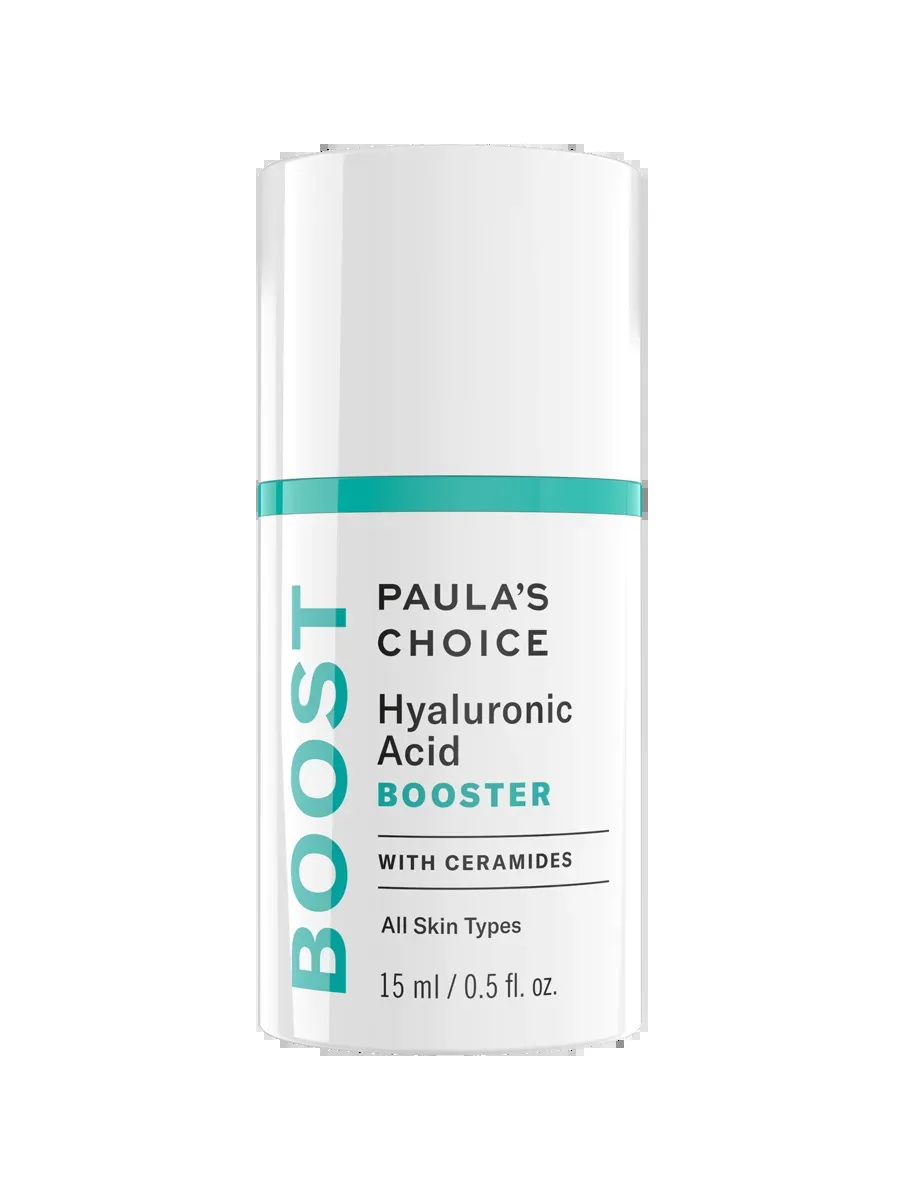
Unlike most hyaluronic acid serums that rely on HA alone, this booster pairs multi-weight hyaluronic acid with a complete ceramide complex (three ceramides plus cholesterol and phytosphingosine) that mirrors the skin's own lipid structure. The result is a hydrator that doesn't just attract water but also helps the skin hold onto it — addressing the root cause of dehydration rather than just the symptom.
A masterclass in minimalist formulation that pairs multi-weight hyaluronic acid with a complete ceramide barrier complex — doing more with twenty ingredients than most serums manage with fifty. The eye-watering price per ounce is the only real obstacle between this booster and a perfect score.
Good choicefor DrynessIn your profileYou chose · Ceramides is a reference standard by mechanism for dryness; this gel carries it high in the ingredient list.Moderate evidenceGentleNo reviews collected yet
The case for it
Ceramide NP, AP, and EOP Complex has trial-supported standing for this concern.
It is present at an effective concentration, declared or high in the ingredient list.
The formula carries none of the triggers this concern is sensitive to.
Same rule for everyone. “Good choice” is the verdict on 9,564 of 45,024 concern verdicts across the catalog; rule R5 decided 9,072 of them.
Unchanged since September 5, 2026, engine 5.1.1.
R5 — Trial-supported or guideline-supported active, adequately or plausibly dosed. · the full register
Carrying active
Ceramide NP, AP, and EOP Complex
Standing
supported — its mechanism is established
Form
adequate
Tolerability
gentle
Row checked
against its sources on July 17, 2026 (evidence table ev-2026.09-r228)
The studies behind the evidence row
Elias PM, Feingold KR (eds), Skin Barrier — stratum corneum ceramides are the principal intercellular lamellar lipid; their depletion is the biochemical signature of dry/xerotic skin — reference work
Good choicefor DehydrationIn your profileYou chose · Hyaluronic Acid is a reference standard by mechanism for dehydration; this gel carries it.Moderate evidenceGentleNo reviews collected yet
The case for it
Hyaluronic Acid + Sodium Hyaluronate has trial-supported standing for this concern.
It is plausibly present at a working level, though the concentration is not declared.
The formula carries none of the triggers this concern is sensitive to.
What would change this: A declared concentration would move this to a firmer reading of the dose.
Same rule for everyone. “Good choice” is the verdict on 9,564 of 45,024 concern verdicts across the catalog; rule R5 decided 9,072 of them.
Unchanged since September 5, 2026, engine 5.1.1.
R5 — Trial-supported or guideline-supported active, adequately or plausibly dosed. · the full register
Carrying active
Hyaluronic Acid + Sodium Hyaluronate
Standing
supported — its mechanism is established
Form
plausible — studied range 0.1%, from the trials on the row; needs leave-on contact; judge it after ~1 weeks
Tolerability
gentle
Row checked
against its sources on July 17, 2026 (evidence table ev-2026.09-r228)
The studies behind the evidence row
Draelos ZD, Cosmetic Dermatology: Products and Procedures — hyaluronic acid classified as a humectant water-binding agent holding many times its weight in water — reference work
Promisingfor AgingIn your profileYou chose · Adenosine has trial-level evidence for aging but no guideline or regulatory standing yet — promising, short of a recommendation; the other actives here are not yet assessed for it.Moderate evidenceGentleNo reviews collected yet
The case for it
Adenosine has trial-level evidence for this concern but no guideline or regulatory standing yet.
It is plausibly present at a working level, though the concentration is not declared.
The formula carries none of the triggers this concern is sensitive to.
What would change this: A declared concentration would move this to a firmer reading of the dose.
Same rule for everyone. “Promising” is the verdict on 7,858 of 45,024 concern verdicts across the catalog; rule R9p decided 7,858 of them.
Unchanged since September 5, 2026, engine 5.1.1.
R9p — 0.5.0: 'Unproven' beside three filled dots read as one question answered twice with opposite words (7,018 rows). The chip measures standing, the dots measure trial volume; where the row carries at least one RCT or a tier-2 source (moderate dots) and the active is present at a working level, the honest word is Promising. Unproven is reserved for plausible-standing rows with limited or weak evidence, or an under-dosed form. Same rank as Unproven — a bet either way; the dots order them. · the full register
Carrying active
Adenosine
Standing
plausible — trials support it
Form
plausible — studied range 1%, from the trials on the row; needs leave-on contact
Tolerability
gentle
Row checked
against its sources on July 17, 2026 (evidence table ev-2026.09-r228)
Good choicefor Compromised Skin BarrierIn your profileYou chose · Ceramides is a reference standard by mechanism for compromised skin barrier; this gel carries it high in the ingredient list.Moderate evidenceGentleNo reviews collected yet
The case for it
Ceramide NP, AP, and EOP Complex has trial-supported standing for this concern.
It is present at an effective concentration, declared or high in the ingredient list.
The formula carries none of the triggers this concern is sensitive to.
Same rule for everyone. “Good choice” is the verdict on 9,564 of 45,024 concern verdicts across the catalog; rule R5 decided 9,072 of them.
Unchanged since September 5, 2026, engine 5.1.1.
R5 — Trial-supported or guideline-supported active, adequately or plausibly dosed. · the full register
Carrying active
Ceramide NP, AP, and EOP Complex
Standing
supported — its mechanism is established
Form
adequate — studied range 0.5–1%, from the trials on the row; needs leave-on contact; judge it after ~4 weeks
Tolerability
gentle
Row checked
against its sources on July 17, 2026 (evidence table ev-2026.09-r228)
The studies behind the evidence row
Elias PM, Skin Barrier / Coderch et al., ceramides and skin barrier function — ceramides ~50% of SC intercellular lipid mass, essential to the permeability barrier — reference work
Good choicefor SensitivityIn your profileYou chose · No fragrance, drying alcohol, declarable allergens or sensitising preservatives in this gel — the profile sensitive skin looks for.Not yet assessedGentleNo reviews collected yet
The case for it
Hyaluronic Acid + Sodium Hyaluronate has no evidence row yet for this concern — it is in the research queue.
The formula carries none of the triggers this concern is sensitive to.
What would change this: A researched evidence row for the lead active would replace this with a verdict.
Same rule for everyone. “Good choice” is the verdict on 1,938 of 45,024 concern verdicts across the catalog; rule F2 decided 1,938 of them.
Unchanged since September 5, 2026, engine 5.1.1.
A verdict is DermApproved’s assessment of how well a product’s ingredients fit a concern — never a claim about what the product treats. Evidence dots and collected reviews sit beside it and are never blended in.
Rules 0.5.1 · evidence table ev-2026.09-r228 · how we decide
Assessment
Pros & Cons
Pros
✓ Dual-weight hyaluronic acid system provides hydration at multiple skin depths
✓ Complete ceramide complex with cholesterol and phytosphingosine mirrors natural barrier lipids
✓ Ultra-minimal 20-ingredient formula with zero filler or marketing ingredients
✓ Fragrance-free, oil-free, silicone-free — compatible with virtually any routine
✓ Versatile enough to mix into moisturizer or layer under any treatment
✓ Immediate visible plumping effect from the first application
Cons
✗ Thirty-nine dollars for half an ounce makes this one of the pricier HA serums available
✗ Brief initial tackiness upon application before full absorption
✗ Small bottle size means frequent repurchasing at twice-daily use
✗ Phytosphingosine may be problematic for fungal acne-prone skin
✗ Needs a moisturizer on top to fully seal in hydration in dry climates
Review
Full Review
In a market drowning in hyaluronic acid serums — every brand from drugstore to luxury has at least one, often with nearly identical marketing copy — the question for any new entry is not whether it hydrates (they all do, at least temporarily) but whether it does anything meaningfully different. Paula's Choice Hyaluronic Acid Booster answers that question with its ingredient list, which is notable as much for what it includes as for its remarkable brevity.
Twenty ingredients. That is the entire formula. In an industry where ingredient lists routinely stretch past forty or fifty entries, this restraint is either confidence or recklessness, and the specific twenty ingredients chosen make it clear which one it is. The formula opens with glycerin and yeast extract as its humectant foundation, then deploys both sodium hyaluronate and hyaluronic acid — two molecular weights working at different depths of the epidermis. The smaller sodium hyaluronate penetrates more effectively, drawing moisture into deeper skin layers. The larger hyaluronic acid molecules form a hydrating film closer to the surface. Together, they create a layered hydration effect that a single-weight HA product simply cannot replicate.
But here is where this booster separates itself from the pack: the ceramide complex. Three ceramides — NP, AP, and EOP — alongside cholesterol and phytosphingosine, replicate the lipid architecture of a healthy skin barrier. This is not decorative. Without a functioning lipid barrier, all the hyaluronic acid in the world is just water passing through a sieve. By including these barrier-building lipids, Paula's Choice has created a serum that hydrates and then makes your skin capable of holding onto that hydration. It is the difference between filling a bucket and filling a bucket that someone has patched the holes in first.
The inclusion of adenosine adds a quiet anti-aging dimension. This naturally occurring nucleoside has solid evidence for stimulating collagen production and reducing the appearance of fine lines — not at the dramatic level of retinol, but meaningfully enough to make this more than a one-trick hydration pony. Panthenol rounds out the active cast, converting to vitamin B5 in the skin where it soothes, strengthens, and enhances moisture retention.
In practice, the booster applies as a clear, lightweight gel that has a brief moment of tackiness before absorbing completely. That tackiness — the most common critique you will find in user reviews — lasts perhaps sixty seconds and is a characteristic of hyaluronic acid formulations in general, not a flaw specific to this product. Once absorbed, the skin feels immediately plumper and has a healthy dewy quality that photographs beautifully and layers impeccably under sunscreen, makeup, or heavier treatments.
The versatility of this booster is one of its strongest selling points. It can be applied alone, mixed into a moisturizer, layered under retinol, paired with vitamin C in the morning, or used as a buffer between sensitive skin and stronger actives. Its stripped-down formula means it plays nicely with essentially everything. There is no fragrance to clash with other products, no silicones to cause pilling, no oils to overwhelm oily skin types. It is the diplomatic neighbor of the skincare world.
Now, the elephant in the room — or rather, the elephant in the very small bottle. At thirty-nine dollars for half an ounce, this is aggressively priced for what is ostensibly a hyaluronic acid serum. You can buy perfectly serviceable HA serums for a fraction of this cost. The question is whether the ceramide complex, the dual-weight HA system, and the adenosine justify the premium. For someone with a compromised barrier who needs hydration and repair simultaneously, the answer is probably yes — buying a separate HA serum and a separate ceramide product would cost more and require more steps. For someone with healthy skin who simply wants a hydration boost, the value proposition is harder to defend.
The product's durability compounds the price concern. At the recommended two to three drops twice daily, the half-ounce bottle lasts approximately six to eight weeks. That translates to roughly two hundred and fifty to three hundred dollars per year for this single product step. Paula's Choice has built enough trust over its decades-long track record that many customers absorb this cost without complaint, but it warrants honest acknowledgment.
What redeems the pricing is the formulation integrity. Every ingredient in this bottle serves a purpose. There are no fillers, no fragrance compounds taking up space, no marketing ingredients included for label appeal. The preservative system is minimal and well-tolerated. The delivery system is straightforward. You are paying for active ingredients in an effective delivery vehicle, and by that metric, the concentration of actives per drop likely justifies the sticker price more than many serums that cost the same but dilute their actives across a larger, waterier volume.
For dehydrated skin, barrier-compromised skin, retinol users, or anyone whose skin has that tight, flaky quality that says moisture is leaving faster than it can be replaced, this booster addresses the problem with unusual intelligence. It is not the cheapest way to get hyaluronic acid on your face, but it may be one of the most complete.
Formula
Key Ingredients
The hero actives that drive this product's performance.
A dual-weight hyaluronic system where the smaller sodium hyaluronate molecules penetrate deeper into the epidermis while the larger hyaluronic acid molecules form a moisture-binding film on the surface — together creating hydration at multiple skin depths that the ceramide complex then helps lock in.
Established mechanismfor Dehydration · established mechanism
Three distinct ceramides that mirror the skin's own lipid composition, working alongside cholesterol and phytosphingosine in this formula to rebuild the intercellular mortar that keeps moisture from escaping — turning a simple hydrating booster into a barrier repair treatment.
Established mechanismfor Dryness · established mechanism
Converts to vitamin B5 in the skin where it enhances the hyaluronic acid's humectant action by strengthening the skin's own moisture-retention capacity and calming any micro-inflammation that compromised barriers often harbor.
Established mechanismfor Dehydration · established mechanism
Provides anti-aging support in this hydration-focused formula by stimulating collagen production and soothing the skin — an ingredient that turns what could be a one-dimensional hydrator into something with anti-wrinkle utility.
Completes the lipid trio alongside the ceramides and phytosphingosine, mimicking the exact ratio found in healthy skin barriers. Without cholesterol, ceramides alone cannot fully restore barrier function — its inclusion here signals a formulator who understands skin lipid biochemistry.
Not yet assessed
Ingredient standings describe the active at treatment-level doses and
vehicles; this product's own condition grades weigh its actual formula.
Apply 2-3 drops to damp skin after cleansing and toning, before heavier serums and moisturizers. Can also be mixed into your moisturizer for an extra hydration boost. Works beautifully under sunscreen in the AM.
Results Timeline
Immediate plumping and hydration visible within minutes of first application. Fine lines appear softened within 1-2 weeks of consistent use. Sustained barrier improvement and deeper hydration at 4-6 weeks.
Pairs Well With
RetinolVitamin C serumNiacinamideAHA/BHA exfoliantsMoisturizer
Hyaluronic acid's capacity to bind up to 1,000 times its weight in water is well-documented in dermatological literature, making it one of the most extensively studied humectants in skincare. The dual-weight approach in this formula leverages research published in the Journal of Drugs in Dermatology (2014) demonstrating that low-molecular-weight hyaluronic acid penetrates the epidermis more effectively than high-molecular-weight forms, reaching the stratum granulosum where it can hydrate from within.
The ceramide complex represents arguably the most scientifically sophisticated element of this formula. A study reported in the Journal of Clinical and Investigative Dermatology (2005) established that ceramides, cholesterol, and free fatty acids in an approximate 3:1:1 molar ratio are essential for optimal barrier function. This formula includes ceramides NP, AP, and EOP alongside cholesterol and phytosphingosine — the precursor to ceramide synthesis — reflecting an understanding of barrier lipid biochemistry that goes beyond simply adding ceramides as a marketing checkbox.
Adenosine has garnered increasing attention in anti-aging research. A study reported in the Journal of Dermatological Science (2009) demonstrated that topical adenosine significantly reduced the appearance of wrinkles in a double-blind, placebo-controlled trial over an eight-week period. Its mechanism involves stimulating fibroblast proliferation and collagen synthesis, which complements the hydration-plumping effect of hyaluronic acid.
Panthenol, the provitamin form of B5, has been shown in research published in the American Journal of Clinical Dermatology (2002) to improve stratum corneum hydration, reduce transepidermal water loss, and maintain skin softness and elasticity. In this formula, it synergizes with the ceramide complex to reinforce the barrier from both lipid and humectant angles.
References
A Randomized, Double-Blind, Placebo-Controlled Study of a Novel Panthenol-Containing Formulation — American Journal of Clinical Dermatology (2002)
Dermatologist Perspective
Dermatologists widely recognize hyaluronic acid as a safe and effective humectant suitable for virtually all skin types, and frequently recommend it as a foundational hydrating step in both therapeutic and cosmetic routines. Many dermatologists observe that the inclusion of a complete ceramide complex in a hyaluronic acid product is unusually thoughtful, as it addresses the common clinical observation that dehydrated skin often has concurrent barrier dysfunction. This combination approach aligns with the dermatological principle of treating both the symptom (dehydration) and the underlying cause (barrier impairment). The fragrance-free, minimal formulation makes it a comfortable recommendation even for patients with sensitized or post-procedure skin.
Guidance
Usage & Recommendations
How to Use
Apply two to three drops to clean, slightly damp skin morning and evening. Pat gently into the face and neck — avoid rubbing, which can cause pilling with gel textures. For an extra boost, mix one to two drops directly into your moisturizer. Always follow with a moisturizer or occlusive to seal the hydration in, especially in dry or air-conditioned environments. Can be applied before or after water-based serums, but always before oil-based products and moisturizers.
Value Assessment
At thirty-nine dollars for half an ounce, this is premium pricing for a hyaluronic acid serum — no way around it. The value argument rests entirely on the ceramide complex, which effectively gives you two products in one: a hydrating serum and a barrier repair treatment. Buying those separately from Paula's Choice would cost significantly more. The minimal ingredient list means a higher concentration of actives per drop compared to serums that pad their formulas with fillers. For budget-conscious buyers, the brand's established track record and ingredient transparency help justify the investment, but those seeking basic HA hydration without barrier repair can find that at a fraction of the cost elsewhere.
Who Should Buy
Anyone dealing with dehydrated, tight, or flaky skin who wants more than just surface-level hydration. Retinol users who need a buffer that hydrates and repairs barrier damage simultaneously. Sensitive skin types looking for a fragrance-free, minimal-ingredient hydrating step that won't trigger reactions.
Who Should Skip
Budget-conscious buyers who just need basic hyaluronic acid hydration — equally effective (if less sophisticated) options exist at a third of the price. Anyone who dislikes the temporary tackiness characteristic of HA gel serums. Those with active fungal acne should patch test carefully due to the phytosphingosine content.
Ready to try Paula's Choice Hyaluronic Acid Booster?
Lightweight, clear gel with a slightly viscous consistency. Applies smoothly but can feel momentarily tacky before fully absorbing into the skin. Not greasy or heavy.
Scent
Completely unscented — no natural or synthetic fragrance of any kind.
Packaging
Small glass dropper bottle with a twist-off pipette cap. The dark-tinted glass helps protect light-sensitive ingredients. Compact and travel-friendly.
Finish
dewylightweightnon-greasy
What to Expect on First Use
Skin feels immediately plumped and dewy after the first application. A slight tackiness dissipates within a minute or two, leaving skin that feels bouncy and hydrated. No tingling, stinging, or adjustment period whatsoever. Results are visible from day one.
How Long It Lasts
6-8 weeks applied morning and evening of 2-3 drops
Part of Paula's Choice Boost line of concentrated treatment products, the Hyaluronic Acid Booster was designed to be a versatile add-on that could be mixed into any routine without disrupting existing products. Its minimalist 20-ingredient formula reflects the brand's philosophy that effective skincare doesn't need thirty filler ingredients to work.
About Paula's Choice Established Brand (5–20 years)
Paula's Choice was founded in 1995 by beauty journalist Paula Begoun and has built its reputation on ingredient transparency and evidence-based formulations. The brand is widely cited in skincare communities for its research-driven approach and publishes detailed ingredient explanations for every product.
Brand founded: 1995 · Product launched: 2015
Myth vs. Reality
Common Myths
Myth
Hyaluronic acid can dry out your skin by pulling moisture from deeper layers.
Reality
In very low humidity environments, high-molecular-weight HA applied without an occlusive on top can theoretically draw moisture upward. This formula mitigates that risk with its ceramide complex, which creates a lipid seal that prevents transepidermal water loss. Applying to damp skin and following with a moisturizer eliminates the concern entirely.
Myth
All hyaluronic acid serums are essentially the same.
Reality
Molecular weight, concentration, and supporting ingredients matter enormously. This formula uses both sodium hyaluronate (smaller molecules, deeper penetration) and hyaluronic acid (larger molecules, surface hydration) alongside ceramides — a combination most competitors skip entirely.
FAQ
Frequently Asked Questions
Can I use Paula's Choice Hyaluronic Acid Booster with retinol?
Absolutely — this booster is an ideal retinol companion. The ceramide complex and panthenol help buffer retinol-induced dryness, while the dual-weight hyaluronic acid maintains hydration levels that retinol can deplete. Apply the booster first, let it absorb, then follow with your retinol product.
How many drops should I use per application?
Two to three drops are sufficient for the full face. The concentrated gel formula spreads easily, so you don't need much. You can also mix 1-2 drops directly into your moisturizer for an extra hydration boost without adding a separate step.
Is this hyaluronic acid booster worth the price?
At thirty-nine dollars for half an ounce, this is one of the pricier HA serums on the market. What justifies the premium is the complete ceramide complex — three ceramides, cholesterol, and phytosphingosine — which most hyaluronic acid products lack entirely. If you need hydration plus barrier repair, the formula earns its price. If you just want basic HA hydration, more affordable options exist.
Should I apply this to damp or dry skin?
Damp skin is ideal. Hyaluronic acid works by attracting water molecules, so applying it to slightly damp skin after cleansing gives it readily available moisture to bind. The ceramides in this formula then help lock that hydration in, but starting with damp skin maximizes the plumping effect.
Can I use this if I have oily skin?
Yes — this oil-free, silicone-free gel formula is lightweight enough for oily skin. Dehydration and oiliness often coexist, and the hyaluronic acid provides water-based hydration without adding any oil or heaviness. The ceramide complex helps normalize barrier function, which can actually help regulate excess oil production over time.
Is this safe for fungal acne-prone skin?
Use with caution. The phytosphingosine in this formula may potentially feed Malassezia yeast in some individuals. While it's not a guaranteed trigger, those with active fungal acne may want to patch test carefully or consult a dermatologist before incorporating it.
Reviews
What Reviewers Tend to Say
Recurring themes our editors read across retailer reviews of this product — summaries in our words, not quotations, and not a substitute for your own patch test.
Common Praise
Delivers instant plumping hydration without heaviness
Works beautifully under makeup and other products
Calms and soothes dehydrated or irritated skin
Clean minimal ingredient list inspires confidence
Noticeable reduction in fine lines with consistent use
Common Complaints
Very expensive for the small 0.5 oz size
Slight initial stickiness before absorption
Runs out quickly at recommended usage
Some feel it needs a moisturizer on top to seal in hydration
The formulation philosophy is real and the reference products earn their reputation — but the booster tier is where percentages started outrunning the evidence.
The internet's favorite hydrator has a counterintuitive dark side — in dry air, a humectant with nothing to seal it can pull water out of your skin instead of into it.
'Barrier repair' is the most over-used phrase in skincare, usually printed on products that contain none of the lipids a barrier is actually built from.
Western sensitive skincare works by subtraction — remove the fragrance, remove the alcohol, shorten the list. Japan's answer adds a designed molecule back in, and one of the two bets has a trial literature.
Aug 28, 2026· 9 min
Questions people ask about sensitive skin
Verified answers from our questions library — the nuance a product page cannot carry.
Products, answers, therapy guides, tools and articles in one search. Brand names,
slang and abbreviations all work — accutane finds isotretinoin, bacne finds truncal acne.