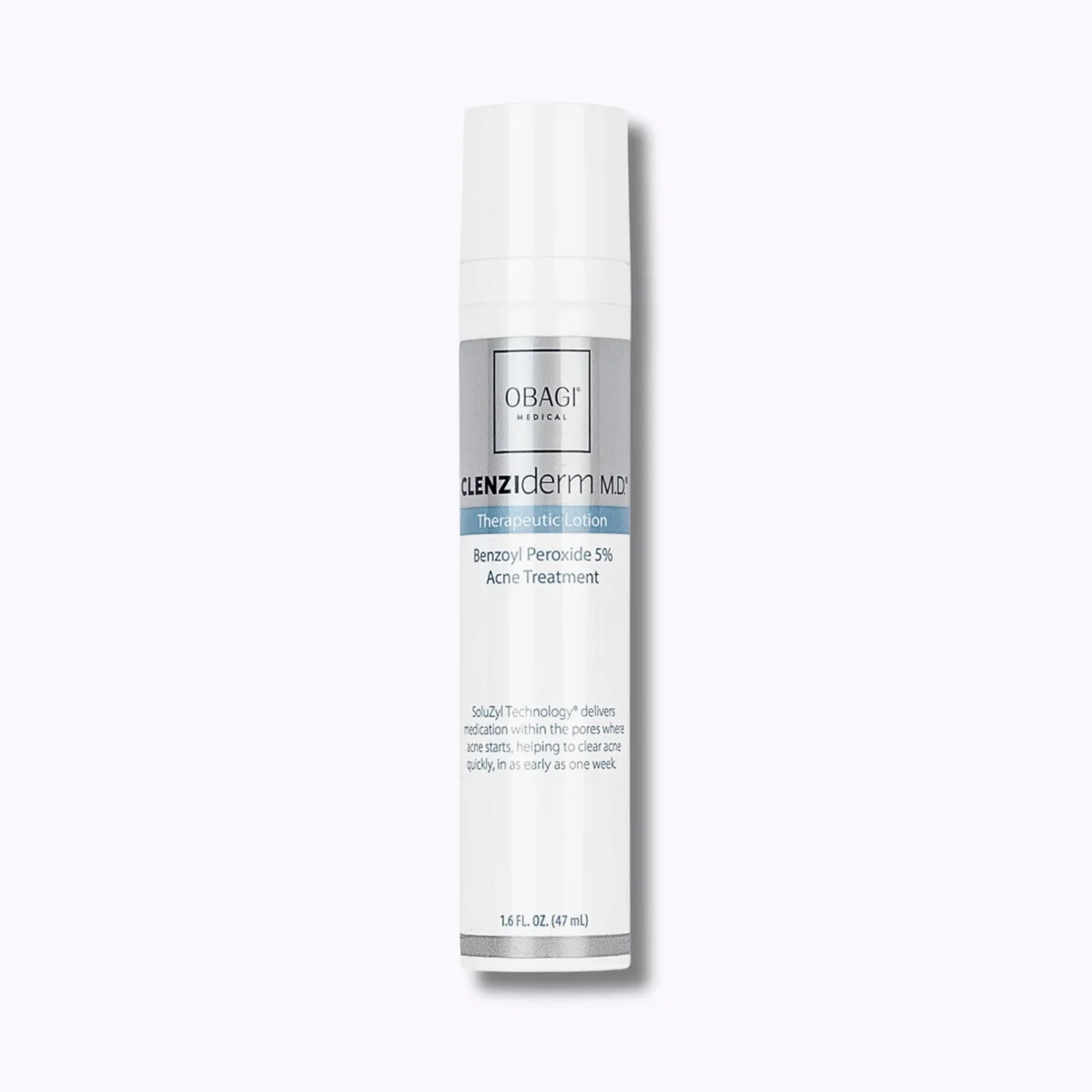
Most 5% benzoyl peroxide products are suspensions of crystals in a gel, which is why they feel gritty and sit unevenly in pores. Obagi's CLENZIderm formulation dissolves the benzoyl peroxide in dimethyl isosorbide and light solvent-emollients so it reaches the follicle in solution, and adds squalane so the lotion is less stripping than its strength suggests. It is an elegant delivery of a very old molecule, at a price that reflects the elegance more than the molecule.
A genuinely elegant 5% benzoyl peroxide: dissolved rather than suspended, softened with squalane, dried to a matte finish and less gritty and stripping than drugstore gels of the same strength. It clears inflamed acne on the same timetable any benzoyl peroxide does. It is also a monograph OTC drug priced at $95 for 47 ml, and the evidence says 2.5% would do the job with less flaking, so the premium buys refinement, not results.
Strong choicefor AcneIn your profileYou chose · Benzoyl Peroxide is an approved or monograph active for acne; this lotion carries it at 5%.Strong evidenceStandard tolerabilityNo reviews collected yet
The case for it
Benzoyl Peroxide 5% is a first-line active — approved, monograph-listed or named in current guidelines — for this concern.
It is present at an effective concentration, declared or high in the ingredient list.
The formula carries no trigger this concern is sensitive to, with the cautions noted.
Cautions: fungal-acne triggers.
Same rule for everyone. “Strong choice” is the verdict on 1,459 of 45,024 concern verdicts across the catalog; rule R2 decided 892 of them.
As of September 25, 2026, engine 5.1.1.
R2 — A regulator- or guideline-recognised first-line active, declared at an effective strength, in a form the claim supports. · the full register
Carrying active
Benzoyl Peroxide 5%
Standing
first line — a regulator recognises it for this use; trials support it · per 21 CFR § 333.310 - Acne active ingredients. (US Code of Federal Regulations (Legal Information Institute, Cornell Law School)), opened July 27, 2026
Form
adequate (declared 5%) — studied range 2.5–10%, from the OTC monograph or label; judge it after ~6 weeks
Tolerability
standard — fungal triggers
Row checked
against its sources on July 27, 2026 (evidence table ev-2026.09-r228)
Also listed for Blackheads and Excess Oiliness — the actives here (Benzoyl Peroxide, Squalane, Emollient Esters) are in our research queue for those concerns; there is no verdict until their evidence rows are written. That is a gap in our table, not a mark against the product.
A verdict is DermApproved’s assessment of how well a product’s ingredients fit a concern — never a claim about what the product treats. Evidence dots and collected reviews sit beside it and are never blended in.
Rules 0.5.1 · evidence table ev-2026.09-r228 · how we decide
Assessment
Pros & Cons
Pros
✓ Benzoyl peroxide dissolved in solution rather than suspended as gritty crystals
✓ Squalane softens a 5% lotion so it strips less than drugstore gels of the same strength
✓ Dries to a matte, residue-free finish that layers under moisturizer and sunscreen
✓ Fragrance-free, alcohol-free and silicone-free eleven-ingredient formula
✓ FDA OTC monograph drug with a DailyMed listing, so the active and dose are regulated
✓ Clears inflamed acne on the well-established benzoyl peroxide timetable
✓ Once-to-three-times-daily dosing gives room to titrate
Cons
✗ $95 for 47 ml is roughly ten times a drugstore 5% benzoyl peroxide
✗ Evidence shows 2.5% clears acne as well as 5% with less peeling
✗ Still dries, flakes and flushes in the first weeks, especially on sensitive skin
✗ Bleaches towels, pillowcases and clothing
✗ Cannot be applied with retinoids or acids in the same step
✗ Solubilisation advantage rests on Obagi's own data, not a published head-to-head trial
Review
Full Review
Look the lotion up on DailyMed, the federal drug-label database, and the first line is a small deflation: benzoyl peroxide 5%, OTC monograph acne drug, the same category as the tube next to the toothpaste at the pharmacy. Obagi's CLENZIderm M.D. Therapeutic Lotion is not prescription-strength and does not contain a prescription active. What it contains is a particular way of delivering an old molecule, and the case for paying $95 rather than $9 rests entirely on whether that way is worth it.
The molecule itself needs no defence. Benzoyl peroxide has been the first-line topical for inflammatory acne for half a century because it releases oxygen inside the follicle, kills the anaerobic bacteria that drive inflammation, does not breed resistance and loosens the keratin plugs that start comedones. The question that has been settled for almost as long is dose: in three double-blind studies across 153 patients, a 2.5% preparation reduced inflammatory lesions as effectively as 5% and 10%, with less peeling and burning than the 10%, and it cut the bacterial population and the free fatty acids in surface lipids within two weeks. Five percent, where this lotion sits, is a reasonable middle; it is not a stronger treatment than 2.5%, only a somewhat more irritating one.
Obagi's argument is about form rather than dose. Ordinary benzoyl peroxide gels are suspensions of crystals, which is why they feel gritty, sit unevenly in pores and leave white residue. The CLENZIderm system, launched in the late 2000s, was built around dissolving the benzoyl peroxide instead: dimethyl isosorbide, a penetration-enhancing glycol ether, and a pair of light solvent-emollients, dicaprylyl ether and benzyl benzoate, hold the active in solution in a water-and-propylene-glycol base so it reaches the follicle as a liquid. Squalane, the one emollient in an eleven-ingredient list, keeps the whole thing from stripping. There is no fragrance, no alcohol, no silicone and nothing decorative; it is a delivery vehicle and a drug.
On the skin the difference is real and easy to feel. The lotion is thin and cool, spreads in a sheer layer with none of the grit of a 5% gel, and dries in a minute to a matte, faintly powdery finish that moisturizer and sunscreen sit on without pilling. The adjustment period is the usual benzoyl peroxide one, just softened: some tightness by day three or four, a little flaking around the nose and mouth, a warm flush on sensitive skin, and then, by the second week, inflamed spots that are visibly shrinking and fewer new ones arriving. Obagi's once-daily start is sensible and its up-to-three-times-daily ceiling is generous; most oily skin does well at once or twice. Fifteen years of physician-office sales and several hundred reviews say the same thing: it works like benzoyl peroxide, it feels better than most benzoyl peroxide, and it costs a great deal more than benzoyl peroxide.
The limitations are the molecule's and the price's. It bleaches everything it dries on, so white pillowcases and washed hands are not optional. It cannot go on in the same application as tretinoin, retinol or an acid without multiplying irritation, and for a Nu-Derm patient that means a morning-and-night split a dermatologist will need to manage. Dry and sensitive skin will find even the softened 5% too much, and the DailyMed label says so plainly. Benzyl benzoate is a declared fragrance allergen for a small sensitised group, and propylene glycol high in the list irritates a few. None of that is unusual for the category.
Two details in use are worth passing on. Because the benzoyl peroxide is in solution, the lotion spreads much further than a gel, and the common mistake is applying too much; a pea-sized amount covers a cheek, and using more only speeds the dryness without adding effect. And the dimethyl isosorbide that dissolves the active is also a penetration enhancer for whatever goes on next, which is one more reason to keep a retinoid or an acid out of the same step and to give the lotion a full minute to dry before the moisturizer.
The price is. Ninety-five dollars for 47 ml is roughly ten times what a drugstore 5% benzoyl peroxide costs, and used once daily over the face the tube lasts six to eight weeks; at three times a day it can be gone in a month. What the money buys is the solubilised vehicle, the squalane, the absence of grit and residue, the physician-brand channel and the reassurance of a product that was designed as one part of a coherent three-step system. What it does not buy is a stronger drug, a faster result or any published head-to-head evidence that solubilised benzoyl peroxide clears acne better than the crystalline kind; Obagi's penetration data are the brand's own.
For whom, then? A CLENZIderm system patient who has been told to use it and has skin that has tolerated it, or an oily-skinned adult who has tried the drugstore gels, hated the grit and the residue, and is willing to pay for a benzoyl peroxide that feels like skincare. For those people it is a well-made product and a comfortable one. For anyone starting benzoyl peroxide for the first time, a 2.5% drugstore gel is the evidence-based first move, and the $86 difference will buy a good moisturizer, a sunscreen and most of a dermatologist's visit.
Formula
Key Ingredients
The hero actives that drive this product's performance.
The sole active, at the middle of the monograph's 2.5 to 10% range. Obagi's claim for this lotion is that its benzoyl peroxide is solubilised rather than suspended as crystals, so a 5% dose penetrates the follicle more evenly and can be used with less of the flaking a gritty 5% gel produces; it kills the acne bacteria by releasing oxygen where they live.
The single emollient in an otherwise austere list, a non-comedogenic, skin-identical lipid that keeps a 5% benzoyl peroxide lotion from stripping the surface, which is why the formula can be used up to three times a day on skin that tolerates it.
Two light, dry-feeling solvent-emollients that carry the benzoyl peroxide with the squalane and dry down to a matte finish; benzyl benzoate also helps keep the active dissolved and is a declared fragrance allergen for the small group sensitised to it.
Not yet assessed
Ingredient standings describe the active at treatment-level doses and
vehicles; this product's own condition grades weigh its actual formula.
A thin layer on affected areas after cleansing, once a day to begin and up to three times if tolerated, with a non-comedogenic moisturizer over it and sunscreen in the morning. Keep it away from retinoids and acids on the same application, off white towels and pillowcases, and wash hands after use.
Results Timeline
Bacterial counts fall within days and inflamed spots start to shrink in the first week or two, with some dryness or peeling in that window. The monograph timeline for visible acne improvement is four to eight weeks of consistent use; stopping brings the acne back, since benzoyl peroxide prevents rather than cures.
Benzoyl peroxide is among the best-characterised topical acne drugs, and the central question for a 5% product is what the concentration adds. A 1986 report in the International Journal of Dermatology pooled three double-blind studies in 153 patients with mild to moderately severe acne, comparing a 2.5% benzoyl peroxide formulation with its vehicle and with proprietary 5% and 10% gels. The 2.5% preparation was more effective than vehicle and equivalent to both 5% and 10% in reducing inflammatory papules and pustules, while desquamation, erythema and burning with 2.5% were less frequent than with 10% and equivalent to 5%; the 2.5% gel also significantly reduced Propionibacterium acnes and the free fatty acid fraction of surface lipids within two weeks. That finding underlies the standard clinical advice that lower concentrations are preferred, and it frames this lotion's 5% as adequate rather than advantageous. Benzoyl peroxide acts by releasing reactive oxygen within the follicle, which kills the anaerobic Cutibacterium acnes without inducing resistance, and it has mild keratolytic and sebum-reducing effects; its irritation is dose- and vehicle-dependent.
The vehicle is where Obagi's formulation work sits. Benzoyl peroxide is poorly water-soluble and most products carry it as micronised crystals in a gel; the CLENZIderm approach dissolves it in dimethyl isosorbide, a glycol ether solvent and penetration enhancer, together with dicaprylyl ether and benzyl benzoate as solvent-emollients in a water and propylene glycol base. The pharmaceutical rationale is that a dissolved active partitions into follicular sebum more uniformly than a suspended crystal, and Obagi has presented in-house penetration data to that effect, but no independent published trial compares solubilised and crystalline benzoyl peroxide on clinical acne outcomes, so the claim should be regarded as plausible rather than proven. Squalane is a non-comedogenic emollient that offsets barrier stress; an acrylate copolymer thickens; polysorbate 60 emulsifies; phenoxyethanol preserves; disodium EDTA chelates; and BHT stabilises the peroxide against decomposition. Benzyl benzoate is a declared fragrance allergen in the EU list, relevant to the small sensitised population. The product's regulatory standing is that of an OTC monograph acne drug, marketed without FDA approval under the monograph, and its label warnings on dryness, sensitivity, fabric bleaching and interaction with other topical acne medications follow that monograph.
Benzoyl peroxide is the first-line topical antimicrobial in every major acne guideline, recommended for mild to moderate inflammatory acne alone and as the resistance-preventing partner to topical antibiotics and retinoids, and clinicians generally counsel that 2.5% to 5% is the useful range, with higher strengths adding irritation without efficacy. A 5% product in a non-gritty, fragrance-free vehicle with an emollient is therefore a reasonable recommendation for oily, acne-prone adults, and the CLENZIderm lotion's elegance is the reason it appears in some practices' protocols, particularly for patients who abandoned drugstore gels over texture and residue. The clinical caveats are the standard ones: begin once daily, expect and manage dryness, separate it from retinoids and acids by time of day, warn about fabric bleaching, and avoid it on eczematous, rosacea-prone or barrier-compromised skin. Practitioners would also be candid that the drug is an inexpensive OTC monograph active, that the solubilisation advantage has not been shown in an independent trial, and that a patient on a budget loses nothing clinically by starting with a 2.5% drugstore product and a good moisturizer.
Guidance
Usage & Recommendations
How to Use
Cleanse and dry the skin fully, then apply a thin layer to the acne-prone areas, not just individual spots, once a day to begin, ideally in the morning so a retinoid can take the evening. If there is no excessive dryness after a week or two, increase to twice daily, and to three times only if the skin clearly tolerates it; if flaking, redness or stinging builds, drop back to once a day or every other day as the label directs. Let it dry for a minute, then follow with a non-comedogenic moisturizer and, in the daytime, sunscreen. Wash hands immediately after use, let the lotion dry before dressing and use white towels and pillowcases, since benzoyl peroxide bleaches fabric. Do not apply it in the same step as tretinoin, retinol, an acid or a vitamin C serum, and keep it away from the eyes, lips and any broken or eczematous skin. Expect four to eight weeks for clear improvement and keep using it to maintain results.
Value Assessment
Ninety-five dollars for 47 ml of a 5% benzoyl peroxide is about ten times the price of the drugstore equivalent, and because the active is an OTC monograph drug the difference is entirely vehicle and channel: a solubilised formula with squalane, no grit, no residue, and Obagi's physician-dispensed reassurance. Used once daily over the face, the tube lasts six to eight weeks, so the running cost is $50 to $65 a month; at the label's three-times-daily ceiling it can be gone in a month, and for spot treatment it lasts several. There is only one size. For a CLENZIderm system patient, or for someone who has genuinely failed drugstore benzoyl peroxide on texture and irritation, the premium buys a product they will actually keep using, which has value; for anyone else, the published evidence says a 2.5% drugstore gel will clear the same acne with less flaking for a fraction of the cost, and the money is better spent on the moisturizer and sunscreen the treatment needs anyway.
Who Should Buy
Oily and combination adults with inflammatory acne who want a benzoyl peroxide that feels like skincare rather than paste, especially those who have tried drugstore 5% gels and given up over grit, residue or dryness, and patients already on Obagi's CLENZIderm system. It suits people who can afford to pay for texture and will use the product consistently.
Who Should Skip
Dry, sensitive, rosacea-prone or eczema-prone skin should not use a 5% benzoyl peroxide lotion at all, and the DailyMed label says so. First-time benzoyl peroxide users get equal results from a 2.5% drugstore gel with less irritation, and anyone on a budget is paying tenfold for a vehicle. Patients on tretinoin or a full Nu-Derm regimen need a dermatologist to schedule the two.
A thin, white, fluid lotion that spreads easily in a sheer layer, feels cool and slightly slick from the solvents, and dries in a minute to a dry, matte, faintly powdery finish
Scent
Unscented apart from the faint chemical note benzoyl peroxide always carries
Packaging
A 1.6 oz white squeeze tube with a flip cap in the CLENZIderm line's blue-and-white livery
Finish
matteinvisible
What to Expect on First Use
The first applications feel like nothing much, a cool sheer lotion that dries matte, and then by day three or four the usual benzoyl peroxide adjustment arrives: some tightness, a little flaking around the mouth and nose, and on sensitive skin a warm flush. Obagi's once-daily start is the right pace, and most oily skin settles within two weeks as the inflamed spots begin to shrink.
How Long It Lasts
About six to eight weeks of once-daily full-face use; as little as a month at three applications a day, or several months for spot use only
Obagi launched the CLENZIderm M.D. system in the late 2000s as its answer to acne, built around a proprietary solubilised benzoyl peroxide the brand argued penetrated the follicle better than the crystalline suspensions in ordinary gels. The Therapeutic Lotion is the treatment step of that three-part system, listed on DailyMed as an OTC monograph drug, and it survived Obagi's 2025 simplification of product names with its function-first label.
About Obagi Legacy Brand (20+ years)
Obagi has been a physician-dispensed brand since dermatologist Zein Obagi founded it in 1988, and its CLENZIderm M.D. acne system has been sold through dermatology practices since the late 2000s. The lotion is an FDA OTC monograph benzoyl peroxide drug with a DailyMed listing, so its active and strength are regulated; Obagi publishes no efficacy figures for it beyond the monograph's standing.
Brand founded: 1988 · Product launched: 2010
Myth vs. Reality
Common Myths
Myth
A higher benzoyl peroxide percentage clears acne faster.
Reality
The classic double-blind comparisons found 2.5% benzoyl peroxide as effective as 5% and 10% at reducing inflammatory lesions, with less peeling and burning than 10%. This lotion's 5% is a reasonable middle, but its advantage over a 2.5% product is in formulation and elegance, not in strength.
Myth
Because it is dispensed by dermatologists, this lotion is prescription-strength.
Reality
It is an over-the-counter monograph drug, the same regulatory category as drugstore benzoyl peroxide, and it carries no prescription active. The physician channel is a distribution choice, and the formulation is the only thing that separates it from a 5% gel at a tenth of the price.
FAQ
Frequently Asked Questions
What is the difference between Obagi Therapeutic Lotion and drugstore benzoyl peroxide?
The active and strength are the same, 5% benzoyl peroxide under the FDA OTC acne monograph. Obagi's formula dissolves the benzoyl peroxide in dimethyl isosorbide and light solvents rather than suspending crystals in a gel, and adds squalane, so it feels lighter and is somewhat less drying. Whether that is worth roughly ten times the price is the only real question.
How often should I use Obagi Therapeutic Lotion?
Start once a day on clean skin with a thin layer over the affected areas, and increase to twice or three times daily only if there is no excessive dryness. If peeling or redness builds, drop back to once a day or every other day, as the DailyMed label directs.
Can I use Obagi Therapeutic Lotion with tretinoin or Nu-Derm?
Not in the same application. Benzoyl peroxide can oxidise tretinoin and the two together multiply irritation. Use the lotion in the morning under sunscreen and the retinoid at night, or alternate days, and expect your dermatologist to adjust the plan if you are on a full Nu-Derm regimen.
Does Obagi Therapeutic Lotion bleach fabric?
Yes. Benzoyl peroxide bleaches anything it dries on, so let the lotion dry fully before dressing, use white pillowcases and towels, and wash hands after application, as the label warns.
Is Obagi Therapeutic Lotion safe during pregnancy?
Topical benzoyl peroxide is generally considered acceptable in pregnancy because so little is absorbed, and many obstetricians and dermatologists suggest it as a first-line acne option when retinoids are stopped. Confirm with your own doctor, and keep it to the affected areas.
Why does Obagi Therapeutic Lotion cost $95?
The price reflects Obagi's physician-dispensed channel and its solubilised formulation rather than the active, which is an inexpensive monograph drug. A 47 ml tube used once daily lasts six to eight weeks; at three times a day it can be gone in a month, which makes the per-use cost steep for a benzoyl peroxide.
Reviews
What Reviewers Tend to Say
Recurring themes our editors read across retailer reviews of this product — summaries in our words, not quotations, and not a substitute for your own patch test.
Common Praise
Clears inflamed breakouts within two or three weeks
Lighter and less gritty than drugstore 5% gels
Dries matte and sits under moisturizer
Less peeling than expected for the strength
Common Complaints
Very expensive for a 5% benzoyl peroxide
Still dries and flakes in the first weeks
Bleaches towels and pillowcases
Small tube goes fast at three-times-daily use
Notable Endorsements
FDA OTC monograph acne drug with a DailyMed listingCore treatment step of the CLENZIderm M.D. system dispensed by dermatologists since the late 2000s
The strongest counterexample to blanket botanical scepticism is also one of the more common contact allergens — and holding both facts at once is the only honest way to read it.
The average teen routine on TikTok runs eleven active ingredients and $168. The version that actually clears acne is three products, barrier-friendly, and mostly under fifty dollars.
Cutting a beard hair takes about a twentieth of a newton. You press with two and stretch your skin by a fifth — which is why almost every shaving problem is a technique problem wearing a hardware costume.
Aug 28, 2026· 10 min
Questions people ask about Acne
Verified answers from our questions library — the nuance a product page cannot carry.
Products, answers, therapy guides, tools and articles in one search. Brand names,
slang and abbreviations all work — accutane finds isotretinoin, bacne finds truncal acne.