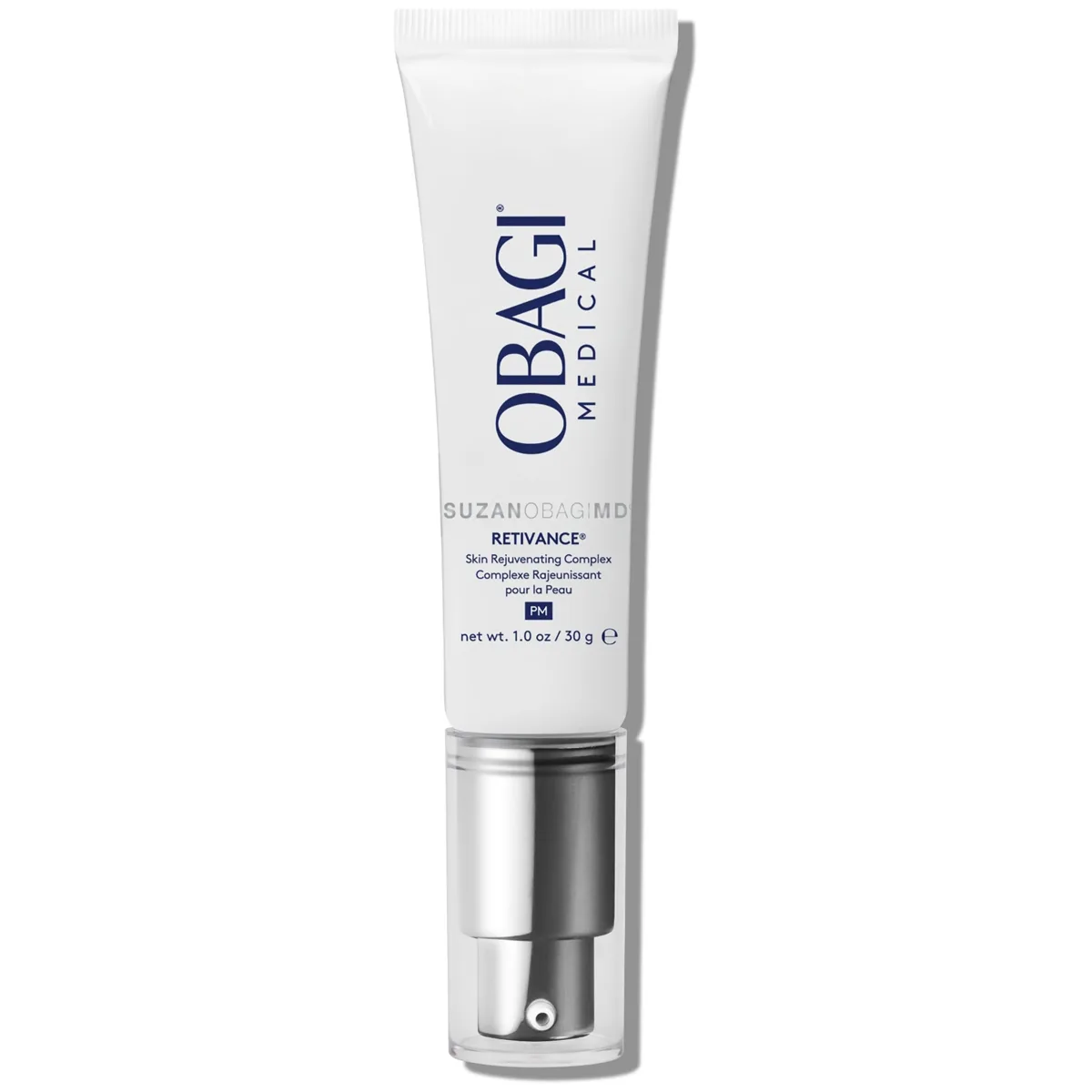
It is a physician-brand retinaldehyde at a declared 0.1%, delivered in an anhydrous silicone-and-plant-oil base with two forms of vitamin E, an oil-soluble vitamin C and chamomile-derived calming, built explicitly for people who have failed tretinoin. Most over-the-counter retinals come in light gels for oily skin; this one is a rich, stabilised serum for the dry, sensitive, mature patient the Obagi clinic sees most.
A well-built 0.1% retinaldehyde for the patient who could not survive tretinoin: stabilised in an anhydrous oil-silicone base, cushioned with vitamin E, an oil-soluble vitamin C and chamomile-derived calming, and genuinely gentle for what it is. Dry, mature and sensitive skin gets real retinoid results with far less peeling. Oily skin will find it heavy, and $155 is a physician-brand price for a molecule now available for much less.
Eight years of physician-channel sales and a few hundred reviews support the tolerability and texture observations here, and retinaldehyde's efficacy rests on independent controlled trials at comparable strength; Obagi publishes no clinical or consumer data for Retivance itself, so its performance is inferred from the molecule and the formulation rather than measured in this product. The peptide's contribution is supplier-supported only.
Verdicts
How well it fits each concern
Verdict by concern tap a concern for the case
Unprovenfor AgingIn your profileYou chose · Vitamin E has early or mechanistic evidence for aging — a reasonable bet, not a recommendation; the other actives here are not yet assessed for it.Limited evidenceGentleNo reviews collected yet
The case for it
Tocopherol + Tocopheryl Acetate has early or mechanistic evidence for this concern, not trial-backed standing.
It is plausibly present at a working level, though the concentration is not declared.
The formula carries none of the triggers this concern is sensitive to.
What would change this: A declared concentration would move this to a firmer reading of the dose.
Same rule for everyone. “Unproven” is the verdict on 1,111 of 45,024 concern verdicts across the catalog; rule R9 decided 1,111 of them.
As of September 25, 2026, engine 5.1.1.
R9 — Plausible-tier actives alone do not earn a recommendation, and 'not for this' would overstate the case against them. 'Unproven' with the evidence dots lets the reader judge the bet (added 0.2.0 after the first shadow run put a 10% niacinamide serum at 'not for this' for hyperpigmentation). 0.5.0: the closing clause reads the other heroes — "nothing else here addresses it" only when every other active has a researched 'none' row; "not yet assessed" when that is the truth. Rows whose dots read moderate or better now reach R9p first. · the full register
Carrying active
Tocopherol + Tocopheryl Acetate
Standing
plausible — trials support it
Form
plausible — studied range 1%, from the OTC monograph or label; needs leave-on contact
Tolerability
gentle
Row checked
against its sources on July 17, 2026 (evidence table ev-2026.09-r228)
Unprovenfor Sun DamageIn your profileYou chose · Vitamin E has early or mechanistic evidence for sun damage — a reasonable bet, not a recommendation; the other actives here are not yet assessed for it.Limited evidenceGentleNo reviews collected yet
The case for it
Tocopherol + Tocopheryl Acetate has early or mechanistic evidence for this concern, not trial-backed standing.
It is plausibly present at a working level, though the concentration is not declared.
The formula carries none of the triggers this concern is sensitive to.
What would change this: A declared concentration would move this to a firmer reading of the dose.
Same rule for everyone. “Unproven” is the verdict on 1,111 of 45,024 concern verdicts across the catalog; rule R9 decided 1,111 of them.
As of September 25, 2026, engine 5.1.1.
R9 — Plausible-tier actives alone do not earn a recommendation, and 'not for this' would overstate the case against them. 'Unproven' with the evidence dots lets the reader judge the bet (added 0.2.0 after the first shadow run put a 10% niacinamide serum at 'not for this' for hyperpigmentation). 0.5.0: the closing clause reads the other heroes — "nothing else here addresses it" only when every other active has a researched 'none' row; "not yet assessed" when that is the truth. Rows whose dots read moderate or better now reach R9p first. · the full register
Carrying active
Tocopherol + Tocopheryl Acetate
Standing
plausible — trials support it
Form
plausible
Tolerability
gentle
Row checked
against its sources on July 17, 2026 (evidence table ev-2026.09-r228)
Also listed for Rough Texture and Dullness — the actives here (Argan Oil, Vitamin E, Bisabolol, Retinal (Retinaldehyde) are in our research queue for those concerns; there is no verdict until their evidence rows are written. That is a gap in our table, not a mark against the product.
Where our review and the verdict differ. The review below was written on the formulation and the published trials; the verdicts above apply the stricter standing test in our methodology — an active earns a recommendation only with guideline or regulatory standing for the concern. Where the two disagree, the verdict is DermApproved’s position.
A verdict is DermApproved’s assessment of how well a product’s ingredients fit a concern — never a claim about what the product treats. Evidence dots and collected reviews sit beside it and are never blended in.
Rules 0.5.1 · evidence table ev-2026.09-r228 · how we decide
Assessment
Pros & Cons
Pros
✓ Declared 0.1% retinaldehyde, at the upper end of over-the-counter retinal strength
✓ Anhydrous silicone-and-oil base with two vitamin E forms keeps the retinal stable
✓ Oil-soluble vitamin C ester adds antioxidant and brightening support beside the retinoid
✓ Bisabolol and chamomile calm retinoid redness in a formula built for tretinoin-averse skin
✓ Rich enough that dry skin needs no separate night cream
✓ Fragrance-free, alcohol-free and airless-pumped
✓ Retinaldehyde has independent controlled-trial evidence against retinoic acid
Cons
✗ $155 for 1 oz, emptied in two to three months at nightly use
✗ Heavy oil-silicone base congests oily and acne-prone skin
✗ Slow to absorb and can feel greasy under a moisturizer
✗ Wheat germ oil and chamomile are allergens for some users
✗ Palmitoyl tripeptide-5 sits last in the list and adds little
✗ Obagi publishes no efficacy data for this serum specifically
Review
Full Review
Every Obagi clinic knows the patient who came in for Nu-Derm, left with tretinoin and hydroquinone, and was back in three weeks with a red, peeling face and a decision not to continue. Tretinoin works, and it loses a large share of the people who start it. Retivance is Obagi's engineered answer to that drop-out: a retinoid strong enough to be worth the trouble and gentle enough to keep the patient, built for the SuzanObagiMD line in 2018 with dermatologist Suzan Obagi specifically for skin that had already failed the harder drug.
The molecule is retinaldehyde, and the choice is well founded. Retinal is one enzymatic step from retinoic acid, closer than retinol, and the French clinical work of the late 1990s established what that means in practice: in a 125-patient trial, a 0.05% retinaldehyde cream reduced wrinkle and roughness measures on optical profilometry as significantly as 0.05% retinoic acid at eighteen weeks, while the retinoic acid group suffered more irritation and worse compliance and the vehicle group saw nothing. Retivance declares 0.1%, twice that trial's concentration and at the upper end of what is sold over the counter, and it is the tenth ingredient in a formula with almost no water.
That last detail is the formulation's real intelligence. Retinaldehyde degrades fast in water and light, and most retinal serums are compromises between potency and shelf life. Retivance is built anhydrous: cyclopentasiloxane and a dimethicone crosspolymer lead, then caprylic/capric triglyceride, a film-forming copolymer and shea butter extract before water even appears in sixth place, followed by argan oil, tocopherol and bisabolol ahead of the retinal itself. Two forms of vitamin E, an oil-soluble vitamin C ester directly after the retinal, titanium dioxide for a faint optical softening, then wheat germ and safflower oils, a spent grain wax, chamomile extract and a palmitoyl tripeptide as the last entry. It is a retinoid dissolved in a protective oil-silicone cushion, sealed in an airless pump, and it means the last pump is as potent as the first.
On the skin that cushion is the whole experience. The serum is dense and silky, glides on with silicone slip, and takes a minute or two to settle into a soft, cushioned, slightly luminous finish. There is no sting. Over the first week or two, dry skin may flake a little around the nose and mouth, and that is generally the extent of the adjustment, which people arriving from tretinoin find almost suspicious. Then the retinoid does its work on the retinoid timetable: smoother texture and a clearer, more even surface at four to eight weeks, and a gradual softening of fine lines and sun-roughened patches over the following months, on the same eighteen-week horizon the trials used. It is a real vitamin A result at a tolerable cost, which is precisely the proposition.
A few practical notes from eight years of users are worth passing on. The serum is best applied to completely dry skin, because any dampness speeds retinoid penetration and brings back the sting the formula was designed to avoid. Two pumps cover a face; the third Obagi permits is for the neck and chest, where retinaldehyde does good work on crepiness and sun damage that tretinoin is often too harsh to treat. And the airless pump is not decorative: retinal is among the most fragile actives in skincare, and an open jar of it is half-spent within weeks, so the packaging is part of what keeps the last dose honest.
It also earns its keep as a companion to the rest of a sensitive routine. Because it carries its own emollients, it pairs naturally with a morning polyhydroxy acid lotion and a mineral sunscreen without stacking irritants, and it slots into the SuzanObagiMD sequence Obagi built around exactly that pairing.
The richness that makes it kind to dry and mature skin is what limits it elsewhere. Oily and combination users report greasiness, slow absorption and, in the acne-prone, congestion from the wheat germ oil and shea; this is not a retinoid for breakouts and does not pretend to be. Wheat germ and chamomile are worth noting for anyone with those allergies. The peptide at the end of the list is a label credit. And the price is the standing Obagi complaint: $155 for 1 oz, emptied in two to three months at two pumps a night, for a molecule that other brands now sell at similar strength in lighter, cheaper formulas. What the premium buys is the anhydrous stabilisation, the calming and antioxidant cast, the physician-brand channel and a base tuned for the exact skin the brand's clinics treat.
For that skin, the dry, sensitive, sun-damaged face that wants a retinoid and cannot take tretinoin, Retivance is one of the more carefully thought-through options available and worth its cost if the alternative is giving up on vitamin A entirely. For oily or resilient skin, or for anyone who simply wants retinaldehyde at 0.1%, lighter and cheaper serums deliver the same active with less oil and less money, and the choice comes down to whether the cushion is a feature or a burden.
Formula
Key Ingredients
The hero actives that drive this product's performance.
The active, declared at 0.1% and sitting tenth in a mostly anhydrous silicone-oil base that keeps it from oxidising. Retinaldehyde is one enzymatic step from retinoic acid, so it converts faster than retinol in skin, and at this concentration in this vehicle it is meant to give tretinoin-averse patients a meaningful vitamin A effect with a fraction of the irritation.
An oil-soluble vitamin C ester listed directly after the retinal, chosen because it dissolves in the same anhydrous base and stays stable beside a retinoid where L-ascorbic acid could not; it adds antioxidant protection and a modest brightening note to the retinaldehyde's texture work.
Two forms of vitamin E, one of them eighth in the list, which is where they need to be in a retinaldehyde formula: they protect the light- and oxygen-sensitive retinal from degrading in the bottle and mop up the radicals a retinoid stirs up in skin.
The chamomile-derived calming pair, bisabolol ninth in the list ahead of the retinal, that carries the SuzanObagiMD promise of tolerability; they take the edge off retinoid-induced redness in a formula designed for people who have already failed tretinoin.
The plant-oil trio that makes this an emollient serum rather than a gel: argan seventh, with wheat germ and safflower further down, they cushion the retinaldehyde, supply linoleic acid to a barrier under retinoid stress and give the formula its rich, slow-absorbing feel.
Not yet assessed
Ingredient standings describe the active at treatment-level doses and
vehicles; this product's own condition grades weigh its actual formula.
Up to three pumps at night on cleansed, toned skin, feathered onto the jawline and neck, then moisturizer over it; the base is rich enough that dry skin may need nothing more. Do not use it on the same night as an acid or another retinoid, and wear SPF 30 or higher every morning after.
Results Timeline
Mild dryness or flaking in the first two to three weeks is possible but far less than with tretinoin. Smoother texture and a clearer surface show at four to eight weeks, and the fine-line and roughness improvements the retinaldehyde trials measured at eighteen weeks are the realistic horizon for visible photoaging change.
The case for retinaldehyde as a gentler retinoid was made in a controlled trial that remains the reference. A 1998 study in the Journal of the American Academy of Dermatology randomised 125 patients with facial photodamage to a 0.05% retinaldehyde cream, a 0.05% retinoic acid cream or the retinaldehyde vehicle, and measured crow's feet wrinkles and roughness by optical profilometry of silicone replicas at baseline, eighteen and forty-four weeks. At eighteen weeks both actives produced significant reductions in wrinkle and roughness features, with a less pronounced but persistent reduction at forty-four weeks and no change in the vehicle group at any point. Retinaldehyde was well tolerated throughout, whereas retinoic acid caused more local irritation and affected compliance. The authors concluded retinaldehyde was efficacious and well tolerated in photodamage. The mechanism is that retinal is oxidised to retinoic acid in keratinocytes in a single step, so it reaches the retinoic acid receptors more efficiently than retinol, which must first be converted to retinal, while its slower conversion than direct retinoic acid application moderates the irritation.
Retivance uses retinaldehyde at a declared 0.1%, twice the trial concentration, in an anhydrous vehicle that addresses the molecule's principal weakness, instability in water and light. The base of cyclopentasiloxane, dimethicone crosspolymer, caprylic/capric triglyceride and a PPG-12/SMDI film-former carries the retinal in a lipophilic matrix, tocopherol and tocopheryl acetate act as sacrificial antioxidants to protect it, and the airless pump limits oxygen exposure. Tetrahexyldecyl ascorbate is a lipid-soluble vitamin C ester that remains stable in this environment where L-ascorbic acid could not, contributing antioxidant capacity and modest evidence for brightening and collagen support. Bisabolol and Chamomilla recutita extract have documented anti-inflammatory activity and are included to offset retinoid dermatitis. Argan, wheat germ and safflower oils supply linoleic and oleic acids that support a barrier under retinoid stress at the cost of comedogenic potential on oily skin. Titanium dioxide provides optical softening, and palmitoyl tripeptide-5 is a signal peptide with supplier data at a position that implies a small dose. Obagi publishes no clinical or consumer data for Retivance itself, so its expected performance is inferred from the retinaldehyde literature and its formulation rather than demonstrated in this product.
Retinaldehyde has a settled place in clinical practice as the retinoid for patients who need vitamin A but cannot tolerate tretinoin or adapalene, and the comparative trial evidence, equivalent profilometric improvement with far fewer drop-outs, is why dermatologists reach for it in rosacea-prone, sensitive or mature patients and in those recovering from a failed prescription course. A 0.1% retinal in a stabilised anhydrous base with antioxidant and anti-inflammatory support is a textbook version of that recommendation, and its origin in a dermatologist-developed line for Nu-Derm drop-outs matches the way it is used. The clinical caveats are familiar: it is a retinoid, so it is avoided in pregnancy and breastfeeding, started on alternate nights, paired with strict daily sunscreen and kept away from acids and other retinoids on the same night; and its rich vehicle makes it a poor fit for acne-prone or seborrhoeic patients, who are better served by a retinal or adapalene gel. Practitioners would also note the absence of product-specific data and the price, which is high relative to other well-formulated retinals. For the dry, sensitive, photoaged patient it is an easy recommendation.
Guidance
Usage & Recommendations
How to Use
Use at night only. Cleanse, apply toner if you use one, and let the skin dry completely, since retinoids penetrate faster on damp skin and sting more. Dispense up to three pumps, though two is enough for most faces, and massage gently over the face, then feather the remainder down over the jawline and neck. Give it a minute or two to settle; on dry or normal skin no further product is needed, while combination skin or a face in its first weeks of retinoid use benefits from a plain barrier moisturizer over the top. Begin every other night for the first two weeks and move to nightly if there is no persistent redness or flaking. Do not use it on the same night as an exfoliating acid, benzoyl peroxide or another retinoid, and wear broad-spectrum SPF 30 or higher every morning without fail. Stop it during pregnancy or breastfeeding and before any resurfacing procedure. Keep the airless bottle capped and away from heat and light.
Value Assessment
One hundred and fifty-five dollars for 1 oz places Retivance among the most expensive retinaldehyde products on the market, and the molecule itself is now available at comparable strength from several brands at a third to half the price. What the premium buys is a deliberately engineered anhydrous vehicle that keeps the retinal potent to the last pump, a full antioxidant and calming cast, a physician-dispensed brand and a base tuned for dry, tretinoin-damaged skin; what it does not buy is any product-specific evidence or a formula suited to oily faces. At two pumps nightly the bottle lasts two to three months, so the running cost is $50 to $75 a month, and starting on alternate nights, as retinoid newcomers should, stretches it toward four months. There is only one size. For a patient who has failed tretinoin and needs a retinoid their skin will accept, the price is a fair trade against abandoning vitamin A altogether; for anyone else, equally well-dosed retinals cost far less.
Who Should Buy
People with dry, sensitive, mature or sun-damaged skin who want a genuine retinoid result and have been unable to tolerate tretinoin or other prescription retinoids, particularly Obagi Nu-Derm patients looking for a gentler vitamin A step. Anyone who prefers a rich, cushioning night serum that doubles as a moisturizer will find the vehicle a comfort rather than a compromise.
Who Should Skip
Oily, combination and acne-prone skin will find the oil-silicone base greasy and potentially congesting and should choose a retinal gel. Pregnant and breastfeeding users must avoid all retinoids, people with wheat or chamomile allergies should check the list, and budget-minded buyers can get 0.1% retinaldehyde in lighter formulas for far less.
Ready to try Obagi Retivance Skin Rejuvenating Complex?
A dense, silky, almost balm-like serum that glides on with pronounced silicone slip, sits for a minute or two and settles into a soft, cushioned, faintly luminous finish
Scent
Unscented; a faint nutty note from the plant oils and nothing else
Packaging
A 1 oz airless pump bottle in SuzanObagiMD's white livery; the airless design matters for a light-sensitive retinal
Finish
velvetysatin
What to Expect on First Use
The first nights are gentler than most people expect from a retinoid: a rich, slow-absorbing serum, no sting, and at most a little dryness or fine flaking around the nose and mouth by the end of the first week. Anyone coming from tretinoin will notice the absence of the burn; anyone with oily skin will notice the richness by the second night.
How Long It Lasts
About two to three months at two pumps nightly; closer to four months on the every-other-night start Obagi's line suggests for retinoid newcomers
Obagi's original business was the Nu-Derm tretinoin-and-hydroquinone system, and its most common clinical failure was the patient whose skin simply could not take tretinoin. The SuzanObagiMD line launched in 2018 to keep those patients in the brand, and Retivance was its retinoid answer, choosing retinaldehyde because the French clinical work of the late 1990s had shown it matched retinoic acid on photodamage with far better tolerance.
About Obagi Legacy Brand (20+ years)
Obagi has been a physician-dispensed brand since dermatologist Zein Obagi founded it in 1988, and Retivance belongs to the SuzanObagiMD line developed with dermatologist Suzan Obagi in 2018 for patients who cannot tolerate the brand's tretinoin-based regimens. Retinaldehyde itself has independent controlled trials; Obagi publishes no efficacy figures for this particular serum.
Brand founded: 1988 · Product launched: 2018
Myth vs. Reality
Common Myths
Myth
Retinaldehyde is a weak, beginner-grade retinoid.
Reality
It is one conversion step from retinoic acid, closer than retinol, and a 0.05% retinaldehyde cream matched 0.05% retinoic acid on profilometric wrinkle and roughness measures at eighteen weeks in a 125-patient trial, with markedly better tolerance. At 0.1% this serum is at the upper end of what over-the-counter retinals offer.
Myth
A rich, oily retinoid serum will make you break out.
Reality
The base is heavy, and oily or acne-prone skin can find it congesting, which is a real limitation. But the richness is a deliberate choice for dry, mature and tretinoin-damaged skin, where a light retinal gel would strip; the product is not built for acne and does not claim to be.
FAQ
Frequently Asked Questions
How strong is Obagi Retivance compared with tretinoin?
It contains 0.1% retinaldehyde, one enzymatic step from retinoic acid. In the key comparative trial, 0.05% retinaldehyde matched 0.05% retinoic acid on wrinkle and roughness measures at eighteen weeks with much less irritation, so Retivance sits meaningfully below prescription strength but well above a typical retinol serum.
Can I use Obagi Retivance if tretinoin was too irritating?
That is exactly who it was made for. Retinaldehyde is documented as well tolerated where retinoic acid caused irritation and compliance problems, and this formula adds bisabolol, chamomile, plant oils and vitamin E to cushion it further. Start every other night and build up.
Is Obagi Retivance suitable for oily or acne-prone skin?
Not ideally. The base is cyclopentasiloxane, shea, argan, wheat germ and safflower oils, rich by design for dry and mature skin, and oily users often report greasiness or congestion. A lighter retinal gel serves oily skin better.
Does Obagi Retivance need a moisturizer over it?
On dry or normal skin, usually not; the oil-and-silicone base is emollient enough on its own. Obagi's directions include a moisturizer after it, which suits combination skin or very dry winter nights, and a barrier cream helps in the first few weeks while skin adjusts.
Is Obagi Retivance safe in pregnancy?
No. Retinaldehyde is a vitamin A derivative, and all topical retinoids are conventionally avoided during pregnancy and breastfeeding. Stop it when trying to conceive and switch to a non-retinoid such as azelaic acid or a PHA on your doctor's advice.
Why is Obagi Retivance mostly silicone and oil with barely any water?
Retinaldehyde degrades quickly in water and light. An anhydrous silicone-and-oil base with two forms of vitamin E keeps it stable, and the airless pump keeps air out. It is why the serum feels rich and why the retinal is still potent at the end of the bottle.
Reviews
What Reviewers Tend to Say
Recurring themes our editors read across retailer reviews of this product — summaries in our words, not quotations, and not a substitute for your own patch test.
Common Praise
Real retinoid results with far less peeling than tretinoin
Rich texture means no separate night cream on dry skin
Skin looks smoother and more even within two months
No sting, no fragrance
Common Complaints
Expensive
Too rich and occlusive for oily or acne-prone skin
Slow to absorb and can feel greasy
Pump dispenses generously and the jar-like bottle empties fast
Notable Endorsements
Developed with dermatologist Suzan Obagi as the retinoid for patients who cannot tolerate Nu-Derm tretinoinDispensed by dermatology practices as a gentler alternative to prescription retinoids
The famous 15/1/0.5 trio isn't marketing folklore — it traces to a specific Duke experiment. But 'the studied combination' and 'any serum with all three names on the label' are not the same thing.
The one home formulation with a genuinely coherent case, taken apart on its own terms: the pH window, the oxidation clock, and what a browning serum has actually become.
One is a single conversion step from prescription retinoic acid. The marketing turns that into '11x stronger.' The evidence tells a subtler — and more useful — story.
Products, answers, therapy guides, tools and articles in one search. Brand names,
slang and abbreviations all work — accutane finds isotretinoin, bacne finds truncal acne.