Glycolic vs Lactic Acid: Which AHA Is Actually Right for You
Glycolic gets the hype and the higher numbers. But lactic acid does something glycolic can't — and for a lot of skin, that changes the whole calculation.
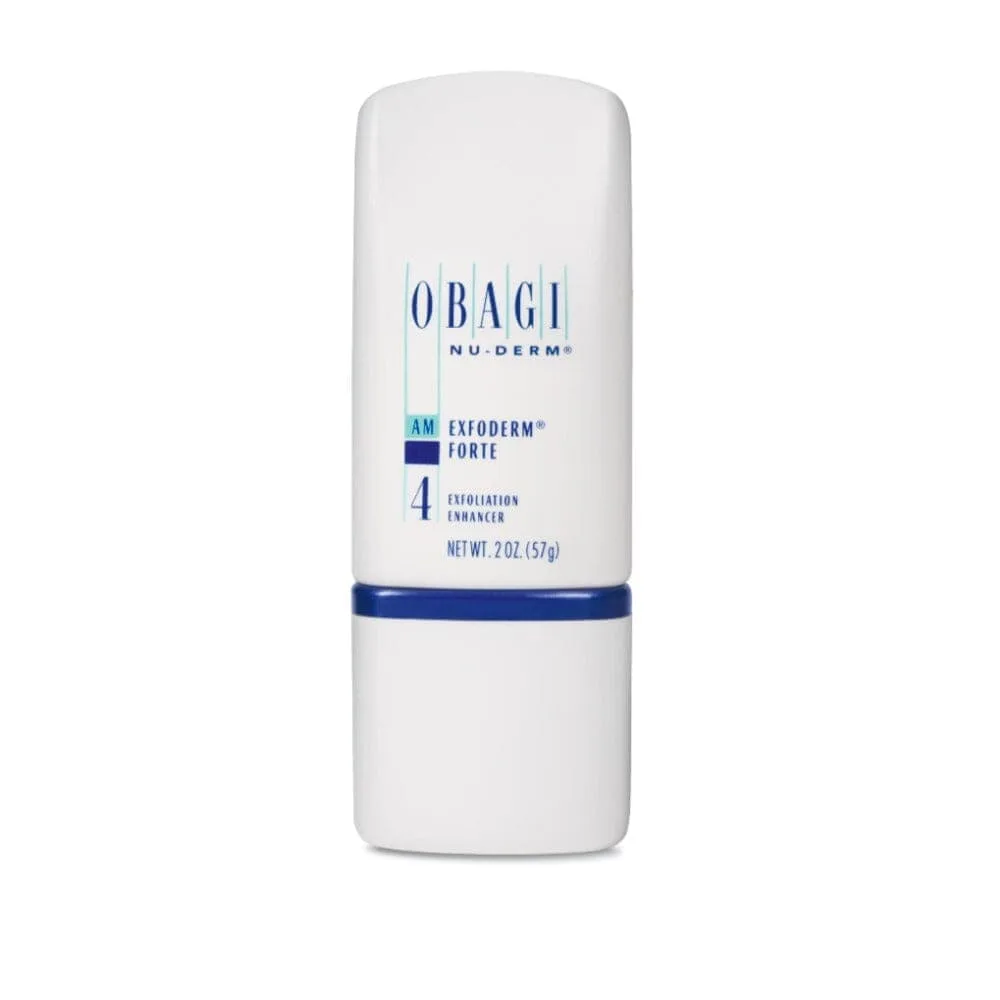
It is the exfoliating step of a physician-supervised regimen, built for the oilier half of Nu-Derm patients: glycolic and lactic acids in the top six of a lean, fragrance-free base with olive oil and vitamin E, and nothing that would soften its job. Its distinction is not the formula, which is simple, but the discipline of being designed around tretinoin at night, which most standalone AHA lotions ignore.
The oily-skin version of Nu-Derm's step four: glycolic and lactic acids in a lean, fragrance-free lotion that exfoliates every morning without getting in tretinoin's way. It does its job, skin gets smoother and clearer within weeks, and inside the regimen it belongs. Bought alone, it is an undisclosed-strength AHA lotion with nothing else in it at $105 for 2 oz, and the drugstore has done this for decades.
Exfoderm Forte has decades of supervised use as a Nu-Derm step, but Obagi neither discloses its acid percentages nor publishes efficacy data for it alone, and its standalone review base is a few hundred across retailers with only a couple of dozen on the brand's site. This assessment therefore rests on the general clinical literature for daily glycolic and lactic acid lotions and on the lotion's role within the system rather than on product-specific results.
The case for it
Same rule for everyone. “Good choice” is the verdict on 9,564 of 45,024 concern verdicts across the catalog; rule R5 decided 9,072 of them. As of September 25, 2026, engine 5.1.1.
Brand or formulator? Disclose a concentration or correct a fact →
The studies behind the evidence row
The case for it
Same rule for everyone. “Good choice” is the verdict on 9,564 of 45,024 concern verdicts across the catalog; rule R5 decided 9,072 of them. As of September 25, 2026, engine 5.1.1.
Brand or formulator? Disclose a concentration or correct a fact →
The studies behind the evidence row
The case for it
Cautions: a photosensitising active — use sun protection.
What would change this: A declared concentration would move this to a firmer reading of the dose.
Same rule for everyone. “Promising” is the verdict on 7,858 of 45,024 concern verdicts across the catalog; rule R9p decided 7,858 of them. As of September 25, 2026, engine 5.1.1.
Brand or formulator? Disclose a concentration or correct a fact →
The studies behind the evidence row
The case for it
Cautions: a photosensitising active — use sun protection.
What would change this: A declared concentration would move this to a firmer reading of the dose.
Same rule for everyone. “Promising” is the verdict on 7,858 of 45,024 concern verdicts across the catalog; rule R9p decided 7,858 of them. As of September 25, 2026, engine 5.1.1.
Brand or formulator? Disclose a concentration or correct a fact →
The studies behind the evidence row
The case for it
What would change this: A declared concentration would move this to a firmer reading of the dose.
Same rule for everyone. “Not for this” is the verdict on 488 of 45,024 concern verdicts across the catalog; rule R10 decided 488 of them. As of September 25, 2026, engine 5.1.1.
Brand or formulator? Disclose a concentration or correct a fact →
The studies behind the evidence row
A verdict is DermApproved’s assessment of how well a product’s ingredients fit a concern — never a claim about what the product treats. Evidence dots and collected reviews sit beside it and are never blended in. Rules 0.5.1 · evidence table ev-2026.09-r228 · how we decide
Two tubes, same number, one word apart. Obagi's Exfoderm and Exfoderm Forte are both step four of the Nu-Derm System and both labelled Lightweight Exfoliating Lotion since the 2025 renaming, and the only visible difference is the word Forte. Underneath, they share almost nothing. The regular version is phytic acid in a rich cream for dry and sensitive faces; the Forte is glycolic and lactic acids in a lighter base for normal, combination and oily skin, and Obagi's Nu-Derm kits are sorted by exactly that line. The Forte is the tube most people picture when they think of Obagi exfoliation, and it is the more conventional product of the two.
The list is short and honest. Water, glycerin, cetearyl alcohol, glycolic acid, a triglyceride, lactic acid, more fatty alcohol, olive oil, sodium hydroxide, and then emulsifiers, fatty acids, a little dimethicone, preservatives and tocopherol last. Two alpha-hydroxy acids in the top six, partially neutralised, in a fragrance-free emollient base that is lighter than the phytic version's but not oil-free. Obagi does not disclose the percentages, which is a real gap for an acid product, but the placement and the lack of any serious sting put them in daily-lotion territory rather than anywhere near a peel. Pairing glycolic with lactic is a sensible move: glycolic is the smallest AHA and penetrates fastest, lactic is larger, gentler and a humectant, and together they exfoliate more broadly with less irritation than the same total dose of glycolic alone.
What it does on the skin is exactly what a daily AHA lotion does. A brief tingle on the first few mornings, smoother skin by the fourth or fifth application, some tightness or light flaking around the nose in the first week if the skin is also on tretinoin at night, and then a clearer, brighter surface by the second and third week that Nu-Derm patients recognise as the point at which the Clear and Blender steps seem to start working harder. That is the product's real function: keeping the stratum corneum thin and turning over so that hydroquinone or arbutin and tretinoin penetrate. The clinical support for daily acids at this kind of strength is solid if modest. A vehicle-controlled trial of 8% glycolic and 8% lactic acid creams in women with photodamaged faces found significantly more improvement than vehicle at 22 weeks, with the authors describing the effect as modest and well tolerated, and that is the right expectation for this tube used alone: better texture, less mottling, a little more brightness, over months.
The Forte's limitations are the limitations of a system step sold separately. There is nothing in it beyond the acids: no niacinamide, no antioxidant beyond a trace of vitamin E, no ceramide, no soothing agent, because in the regimen those jobs belong to other tubes. Dry and sensitive skin will find it too much, especially once tretinoin is in the picture, and that is why the phytic version exists. Olive oil and myristic acid carry a mild congestion risk for the most acne-prone users, which is a small irony in the oily-skin version. And the undisclosed acid strength means a buyer cannot compare it with the many glycolic lotions that state theirs.
One thing the tube does well that is easy to miss is behave. Many glycolic lotions at this level are watery gels that sting on contact and leave oily skin oddly tight; this one is a proper emulsion, with enough triglyceride and olive oil to feel like a light moisturizer and enough fatty alcohol to spread evenly, and it dries to a near-matte finish that mineral sunscreen sits on without a fight. For a patient applying five products before nine in the morning, a step that absorbs in under a minute and does not pill is not a small thing, and it is part of why Nu-Derm regimens, for all their demands, tend to get finished by the people who start them.
The price is the objection everyone raises. One hundred and five dollars for 2 oz of two AHAs in an emollient base is a system-step price, and used every morning the tube lasts about two months, so the running cost is around $50 a month for daily exfoliation that a $20 drugstore glycolic lotion delivers with a stated percentage. Inside a Nu-Derm programme, where a physician has prescribed the sequence and the exfoliant's value lies in what it lets the hydroquinone and tretinoin do, the cost is part of the regimen. Outside it, the premium buys Obagi's name and the confidence that the lotion was designed around tretinoin rather than despite it, which for a patient already on a retinoid is worth something and for anyone else is not.
For Nu-Derm patients with normal-to-oily skin, this is the step four they should be using, and it does its narrow job well and without fuss. For someone outside the system with oily, resilient skin who wants a fragrance-free daily AHA and does not mind paying for the brand, it is a perfectly good one. For everyone else, glycolic and lactic acids are a solved problem at a fraction of the price, and the number on the tube does not change the chemistry inside it.
The hero actives that drive this product's performance.
| Ingredient | Function | Evidence |
|---|---|---|
| Glycolic Acid | Fourth in the list, ahead of the emollient triglyceride, at an undisclosed but clearly working level and partly neutralised by the sodium hydroxide further down. It is the reason this is the Forte: the smallest AHA, penetrating fastest, loosening the compacted surface so the Nu-Derm hydroquinone and tretinoin steps reach fresh skin on oilier, more resilient faces. | Established mechanism for Rough Texture · established mechanism |
| Lactic Acid | Sixth in the list, the second AHA, larger and gentler than glycolic and a humectant in its own right; pairing the two gives a broader exfoliating action with less sting than the same total dose of glycolic alone, and the lactic acid keeps the lotion from drying skin it is meant to resurface daily. | Established mechanism for Rough Texture · established mechanism |
| Olea Europaea (Olive) Fruit Oil | Eighth in the list, the single plant oil in a lighter base than the phytic Exfoderm's; with the triglyceride and fatty alcohols it gives just enough cushion for daily acid use on normal-to-oily skin without the richness that would congest it. | Not yet assessed |
| Tocopherol | The last ingredient, active vitamin E at a small antioxidant dose, protecting the olive oil in the tube and offering skin being exfoliated every morning a little radical defence before sunscreen goes on. | Limited for Aging |
Ingredient standings describe the active at treatment-level doses and vehicles; this product's own condition grades weigh its actual formula.
Aqua (Water), Glycerin, Cetearyl Alcohol, Glycolic Acid, Caprylic/Capric Triglyceride, Lactic Acid, Cetyl Alcohol, Olea Europaea (Olive) Fruit Oil, Sodium Hydroxide, Polysorbate 60, Stearyl Alcohol, Palmitic Acid, Saponins, Dimethicone, Myristic Acid, Stearic Acid, Ethylhexylglycerin, Phenoxyethanol, Tocopherol
treatment
AM
In Nu-Derm it is the morning step after cleanser, toner and Clear, before sunscreen; alone, apply a thin layer to clean skin in the morning under SPF. Keep tretinoin to the night and do not add another acid, and start on alternate mornings if you are new to AHAs.
A brief tingle on the first mornings and noticeably smoother skin within a week. Brightness and a clearer surface show at two to four weeks; the fine-line and tone improvements seen in trials of daily glycolic and lactic acid creams took around five months, and inside Nu-Derm the system's own six-to-twenty-four-week horizon applies.
The formula is a conventional daily alpha-hydroxy acid lotion, and its evidence is the evidence for that class. Glycolic and lactic acids reduce corneocyte cohesion in the lower stratum corneum, accelerating desquamation and thinning the compacted surface layer, and with sustained use they increase epidermal thickness and dermal glycosaminoglycans; glycolic acid, the smallest AHA, penetrates fastest, while lactic acid is larger, gentler and also a component of the skin's natural moisturizing factor, so the pair broadens the exfoliating action while tempering irritation. The strength of that action depends on free acid, which depends on concentration and pH; Exfoderm Forte discloses neither, but the acids' positions fourth and sixth in the list, the sodium hydroxide neutraliser and the mild tingle users report are consistent with a moderate daily-use formulation. The most relevant controlled evidence is a 1996 double-blind, vehicle-controlled trial in the Archives of Dermatology in which 74 women with moderately severe facial photodamage applied 8% glycolic acid, 8% L-lactic acid or vehicle creams twice daily for 22 weeks; on the face, 76% of glycolic and 71% of lactic users achieved at least one grade of improvement in overall photodamage against 40% on vehicle, and on the forearms lactic acid also improved mottled hyperpigmentation, sallowness and roughness, with the authors describing both acids as modestly useful and well tolerated. That study frames what a daily AHA lotion at similar strength can do on its own: gradual, measurable improvement in texture and tone over months.
Within the Nu-Derm System the lotion's role is different and largely mechanical. Exfoliating the stratum corneum each morning improves penetration of the hydroquinone or arbutin in the Clear step and the tretinoin in the Blender, and the regimen's published before-and-after results belong to those actives rather than to Exfoderm Forte. The vehicle is a lean oil-in-water emulsion: glycerin for humectancy, caprylic/capric triglyceride and olive oil for emollience, cetearyl, cetyl and stearyl alcohols with palmitic, myristic and stearic acids for structure, polysorbate 60 to emulsify, dimethicone for slip, saponins as mild plant surfactants, and tocopherol as a small antioxidant that also protects the olive oil. Obagi publishes no clinical or consumer data for Exfoderm Forte as a standalone product.
Within the Nu-Derm System, Exfoderm Forte is the step four a physician selects for a patient with normal, combination or oily skin, on the reasoning that resilient skin tolerates a glycolic-lactic lotion each morning alongside night-time tretinoin and benefits from the faster turnover, while dry or sensitive patients are moved to the phytic acid version to keep the regimen tolerable. Its clinical purpose is to improve penetration of the hydroquinone or arbutin and tretinoin steps, and clinicians do not expect it to produce results on its own beyond the modest texture and tone improvement any daily AHA gives. Used outside the system, dermatologists would regard it as an ordinary fragrance-free glycolic-lactic lotion with the drawback of an undisclosed strength, suitable for oily patients wanting gentle daily exfoliation under sunscreen but with no particular advantage over stated-percentage products at lower cost. The standard AHA precautions apply: morning use with strict daily sunscreen, no stacking with other acids or benzoyl peroxide, a slow start for retinoid users, and avoidance on inflamed, freshly treated, rosacea-prone or eczematous skin. The system's tretinoin and hydroquinone steps rule it out in pregnancy; the lotion alone does not.
Apply in the morning to clean, dry skin. In the Nu-Derm sequence it follows the foaming cleanser, toner and Clear or Clear Fx steps and precedes sunscreen; on its own, use it after cleansing and before moisturizer or SPF. Squeeze a pea-sized amount and spread a thin, even layer over the face, feathering to the jawline and avoiding the eye contour and lips. Expect a brief tingle that fades within a minute; if it persists or the skin flakes, drop to alternate mornings for the first two weeks, particularly if you are also using tretinoin at night. Follow with a broad-spectrum sunscreen every morning without exception. Do not combine it with salicylic acid, another AHA, benzoyl peroxide or a vitamin C serum in the same routine, and pause it on skin that is inflamed, sunburnt or recently treated. Rinse with water immediately if it gets into the eyes.
One hundred and five dollars for 2 oz is a physician-channel price for two of the most inexpensive acids in skincare in a plain emollient base, and stated-strength glycolic and lactic lotions from drugstore and clinical brands cost a third as much or less. A tube used every morning lasts about two months, so the running cost is around $50 a month, or roughly $35 on the alternate-morning schedule new AHA users should start with. Inside a prescribed Nu-Derm regimen the price is part of a system chosen for its whole-regimen results, and the Forte's value is in the tretinoin and hydroquinone penetration it enables; on its own, the premium buys Obagi's name and a formula designed with a night-time retinoid in mind, which matters to a retinoid user and to no one else. There is only one size.
Nu-Derm System patients with normal, combination or oily skin who need step four and should take this version rather than the phytic Exfoderm, and oily-skinned people outside the system who want a fragrance-free daily glycolic-lactic lotion built to sit under sunscreen beside a night-time retinoid and are willing to pay Obagi's price for it.
Dry, sensitive, rosacea-prone or eczema-prone skin should use the regular Exfoderm or avoid daily AHAs altogether. Anyone who wants to know the acid strength they are applying, or who is shopping on ingredients per dollar, will find stated-percentage glycolic and lactic lotions for far less, and people with active inflammatory acne need a treatment, not an exfoliant.
Ready to try Obagi Exfoderm Forte Lightweight Exfoliating Lotion?
Buy at Amazon ♥A light, fluid white lotion, thinner than the phytic Exfoderm, that spreads quickly, absorbs in under a minute and leaves a soft, nearly matte finish
Unscented; a faint neutral cream smell and a whisper of acid
A 2 oz white tube with a flip cap in the Nu-Derm System's blue-banded livery, labelled step four
The first mornings bring a brief tingle for half a minute, the sign of a working glycolic dose, and skin that feels smoother by the third or fourth use. Some tightness or light flaking around the nose in the first week is normal, especially on skin also using tretinoin at night; sensitive users notice the sting and should be on the plain Exfoderm instead.
About two months at a thin layer every morning; three on the alternate-day schedule many Nu-Derm users start with
All Year
Nu-Derm was built in the late 1980s around the idea that skin should be prepared and kept turning over so that hydroquinone and tretinoin could work, and Exfoderm was its step four. The Forte version, swapping phytic acid for glycolic and lactic in a lighter base, was added for normal-to-oily patients who found the original too rich and too mild, and it is the exfoliant Obagi's oily-skin Nu-Derm kits ship with. The 2025 catalogue renaming gave it the function-first label it now carries.
Obagi was founded in 1988 by dermatologist Zein Obagi, and Exfoderm Forte is the oily-skin version of step four in the Nu-Derm System, dispensed under medical supervision for nearly four decades; the full regimen with tretinoin and hydroquinone has published clinical work, while this lotion alone carries no standalone efficacy figures and Obagi does not disclose its acid percentages.
Exfoderm Forte is a strong glycolic peel in a tube.
It is a partially neutralised daily lotion with glycolic and lactic acids at undisclosed but modest levels, buffered with sodium hydroxide and cushioned with olive oil. Daily glycolic and lactic creams at similar strengths improved photodamage modestly over five months in controlled trials; this is steady resurfacing, not a peel.
If Forte is stronger, it must give better Nu-Derm results than the regular Exfoderm.
The two versions match skin type, not ambition. Oily, resilient skin tolerates and benefits from the AHAs; dry or sensitive skin on tretinoin will over-exfoliate with the Forte and do better with phytic acid. Nu-Derm's results come from the hydroquinone and tretinoin steps either way.
Obagi does not publish the percentages. Glycolic acid is fourth and lactic acid sixth in the ingredient list, partly neutralised with sodium hydroxide, which is consistent with a moderate daily-use dose rather than a peel strength.
Forte for normal, combination and oily skin that tolerates acids; the regular Exfoderm for dry, sensitive or reactive skin. Obagi's own Nu-Derm kits are split the same way, and the Forte's glycolic and lactic acids will sting and flake skin the phytic acid version leaves calm.
That is how it is designed to be used, but not in the same step: Exfoderm Forte in the morning under sunscreen, tretinoin at night with the Blender. Skin new to both may need to start the Forte on alternate mornings for a couple of weeks.
It helps with the congestion and rough texture that go with oily skin, since glycolic and lactic acids loosen the plugs that start comedones, but it is not an acne treatment and has no salicylic acid or benzoyl peroxide. Active inflammatory acne should be treated first.
The lotion itself, glycolic and lactic acids at cosmetic strength with olive oil and vitamin E, is generally considered acceptable in pregnancy. The Nu-Derm System it belongs to is not, because of the tretinoin and hydroquinone steps, so use it alone and check with your obstetrician.
It is priced as a step in a physician-dispensed regimen, not as a standalone exfoliant, and its nineteen-ingredient formula of two AHAs in a light emollient base costs little to make. A 2 oz tube lasts about two months used every morning, so the running cost is roughly $50 a month.
Recurring themes our editors read across retailer reviews of this product — summaries in our words, not quotations, and not a substitute for your own patch test.
Smoother, brighter skin within a couple of weeks
Light enough for oily skin under sunscreen
Keeps congestion down during a Nu-Derm regimen
Mild tingle rather than a sting
Expensive for a glycolic lotion
Acid strength not stated
Too strong for sensitive or dry skin
Little in the formula beyond the acids