Shea Butter Is Doing a Different Job Than You Think
It is sold as deeply nourishing. What it measurably does is seal — and the difference decides whether you should apply it to damp skin or not at all.
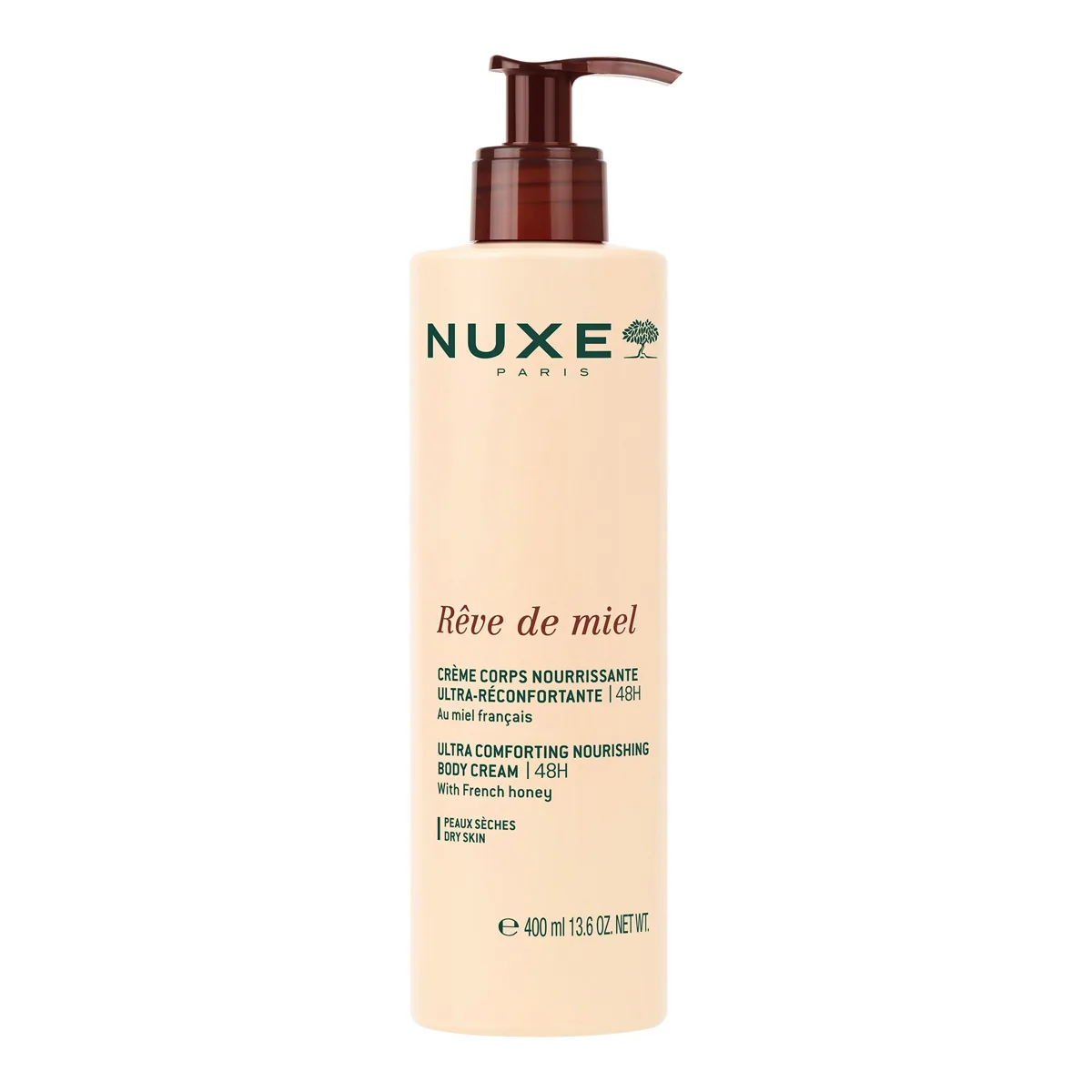
Most honey-branded body creams are ordinary lotions with a spoonful of honey for the label; this one is a serious dry-skin formula that happens to smell of honey. Glycerin and diglycerin together, squalane to carry a shea-and-almond lipid load, and a 48-hour hydration claim measured instrumentally rather than by questionnaire put it closer to a pharmacy emollient than to the gift-set body butters it sits beside.
A serious dry-skin body cream hiding inside a comfort-food brand: glycerin and diglycerin for water, squalane and sweet almond for lipids, shea to seal it, and a velvet finish that sets in a minute. The honey is mostly scent and the fragrance rules it out for the most reactive skin, but at $42 for 400 ml it is one of the better-value pharmacy body creams for anyone whose shins crack in January.
The current formula is a recent rebuild of a long-running Rêve de Miel body cream, and reviews of this version number only a handful on Nuxe's own sites so far. The assessment relies on the ingredient list, on Nuxe's brand-run usage and instrumental panels of around 30 and 11 volunteers respectively, and on the older product's reputation, rather than on broad real-world feedback for this exact cream.
The case for it
Cautions: fragrance.
Same rule for everyone. “Good choice” is the verdict on 9,564 of 45,024 concern verdicts across the catalog; rule R5 decided 9,072 of them. As of September 25, 2026, engine 5.1.1.
Brand or formulator? Disclose a concentration or correct a fact →
The studies behind the evidence row
The case for it
Same rule for everyone. “Good choice” is the verdict on 9,564 of 45,024 concern verdicts across the catalog; rule R5 decided 9,072 of them. As of September 25, 2026, engine 5.1.1.
Brand or formulator? Disclose a concentration or correct a fact →
The studies behind the evidence row
Also listed for Winter Skin and Rough Texture — the actives here (Glycerin, Squalane, Honey, Shea Butter) are in our research queue for those concerns; there is no verdict until their evidence rows are written. That is a gap in our table, not a mark against the product.
As a body productNot judged: what a body product is for — real substance, not just slip, realistic to use daily — cannot yet be measured from the ingredient list (only fragrance load can).
A verdict is DermApproved’s assessment of how well a product’s ingredients fit a concern — never a claim about what the product treats. Evidence dots and collected reviews sit beside it and are never blended in. Rules 0.5.1 · evidence table ev-2026.09-r228 · how we decide
Rêve de Miel means honey dream, the tube says French honey in a cursive flourish, and the scent that rises from the pump is unmistakably honey and vanilla. So it is worth saying plainly that honey is the seventeenth ingredient in this cream, tucked between a preservative and a gelling agent, and that its contribution to how your skin feels tomorrow is modest. This is not a complaint. It is the beginning of the case for the product, because what sits above the honey on the label is a genuinely well-designed dry-skin formula that most honey-branded body creams cannot match, and Nuxe deserves to be judged on the chemistry rather than the marketing.
The chemistry runs in the order a dermatologist would draw it on a whiteboard. Water first, then glycerin, then sweet almond oil and camellia oleifera oil, then diglycerin, then squalane, then shea butter. That is two humectants, three plant lipids and a sebum-identical emollient before the first emulsifier appears. Glycerin and diglycerin together are the key to the 48-hour hydration claim: glycerin pulls water into the outer skin quickly, diglycerin holds it longer, and between them they keep the surface measurably wetter into the second day, which Nuxe backed with an instrumental test on eleven volunteers. Eleven is a small panel and it was the brand's own, but corneometry on humectant-heavy creams is a reasonably honest measurement and the claim is plausible for the ingredient load. The almond and camellia oils replenish the lipids that dry skin is short of, the squalane spreads them thin and speeds absorption, and the shea butter, with hydrogenated coconut oil and a mid-chain triglyceride behind it, forms the occlusive layer that stops the water leaving. Lauroyl lysine, an amino-acid derivative, gives the cream its powdery-soft slip, and the emulsifiers are the gentle glutamate and polyglyceryl types that sensitive-skin ranges favour.
What that architecture delivers in practice is a cream that is much richer than it feels. Pumped onto damp skin after a shower it melts, spreads a long way, and sets to a velvet finish within a minute, so there is no waiting to dress and no film on the sheets. Dry shins feel different the same evening; over two or three weeks, the tight, papery sensation that comes with heated rooms and cold streets stops arriving, and rough elbows and knees smooth out. Nuxe's 21-day usage panel reported restored comfort and elasticity, which matches what the formula would predict. It is the kind of body cream that makes a winter routine easy to keep because it is pleasant to use and quick, which matters more for adherence than any single ingredient.
The scent is part of that pleasure and the main reason for caution. Parfum is fourteenth, with amyl salicylate and dimethyl phenethyl acetate at the end of the list as its declared components, and the accord is the classic Rêve de Miel honey, vanilla and mimosa: warm, edible, comforting, softer than Nuxe's Prodigieux fragrances and faded to a whisper within a couple of hours. Two listed fragrance chemicals is a light load by the standards of scented body care, and the absence of the usual citrus terpenes is a point in its favour. Even so, a scented cream applied over the whole body daily is a real exposure, and for anyone with eczema, a history of fragrance reactions, or a chest and neck that flush at perfume, the responsible advice is an unscented emollient on the flares and this, if anything, around them. Nuxe positions the range for dry skin, not for atopic skin, and the distinction holds.
The other caveat is where on the body it goes. Sweet almond and hydrogenated coconut oil are oleic-rich and somewhat comedogenic, and shea is not far behind; on a back or chest prone to breakouts, a cream this lipid-heavy is a bad idea, however kind it is to the legs. Oily skin generally will find it too much in summer. This is a fall-and-winter cream for dry and normal skin, and it is best understood as one.
The relaunch deserves a note because it explains why the formula reads more modern than the brand's reputation. Rêve de Miel has been Nuxe's dry-skin range for more than three decades, best known for a lip balm that half of France keeps on a bedside table, and the older body products leaned on mineral oil and heavier waxes. The recent rebuild moved the body cream onto squalane and diglycerin, swapped the jar for a 400 ml pump bottle, and kept the honey and the scent. It is a reformulation done in the right direction, and the only thing lost is the ritual of scooping.
Which brings the price into focus, because 400 millilitres for $42 is unusually generous for a French pharmacy body cream. Daily head-to-toe use gets three to four months from a bottle, around $3 a week, and kept to legs and arms it lasts most of a winter. A drugstore emollient is cheaper and a fragrance-free clinical cream is safer for reactive skin, but for ordinary dry skin that wants comfort, scent and a formula built properly, the value is real.
The verdict is warm with a boundary. If your skin is dry, intact and untroubled by fragrance, this is one of the better body creams in its price range, and the honey is a lovely irrelevance. If your skin is eczema-prone, reactive or breakout-prone on the body, look at the ingredient list rather than the tube and pick something plainer. Either way, know what you are buying: not a honey cream, but a good cream that smells of honey.
The hero actives that drive this product's performance.
| Ingredient | Function | Evidence |
|---|---|---|
| Glycerin and Diglycerin | Glycerin sits second and diglycerin fifth, an unusually heavy humectant pairing for a body cream, and the plain reason Nuxe can back a 48-hour hydration claim with instrumental data. Diglycerin holds water more persistently than glycerin alone, which is what keeps the effect running into the second day. | Established mechanism for Dryness · established mechanism |
| Sweet Almond and Camellia Oleifera Oils | Third and fourth in the list, ahead of the shea, these oleic-rich oils supply most of the lipid replenishment the cream promises for dry skin. They are what makes the texture melt rather than drag, and the reason it is a poor fit for the acne-prone chest and back. | Not yet assessed |
| Squalane | Sixth in the formula, a sebum-identical emollient that spreads the heavier butters and oils thin and absorbs quickly, which is how a cream this rich manages to leave no sticky film. It is a more modern choice than the mineral-oil base of older Rêve de Miel body products. | Established mechanism for Dryness · established mechanism |
| Shea Butter | Seventh, backed by hydrogenated coconut oil and a mid-chain triglyceride, forming the occlusive cushion that seals the humectant water in. It is the part of the formula doing the 'ultra comforting' work on shins and elbows that crack in winter. | Established mechanism for Dryness · established mechanism |
| Honey (Mel) | The Rêve de Miel signature, French-sourced, listed seventeenth. At that position it is a humectant footnote and a scent contributor rather than the active the front label implies; the glycerin and oils above it are the reason the cream works. | Not yet assessed |
Ingredient standings describe the active at treatment-level doses and vehicles; this product's own condition grades weigh its actual formula.
Aqua/Water, Glycerin, Prunus Amygdalus Dulcis (Sweet Almond) Oil, Camellia Oleifera Seed Oil, Diglycerin, Squalane, Butyrospermum Parkii (Shea) Butter, Caprylic/Capric Triglyceride, Hydrogenated Coconut Oil, Pentylene Glycol, Glyceryl Stearate Citrate, C10-18 Triglycerides, Lauroyl Lysine, Parfum/Fragrance, Polyglyceryl-3 Stearate, 1,2-Hexanediol, Mel/Honey, Polyacrylate Crosspolymer-6, Hydrogenated Lecithin, Sodium Stearoyl Glutamate, Tocopherol, Ethylhexylglycerin, Sodium Gluconate, Helianthus Annuus (Sunflower) Seed Oil, Solanum Lycopersicum (Tomato) Fruit Extract, Amyl Salicylate, Dimethyl Phenethyl Acetate
moisturizer
AM & PM
Pump onto damp skin within a few minutes of showering so the glycerin and diglycerin have water to hold, and massage in until the velvet finish sets, about a minute. It is rich enough to stand alone through winter; in summer, the arms and décolletage may prefer a lighter lotion with this kept for legs.
Immediate: soft, supple skin with no residue and a warm honey scent. Short-term (1-3 weeks): tightness and flaking on shins and elbows settle with daily use; Nuxe's 21-day panel reported restored comfort and elasticity. Long-term: maintained hydration through cold months; the cream does not change texture below the surface or treat eczema.
The formulation follows the three-component model of dry-skin emollients that the dermatology literature supports: humectants to bind water in the stratum corneum, lipids to replenish the intercellular matrix, and occlusives to slow transepidermal water loss. On the humectant side, glycerin at the second position is the most extensively evidenced topical humectant, with controlled studies demonstrating increased corneometry readings and improved barrier recovery over days of use; diglycerin, a dimer of glycerin, has a higher molecular weight and lower volatility, and formulation studies show it sustains skin hydration longer than glycerin alone, which is the plausible basis for Nuxe's 48-hour instrumental result on an 11-volunteer panel. Pentylene glycol adds further humectancy and boosts the preservative system.
The lipid phase is led by sweet almond and camellia oleifera oils, both oleic-acid dominant and well documented as emollients on intact skin, with the usual caveat that oleic acid can disrupt barrier organisation on atopic or compromised skin, which argues against using the cream on active eczema. Squalane, the saturated form of the sebum lipid squalene, is a highly stable, non-comedogenic emollient with a good record of tolerance, and its use as a spreading agent is why the cream absorbs faster than its lipid content would suggest. Shea butter contributes triglycerides and unsaponifiable compounds that have been shown in controlled studies to improve hydration and reduce water loss, and hydrogenated coconut oil and C10-18 triglycerides add occlusive structure. Lauroyl lysine is an amino-acid derivative used for a soft, powdery after-feel.
Honey, listed seventeenth, has laboratory and clinical evidence as a humectant and wound-healing agent at high concentrations, but at this position in a leave-on cream its contribution is minor; its presence is primarily sensory and brand-defining. Tocopherol and tomato extract form a small antioxidant system protecting the oils. The preservative combination of pentylene glycol, 1,2-hexanediol and ethylhexylglycerin is a low-irritation, formaldehyde-free system. The fragrance is the main tolerance variable: parfum sits fourteenth with amyl salicylate and dimethyl phenethyl acetate as declared components, a lighter allergen profile than citrus-terpene-heavy scents, but still a sensitisation risk for susceptible individuals across a large daily application area. Nuxe's efficacy claims rest on brand-run usage panels of around 30 volunteers and the small instrumental test; no independent study of the product exists.
For ordinary xerosis, the clinical advice is straightforward: a cream rather than a lotion, applied daily to damp skin, containing humectants and occlusive lipids, and this formula meets that brief better than most consumer body creams, with glycerin and diglycerin high in the list and a shea-and-squalane lipid phase that dermatologists would recognise as sound. Where clinical practice draws a line is at fragrance. Atopic dermatitis guidelines consistently recommend fragrance-free emollients, and a scented cream, even one with a light allergen profile like this, is not what would be recommended for a patient with active eczema or a history of contact sensitisation; for such patients the usual suggestion is an unscented emollient on affected areas, with a product like this reserved for intact skin if the patient values the sensory experience. The oleic-rich oils are a further reason to keep it off acne-prone areas of the trunk. For patients with dry but resilient skin, particularly in winter, it is a reasonable and pleasant choice, and its fast absorption is the sort of property that helps people actually apply moisturiser daily, which is the intervention that matters most.
Step out of the shower, pat the skin so it is damp rather than wet, and pump a hazelnut-sized amount per limb into the palm, massaging it in with long strokes until the cream turns from melt to velvet, which takes about a minute. Damp skin gives the glycerin and diglycerin water to hold and makes the cream go further. Concentrate on shins, elbows, knees and heels in winter, and apply daily rather than trusting the 48-hour figure to cover a skipped day. Keep it off breakout-prone areas of the back and chest and off active eczema patches, where an unscented emollient belongs. It works morning or evening; at night it has longer to sink in before clothing.
Forty-two dollars for 400 ml is the strongest value proposition in Nuxe's body range and competitive with other French pharmacy creams that usually sell 200 ml for a similar sum. Daily whole-body use lasts three to four months, roughly $3 a week, and a legs-and-arms winter routine stretches it much further. What the money buys is a properly constructed dry-skin formula, squalane and diglycerin rather than mineral oil and wax, Nuxe's decades of pharmacy tolerance testing, and a scent that makes the routine a pleasure. A drugstore emollient will hydrate for less, and a fragrance-free clinical cream is the better spend for reactive skin, but for ordinary dry skin that wants a cream it will enjoy using, this is fairly and even generously priced. There is no smaller size, which is the one inconvenience.
People with dry or normal body skin, especially in cold months, who want a rich cream that absorbs fast, hydrates into a second day and smells of honey and vanilla without being sickly. It suits anyone who likes French pharmacy formulas and wants a generous 400 ml bottle at a fair price.
Those with eczema, reactive skin or a history of fragrance reactions, who are better served by an unscented emollient on the areas that matter. It is also too rich and too oleic for oily skin, warm weather and breakout-prone backs and chests, and vegans should note it contains honey.
Ready to try Nuxe Ultra Comforting Nourishing Body Cream 48h?
Buy at Amazon ♥A dense, velvety cream that turns to a melt on contact and absorbs within a minute, leaving skin supple with no tack
The Rêve de Miel accord of honey, vanilla and mimosa, warm and sweet without being cloying, lingering softly for an hour or two
A 400 ml cream-coloured plastic bottle with a brown pump in the Rêve de Miel design
Nothing about the first week needs managing: the cream sinks in fast for something this rich, the scent is comforting rather than loud, and dry shins feel different the same evening. Anyone with eczema patches or a fragrance history should apply it around rather than over the worst areas at first and watch for warmth.
Around 3 to 4 months with daily full-body use, longer if kept to legs and arms
fall winter
Rêve de Miel has been Nuxe's answer to dry skin for more than thirty years, built on honey and plant oils and best known for its lip balm. The body cream was rebuilt in the range's recent relaunch, keeping the French honey and the signature scent while moving the base to squalane, diglycerin and a cleaner emulsifier system, with a 400 ml pump bottle replacing the older jar format.
Nuxe has sold through French pharmacies since 1989, and Rêve de Miel, its honey-based dry-skin range, has been on shelves for more than thirty years. The brand dermatologically tests every formula and publishes its own usage and instrumental panels, but independent clinical trials of individual products are not available.
Honey is what moisturises in this cream
Honey is listed seventeenth. The hydration comes from glycerin at second and diglycerin at fifth, and the nourishment from sweet almond, camellia, squalane and shea above it. Honey adds a little humectancy and most of the scent.
48-hour hydration means you can apply it every other day
The figure comes from an instrumental measurement of skin water content on 11 volunteers, which is a real but small test. Daily application after showering is still what keeps very dry skin comfortable, particularly in winter.
Yes, it is one of the better pharmacy body creams for it. Glycerin and diglycerin bind water, squalane and sweet almond replenish lipids, and shea with hydrogenated coconut oil seals the surface, which is the standard three-part logic of a dry-skin emollient. The only reservation is fragrance for skin that is also reactive.
On intact skin around eczema, yes, and it is gentler than most scented creams thanks to a mild emulsifier system. On active patches, dermatology advice favours a fragrance-free emollient, since parfum and amyl salicylate are in this formula; use an unscented product on flares and this everywhere else.
No, which is the surprise given the ingredient list. Squalane and caprylic/capric triglyceride carry the shea and oils thin, and the polyacrylate gelling agent gives a velvet set within about a minute, so you can dress straight after.
No. It contains French honey, which is the Rêve de Miel signature, so it is not suitable for vegans. Nuxe's Very Rose and Prodigieux body products are the vegan alternatives in its range.
Applied daily over the whole body it lasts three to four months, which works out at roughly $3 a week. Kept to legs and arms in winter it will go well beyond that.
Honey first, with vanilla and a soft mimosa note behind it, the same accord as the rest of the Rêve de Miel range. It is warm and sweet, noticeably present on application and faded to a whisper after an hour or two.
Recurring themes our editors read across retailer reviews of this product — summaries in our words, not quotations, and not a substitute for your own patch test.
melts in with no sticky feel
honey and vanilla scent
skin stays soft next morning
generous pump bottle
calms winter tightness
too fragranced for reactive skin
rich for warm weather
honey is far down the list
pump bottle is not travel friendly