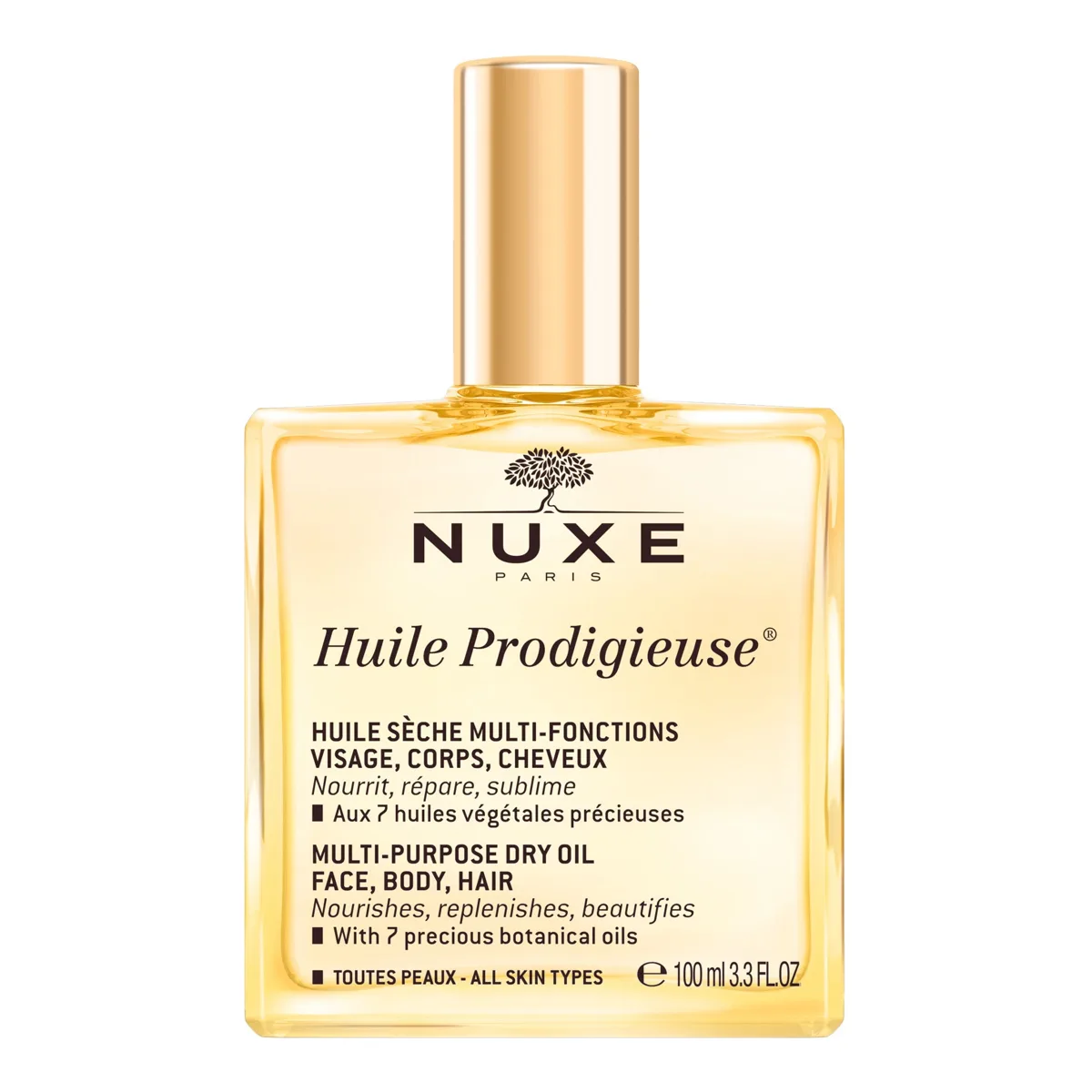
Thirty-five years before multi-use oils became a trend, this was the one, and the reason it still leads is the base rather than the botanicals: a pair of light esters that let seven genuine plant oils spread over a whole body and dry to satin. Most dry oils achieve that finish with silicones or a heavy dose of isododecane; this one does it with coco-caprylate/caprate and dicaprylyl ether and a fragrance that has become a signature in its own right.
The original multi-use dry oil, and still one of the best on the body: seven real botanical oils in a clever ester base that dries to satin in a minute and smells like a French summer. It is a perfume as much as a skincare product, with parfum eighth in the list and thirteen scent components behind it, so it is a treat for dry, resilient body skin and a gamble for sensitive or acne-prone faces.
Supporting rolefor DrynessIn your profileYou chose · Nothing here targets dryness directly; occlusive emollience is the recognised companion to treating it, and this oil does that without known triggers.Not yet assessedStandard tolerabilityNo reviews collected yet
The case for it
Coco-Caprylate/Caprate and Dicaprylyl Ether has no evidence row yet for this concern — it is in the research queue.
The formula carries no trigger this concern is sensitive to, with the cautions noted.
Cautions: fragrance.
What would change this: A researched evidence row for the lead active would replace this with a verdict.
Same rule for everyone. “Supporting role” is the verdict on 8,197 of 45,024 concern verdicts across the catalog; rule R8 decided 4,250 of them.
As of September 25, 2026, engine 5.1.1.
R8 — The category's job (barrier care, humectant hydration, gentle cleansing, photoprotection) is the documented supportive role for this concern. This is the honest verdict for a moisturizer on an acne page. · the full register
Also listed for Dullness — the actives here (Emollient Esters, Macadamia Oil, Argan Oil, Borage Seed Oil) are in our research queue for that concern; there is no verdict until their evidence rows are written. That is a gap in our table, not a mark against the product.
As a oilNot judged: what a oil is for — fatty-acid profile, seals moisture, resists going rancid — cannot yet be measured from the ingredient list (only pore and malassezia risk can).
A verdict is DermApproved’s assessment of how well a product’s ingredients fit a concern — never a claim about what the product treats. Evidence dots and collected reviews sit beside it and are never blended in.
Rules 0.5.1 · evidence table ev-2026.09-r228 · how we decide
Assessment
Pros & Cons
Pros
✓ Ester base gives a true dry-touch finish that sets to satin within a minute
✓ Seven genuine botanical oils, with sebum-like macadamia leading the blend
✓ Excellent on body skin, smoothing rough shins and elbows within a couple of weeks
✓ Tsubaki and camellia oils make it a capable frizz-taming hair oil
✓ Silicone-free, vegan and preservative-free by nature of the anhydrous format
✓ Thirty-five-year track record with thousands of reviews across retailers
✓ Available in 50 ml and 100 ml with a well-made glass spray bottle
Cons
✗ Parfum is the eighth ingredient with thirteen fragrance components, several declared allergens
✗ Oleic-rich almond, hazelnut and macadamia oils can congest acne-prone facial skin
✗ Too fragranced for sensitive, rosacea-prone or eczema-prone skin
✗ $45 for 100 ml is premium pricing for a body oil
✗ Pump spray can dispense unevenly and the glass bottle is heavy to travel with
✗ Stretch-mark and anti-pollution claims outrun the evidence
Review
Full Review
Nuxe describes Huile Prodigieuse as more than skincare, more than a fragrance, a skin signature. It is easy to roll your eyes at that sentence and it is also, on inspection, the most accurate thing the brand could say. This is an oil that has been in French bathrooms since 1991, that the whole company was built on, and that people buy again and again for reasons that have as much to do with how it smells as what it does. Reviewing it fairly means holding both halves at once: the formulation, which is genuinely well made, and the fragrance, which is the reason it sells and the reason it will not suit everyone.
Start with the base, because it is the clever part. The first ingredient is not a botanical oil at all but coco-caprylate/caprate, a light coconut-derived ester, and the third is dicaprylyl ether, another fast-spreading emollient. Between and after them come the seven oils Nuxe advertises: macadamia, sweet almond, hazelnut, camellia oleifera, tsubaki, argan and borage. The two esters are what make the difference between this and a bottle of almond oil. They thin the blend so it spreads like water, they carry the heavier oils across a lot of skin quickly, and they set to a satin finish rather than a slick. Most modern dry oils achieve that trick with silicones or a heavy dose of a volatile hydrocarbon. Nuxe did it in 1991 with plant-derived esters, and it still works.
The oils themselves are a sensible mix. Macadamia leads, chosen for palmitoleic acid that resembles skin's own sebum; almond and hazelnut supply oleic-acid softness; the two camellias, one of them the tsubaki added in the 2016 reformulation, bring the slip that makes it work on hair; argan and borage sit lower down and contribute antioxidants and, in borage's case, gamma-linolenic acid. Tocopherol, ascorbic acid, rosemary and a tomato extract round out an antioxidant system that mostly exists to keep the oils from going rancid but does no harm on the skin. On the body this blend does exactly what it promises. Pressed onto damp skin after a shower it disappears in a minute, legs and shoulders take on a soft sheen, and rough patches on shins and elbows feel smoother within a week or two. Nuxe's own 29-person panel found every volunteer's skin softer after 28 days, which is a brand-run result but not a surprising one.
Then there is the eighth ingredient. Parfum sits above tsubaki, above argan, above borage, and the final thirteen entries in the list are its components: acetyl cedrene, linalyl acetate, linalool, bitter orange peel oil, limonene, citronellol, vanillin, geraniol, geranium oil, isoeugenyl acetate, pinene and more. Several are declared allergens. The scent they build is famous for a reason, a warm, solar accord of orange blossom, magnolia and vanilla that smells like sun lotion filtered through a good perfumery, and it lasts on skin for hours. People buy the oil for this smell. There is a perfume, a shower oil, a candle and a body lotion built on it. But it means that the sentence "100 percent botanical oils" on the label describes the oils, not the product, and a face that reacts to fragrance will notice. On a resilient body it is almost never a problem. On the cheeks of someone with rosacea, or around the eyes, it is one of the more likely oils on the market to cause a flush.
The face question deserves a straight answer, because Nuxe markets this for face, body and hair. Dry, normal, non-reactive skin can use two or three drops as the last step at night and get a lovely glow. Acne-prone skin should not: almond, hazelnut and macadamia are oleic-rich oils with a reputation for congestion, and the fragrance is an added risk on already inflamed skin. Sensitive skin should not either, for the reasons above. The honest positioning is body oil first, hair oil second, face oil for the lucky. As a hair product it is quietly excellent: a drop warmed between the palms and smoothed over the ends tames frizz without weighing fine hair down, which is the tsubaki earning its place.
On price, $45 for 100 ml is not cheap for a body oil, and Nuxe is charging for the icon as much as the formula. Against it, the dose is small, a bottle lasts three to four months of daily body use, and the 50 ml at $29.50 is a reasonable way to find out whether the scent is for you before committing. The pump spray is elegant and occasionally sprays sideways; the glass bottle is heavy for travel. These are cosmetic gripes about a cosmetic product.
Where this lands, then, is somewhere warm but specific. As a body oil for dry or normal skin that loves a scent, Huile Prodigieuse is still one of the best-made products in its category, thirty-five years on, and it earns its cult. As a face oil it is a product to approach with your skin's history in mind rather than the marketing, and as a fragrance-free option it simply is not one. Buy it for the body and the hair, enjoy it for the smell, and keep expectations for stretch marks and anti-pollution claims where they belong, at softer skin and a pleasant afternoon.
Formula
Key Ingredients
The hero actives that drive this product's performance.
The first true plant oil in the list and the backbone of the nourishing claim, chosen for a palmitoleic acid content that mirrors human sebum. It is what makes the oil feel like it belongs on skin rather than sitting on top, while the coconut ester ahead of it keeps the whole thing from feeling like macadamia oil alone would.
The dry-touch secret. These two light, fast-spreading emollients open the formula and are why seven botanical oils can be applied over a whole body and still leave a satin finish rather than a slick. Without them Huile Prodigieuse would be a conventional heavy oil.
The softening pair, both high in oleic acid, sitting fifth and sixth. They supply most of the emollience users describe as skin feeling smoother and are also the reason this oil is not the best choice on acne-prone facial skin, where oleic-heavy oils can be pore-clogging.
Tsubaki was the addition in the 2016 reformulation, a Japanese camellia oil rich in oleic acid and traditionally used on hair; here it is what carries the hair-conditioning claim and adds slip on the lengths without weight. The related camellia oleifera oil reinforces it.
The one oil in the seven with a distinctive fatty-acid profile: unusually rich in gamma-linolenic acid, which is the basis for its smoothing and barrier-support role. It is listed after the fragrance, so its dose is modest, but it is the ingredient that gives the blend a claim beyond emollience.
Included for its vitamin E and linoleic acid content and marketed as the repairing oil of the seven; in this blend it sits tenth, so its main contribution is to the overall antioxidant load alongside the tocopherol, ascorbic acid and tomato extract that follow it.
On the body, spray or pour onto damp skin straight after a shower and press in; the esters let it spread thin. On the face, use two or three drops as the very last step over moisturiser, and keep it off breakout-prone zones. A drop rubbed between the palms and smoothed over dry hair ends tames frizz without weight.
Results Timeline
Immediate: a satin sheen and softness that lasts several hours, and a scent that lingers all day. Short-term (1-2 weeks): body skin that was rough or flaky feels consistently smoother. Long-term: Nuxe's 28-day panel reported softer, more nourished skin; expect maintained comfort, but no change to pigment, texture below the surface, or stretch marks beyond a temporary softening of their appearance.
Pairs Well With
body lotion on very dry skinmoisturizer as the last face stepleave-in hair conditioner
The formulation logic of Huile Prodigieuse rests on a distinction between spreading and nourishing. Coco-caprylate/caprate and dicaprylyl ether, the first and third ingredients, are low-viscosity emollients with high spreading values that dilute the heavier triglyceride oils and evaporate or absorb quickly, producing the dry-touch finish; this is the same principle behind silicone-based dry oils, achieved with plant-derived esters. The botanical oils supply the fatty acids. Macadamia oil is notable for palmitoleic acid, which makes up a significant fraction of human sebum and declines with age; sweet almond and hazelnut are oleic-acid oils with well-documented emollient and skin-softening effects in controlled studies; camellia oleifera and camellia japonica (tsubaki) are similarly oleic-rich and have a long record in Japanese hair care, where their low viscosity and cuticle-smoothing effect are the basis for the frizz-control benefit.
Two oils carry claims beyond softening. Borage seed oil is one of the richest plant sources of gamma-linolenic acid, an omega-6 fatty acid studied for barrier support and anti-inflammatory activity when applied topically or taken orally, with mixed results in atopic dermatitis trials; at its position after the fragrance in this list, the dose is modest. Argan oil contributes tocopherols and linoleic acid, and small studies have reported improvements in skin elasticity and hydration with its use. Tocopherol, tocopheryl acetate, ascorbic acid, rosemary extract and tomato extract form an antioxidant package whose main job is protecting the oils from oxidation; Nuxe's anti-pollution claim rests on that antioxidant content and on a brand-run test, not on independent evidence of protection against pollutant-induced damage.
The clinical concern with the formula is well characterised. Parfum is present at a high enough level to sit eighth, and the listed components include linalool, limonene, citronellol, geraniol and isoeugenyl acetate, all recognised contact allergens under EU cosmetic regulation, along with bitter orange and geranium essential oils. Leave-on application over large body areas is a meaningful exposure, and fragrance remains the leading cause of cosmetic allergic contact dermatitis in patch-test series. Oleic-acid-dominant oils are also associated in the dermatological literature with barrier disruption when applied to compromised skin, which is why they are not recommended for atopic eczema, and with comedogenicity on acne-prone facial skin. The stretch-mark claim describes a temporary improvement in surface appearance from emollience; no topical oil has been shown to alter the dermal structure of striae. Nuxe's efficacy figures come from a 29-volunteer usage test and are perception data rather than measured outcomes.
Dermatologist Perspective
In clinical practice, plant-oil blends like this are usually welcomed on the body of a patient with ordinary dry skin and treated with caution everywhere else. The reasons are consistent across the dermatology literature: heavily fragranced leave-on products applied over large areas are a classic driver of sensitisation, and oleic-acid-rich oils such as almond, hazelnut and macadamia have been linked both to congestion on acne-prone faces and to barrier disruption on atopic skin, which is why eczema guidance steers patients toward bland, fragrance-free emollients instead. Dermatologists who comment on Huile Prodigieuse tend to make exactly that split, recommending it for legs, arms and hair ends and advising against it on reactive facial skin, around the eyes, or on a child. For a patient without those issues, the product's long history of use gives reasonable confidence in its tolerance, and its antioxidant content is a harmless bonus. Claims about stretch marks and pollution protection are treated as marketing.
Guidance
Usage & Recommendations
How to Use
On the body, step out of the shower, pat the skin until it is damp rather than wet, and spray two or three pumps onto each limb, pressing and sweeping with the palms until the sheen sets, which takes about a minute. Damp skin makes the esters spread further and cuts the amount needed. For hair, warm a single pump between the palms and smooth it over the lengths and ends only, keeping it off the roots; it works on dry or towel-dried hair. On the face, if your skin is dry and non-reactive, press two or three drops over moisturiser as the final evening step and avoid the eye area. Store it out of direct sun to protect the oils, and patch test on the inner arm before the first full-body application if you have any history of fragrance reactions.
Value Assessment
Forty-five dollars for 100 ml buys a bottle that lasts three to four months of daily body use, so the running cost is roughly $3 a week for an oil, a fragrance and a hair product in one. The 50 ml at $29.50 is worse per millilitre but a sensible trial size given how polarising the scent is, and Nuxe's site regularly bundles the oil with a shower oil or candle at a discount. What the price reflects is the icon status and the perfumery-grade fragrance more than the botanicals; a similar seven-oil blend without the scent would cost a fraction from an indie brand. Fair value for someone who loves the smell and uses it head to toe; poor value if it ends up as a face oil used three drops at a time, where cheaper unscented options do the same job with less risk.
Who Should Buy
People with dry or normal body skin who want one elegant product for post-shower moisture, a glow on the shoulders and legs, and a frizz tamer for hair ends, and who enjoy a strong, sunny fragrance that lasts all day. It is also the right pick for anyone curious about the French pharmacy classic that started the multi-use oil category.
Who Should Skip
Anyone with sensitive, rosacea-prone or eczema-prone skin, and anyone who wants to use an oil on an acne-prone face, since the fragrance load and the oleic-rich almond, hazelnut and macadamia oils are both against them. It is also the wrong choice for people who need a fragrance-free product or who want a face oil chosen on evidence rather than heritage.
A thin, pale gold oil that spreads like water and sets to a satin sheen within a minute, leaving a faint slip but no greasy film
Scent
The famous solar accord of orange blossom, magnolia and vanilla, warm and sun-lotion-adjacent, strong on application and detectable on skin for most of the day
Packaging
Nuxe's signature clear glass bottle with a gold pump spray and gold cap, in 50 ml and 100 ml sizes
Finish
satinglowynon-greasy
What to Expect on First Use
The first application is mostly about the smell, which is strong, sweet and unmistakably Nuxe, and about the surprise that seven oils can vanish into skin this fast. There is no adjustment period on the body. On the face, the first few days are the time to watch for congestion along the jaw or a warm flush from the fragrance; if either shows up, it belongs on the body only.
How Long It Lasts
A 100 ml bottle lasts 3 to 4 months used daily on the body after showering, or well over a year if kept to face drops and hair ends
Aliza Jabès bought a small Paris laboratory in 1989 and launched Huile Prodigieuse in 1991 with the idea of one natural product that could beautify face, body and hair together; it became the foundation of Nuxe's growth into the French pharmacy giant it is today. The formula was rebuilt in 2016 to add tsubaki oil and bring the blend to seven botanicals, and the solar fragrance has since spawned a perfume, a shower oil, a body lotion and a family of shimmering and floral variants.
About Nuxe Legacy Brand (20+ years)
Nuxe was founded in 1989 and Huile Prodigieuse, launched two years later, is the product the whole company was built on; it has been reformulated once, in 2016, when tsubaki oil was added. The brand runs its own usage panels and dermatological testing but publishes no independent clinical studies of the oil.
Brand founded: 1989 · Product launched: 1991
Myth vs. Reality
Common Myths
Myth
Because it is 100 percent botanical oils it must be gentle enough for the face
Reality
The seven oils are botanical, but parfum sits eighth in the list and thirteen individual fragrance components follow it, several of them declared allergens. The oil is well tolerated on most body skin; on a reactive face or around the eyes it is one of the more likely oils to cause a flush.
Myth
It fades stretch marks
Reality
Nuxe's claim is that it diminishes the appearance of stretch marks, which is what any good emollient does by softening and plumping the surface. No oil changes the dermal collagen structure of a stretch mark, and no study shows this one does.
FAQ
Frequently Asked Questions
Can I use Nuxe Huile Prodigieuse on my face?
Nuxe says yes, and plenty of people do, but it deserves a caveat. The fragrance sits eighth in the formula with thirteen scent components behind it, and the oleic-rich almond, hazelnut and macadamia oils can congest acne-prone skin. Normal or dry, non-reactive skin will enjoy two or three drops as a final step; sensitive, rosacea-prone or breakout-prone faces should keep it to the body.
What are the seven oils in Huile Prodigieuse?
Macadamia, sweet almond, hazelnut, camellia oleifera, tsubaki (camellia japonica), argan and borage. Tsubaki was added in the 2016 reformulation. They sit in a base of two light plant-derived esters, which is what gives the oil its dry, fast-absorbing finish.
Why does Nuxe Huile Prodigieuse not feel greasy?
The first and third ingredients are coco-caprylate/caprate and dicaprylyl ether, light emollients that spread quickly and leave a satin rather than a slick finish. They dilute and carry the seven heavier botanical oils so that a small amount covers a lot of skin and sets within a minute.
Does Huile Prodigieuse really work on hair?
On dry ends and frizz, yes: the tsubaki and camellia oils are traditional hair oils and a drop warmed between the palms smooths lengths without weighing fine hair down. It is not a treatment for the scalp and will not repair damage; it makes hair look and feel better on the day.
Is Nuxe Huile Prodigieuse safe during pregnancy?
It contains nothing that is contraindicated in pregnancy; the ingredients are plant oils, vitamin E, antioxidants and fragrance. Pregnancy does make skin more reactive and scent more overwhelming for some, so a patch test and a light hand are sensible, and the stretch-mark claim should be read as softening, not prevention.
How does Huile Prodigieuse differ from the Riche, Florale and Or versions?
The classic is the reference: seven oils in a dry ester base with the solar orange-blossom and vanilla scent. Riche swaps the dry esters for richer emollients for very dry skin, Florale keeps the base but changes the perfume to magnolia and white musk, and Or adds mica and mineral pigments for a golden shimmer.
Reviews
What Reviewers Tend to Say
Recurring themes our editors read across retailer reviews of this product — summaries in our words, not quotations, and not a substitute for your own patch test.
Common Praise
signature scent lingers all day
dry, non-greasy finish on the body
leaves a satin glow on legs and shoulders
tames frizzy hair ends
one bottle for face, body and hair
Common Complaints
fragrance too strong for the face
can trigger breakouts on acne-prone skin
pump spray dispenses unevenly
pricey for a body oil
scent is polarising
Notable Endorsements
The best-selling product in French pharmacies for decadesBeauty-award fixture in the UK and FranceReformulated in 2016 with tsubaki oil
Cutting a beard hair takes about a twentieth of a newton. You press with two and stretch your skin by a fifth — which is why almost every shaving problem is a technique problem wearing a hardware costume.
Your immune cells already make it to kill microbes. Now it's in a spray bottle for breakouts and redness, and the real evidence is quietly stronger than the 'miracle mist' marketing that's outrunning it.
IPL is a filtered flashlamp, a true vascular laser is one wavelength aimed at haemoglobin, and the choice between them turns on a distinction almost no consult makes: whether your redness is vessels or a state.
The most common self-inflicted skincare injury is not a bad product. It is three good ones started in the same fortnight, leaving nobody able to name the culprit.
Products, answers, therapy guides, tools and articles in one search. Brand names,
slang and abbreviations all work — accutane finds isotretinoin, bacne finds truncal acne.