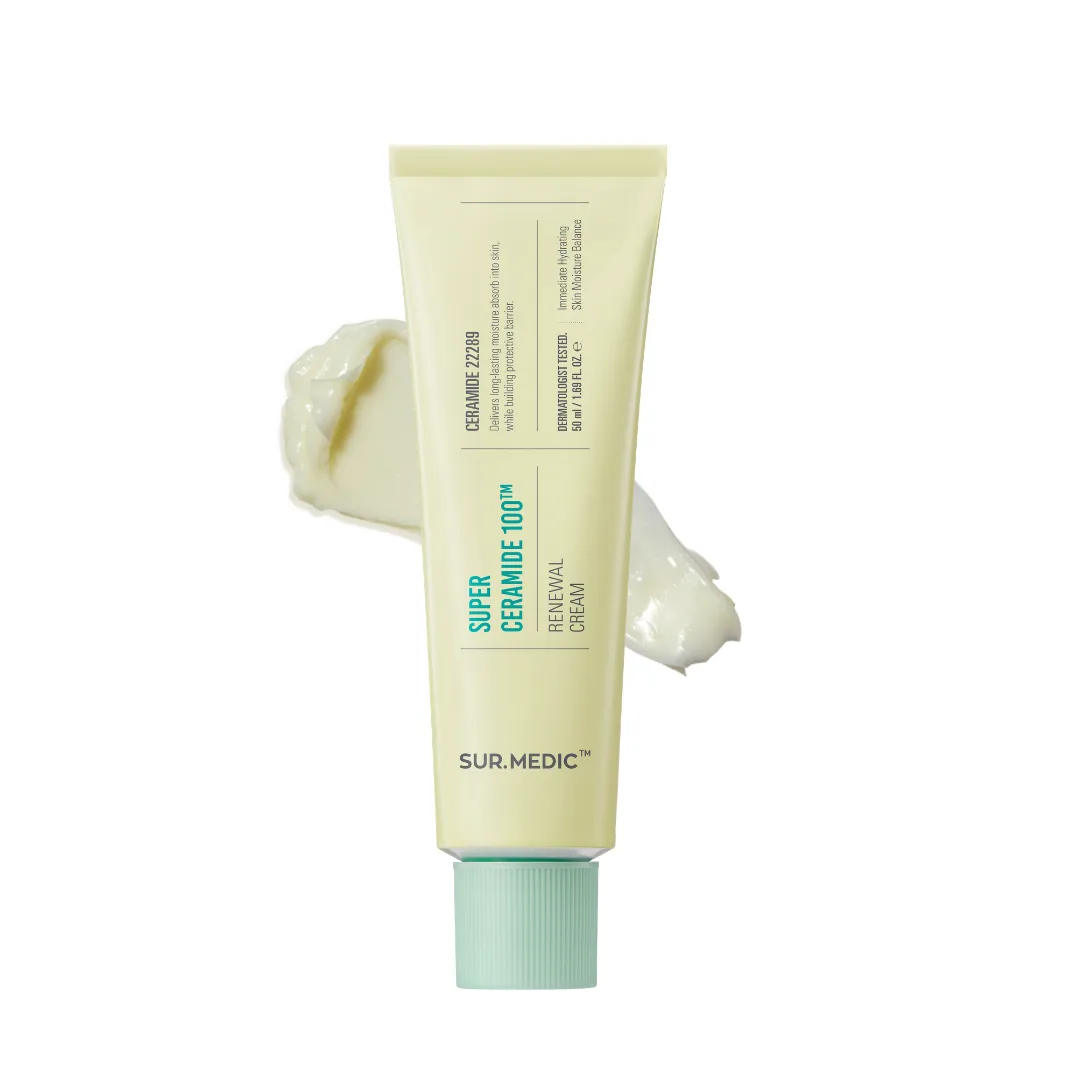
It is one of the very few creams that prints its ceramide concentrations on the ingredient list, and the numbers undercut the name: one ceramide at 502 parts per million, four at 0.1 or 0.05 parts per million. Around that sit a competent niacinamide-and-humectant base, five peptides at the end of a ninety-two-ingredient list and a ten-oil herbal fragrance, a combination that reads more like a spa cream with a barrier label than a barrier cream.
A silky, fast-absorbing, pleasantly scented hydrating cream sold as a five-ceramide barrier treatment for sensitive skin, whose own label discloses ceramide doses in the parts-per-million range and whose ten essential oils make it wrong for the skin it targets. Niacinamide and a strong humectant base do honest work underneath; the name and the audience are the problems, not the texture.
No study of this cream has been published by Neogen, and its modest review count on K-beauty retailers speaks mostly to texture and scent, so the assessment rests on the most recent published ingredient list, including its declared ceramide concentrations, and on the general evidence for niacinamide, humectants and essential-oil sensitisation. The product moved from a jar to a tube marked 'Ceramide 22289' in 2026; that code also appears on the line's hand cream, and no revised formula has been published, so the list here is treated as current.
Verdicts
How well it fits each concern
Verdict by concern tap a concern for the case
Good choicefor DehydrationIn your profileYou chose · Glycerin is a reference standard by mechanism for dehydration; this cream carries it high in the ingredient list.Moderate evidenceStandard tolerabilityNo reviews collected yet
The case for it
Glycerin + Dipropylene Glycol + Propanediol + Three-form Hyaluronic Acid has trial-supported standing for this concern.
It is present at an effective concentration, declared or high in the ingredient list.
The formula carries no trigger this concern is sensitive to, with the cautions noted.
Same rule for everyone. “Good choice” is the verdict on 9,564 of 45,024 concern verdicts across the catalog; rule R5 decided 9,072 of them.
As of September 25, 2026, engine 5.1.1.
adequate — studied range 20%, from the trials on the row; needs leave-on contact; judge it after ~1 weeks
Tolerability
standard
Row checked
against its sources on July 17, 2026 (evidence table ev-2026.09-r228)
The studies behind the evidence row
USP glycerin monograph / Fluhr et al., glycerol and the skin (review) — glycerin is the reference humectant, drawing and holding water in the stratum corneum — reference work
Good choicefor DrynessIn your profileYou chose · Glycerin is a reference standard by mechanism for dryness; this cream carries it high in the ingredient list.Moderate evidenceStandard tolerabilityNo reviews collected yet
The case for it
Glycerin + Dipropylene Glycol + Propanediol + Three-form Hyaluronic Acid has trial-supported standing for this concern.
It is present at an effective concentration, declared or high in the ingredient list.
The formula carries no trigger this concern is sensitive to, with the cautions noted.
Cautions: fragrance.
Same rule for everyone. “Good choice” is the verdict on 9,564 of 45,024 concern verdicts across the catalog; rule R5 decided 9,072 of them.
As of September 25, 2026, engine 5.1.1.
Promisingfor DullnessIn your profileYou chose · Glycerin has trial-level evidence for dullness but no guideline or regulatory standing yet — promising, short of a recommendation; the other actives here are not yet assessed for it.Moderate evidenceStandard tolerabilityNo reviews collected yet
The case for it
Glycerin + Dipropylene Glycol + Propanediol + Three-form Hyaluronic Acid has trial-level evidence for this concern but no guideline or regulatory standing yet.
It is present at an effective concentration, declared or high in the ingredient list.
The formula carries no trigger this concern is sensitive to, with the cautions noted.
What would change this: Guideline or regulatory standing for the active on this concern would move this from a promising bet to a recommendation.
Same rule for everyone. “Promising” is the verdict on 7,858 of 45,024 concern verdicts across the catalog; rule R9p decided 7,858 of them.
As of September 25, 2026, engine 5.1.1.
R9p — 0.5.0: 'Unproven' beside three filled dots read as one question answered twice with opposite words (7,018 rows). The chip measures standing, the dots measure trial volume; where the row carries at least one RCT or a tier-2 source (moderate dots) and the active is present at a working level, the honest word is Promising. Unproven is reserved for plausible-standing rows with limited or weak evidence, or an under-dosed form. Same rank as Unproven — a bet either way; the dots order them. · the full register
Does the jobDoes what a moisturizer is for: supplies barrier lipids, draws in water.
A verdict is DermApproved’s assessment of how well a product’s ingredients fit a concern — never a claim about what the product treats. Evidence dots and collected reviews sit beside it and are never blended in.
Rules 0.5.1 · evidence table ev-2026.09-r228 · how we decide
Assessment
Pros & Cons
Pros
✓ Niacinamide sixth on the list provides genuine barrier support and tone evening
✓ Generous humectant base with glycerin, glycols and three forms of hyaluronic acid
✓ Silky, fast-absorbing, non-greasy texture that layers under sunscreen
✓ Centella, mugwort, panthenol, allantoin and squalane add real soothing and emollience
✓ Ceramide concentrations are honestly disclosed on the label
✓ Pleasant herbal spa scent for those who enjoy essential oils
✓ Made by a Korean biotech manufacturer with real formulation capacity
Cons
✗ Ceramides are present at 502 ppm and 0.1 to 0.05 ppm, far below a working barrier dose
✗ Ten essential oils, several common allergens, in a cream marketed to sensitive skin
✗ Bergamot and orange peel oils are photosensitising
✗ Five peptides sit at the tail of a 92-ingredient list at trace levels
✗ Coconut oil is a concern for breakout-prone skin
✗ The name and packaging promise far more than the published formula contains
Review
Full Review
Most ceramide creams keep their doses to themselves, and it is easy to see why. This one does not. Read the ninety-two-ingredient list on SUR.MEDIC+'s Super Ceramide 100 Renewal Cream and the numbers are right there in brackets: ceramide 3 at 502 parts per million, ceramides 2 and 4 at 0.1 parts per million, ceramides 1 and 6 II at 0.05 parts per million. Five types of ceramides, as the box promises, and one of them at a twentieth of a percent while the other four amount to a few molecules per tube. That is a level of disclosure worth respecting, and it is also the single most damaging fact about the product, because it turns the name into a question. Super what, exactly?
The answer, if you read the list for what it actually contains in quantity, is a competent Korean hydrating cream. Glycerin is second, followed by three glycols, and niacinamide sits sixth, which matters more than anything the box mentions: niacinamide stimulates the skin's own ceramide synthesis far more effectively than adding trace ceramides ever could, evens tone and calms low-grade inflammation, and at this position it is present at a working level. Then come the texture ingredients, a pair of silicones and light esters that make the cream spread thin and absorb in a minute, and further down three forms of hyaluronic acid, squalane, panthenol, allantoin, centella and mugwort extracts, a bifida ferment and, near the end, five signalling peptides. On robust skin the result is genuinely nice: silky, fast, faintly dewy, comfortable all day, with the plumped look a good humectant cream gives. If it had been sold as Super Niacinamide Hydration Cream, this review would be shorter and kinder.
But it is sold as a barrier repair cream for sensitive and damaged skin, and that is where the second problem appears at position twenty-seven. Bergamot fruit oil, then lavender, orange peel, rosewood, rosemary, eucalyptus, and later chamomile, geranium, spearmint and rose flower oil: ten essential oils, several of them ahead of the centella and the hyaluronic acid on the list. They give the cream its herbal spa scent, which many reviewers enjoy, and they make it, by any dermatological standard, a poor choice for the skin it is marketed to. Lavender, geranium, rose and bergamot are among the most frequently positive fragrance allergens on patch testing; bergamot and orange peel oils are photosensitising; eucalyptus and spearmint are sensory irritants. A compromised barrier is precisely the skin that lets those molecules through, and the reviewers who report warmth, flushing or stinging are describing the predictable result. The brand's claim that the cream is free of artificial fragrance is technically true and practically misleading, because essential oils are fragrance in every way that matters to a reactive face.
The rest of the list is the maximalist Korean style, and it deserves a fair reading rather than a sneer. Centella and mugwort are real soothing botanicals with some evidence; a bifida lysate has early data for barrier support; squalane, panthenol and allantoin are sound. The five peptides in the final fifteen positions, including the neuropeptide acetyl hexapeptide-8 and a growth-factor mimic, are there to justify the anti-wrinkle and lifting language, and at those positions they are ingredients for the label rather than for the face. Coconut oil mid-list is a small flag for breakout-prone skin. None of this is harmful; most of it is simply not doing what the box says.
It is worth being fair about why the ceramides are dosed this way, because it is not unique to Neogen. Ceramides are expensive, difficult to keep dissolved in a light water-based cream without turning it waxy, and Korean labelling rules reward a count of ingredients over the amount of any one of them; a five-ceramide claim at trace levels is common practice across the market, and this product simply happens to print the numbers. The honest comparison is not with an ideal cream but with the many competitors who do the same thing silently, and against them SUR.MEDIC+ is at least telling you.
Who, then, is this cream actually for? Someone with normal or combination skin that is not reactive, who wants a light, silky daily moisturizer with a good niacinamide dose, enjoys a herbal scent and wears sunscreen every morning, because the bergamot demands it. For that person it is a pleasant product at a fair price, about thirty dollars for fifty millilitres, in clinical-looking packaging that suggests more science than the formula delivers. It is not for the person the name and the packaging are aimed at, the one with a damaged barrier looking for ceramides, who will find a twentieth of a percent of one ceramide and ten essential oils.
Neogen, to its credit, is a real laboratory, a Korean biotech that manufactures for other brands, and the cream is well made as a physical object. The disclosure of the ceramide doses is presumably a Korean regulatory habit rather than a marketing choice, and it is the most useful thing on the label. Take it at its word. Buy this as a niacinamide hydrating cream with a spa fragrance if that describes what you want, skip it if your skin is sensitive, and let the number in the name stand as a reminder that a count of ingredients says nothing about the amount of any of them.
Formula
Key Ingredients
The hero actives that drive this product's performance.
The five ceramides the name is built on, with the doses helpfully printed on the label: ceramide 3 at 502 parts per million, about 0.05 percent, and the other four at 0.1 and 0.05 parts per million, which is to say a few molecules for the sake of the claim. Ceramide NP at 0.05 percent is a real if modest barrier contribution; the other four are decoration.
Established mechanismfor Dryness · established mechanism
Sixth on the list and, quietly, the most useful active in the tube: it stimulates the skin's own ceramide production far more effectively than the trace ceramides added further down, and it evens tone and calms low-grade inflammation. It is the reason the cream can deliver on barrier support despite the arithmetic of its ceramide doses.
A herbal-spa scent built from a long list of essential oils starting with bergamot at twenty-seventh, ahead of the centella and the hyaluronic acid. They make the cream smell like a treatment room and are the single biggest reason it is a poor match for the sensitive, damaged skin it is marketed to; bergamot and citrus peel oils are also photosensitising.
The humectant core, with glycerin second and three glycols behind it, plus sodium hyaluronate, hyaluronic acid and a hydrolysed fragment mid-list. This is where the immediate silky hydration comes from, and it is competent and generous in the K-beauty manner.
Established mechanismfor Dehydration · established mechanism
The three soothing botanicals the brand names on the box, all present at cosmetic levels around the thirtieth to fortieth position. Centella and mugwort have genuine calming reputations and some data, and the bifida lysate is a probiotic-style ferment with early barrier evidence; together they would help more if the essential oils above them were not working against them.
Five signalling and neuropeptides in the final fifteen positions of a ninety-two-ingredient list, there to support the anti-wrinkle and firming claims. Each has some leave-on data at working concentrations; at these positions they are label content rather than functional doses.
Not yet assessed
Ingredient standings describe the active at treatment-level doses and
vehicles; this product's own condition grades weigh its actual formula.
Use it as the final step over toner and serum, morning and night, with a sunscreen over it by day since the bergamot and citrus peel oils are photosensitising. On skin that is already irritated or freshly treated with acids or retinoids, choose a plainer, fragrance-free cream instead.
Results Timeline
A silky, hydrated, faintly dewy finish is immediate and lasts through the day. Skin that is merely dehydrated looks smoother within a week; the barrier and anti-wrinkle promises depend on niacinamide over months, and the trace ceramides and peptides will not add a visible effect on top.
Pairs Well With
Broad-spectrum sunscreen SPF 30+A fragrance-free tonerNeogen Real Ferment Micro Essence
The formula's disclosed ceramide concentrations allow a precise assessment that most barrier creams do not permit. Ceramides make up roughly half the lipid mass of the stratum corneum, and topical ceramide creams with clinical evidence for barrier repair typically contain them in the range of several tenths of a percent to a few percent, often in a physiological ratio with cholesterol and free fatty acids; ceramide NP at 502 ppm, or 0.05 percent, sits at the very bottom of the range that could plausibly contribute, and ceramides at 0.1 and 0.05 ppm are three to four orders of magnitude below any functional level, present only to support the five-ceramide claim. The cream's actual barrier mechanism is niacinamide at the sixth position, which upregulates the synthesis of ceramides, free fatty acids and cholesterol in keratinocytes and has consistent evidence for reducing transepidermal water loss with sustained use, along with the humectant load of glycerin, dipropylene glycol, propanediol and three hyaluronate species that raises stratum corneum hydration directly. Centella asiatica triterpenes and Artemisia vulgaris extract have anti-inflammatory data in leave-on use, and Bifida ferment lysate has small studies suggesting barrier and immune-modulating effects, though at their positions here the contributions are modest. The peptides, palmitoyl tripeptide-5, acetyl tetrapeptide-11, acetyl hexapeptide-8, the dipeptide diaminobutyroyl benzylamide neuropeptide mimic and oligopeptide-1, each have some supplier or small-trial data at defined concentrations in leave-on serums; at the seventy-sixth to ninety-first positions of this list, no functional dose can be inferred. The formulation's most clinically significant feature is its essential-oil content. Lavender, geranium, rose and bergamot oils contain linalool, geraniol, citronellol and limonene, all listed fragrance allergens with high patch-test positivity rates, and bergamot and orange peel oils contain furanocoumarins with documented phototoxic potential; eucalyptus and spearmint oils are sensory irritants. Ten such oils in a product intended for compromised skin is inconsistent with the evidence on fragrance avoidance in barrier-impaired dermatoses, and the sensitive-skin positioning is not supported by the composition. Coconut oil at the forty-fifth position is a recognised comedogenic ingredient at higher levels and a minor concern here.
Dermatologist Perspective
The clinical picture of this cream is a contradiction between its labelling and its list. Barrier repair in dry, eczema-prone or damaged skin rests on fragrance-free emollients with physiological lipids at meaningful concentrations, and practitioners would note that the ceramide doses printed on this label are far below those used in the creams with evidence, while the niacinamide and humectants provide the real, if modest, benefit. The presence of ten essential oils, several of them the fragrance allergens most often identified on patch testing and two of them phototoxic, would lead most dermatologists to steer patients with rosacea, eczema, a contact-allergy history or a recently compromised barrier away from it, regardless of the sensitive-skin claims, and to advise daily sun protection for anyone who does use it. For a patient with robust, normal skin seeking a light hydrating moisturizer with niacinamide, the cream is an acceptable cosmetic choice; as a treatment for barrier damage it would not be recommended over a plain ceramide-and-niacinamide cream from a fragrance-free line.
Guidance
Usage & Recommendations
How to Use
Morning and night, after cleansing, toner and any serum, squeeze out a pea-to-almond amount and smooth it over the face and neck along the direction of the skin, allowing a minute for the silky finish to set. In the morning follow with a broad-spectrum SPF 30 or higher, which is not optional with this formula because its bergamot and orange peel oils are photosensitising. Do not use it over freshly applied acids or retinoids on skin that is already irritated, and if warmth, flushing or stinging appears within minutes of application, stop and switch to a fragrance-free barrier cream. Keep the tube capped to protect the botanicals.
Value Assessment
Around thirty dollars for fifty millilitres is mid-range for a Korean prestige-styled cream and buys a well-made, silky niacinamide moisturizer with a generous humectant base, which is fair value for normal skin that enjoys a spa scent. As a ceramide cream it is poor value, because the ceramide content is a fraction of what fragrance-free barrier creams at half the price deliver, and the five peptides and long botanical roster add cost to the label rather than benefit to the face. The two-month tube keeps the monthly cost reasonable, and Neogen's manufacturing scale means the texture and stability are better than the price suggests. Anyone buying for the name should redirect the money to a cream whose ceramides are measured in percent; anyone buying for the feel and the scent is paying about the right amount.
Who Should Buy
People with normal or combination skin that is not reactive, who want a light, silky, fast-absorbing daily moisturizer with a good niacinamide dose and enjoy a herbal-citrus spa scent, and who wear sunscreen every morning. It suits fans of maximalist Korean formulas and of SUR.MEDIC+'s clinical aesthetic who understand they are buying hydration rather than ceramide repair.
Who Should Skip
Anyone with sensitive, rosacea-prone, eczema-prone or barrier-damaged skin, which is exactly the audience the packaging targets, should avoid the ten essential oils and choose a fragrance-free ceramide cream. People shopping for a genuine ceramide dose will not find one here, breakout-prone skin should note the coconut oil, and anyone who skips daytime sunscreen should not use a cream with bergamot in it.
Ready to try Neogen Super Ceramide 100 Renewal Cream?
A light, silky, silicone-smoothed cream that spreads thinly, absorbs in about a minute and leaves a soft, satin, faintly dewy finish without greasiness.
Scent
A pronounced herbal-citrus spa fragrance from bergamot, lavender, orange, eucalyptus, rosemary, geranium, spearmint and rose oils; it is noticeable on application and lingers for a while.
Packaging
A 50 mL pale-yellow squeeze tube with a mint cap, boxed, in SUR.MEDIC+'s 2026 packaging; earlier stock came in a white screw-top jar.
Finish
satindewylightweight
What to Expect on First Use
The first application is pleasant on robust skin: fast-absorbing, silky and scented like a spa treatment. Reactive skin often feels a warmth or flush within minutes from the essential oils, and anyone with a compromised barrier may sting; there is no purging or adjustment beyond deciding whether the fragrance load suits your face.
Neogen created SUR.MEDIC+ in 2019 as a clinical-styled sister label to its Dermalogy range, with clinical white packaging and names ending in 100 to signal potency. The Super Ceramide 100 line was its barrier franchise, pairing five ceramides with hyaluronic acid and a long list of soothing botanicals in the maximalist Korean style, and the cream became its anchor product alongside a matching hand cream and mask.
About Neogen Legacy Brand (20+ years)
Sold under SUR.MEDIC+, the clinical-styled sister label of Neogen Dermalogy, this cream comes from Neogen Corporation, a Korean biotechnology firm founded in 2000 that manufactures for other brands and has real formulation depth. That depth does not extend to published testing of this product, and the ceramide concentrations printed on its own ingredient list sit far below what the name implies.
Brand founded: 2000 · Product launched: 2019
Myth vs. Reality
Common Myths
Myth
Five types of ceramides means a ceramide-rich barrier cream.
Reality
The label discloses the doses: ceramide 3 at 502 parts per million, roughly 0.05 percent, and ceramides 1, 2, 4 and 6 II at 0.1 and 0.05 parts per million, which are trace amounts included so the count can be five. The barrier support in this cream comes mostly from niacinamide and humectants, not from the ceramides in its name.
Myth
Essential oils are gentler than synthetic fragrance on damaged skin.
Reality
Essential oils are fragrance, and several here, lavender, geranium, rose, bergamot and citrus peel, are among the most common cosmetic contact allergens, while bergamot and orange oils are photosensitising. A cream carrying ten of them is a stronger irritation risk for compromised skin than a lightly fragranced synthetic formula would be.
FAQ
Frequently Asked Questions
How much ceramide is in SUR.MEDIC+ Super Ceramide 100 Renewal Cream?
The ingredient list states it: ceramide 3 at 502 ppm, which is about 0.05 percent, and ceramides 1, 2, 4 and 6 II at 0.1 or 0.05 ppm each. Only the ceramide 3 is present at a level that could contribute to the barrier; the other four are there to make the count five.
Is the Super Ceramide 100 Renewal Cream good for sensitive or damaged skin?
Its marketing says so, but its formula contains ten essential oils including bergamot, lavender, orange peel, eucalyptus, geranium and spearmint, several of which are common contact allergens. Reactive, rosacea-prone or eczema-prone skin should choose a fragrance-free ceramide cream; this one suits robust skin that enjoys a spa scent.
Is SUR.MEDIC+ the same brand as Neogen?
Yes. SUR.MEDIC+ is a clinical-styled sub-brand of Neogen Dermalogy, made by Neogen Corporation in Korea and sold through the same channels. The clinical white packaging and 100 names are a design language, not a separate manufacturer.
Does the Super Ceramide 100 cream contain fragrance?
It contains no synthetic parfum, which is why it is sometimes described as fragrance-free, but it carries a long list of essential oils, bergamot, lavender, orange, rosewood, rosemary, eucalyptus, chamomile, geranium, spearmint and rose, that produce a distinct herbal-citrus scent. Essential oils are fragrance for the purposes of skin sensitivity.
Can I use SUR.MEDIC+ Super Ceramide 100 Renewal Cream in the morning?
Yes, with sunscreen over it. Bergamot and orange peel oils in the formula are photosensitising, so daytime use without SPF risks irritation and pigmentation on exposed skin. The light, silky texture sits well under sunscreen.
What actually works in the Super Ceramide 100 Renewal Cream?
Niacinamide, sixth on the list, which stimulates the skin's own ceramide production and evens tone, plus a generous humectant base of glycerin, glycols and three forms of hyaluronic acid. Those deliver the silky hydration and modest barrier support users feel; the trace ceramides and the five peptides at the end of the list do not add measurably.
Reviews
What Reviewers Tend to Say
Recurring themes our editors read across retailer reviews of this product — summaries in our words, not quotations, and not a substitute for your own patch test.
Common Praise
Silky, lightweight hydration that absorbs fast
Pleasant herbal spa scent
Skin looks plumper and smoother
Clinical-looking packaging
Common Complaints
Strong essential-oil fragrance despite the sensitive-skin positioning
The fourth most frequent positive patch test in North America is an oxidation product of a molecule that occurs naturally in lavender. Nobody synthesised it into your face cream.
Western sensitive skincare works by subtraction — remove the fragrance, remove the alcohol, shorten the list. Japan's answer adds a designed molecule back in, and one of the two bets has a trial literature.
Essential oils are declared by botanical name rather than as fragrance, which is why the most heavily perfumed products in the natural aisle can carry the reassuring word — and why the bottle gets more sensitising the longer you own it.
Serums, masks, and peptide 'treatments' replaced the waxy balm this year. Some of it is real barrier science; some is a controlled irritant that stings your lips into looking fuller for an hour.
Products, answers, therapy guides, tools and articles in one search. Brand names,
slang and abbreviations all work — accutane finds isotretinoin, bacne finds truncal acne.