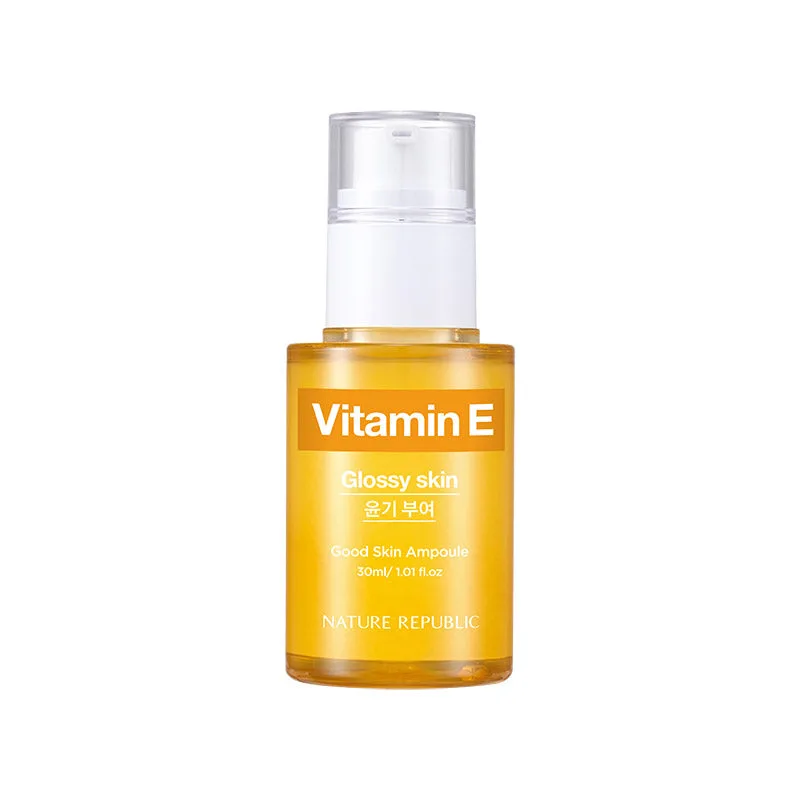
The nourishing entry in Nature Republic's colour-coded Good Skin shelf — a humectant-and-ester serum with a light oil-film finish, vitamin E in two forms and four plant oils at the tail of the list, scented with five essential oils and priced at fifteen dollars. Its difference from its siblings is the ester and the glow; its difference from a dedicated facial oil is that it is mostly water and glycerin with a gloss on top.
A fifteen-dollar nourishing ampoule that leaves dry skin soft and faintly glossy — a humectant base, a light ester and a modest dose of vitamin E in two forms, with panthenol as the quiet best ingredient and four plant oils bringing up the rear of the list. It does its small job pleasantly and cheaply. Five essential oils on a serum for dry, often reactive skin are the reason it is not an easy recommendation, and the reason a shopper should read the middle of the list before the yellow label.
The Vitamin E ampoule has been part of the Good Skin range since around 2020, with reviews in the low hundreds across the brand's US site and Korean resellers that overlap with its colour-coded siblings. Its thirty-one-ingredient list is consistent across sources and its humectant, ester and vitamin E chemistry is well understood, so this assessment rests on the formula and on a predictable pattern of user feedback; the 'glossy skin' claim describes the ester finish and has not been measured anywhere.
Verdicts
How well it fits each concern
Verdict by concern tap a concern for the case
Good choicefor DrynessIn your profileYou chose · Glycerin is a reference standard by mechanism for dryness; this ampoule carries it.Moderate evidenceStandard tolerabilityNo reviews collected yet
The case for it
Glycerin, Propanediol and Betaine has trial-supported standing for this concern.
It is plausibly present at a working level, though the concentration is not declared.
The formula carries no trigger this concern is sensitive to, with the cautions noted.
Cautions: fragrance.
What would change this: A declared concentration would move this to a firmer reading of the dose.
Same rule for everyone. “Good choice” is the verdict on 9,564 of 45,024 concern verdicts across the catalog; rule R5 decided 9,072 of them.
As of September 25, 2026, engine 5.1.1.
Promisingfor DullnessIn your profileYou chose · Glycerin has trial-level evidence for dullness but no guideline or regulatory standing yet — promising, short of a recommendation; the other actives here are not yet assessed for it.Moderate evidenceStandard tolerabilityNo reviews collected yet
The case for it
Glycerin, Propanediol and Betaine has trial-level evidence for this concern but no guideline or regulatory standing yet.
It is plausibly present at a working level, though the concentration is not declared.
The formula carries no trigger this concern is sensitive to, with the cautions noted.
What would change this: A declared concentration would move this to a firmer reading of the dose.
Same rule for everyone. “Promising” is the verdict on 7,858 of 45,024 concern verdicts across the catalog; rule R9p decided 7,858 of them.
As of September 25, 2026, engine 5.1.1.
R9p — 0.5.0: 'Unproven' beside three filled dots read as one question answered twice with opposite words (7,018 rows). The chip measures standing, the dots measure trial volume; where the row carries at least one RCT or a tier-2 source (moderate dots) and the active is present at a working level, the honest word is Promising. Unproven is reserved for plausible-standing rows with limited or weak evidence, or an under-dosed form. Same rank as Unproven — a bet either way; the dots order them. · the full register
Carrying active
Glycerin, Propanediol and Betaine
Standing
plausible — trials support it
Form
plausible — studied range 2–20%, from the trials on the row; needs leave-on contact; judge it after ~1 weeks
Tolerability
standard
Row checked
against its sources on July 17, 2026 (evidence table ev-2026.09-r228)
The studies behind the evidence row
Harry's Cosmeticology / Baran & Maibach Textbook of Cosmetic Dermatology — humectant, emollient and occlusive classification — standard reference text
Good choicefor DehydrationIn your profileYou chose · Panthenol (Vitamin B5) is a reference standard by mechanism for dehydration; this ampoule carries it high in the ingredient list.Moderate evidenceStandard tolerabilityNo reviews collected yet
The case for it
Panthenol has trial-supported standing for this concern.
It is present at an effective concentration, declared or high in the ingredient list.
The formula carries no trigger this concern is sensitive to, with the cautions noted.
Same rule for everyone. “Good choice” is the verdict on 9,564 of 45,024 concern verdicts across the catalog; rule R5 decided 9,072 of them.
As of September 25, 2026, engine 5.1.1.
R5 — Trial-supported or guideline-supported active, adequately or plausibly dosed. · the full register
Carrying active
Panthenol
Standing
supported — its mechanism is established
Form
adequate — studied range 2.5%, from the trials on the row; needs leave-on contact
Tolerability
standard
Row checked
against its sources on July 17, 2026 (evidence table ev-2026.09-r228)
The studies behind the evidence row
Cosmetic Ingredient Review assessment of panthenol / dexpanthenol — humectant and moisturizer that raises stratum-corneum water content — reference work
A verdict is DermApproved’s assessment of how well a product’s ingredients fit a concern — never a claim about what the product treats. Evidence dots and collected reviews sit beside it and are never blended in.
Rules 0.5.1 · evidence table ev-2026.09-r228 · how we decide
Assessment
Pros & Cons
Pros
✓ Coco-caprylate ester gives a soft, faintly glossy finish that dry skin enjoys
✓ Glycerin, propanediol and betaine hydrate before the ester softens
✓ Panthenol placed eighth — a genuine soother for tight, dry skin
✓ Vitamin E in both ester and free forms for modest antioxidant support
✓ Buffers retinoid dryness and layers cleanly under a cream
✓ Fifteen dollars for 30 mL — about two months of nightly use
✓ Silicone-free and alcohol-free, with a hygienic pump
Cons
✗ Five essential oils — orange, cypress, lavandin, rosemary, litsea — on a serum for often-reactive dry skin
✗ Fragrance allergens present but not separately declared
✗ The four advertised plant oils are the last four ingredients
✗ Vitamin E is a modest theme, not a treatment dose
✗ Too rich and filmy for oily or fungal-acne-prone skin
✗ Not nourishing enough alone for very dry skin in winter
Review
Full Review
The tube of Nature Republic's Good Skin Vitamin E Ampoule promises 'vitamin E derivatives and four plant oils including jojoba', and the four plant oils are there: jojoba, macadamia, olive and grape seed, listed twenty-eighth, twenty-ninth, thirtieth and thirty-first of thirty-one ingredients, after the free vitamin E and the lecithin, at the tail of the bottle where ingredients go to be named rather than to work. That is not a scandal — every budget ampoule does it — but it is the right place to start reading, because it sends you back up the list to find where the softness the product delivers actually comes from. It comes from the fourth ingredient, and the fourth ingredient is a light coconut-derived ester.
Coco-caprylate/caprate is the emollient backbone here, placed above the preservative, and it is what turns the Good Skin range's shared watery base into something that leaves a soft, faintly glossy film on the skin — the 'oil film that keeps dry skin moisturized without being too sticky' in the brand's copy, described accurately. Around it sits the base that every ampoule on the colour-coded shelf shares: glycerin second, propanediol third, betaine seventh, chlorella extract ninth as the line's signature, glucose, fructooligosaccharides and fructose as sugar humectants, an acrylate and xanthan for body. Panthenol is eighth, ahead of the vitamin E, and it is the ingredient a formulator would point to as the one doing the most honest work for dry, tight skin — provitamin B5 with a decent record for soothing and barrier support in leave-ons — and the one the label does not mention. Vitamin E itself appears twice: tocopheryl acetate sixteenth, the stable ester that skin must convert before it acts, and free tocopherol twenty-fifth, the active antioxidant form. Both are modest placements. Vitamin E is a well-studied lipid antioxidant and a good emollient, and at these levels it contributes a small protective and softening effect and the ampoule's theme; it is not a dose that changes how skin ages, and the bottle does not claim that it is.
On the face this adds up to something pleasant and simple. Three or four drops spread easily with an obvious slip, settle within a minute into a soft, low-shine film, and leave dry or normal skin looking rested and feeling comfortable through the night. The plumping arrives first from the humectants, the softness second from the ester, and the faint glow — the 'glossy skin' on the label — is the film catching light. It sits well over a retinoid and takes the edge off retinoid dryness, which is one of its better uses, and on normal skin in mild weather it can be the last step. Dry skin in winter layers a cream over it. Oily skin, as the brand's own positioning implies, finds it one layer too many within the hour, and fungal-acne-prone skin will not thank the ester and the oils. It is, in short, a light nourishing serum for dry and normal faces, and as such it is fine.
The complication sits in the middle of the list, between the acetate and the tocopherol. Orange oil at eighteenth, then cypress, lavandin, rosemary and litsea cubeba oils from twenty-first to twenty-fourth — five essential oils scenting the ampoule in place of a synthetic fragrance. The scent is nice: a fresh herbal-citrus that most users like. The molecules that make it are limonene from the orange, linalool from the lavandin, citral from the litsea cubeba and the camphoraceous terpenes of rosemary and cypress, and between them they account for a large share of fragrance contact allergy; on this list they are not separately declared. Dry skin is very often reactive skin, and a nourishing serum aimed at dry skin that carries five essential oils is a product whose main liability is the thing that makes it smell good. For a healthy, non-reactive face this is a non-issue. For rosacea, eczema or a history of fragrance allergy it is the reason to choose an unscented serum — the brand's own Ceramide ampoule, in the same range, is the gentler pick for the same skin.
It has sold since around 2020 alongside the rest of the Good Skin shelf, through the brand's US site and Korean resellers, and its reviews — in the low hundreds and overlapping with its siblings — say what the list predicts: soft, glossy, nice smell, good for dry skin, too much for oily, irritating for some. Fifteen dollars for 30 millilitres is about two months of nightly use, and it is priced like the light humectant-and-ester serum it is; there is nothing in the bottle that a dearer product would improve on for its purpose and nothing missing that would make it cheaper. Against a plain facial oil at the same price it is more hydrating and less nourishing, which suits normal skin and short-changes very dry skin.
The verdict is small and specific, as the product is. For dry and normal skin that tolerates essential oils and wants a cheap serum with a soft, glowy finish, the yellow ampoule is a pleasant, honest buy whose vitamin E is a theme and whose panthenol is the quiet hero. For reactive skin, the five oils in the middle of the list matter more than the four at the end, and both matter more than the letter on the front.
Formula
Key Ingredients
The hero actives that drive this product's performance.
The named active appears twice — tocopheryl acetate sixteenth, the stable ester that skin must convert, and free tocopherol twenty-fifth, the active antioxidant form — both in the bottom half of the list. Vitamin E is a well-studied lipid antioxidant and emollient, and at these positions it contributes a modest protective and softening effect rather than a treatment dose; it is the theme of the ampoule more than its engine.
Fourth, above the preservative — a light, dry-feeling coconut-derived ester that forms the emollient backbone of the 'oil film' the brand describes. It is why the ampoule leaves a soft, faintly glossy finish rather than the watery one its siblings have, and it does more for the nourishing feel than the four plant oils at the very end of the list.
Second, third and seventh — the humectant trio that makes the ampoule hydrating as well as emollient, with betaine adding a smooth, non-tacky slip. Together with the sugars further down they are the same base every Good Skin ampoule shares, and they are the reason this one plumps before it softens.
Established mechanismfor Dryness · established mechanism
Eighth, placed ahead of the chlorella signature and the vitamin E — provitamin B5 with a decent record for soothing and barrier support in leave-ons. It is the quiet best ingredient in the bottle for dry, tight skin, and it is not the one on the label.
Established mechanismfor Dehydration · established mechanism
The 'four plant oils including jojoba' on the tube — listed as the last four of thirty-one ingredients, after the free tocopherol and the lecithin. At that position they are a nourishing gesture rather than a lipid dose; the emollience that dry skin feels comes from the ester at fourth place, and these oils lend a trace of richness and the marketing line.
Established mechanismfor Dryness · established mechanism
Five essential oils scattered from eighteenth to twenty-fourth, providing a fresh herbal-citrus scent in place of a synthetic fragrance — and adding limonene, linalool and citral-type allergens that the label does not separately declare. On a nourishing ampoule aimed at dry skin, which is often also reactive skin, they are the formula's main liability.
Not yet assessed
Ingredient standings describe the active at treatment-level doses and
vehicles; this product's own condition grades weigh its actual formula.
It sits in the serum slot after toner and before cream, and on normal skin in mild weather its ester-and-oil finish is enough to be the last step. Dry skin layers a cream over it; oily skin will find it one layer too many. It goes over retinoids and acids without conflict and takes the edge off their dryness, and it is a good candidate for the 'oil last' position in a winter routine.
Results Timeline
Softness and a faint glow are immediate — the ester film and vitamin E doing their surface work — and last until the next wash. Dry, dull skin looks more comfortable within a week of nightly use; there is no deeper change to wait for, since a modest vitamin E dose over a humectant base is a maintenance product rather than a corrective one.
Pairs Well With
a hydrating toner underneatha cream over it on dry skin in wintera retinoid, whose dryness it buffers
Vitamin E is among the better-studied cosmetic antioxidants. Alpha-tocopherol is the skin's principal lipid-phase antioxidant, is depleted by UV exposure, and topical application at concentrations of around 1 to 5 percent has been shown to reduce UV-induced lipid peroxidation and, in combination with vitamin C, to enhance photoprotection; it is also an effective emollient. Tocopheryl acetate is the stable ester most often used in cosmetics and must be hydrolysed by skin esterases to become active, a conversion that is inefficient and slow, so free tocopherol is the more directly useful form. In this ampoule both appear in the lower half of the list at undisclosed but evidently modest levels, consistent with a supporting antioxidant and emollient role rather than the doses used in the photoprotection literature.
The formula's hydration and emollience follow a standard pattern. Glycerin, propanediol and betaine are humectants with well-documented effects on stratum corneum water content and flexibility; coco-caprylate/caprate is a light, rapidly spreading ester that forms a semi-occlusive film reducing water loss modestly; panthenol has clinical evidence for improving barrier function and reducing irritation in leave-ons. The four plant oils — jojoba, macadamia, olive and grape seed — have recognised emollient and fatty-acid profiles but, at the final positions in the list, contribute little to the measured lipid content. Chlorella vulgaris extract has laboratory antioxidant activity and no clinical evidence in this context.
The essential oils carry the formula's most relevant safety literature. Sweet orange oil is largely limonene; lavandin oil contains linalool and linalyl acetate; litsea cubeba oil is rich in citral; rosemary and cypress oils contribute camphoraceous monoterpenes. Limonene, linalool and citral are recognised fragrance allergens under cosmetic labelling regulations, with oxidised limonene and linalool among the most frequent positive reactions in patch-test series, and their presence via essential oils rather than a synthetic accord does not change that. No published study of this ampoule exists.
Dermatologist Perspective
Dermatologists would regard this as a light, emollient hydrating serum with a modest antioxidant component — reasonable for dry and normal skin as a maintenance step, useful for buffering retinoid dryness, and of no particular clinical significance beyond that. The vitamin E content would not be expected to deliver the photoprotective benefits seen in studies at higher concentrations, and the plant oils at the end of the list would be regarded as nominal. The clinical caution would be the essential-oil content: five oils carrying limonene, linalool and citral on a product marketed to dry skin — a population with a higher prevalence of atopic and reactive skin — is a combination clinicians would flag, advising rosacea, eczema and fragrance-allergic patients toward an unscented alternative. Oily and acne-prone patients would be steered to a lighter product. For a healthy, non-reactive, dry-skinned patient it is unobjectionable.
Guidance
Usage & Recommendations
How to Use
After the evening cleanse and toner, pump three or four drops into the palm and press over the face and neck, letting the serum settle into its soft film for about a minute before applying a cream if the skin is dry; normal skin in mild weather can stop here. It works over a retinoid or on the nights between, and can be pressed onto the driest areas as a spot step in winter. Patch-test on the jaw if skin is fragrance-sensitive, rosacea-prone or eczema-prone, given the five essential oils, and keep it off oily or fungal-acne-prone areas. Morning use is possible under sunscreen but the ester finish suits nights better.
Value Assessment
At around fifteen dollars for 30 millilitres on the brand's US site, and less through Korean resellers, the Vitamin E ampoule is priced in line with the rest of the Good Skin shelf and with other budget K-beauty serums, and two months of nightly use for that money is fair for what it is — a humectant-and-ester serum with a modest vitamin E content and a scent. There is one size. Nature Republic is an established mass brand without clinical validation, and the product carries no premium and no shortfall against comparable ampoules; its value is good for dry and normal skin that tolerates essential oils, ordinary for anyone comparing it to a plain facial oil, and poor for reactive skin, which should spend the same money on an unscented serum.
Who Should Buy
People with dry or normal, non-reactive skin who want a cheap night serum with a soft, glowy, lightly emollient finish and a fresh herbal-citrus scent, and anyone on a retinoid looking for an inexpensive buffer against its dryness. It suits winter routines and collectors of the Good Skin shelf who want the nourishing entry.
Who Should Skip
Sensitive, rosacea-prone, eczema-prone or fragrance-allergic skin, for which five essential oils are the wrong choice on a nourishing serum; oily, acne-prone and fungal-acne-prone skin, which will find the ester film heavy; and anyone buying for a meaningful vitamin E dose or for the plant oils, which sit at the very end of the list.
Ready to try Nature Republic Good Skin Vitamin E Ampoule?
A pale, slightly milky serum with an obvious ester slip that spreads easily and settles into a soft, faintly glossy film rather than disappearing
Scent
A fresh herbal-citrus blend — orange and lemony litsea over lavandin, rosemary and a green cypress note — distinct on application and fading within a few minutes
Packaging
A clear 30 mL glass pump bottle with a yellow 'Vitamin E' label in the Good Skin line's colour-coded style; precise and hygienic, and identical in form to the rest of the range
Finish
glowysatin
What to Expect on First Use
The first application is a small pleasure on dry, tight skin: a cool, scented serum that turns into a soft, low-shine film within a minute and leaves the face looking rested. Oily skin registers it as one layer too many within the hour. Some sensitive users feel a mild warmth from the oils on freshly cleansed skin; for everyone else there is nothing to adjust to, and the effect on day thirty is the effect on day one.
How Long It Lasts
About two months at three or four drops nightly; longer as an occasional winter or post-retinoid step
Nature Republic launched the Good Skin ampoule line around 2020 as a drugstore answer to single-active serums — a row of 30 mL pumps each named for one ingredient over a shared chlorella-and-humectant base. The Vitamin E ampoule is the range's dry-skin, 'glossy skin' variant, built to give the base an emollient finish and sold since through the brand's US site and Korean resellers at a price that invites buying several from the shelf.
About Nature Republic Established Brand (5–20 years)
Nature Republic, a Korean drugstore brand founded in 2009, sells its Good Skin ampoules as a colour-coded shelf of single-ingredient serums over a shared chlorella base — a budget take on the one-active trend. The brand publishes its ingredient lists and prices low, but it runs no clinical studies on individual products and its ampoule names describe a theme more than a dose.
Brand founded: 2009 · Product launched: 2020
Myth vs. Reality
Common Myths
Myth
A vitamin E ampoule delivers a concentrated antioxidant treatment.
Reality
Tocopheryl acetate is sixteenth and free tocopherol twenty-fifth in a thirty-one-ingredient list — modest levels, with the acetate needing enzymatic conversion before it is active. The ampoule is mostly water, glycerin, propanediol and a light ester; vitamin E is its theme and a real but small contributor, not a dose that would change how skin ages.
Myth
Essential oils are a gentler way to scent a product for dry, sensitive skin.
Reality
Orange, lavandin, rosemary, litsea cubeba and cypress oils carry limonene, linalool and citral — the same molecules behind most fragrance allergy — and here they are not separately declared. Dry skin is often reactive skin, and five essential oils on a nourishing serum are the ingredients most likely to be the reason it does not suit someone.
FAQ
Frequently Asked Questions
How much vitamin E is in the Nature Republic Good Skin Vitamin E Ampoule?
The brand does not declare a percentage. Tocopheryl acetate is the sixteenth of thirty-one ingredients and free tocopherol the twenty-fifth, which places both at modest, supporting levels rather than a treatment dose; the ampoule's softening effect comes mainly from its ester and humectant base.
Is the Good Skin Vitamin E Ampoule good for oily skin?
Usually not. Its coco-caprylate ester and trailing plant oils leave a soft, faintly glossy film that dry and normal skin enjoy and oily skin finds heavy; the brand's own positioning is for dry skin. Oily faces do better with the range's hyaluronic acid or tea tree ampoules.
Does the Vitamin E Ampoule contain fragrance?
Not a synthetic one, but it is scented with five essential oils — orange, cypress, lavandin, rosemary and litsea cubeba — which contain limonene, linalool and citral-type allergens. Fragrance-sensitive, rosacea-prone or eczema-prone skin should patch-test or choose an unscented serum.
Can I use the Good Skin Vitamin E Ampoule with retinol?
Yes — it has no active that conflicts with retinoids, and its emollient finish and panthenol help with retinoid dryness. Apply it over the retinoid or on alternate nights; the only caution is the essential oils on skin that a retinoid has already made reactive.
Where are the plant oils in the Vitamin E Ampoule's ingredient list?
At the very end — jojoba, macadamia, olive and grape seed oils are the last four of thirty-one ingredients, after the free vitamin E. They add a trace of richness and the 'four plant oils' line on the label; the emollience users feel is largely the coco-caprylate ester listed fourth.
Is the Good Skin Vitamin E Ampoule a serum or a facial oil?
A serum with an oil-like finish. It is mostly water, glycerin and propanediol with a light ester and trace oils, so it hydrates like a serum and leaves the soft, low-shine film of a very light oil. Dry skin can layer a cream over it; normal skin in mild weather can stop there.
Reviews
What Reviewers Tend to Say
Recurring themes our editors read across retailer reviews of this product — summaries in our words, not quotations, and not a substitute for your own patch test.
Common Praise
Leaves dry skin soft and faintly glossy without heaviness
Essential oils are declared by botanical name rather than as fragrance, which is why the most heavily perfumed products in the natural aisle can carry the reassuring word — and why the bottle gets more sensitising the longer you own it.
The fourth most frequent positive patch test in North America is an oxidation product of a molecule that occurs naturally in lavender. Nobody synthesised it into your face cream.
Cutting a beard hair takes about a twentieth of a newton. You press with two and stretch your skin by a fifth — which is why almost every shaving problem is a technique problem wearing a hardware costume.
The strongest counterexample to blanket botanical scepticism is also one of the more common contact allergens — and holding both facts at once is the only honest way to read it.
Products, answers, therapy guides, tools and articles in one search. Brand names,
slang and abbreviations all work — accutane finds isotretinoin, bacne finds truncal acne.