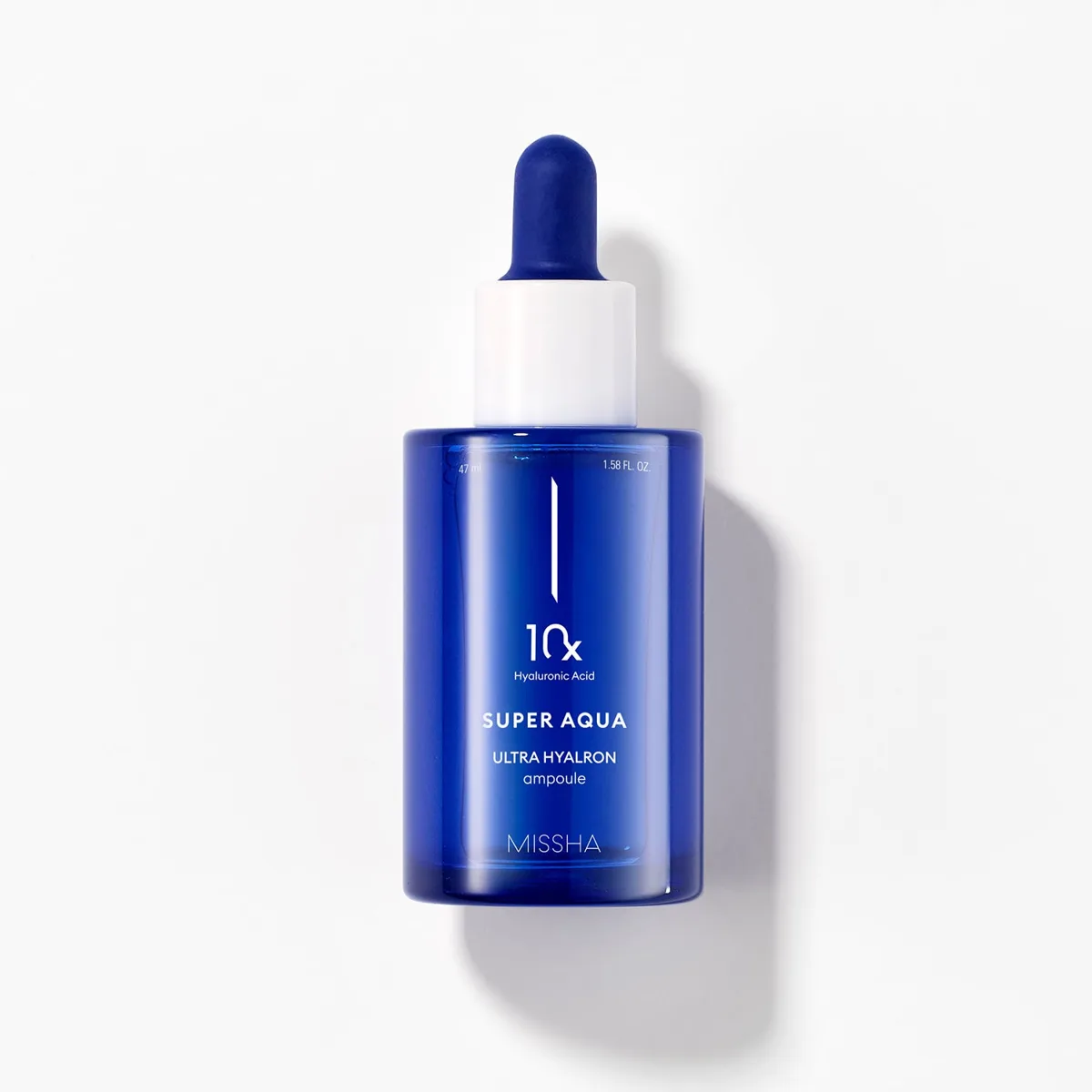
It is a hyaluronic ampoule that does not feel like one: a volatile silicone at fourth gives it a smooth, non-sticky set, niacinamide at sixth adds a real active the label ignores, and a synthetic coolant provides the freshness. The ten hyaluronic forms are present, lower on the list than the name implies, and the humectant base does most of the work.
A silky, cooling, fairly priced hyaluronic ampoule whose best ingredient, niacinamide at sixth, is never mentioned on the label and whose headline, ten hyaluronic forms, lives in the back half of the list. It hydrates well and feels better than most hyaluronic serums; the four essential oils and the coolant are odd choices in a bottle recommended for sensitive skin, and reactive users have a fragrance-free sibling to choose instead.
The Ultra Hyalron line has a long sales history, but this reformulated ampoule has only been on the US store since April 2024 and no per-product review count could be confirmed this session, with the Amazon listing unreadable and the brand's store showing no reviews. The assessment rests on the published ingredient order and the general evidence for its humectants and niacinamide rather than on measured results for this bottle.
Verdicts
How well it fits each concern
Verdict by concern tap a concern for the case
Good choicefor DehydrationIn your profileYou chose · Glycerin is a reference standard by mechanism for dehydration; this ampoule carries it high in the ingredient list.Moderate evidenceStandard tolerabilityNo reviews collected yet
The case for it
Methylpropanediol & Glycerin has trial-supported standing for this concern.
It is present at an effective concentration, declared or high in the ingredient list.
The formula carries no trigger this concern is sensitive to, with the cautions noted.
Same rule for everyone. “Good choice” is the verdict on 9,564 of 45,024 concern verdicts across the catalog; rule R5 decided 9,072 of them.
As of September 25, 2026, engine 5.1.1.
R5 — Trial-supported or guideline-supported active, adequately or plausibly dosed. · the full register
Carrying active
Methylpropanediol & Glycerin
Standing
supported — its mechanism is established
Form
adequate — studied range 20%, from the trials on the row; needs leave-on contact; judge it after ~1 weeks
Tolerability
standard
Row checked
against its sources on July 17, 2026 (evidence table ev-2026.09-r228)
The studies behind the evidence row
USP glycerin monograph / Fluhr et al., glycerol and the skin (review) — glycerin is the reference humectant, drawing and holding water in the stratum corneum — reference work
Good choicefor DrynessIn your profileYou chose · Glycerin is a reference standard by mechanism for dryness; this ampoule carries it high in the ingredient list.Moderate evidenceStandard tolerabilityNo reviews collected yet
The case for it
Methylpropanediol & Glycerin has trial-supported standing for this concern.
It is present at an effective concentration, declared or high in the ingredient list.
The formula carries no trigger this concern is sensitive to, with the cautions noted.
Cautions: fragrance.
Same rule for everyone. “Good choice” is the verdict on 9,564 of 45,024 concern verdicts across the catalog; rule R5 decided 9,072 of them.
As of September 25, 2026, engine 5.1.1.
Promisingfor DullnessIn your profileYou chose · Glycerin has trial-level evidence for dullness but no guideline or regulatory standing yet — promising, short of a recommendation; the other actives here are not yet assessed for it.Moderate evidenceStandard tolerabilityNo reviews collected yet
The case for it
Methylpropanediol & Glycerin has trial-level evidence for this concern but no guideline or regulatory standing yet.
It is present at an effective concentration, declared or high in the ingredient list.
The formula carries no trigger this concern is sensitive to, with the cautions noted.
What would change this: Guideline or regulatory standing for the active on this concern would move this from a promising bet to a recommendation.
Same rule for everyone. “Promising” is the verdict on 7,858 of 45,024 concern verdicts across the catalog; rule R9p decided 7,858 of them.
As of September 25, 2026, engine 5.1.1.
R9p — 0.5.0: 'Unproven' beside three filled dots read as one question answered twice with opposite words (7,018 rows). The chip measures standing, the dots measure trial volume; where the row carries at least one RCT or a tier-2 source (moderate dots) and the active is present at a working level, the honest word is Promising. Unproven is reserved for plausible-standing rows with limited or weak evidence, or an under-dosed form. Same rank as Unproven — a bet either way; the dots order them. · the full register
Carrying active
Methylpropanediol & Glycerin
Standing
plausible — trials support it
Form
adequate — studied range 2–20%, from the trials on the row; needs leave-on contact; judge it after ~1 weeks
Tolerability
standard
Row checked
against its sources on July 17, 2026 (evidence table ev-2026.09-r228)
The studies behind the evidence row
Harry's Cosmeticology / Baran & Maibach Textbook of Cosmetic Dermatology — humectant, emollient and occlusive classification — standard reference text
A verdict is DermApproved’s assessment of how well a product’s ingredients fit a concern — never a claim about what the product treats. Evidence dots and collected reviews sit beside it and are never blended in.
Rules 0.5.1 · evidence table ev-2026.09-r228 · how we decide
Assessment
Pros & Cons
Pros
✓ Niacinamide sixth on the list, a real active the label does not even mention
✓ Volatile silicone gives a silky, non-tacky finish rare in hyaluronic serums
✓ Strong humectant base of methylpropanediol, glycerin and glycols
✓ Ten hyaluronic forms add a spread of molecular weights, if low on the list
✓ Oil-free and fungal-acne friendly, layers cleanly under sunscreen
✓ Fair price for 47ml from a long-established line
Cons
✗ Four essential oils in an ampoule recommended for sensitive skin
✗ Synthetic coolant can tingle on reactive or freshly exfoliated skin
✗ Hyaluronic acids sit between twentieth and thirty-ninth despite the name
✗ 'Ten layers of skin' claim is marketing, not physiology
✗ No lipids; dry skin needs a cream over it in winter
✗ Bergamot oil raises a phototoxicity question the label does not address
Review
Full Review
Ten hyaluronic acids for ten layers of skin is the kind of claim that survives because it sounds like a fact, and Missha has built its Ultra Hyalron sub-line on it since the early 2020s. Skin does not have ten layers in the sense the claim implies, and hyaluronic acid of any molecular weight stays in or on the stratum corneum, so the phrase describes a marketing diagram rather than a mechanism. Set it aside, because the 2024 'new and improved' ampoule underneath it is a better product than its own story. The ingredient order is where the real design lives. Water, then methylpropanediol and glycerin, the humectants that will do most of the hydrating; then cyclohexasiloxane, a volatile silicone, which is the single decision that changes how this ampoule feels; then hexanediol and, sixth, niacinamide, an active with real leave-on evidence that the label never mentions. Only at twentieth does the first hyaluronic acid appear, sodium hyaluronate, and the other nine forms, hydrolysed, acetylated, crosspolymer, potassium salt and the rest, are strung between there and thirty-ninth. They are all present, they add a spread of molecular weights that bind water at slightly different depths of the outer skin, and they are a garnish on a humectant base that would hydrate almost as well without them. In use that base is the point. The silicone spreads the gel thin and flashes off, so the ampoule sets to a smooth, silky, non-tacky finish that hyaluronic serums, which usually leave a faint film, rarely achieve, and the coolant at fourteenth gives a mild chill that reads as fresh on a warm day. Damp skin drinks it in a minute; a cream or sunscreen goes over it without pilling; dehydrated skin feels plumper immediately and steadily more comfortable over a week or two. Missha's own advice to apply a second coat on very dry skin is honest, because the formula is oil-free and does not seal, and dry skin in winter will need a proper cream over it whatever the bottle says about deep moisture. Combination and normal skin can use it as the only hydrating step and be happy. What the niacinamide adds is slower and unadvertised: at sixth it is present at a working level, and over two or three months of twice-daily use it supports the barrier and modestly evens tone, which is a pleasant surprise in a product bought for water. A few weeks of use fill in the rest. Morning is its natural slot, where the cool set makes a mineral sunscreen easier to spread and the finish photographs as skin rather than film; at night, under a cream, it is a fine but unremarkable humectant layer. The dropper doses a little more than a face wants, which is why the neck and chest get the rest and why the bottle empties in two months rather than three. On oily skin in summer it can be the last step entirely, and the absence of oil means it never turns to shine by lunch. Nothing about it pills, stings on intact skin or needs an adjustment period, which is most of what a hydrating ampoule is for. Then the complication. The ampoule is recommended for sensitive skin and sold as free from twenty irritants, and it contains orange peel oil, bergamot fruit oil, lavender oil and chamomile flower oil in the mid-twenties, plus the synthetic coolant. The scent they produce is soft and gone in ten minutes, and most people will enjoy it; the trouble is that essential oils are the ingredients most likely to bother the exact skin the label courts, bergamot carries a phototoxicity question if it is not furocoumarin-free, and a coolant on a freshly exfoliated or rosacea-prone face reads as a sting rather than a refreshment. The line's plain Ultra Hyalron serum, fragrance-free and hyaluronic-led, is the version reactive skin should buy, and it is a strange pair of products for one brand to sell to one customer under one name. The brand has sold the Ultra Hyalron line for years and this reformulation has kept the customers it had, which is a modest kind of evidence but a real one. Twenty-six dollars list and around twenty on the brand's site for 47ml, two months of twice-daily use, is fair and a little generous by Korean ampoule standards, and the texture alone justifies it for anyone who has given up on sticky hyaluronic serums. Missha has been making reliable, affordable hydration for a quarter of a century and this is a competent, pleasant example, sold on a claim it does not need and scented in a way it should not be. Buy it for the silicone finish and the niacinamide, and let the ten layers be the brand's concern. If the scent or the tingle turns out to be a problem, the fragrance-free serum in the same line is a bottle away, and the two together, serum for the reactive weeks and ampoule for the rest, is not a bad way to run a year.
Formula
Key Ingredients
The hero actives that drive this product's performance.
The ten forms that name the ampoule sit between twentieth and thirty-ninth on the list, with sodium hyaluronate the highest at twentieth; together they add a spread of molecular weights for surface and slightly deeper water-binding, but at these positions they ride on the humectant base rather than define it.
Established mechanismfor Dehydration · established mechanism
Sixth, well above any of the hyaluronic acids, which makes it the ampoule's most substantial active and the quiet reason a 'hydrating' serum also supports the barrier and evens tone over weeks; the label never mentions it.
Second and third, the humectants that carry the real hydration load; the ampoule's plumping is mostly these two and the pentylene glycol and polyglycerin behind them, with the hyaluronic acids as the finishing touch and the marketing.
Established mechanismfor Dehydration · established mechanism
Cyclohexasiloxane
Fourth, a volatile silicone that spreads the ampoule thinly and flashes off, leaving a smooth, non-tacky finish that most hyaluronic serums cannot manage; it is the reason the texture reads as silky rather than sticky.
Not yet assessed
Methyl Diisopropyl Propionamide (cooling agent)
Fourteenth, a synthetic TRPM8 coolant that gives the ampoule a faint, alcohol-free chill on application, a sensory cue for 'refreshing hydration' that sensitive skin may notice as a light tingle.
Listed in the mid-twenties, four essential oils give the ampoule a soft citrus-floral scent and are the one clear contradiction in a product 'recommended for sensitive skin' and 'free from twenty irritants'; bergamot in particular carries a phototoxicity question the label does not answer.
Not yet assessed
Ingredient standings describe the active at treatment-level doses and
vehicles; this product's own condition grades weigh its actual formula.
A dropper's worth pressed into damp skin after toner and before moisturizer, morning and night; Missha suggests a second application for very dry skin, and it sits well under a cream or sunscreen thanks to the silicone slip.
Results Timeline
Immediate plumping and a cool, smooth feel that lasts through the day; dehydrated skin feels steadily more comfortable over a week or two of twice-daily use, and the niacinamide at sixth may add a modest evening of tone over two to three months, though that is not what the ampoule is sold for.
The hydration mechanism is a humectant one, and the ingredient order makes the hierarchy plain. Methylpropanediol and glycerin at second and third, with pentylene glycol, polyglycerin-3 and propanediol behind them, bind water into the stratum corneum and account for the immediate plumping; the ten hyaluronic acid forms, from sodium hyaluronate at twentieth down to potassium hyaluronate at thirty-ninth, contribute additional water-binding across a range of molecular weights, with low-molecular fractions reaching slightly deeper into the outer layers and high-molecular ones forming a surface film, but at these positions they are a minority of the humectant load. Cyclohexasiloxane at fourth is a volatile cyclic silicone that reduces surface tension for thin spreading and evaporates, which is why the finish is smooth rather than tacky; it leaves no occlusive film, so the ampoule does not reduce water loss and needs a moisturizer over it on dry skin. Niacinamide at sixth is the formula's most evidence-backed active, with controlled-trial support for improving barrier lipid synthesis, reducing transepidermal water loss and evening tone over eight to twelve weeks, summarised in a 2021 review in Antioxidants, and its inclusion above every hyaluronic form makes the ampoule more useful than its name. Methyl diisopropyl propionamide is a TRPM8 agonist that produces a cold sensation without evaporation or vasodilation, purely a sensory cue. Beta-glucan, oat kernel extract and polyquaternium-51 add soothing and moisture-retention support. The formula's liabilities are the four essential oils, orange, bergamot, lavender and Roman chamomile, which are recognised contact sensitisers and, in bergamot's case, a potential phototoxin unless furocoumarin-free, and which sit uneasily with a sensitive-skin recommendation; the twenty-irritant exclusion list the brand cites does not cover them. The peptide-like tetradecyl aminobutyroylvalylaminobutyric urea trifluoroacetate, phloretin and tetrahydropiperine near the end are trace-level inclusions with no dose-relevant evidence here.
From a clinical standpoint this is a humectant hydrating serum with a worthwhile niacinamide dose and a cosmetically elegant silicone finish, and it would be regarded as a reasonable hydration step for normal, combination and mildly dry skin, ideally under a lipid-containing moisturizer. Its niacinamide content gives it more barrier value than a plain hyaluronic serum. The reservation is the fragrance profile: four essential oils, including bergamot, and a sensory coolant are not what dermatology guidance would choose for rosacea-prone, atopic or sensitised skin, and the 'recommended for sensitive skin' label should be read with that in mind; patients in those groups would usually be steered to a fragrance-free hyaluronic or niacinamide serum, of which the same line offers one. The ten-hyaluronic-acid framing has no clinical significance, since topical hyaluronic acid acts in the stratum corneum regardless of how many forms are combined. Pregnancy and interaction with actives are not concerns.
Guidance
Usage & Recommendations
How to Use
After cleansing and toner, while the skin is still slightly damp, dispense a dropper's worth into the palms and press them over the face and neck rather than rubbing, letting the palms' warmth help the gel sink in; it sets within a minute to a smooth finish. Follow with moisturizer, and with sunscreen in the morning, since the ampoule is oil-free and does not seal. On very dry skin, apply a second coat as Missha suggests before the cream. It layers under retinoids, acids and vitamin C without conflict. Patch test behind the ear if you react to essential oils, and use it sparingly after exfoliation, when the coolant can tingle.
Value Assessment
Twenty-six dollars list and about twenty on Missha's site for 47ml is fair to good for a hydrating ampoule with this texture and a hidden niacinamide dose, working out to roughly two months at a dropper twice daily and undercutting most multi-weight hyaluronic serums from Western brands. The value case rests on the silicone finish and the humectant base rather than on the ten hyaluronic forms, which are cheap ingredients at low positions, and it holds best for combination and normal skin that can use the ampoule as its only hydrating layer. For dry skin that must add a cream anyway, and for reactive skin that would be better served by the line's fragrance-free serum at a similar price, the value is fair rather than compelling. Missha's brand premium is small and its record long; there is one size and no refill.
Who Should Buy
Normal, combination and mildly dry skin that wants a plumping hyaluronic serum without the stickiness, and would enjoy an unadvertised niacinamide bonus, a light scent and a cool feel, will find this a pleasant, well-priced daily hydrator, especially under sunscreen in warm weather.
Who Should Skip
Rosacea-prone, eczema-prone or fragrance-reactive skin should choose the line's fragrance-free Ultra Hyalron serum instead of an ampoule with four essential oils and a coolant, and very dry skin should not expect it to replace a cream. Anyone buying for the ten-layer hyaluronic story is buying a diagram.
Ready to try Missha Super Aqua Ultra Hyalron Ampoule?
A clear, lightly viscous gel-serum with a silky silicone slip that spreads thin, cools faintly, and sinks in within a minute to a smooth, non-tacky finish.
Scent
A soft citrus-floral scent from orange, bergamot, lavender and chamomile oils, noticeable on application and gone within ten minutes.
Packaging
A 47ml cobalt-blue glass dropper bottle with a white collar; the dropper doses generously, which suits the brand's advice to layer twice on very dry skin.
Finish
dewylightweightfast-absorbing
What to Expect on First Use
The first application is cool, silky and faintly scented, with a soft plumping that reads as fresh rather than heavy; the coolant's tingle is mild on intact skin and more noticeable on a freshly exfoliated or reactive face, which is the only thing to watch in the first week.
How Long It Lasts
About two months at a dropper twice daily, a little less with the brand's double-application routine.
Missha's Super Aqua range has been the brand's hydration franchise since the 2000s, and the Ultra Hyalron sub-line arrived in the early 2020s with a 'ten hyaluronic acids for ten skin layers' story that sold well across Asia. The 2024 'new and improved' ampoule reworked the texture around a volatile silicone and added niacinamide and a cooling agent, keeping the ten-form complex as the headline.
About Missha Legacy Brand (20+ years)
Missha, the Seoul brand founded by Able C&C in 2000, has run its Super Aqua hydration range for well over a decade and reworked the Ultra Hyalron sub-line around ten hyaluronic acid forms in the early 2020s. This 'new and improved' ampoule is the 2024 version; the brand claims it is free of twenty irritants and publishes no trial, so it is judged on its ingredient order.
Brand founded: 2000 · Product launched: 2024
Myth vs. Reality
Common Myths
Myth
Ten kinds of hyaluronic acid penetrate ten layers of skin.
Reality
Different molecular weights of hyaluronic acid sit at different depths of the stratum corneum, which is a single layer of the epidermis, not ten layers of skin; here the ten forms sit between twentieth and thirty-ninth on the list, and the plumping comes mostly from methylpropanediol, glycerin and the glycols above them.
Myth
Free from twenty irritants means nothing in it can irritate.
Reality
The exclusion list covers parabens, alcohol, mineral oil and similar, but the formula carries orange, bergamot, lavender and chamomile essential oils and a synthetic coolant, which are the ingredients most likely to bother the sensitive skin the ampoule is recommended for.
FAQ
Frequently Asked Questions
What is the difference between the Missha Ultra Hyalron Ampoule and the Ultra Hyalron Serum?
The serum is a plain humectant gel with the hyaluronic forms high on its list and no fragrance; the ampoule is the 2024 reformulation with a volatile silicone for a silkier set, niacinamide at sixth, a cooling agent and four essential oils. The ampoule feels better and the serum is the safer choice for reactive skin.
Is the Missha Super Aqua Ultra Hyalron Ampoule good for sensitive skin?
Missha recommends it for sensitive skin and lists twenty excluded irritants, but the formula carries orange, bergamot, lavender and chamomile oils and a synthetic coolant. Most skin will be fine; rosacea-prone or fragrance-reactive skin should patch test or choose the fragrance-free serum in the same line.
How do you use the Missha Ultra Hyalron Ampoule?
After toner, press a dropper's worth into slightly damp skin with the palms, morning and night, then follow with moisturizer. Missha suggests a second application for very dry skin, and the silicone slip means it sits cleanly under sunscreen.
Does the Missha Ultra Hyalron Ampoule contain niacinamide?
Yes, sixth on the list, above every hyaluronic acid form, though the label does not mention it. It is the ampoule's most substantial active and adds barrier support and a modest tone benefit over months to what is sold purely as a hydrator.
Is the Missha Ultra Hyalron Ampoule enough on its own for dry skin?
Not in cold weather. It is oil-free and humectant-led, so it plumps and hydrates but does not seal; dry skin needs a cream with ceramides or oils over it, and the brand's own advice to apply twice reflects that. For combination and normal skin it can be the only hydrating step.
Why does the Missha Ultra Hyalron Ampoule feel cool on the skin?
It contains methyl diisopropyl propionamide, a synthetic cooling agent that triggers the skin's cold receptors without alcohol or menthol. The chill is a sensory cue rather than a benefit, and it can read as a tingle on freshly exfoliated or reactive skin.
Reviews
What Reviewers Tend to Say
Recurring themes our editors read across retailer reviews of this product — summaries in our words, not quotations, and not a substitute for your own patch test.
The fourth most frequent positive patch test in North America is an oxidation product of a molecule that occurs naturally in lavender. Nobody synthesised it into your face cream.
Essential oils are declared by botanical name rather than as fragrance, which is why the most heavily perfumed products in the natural aisle can carry the reassuring word — and why the bottle gets more sensitising the longer you own it.
The internet's favorite hydrator has a counterintuitive dark side — in dry air, a humectant with nothing to seal it can pull water out of your skin instead of into it.
Products, answers, therapy guides, tools and articles in one search. Brand names,
slang and abbreviations all work — accutane finds isotretinoin, bacne finds truncal acne.