


Hyaluronic Acid Gets the Ad Budget. Glycerin Does the Work.
The cheapest humectant on the ingredient list is also the best-studied, the most reliable in dry air, and the one your favorite moisturizer is quietly built around.
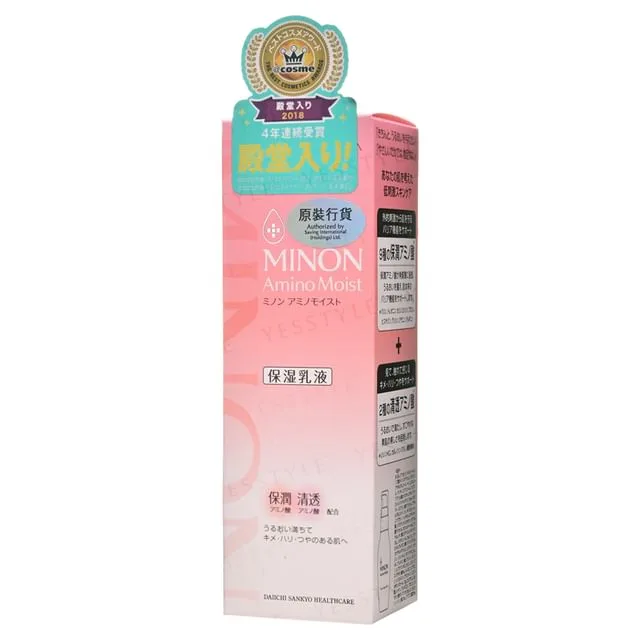
It's the most comprehensive Minon product in the Amino Moist range — eleven amino acids (beyond the standard nine), plus squalane, beeswax, and a phytosteryl emollient ester, all in a fragrance-free emulsion format. The Charge Milk works as both a complete moisturizer for combination skin and as a layered middle step before a richer cream for dry skin, which gives it more routine flexibility than most sensitive-skin emulsions.
The most comprehensive ingredient list in Minon's Amino Moist range — eleven amino acids, squalane, beeswax, phytosteryl emollient ester, and the brand's signature carnosine, all in a fragrance-free milk emulsion. Pairs cleanly with the Charge Lotion family to complete a fully Minon-anchored sensitive-skin routine. The 100g size at premium pharmacy-brand pricing is the main value flag.
The case for it
Same rule for everyone. “Good choice” is the verdict on 9,564 of 45,024 concern verdicts across the catalog; rule R5 decided 9,072 of them. Unchanged since September 5, 2026, engine 5.1.1.
Brand or formulator? Disclose a concentration or correct a fact →
The studies behind the evidence row
The case for it
Same rule for everyone. “Good choice” is the verdict on 9,564 of 45,024 concern verdicts across the catalog; rule R5 decided 9,072 of them. Unchanged since September 5, 2026, engine 5.1.1.
Brand or formulator? Disclose a concentration or correct a fact →
The studies behind the evidence row
The case for it
What would change this: A researched evidence row for the lead active would replace this with a verdict.
Same rule for everyone. “Good choice” is the verdict on 1,938 of 45,024 concern verdicts across the catalog; rule F2 decided 1,938 of them. Unchanged since September 5, 2026, engine 5.1.1.
Brand or formulator? Disclose a concentration or correct a fact →
The case for it
What would change this: A researched evidence row for the lead active would replace this with a verdict.
Same rule for everyone. “Supporting role” is the verdict on 8,197 of 45,024 concern verdicts across the catalog; rule R8 decided 4,250 of them. Unchanged since September 5, 2026, engine 5.1.1.
Brand or formulator? Disclose a concentration or correct a fact →
Does the jobDoes what a moisturizer is for: draws in water, softens and smooths.
A verdict is DermApproved’s assessment of how well a product’s ingredients fit a concern — never a claim about what the product treats. Evidence dots and collected reviews sit beside it and are never blended in. Rules 0.5.1 · evidence table ev-2026.09-r228 · how we decide
When pharmaceutical companies make skincare, the formulation philosophy tends to show up in unexpected places. The Minon Amino Moist Charge Milk is exactly that kind of product — what most brands would ship as a basic sensitive-skin emulsion, Daiichi Sankyo built with eleven amino acids, squalane, beeswax, a phytosteryl emollient ester, and the brand's signature carnosine inclusion, all in a fragrance-free milk format. The ingredient density is unusual for the price tier, and it's the reason this product has become a recurring dermatologist recommendation in Japan for chronic sensitive-skin complexions.
The ingredient architecture is genuinely thoughtful. Water leads, butylene glycol and glycerin sit in the second and third positions as the primary humectant phase, xylitol joins as a slower-acting humectant for sustained moisture binding. Diisostearyl malate and squalane provide the lipid component that distinguishes this milk from the watery Charge Lotion products. Dimethicone and cyclopentasiloxane round out the silicone phase for the milk's cushioned sensorial finish. Beeswax functions as a natural occlusive that supports the barrier-protection mechanism. And the amino acid lineup is the most comprehensive in the Minon range — glycine, leucine, histidine, histidine HCl, serine, valine, sodium aspartate, threonine, alanine, isoleucine, arginine, proline, tyrosine, glutamic acid, taurine, and phenylalanine. The expanded amino acid set goes beyond the standard NMF profile to include taurine and aspartate, which signals the brand's research-driven approach to barrier replenishment.
The phytosteryl/behenyl/octyldodecyl lauroyl glutamate is the same skin-mimetic ester that Minon uses throughout the Amino Moist range. In a milk emulsion format it contributes meaningfully to the cushioned post-application feel and supports the formula's positioning for compromised barriers — it integrates into the stratum corneum lipid lamellae rather than just sitting on top of the skin.
In practical use the milk slots into a Minon-anchored routine in two common ways. As a complete moisturizer for combination-to-normal skin, it functions as the single emulsion step after the Charge Lotion and before sunscreen — providing enough barrier support and humectant load to handle most daily needs without requiring a separate cream layer. As a middle step in a layered routine for very dry skin, it functions as the emulsion phase between treatment serums and the richer Moisture Charge Cream — delivering the lipid-and-emollient barrier component that the Lotion and Cream alone don't quite address.
The milk texture is the right format for this purpose. Slightly thicker than the Charge Lotion and noticeably lighter than the Moisture Charge Cream, the Milk warms quickly against skin and absorbs within 40-60 seconds with a cushioned (not slippery, not shiny) finish. The silicones contribute to the texture without dominating it — this isn't a product where you feel silicone slip after application. The squalane provides emolliency without greasiness; the beeswax provides occlusion without heaviness.
The fragrance-free positioning is identical to the rest of the Amino Moist range — no masking perfumes, no botanical aromatic extracts, no fragrance creeping in under other ingredient names. The product has only the faint inherent note of a clean amino-acid emulsion, which fades immediately on application. For sensitive-skin users specifically frustrated by the fragrance creep that's affected even supposedly-fragrance-free Japanese pharmacy brands, this matters.
The honest considerations worth flagging: the formula contains silicones (dimethicone, cyclopentasiloxane, dimethiconol, trimethylsiloxysilicate) that some buyers avoid on principle. The beeswax disqualifies it for vegans (the Charge Lotion II is the vegan alternative within the Minon range). The hydrogenated lecithin and beeswax both appear on standard fungal-acne avoid lists, which means Malassezia-prone skin should look at the Charge Lotion II alone instead. And the 100g size at the premium price point goes faster than competitors' larger formats at similar prices.
Value is the genuine consideration. At about $26 for 100g at Japanese pharmacy pricing, the per-gram cost is significantly above mainstream Japanese sensitive-skin emulsions and roughly at parity with Western sensitive-skin specialist brands. The 100g bottle lasts about 2 months of twice-daily face use, putting monthly cost at about $13 — reasonable for a specialty product, less reasonable if you don't specifically need the formulation depth. International markup at non-Japanese retailers can push this product to $34-$42, which weakens the value proposition meaningfully.
Who this is for: chronic sensitive, dry, atopic, or compromised-barrier complexions building or completing a Minon Amino Moist routine, anyone who has tried lighter sensitive-skin emulsions without getting enough barrier support, post-procedure recovery users needing a maximally-tolerable emulsion step, and routine builders who specifically value the ingredient depth that Daiichi Sankyo's pharmaceutical-grade formulation brings.
Who should skip: fungal-acne-prone complexions (beeswax and hydrogenated lecithin are concerns), vegan users (use Charge Lotion II alone), silicone-avoiders on principle, budget-conscious shoppers facing $40+ international markup where simpler sensitive-skin emulsions become more competitive, and cruelty-free purchasers ruled out by Daiichi Sankyo's mainland China distribution.
The broader take: this is the version of a sensitive-skin emulsion that Daiichi Sankyo's institutional knowledge produces when applied to a 'basic' moisturizing step. The eleven-amino-acid complex, the squalane, the beeswax, the phytosteryl ester, the carnosine — all of these reflect formulation choices that most pharmacy-brand emulsions skip in favor of cost savings. For sensitive-skin users who've tried simpler emulsions and found them inadequate, this is the meaningful upgrade. For users with simpler needs, simpler products will work fine at lower cost. The premium is real; the value depends entirely on whether you need what's being paid for.
The hero actives that drive this product's performance.
| Ingredient | Function | Evidence |
|---|---|---|
| Eleven-Amino-Acid NMF Complex | Minon's most comprehensive amino acid lineup yet — glycine, leucine, histidine, histidine HCl, serine, valine, sodium aspartate, threonine, alanine, isoleucine, arginine, proline, tyrosine, glutamic acid, taurine, and phenylalanine. The expanded amino acid set goes beyond the standard NMF profile to include taurine and aspartate, which signals the brand's research-driven approach to barrier replenishment. | Not yet assessed |
| Squalane | A skin-mimetic emollient (saturated version of natural sebum squalene) that provides emolliency, surface occlusion, and TEWL prevention without greasy heaviness. Its inclusion here distinguishes the Charge Milk from the watery Charge Lotion products — squalane provides the milk-format's characteristic cushioned absorption. | Established mechanism for Dryness · established mechanism |
| Beeswax + Phytosteryl Lauroyl Glutamate Lipid Layer | The barrier-supportive lipid system — beeswax as a natural occlusive, phytosteryl/behenyl/octyldodecyl lauroyl glutamate as the skin-mimetic ester that integrates into the stratum corneum lipid lamellae. Together they provide the milk's actual barrier-repair character beyond just humectant hydration. | Not yet assessed |
| Glycerin + Xylitol + Butylene Glycol | A triple-humectant phase — glycerin and butylene glycol as the standard humectant duo, with xylitol added as a slower-acting humectant that provides more sustained moisture binding. Together they keep the milk's water phase delivering hydration over a long contact window. | Established mechanism for Dryness · established mechanism |
| Carnosine + Allantoin (Barrier-Soothing Complex) | Carnosine for antioxidant and anti-glycation activity, allantoin as a mild keratolytic and soothing agent. Both contribute to the milk's tolerance for chronically reactive complexions and to its position as a leave-on product that addresses skin condition beyond just hydration. | Not yet assessed |
Ingredient standings describe the active at treatment-level doses and vehicles; this product's own condition grades weigh its actual formula.
Water, Butylene Glycol, Glycerin, Xylitol, Diisostearyl Malate, Dimethicone, Arachidyl Alcohol, Behenyl Alcohol, Pentylene Glycol, Beeswax, Hydroxyethyl Acrylate/Sodium Acryloyldimethyl Taurate Copolymer, Glyceryl Stearate, Arachidyl Glucoside, Phenoxyethanol, Squalane, Trimethylsiloxysilicate, Cyclopentasiloxane, Glyceryl Caprylate, Polysorbate 60, Stearyl Glycyrrhetinate, Xanthan Gum, Dimethiconol, Carnosine, Phytosteryl/Behenyl/Octyldodecyl Lauroyl Glutamate, Histidine, Taurine, Lysine HCl, Polyquaternium-61, Glutamic Acid, Glycine, Leucine, Histidine HCl, Serine, Valine, Sodium Aspartate, Threonine, Alanine, Isoleucine, Allantoin, 1,2-Hexanediol, Phenylalanine, Hydrogenated Lecithin, Arginine, Proline, Polyglyceryl-10 Laurate, Tyrosine, Disodium Inosinate, Disodium Guanylate
moisturizer
AM & PM
Apply after Charge Lotion I or II and before any cream. The milk works as a complete moisturizer for combination-to-normal skin or as a middle-layer step before a richer cream for very dry complexions. Pat in rather than rubbing for best absorption.
Immediate plumping and cushioned finish on first use. Sustained dryness improvement and reduced reactivity from twice-daily use becomes noticeable within 2-3 weeks, especially when paired with the Charge Lotion as a layered routine.
The relevant chemistry here is the layered hydration-plus-barrier-support architecture. The humectant phase (butylene glycol, glycerin, xylitol) draws water into the upper stratum corneum via osmotic gradient. The lipid phase (diisostearyl malate, squalane, beeswax, phytosteryl lauroyl glutamate) provides emollient occlusion that slows transepidermal water loss after the humectants do their work. The silicone phase (dimethicone, cyclopentasiloxane, dimethiconol, trimethylsiloxysilicate) provides the cushioned sensorial finish without affecting the underlying hydration mechanism. This is a textbook example of well-engineered moisturizing emulsion chemistry — humectants, lipids, and silicones each doing their distinct jobs without competing with each other.
The amino acid complex is the more interesting formulation choice. The eleven amino acids in this formula (glycine, leucine, histidine, histidine HCl, serine, valine, sodium aspartate, threonine, alanine, isoleucine, arginine, proline, tyrosine, glutamic acid, taurine, phenylalanine) go beyond standard NMF composition to include taurine and aspartate, both of which have additional skin-supportive activity beyond pure NMF replenishment. Taurine in particular has documented activity as an osmoprotectant in keratinocytes and may contribute to barrier resilience under stress.
The squalane inclusion deserves a brief mechanistic note. Squalane is a skin-mimetic emollient — the saturated, stable version of the squalene naturally present in human sebum. In leave-on formulations its mechanism is reasonably well-documented: it integrates with the skin's surface lipid layer to provide both emollient softening and modest TEWL reduction without the comedogenicity issues of heavier triglyceride oils. At the concentration used in this milk, it likely contributes meaningfully to the formula's barrier-supportive character.
The phytosteryl/behenyl/octyldodecyl lauroyl glutamate is part of the same family of skin-mimetic emollient esters that Minon uses across the Amino Moist range. These ingredients are designed to integrate into the stratum corneum lipid lamellae structure rather than just sitting on the skin's surface — a more sophisticated approach to barrier support than basic occlusive emollients.
The carnosine inclusion provides the same antioxidant and anti-glycation activity as in the Charge Lotion products. At cosmetic concentrations in a leave-on emulsion, the dwell time is sufficient for these mechanisms to operate to a useful degree.
The inclusion of disodium inosinate and disodium guanylate is unusual — these are typically found in food applications as flavor enhancers. In this cosmetic context their role is less clear; they may function as humectant or osmoprotectant components, but the published cosmetic-chemistry literature on these ingredients in skincare is thin.
The Minon Charge Milk occupies a specific position in Japanese clinical dermatology — it is among the emulsions most frequently suggested for sensitive-skin patients building a full Amino Moist routine, and for post-procedure recovery contexts where a maximally-tolerable emulsion step is needed between treatment serums and richer occlusive creams. Clinically the appealing characteristics are the comprehensive amino-acid complex (genuinely formulated rather than cosmetically claimed), the squalane and phytosteryl emollient ester for actual barrier support, the genuine fragrance-free formulation, and the absence of common contact sensitizers across the ingredient list. The flags clinicians sometimes raise are the beeswax inclusion (a moderate contact-allergen for a small percentage of patients) and the price point (some patients find lower-priced sensitive-skin emulsions sufficient). For patients with chronic compromised barrier, atopic dermatitis, or post-procedure needs, the Charge Milk is among the more thoughtfully formulated pharmacy-brand options available; for patients with simpler hydration needs, simpler emulsions typically work fine at lower cost.
After cleansing and applying your hydrating toner (Charge Lotion I or II), dispense a quarter-sized amount of the Milk into clean damp palms. Warm briefly between your hands. Press and pat into damp skin, allowing the milk to absorb without rubbing — about 40-60 seconds. Follow with a richer cream (Minon Moisture Charge Cream for brand-consistent layering) if your skin is very dry, or proceed directly to sunscreen in the AM if the Milk alone provides sufficient hydration. Safe for use morning and evening. Can be used on the body for spot dryness, though the 100g size limits widespread body application.
At approximately $26 for 100g at Japanese pharmacy pricing, this sits in the premium sensitive-skin emulsion bracket — meaningfully above mainstream Japanese sensitive-skin moisturizers and roughly at parity with Western sensitive-skin specialist brands. The premium reflects the cost of the eleven-amino-acid complex, the carnosine inclusion, the squalane and phytosteryl emollient ester, and Daiichi Sankyo's pharmaceutical-grade formulation overhead. The 100g bottle lasts about 2 months of twice-daily face use, putting monthly cost at about $13 — reasonable for a specialty product. International markup at non-Japanese retailers can push this product to $34-$42, which weakens the value proposition meaningfully; at that pricing, simpler ceramide-based emulsions from CeraVe or La Roche-Posay may serve sensitive-skin needs adequately for less spend. Compared to the Moist Charge Cream (the richer occlusive next step in the Minon routine), the Milk is the better value if you only need one product; the Cream adds occlusive richness that the Milk doesn't fully provide.
Chronic sensitive, dry, atopic, or compromised-barrier complexions building or completing a Minon Amino Moist routine, anyone who has tried lighter sensitive-skin emulsions without getting enough barrier support, post-procedure recovery users needing a maximally-tolerable emulsion step, and routine builders who specifically value the ingredient depth that Daiichi Sankyo's pharmaceutical-grade formulation brings.
Fungal-acne-prone complexions (beeswax and hydrogenated lecithin are Malassezia concerns), vegan users (the Charge Lotion II is the vegan alternative within the Minon range), silicone-avoiders on principle, budget-conscious shoppers facing $40+ international markup where simpler sensitive-skin emulsions become more competitive, and cruelty-free purchasers ruled out by Daiichi Sankyo's mainland China distribution.
Ready to try Minon Amino Moist Charge Milk?
Buy at Amazon ♥A medium-weight milk with a slightly cushioned feel — thicker than the Charge Lotion but lighter than a cream; pours readily and absorbs within 40-60 seconds.
Genuinely fragrance-free — only the faint inherent ingredient note of a clean amino-acid emulsion.
Standard plastic bottle with a flip-top cap or pump (varies by retailer); the cap closes cleanly and the bottle survives bathroom humidity well.
First application is sensorially soft — the milk warms quickly against skin and sinks in with a cushioned (not slippery) finish. Skin feels immediately plumped and protected without any shine or greasiness. Within the first week, reactive complexions typically report noticeably less mid-day tightness and a more consistent dewy-but-not-shiny finish that holds through the AM routine.
About 2 months at twice a day face use; slightly less if used as a body application for spot dryness.
All Year
Minon was developed by Daiichi Sankyo Healthcare in 1973 for sensitive complexions, and the Amino Moist sub-line was added in the 2000s. The Charge Milk was designed as the emulsion step that completes the Amino Moist hydration sequence — Lotion sets up hydration, Milk delivers the lipid-and-emollient barrier support, optional Moisture Charge Cream adds richer occlusion for very dry skin. The expanded amino acid set (eleven amino acids vs nine in the lotion) reflects Daiichi Sankyo's continued formulation refinement.
Minon was founded in 1973 by Daiichi Sankyo Healthcare — the OTC arm of one of Japan's largest pharmaceutical companies — as a dedicated sensitive-skin franchise. The Amino Moist sub-line anchors on natural-moisturizing-factor amino acid composition with proprietary clinical work behind it, and is among the most-recommended brand by Japanese dermatologists for atopic and barrier-compromised patients.
All sensitive-skin emulsions are functionally interchangeable.
They're not. The Minon Charge Milk includes barrier-supportive lipids (squalane, beeswax, phytosteryl lauroyl glutamate) that many sensitive-skin emulsions skip in favor of pure humectant hydration. For chronic compromised-barrier complexions, the lipid component is the difference between an emulsion that provides temporary plumping and one that actually supports barrier recovery.
An emulsion in a sensitive-skin routine is optional if you have a serum and a cream.
It's optional in mild cases. For very reactive or chronically dry complexions, the middle-step emulsion delivers a layer of barrier-supportive emollients between the hydrating treatment serum and the heavier occlusive cream — closing a gap that the two products alone don't always address. The Minon routine specifically benefits from the full layered approach.
The Milk is the lighter middle-layer step — emulsion texture, suitable for combination-to-normal skin as a complete moisturizer or as a base layer for very dry skin. The Cream is the richer occlusive layer that follows for genuinely dry winter complexions or chronically compromised barriers. Pick the Milk alone if your skin is normal-to-mildly-dry; pair both for the full layered Minon routine.
Probably not. The hydrogenated lecithin and the beeswax in this formula are on standard Malassezia avoid lists, which means fungal acne sufferers may experience flares. The squalane and silicone components are Malassezia-safe, but the overall formula combination is not the best choice for active fungal acne. Look at the Charge Lotion II for a Malassezia-safer alternative within the Minon range.
Yes — the milk texture absorbs fast enough to layer under sunscreen and makeup without feeling heavy in warm weather. The squalane component provides barrier support without occlusive weight, which makes it work year-round rather than only in winter. For very oily summer skin in humid climates, the lighter Charge Lotion alone may be sufficient.
The silicones (dimethicone, cyclopentasiloxane, dimethiconol, trimethylsiloxysilicate) provide the milk's cushioned, non-greasy sensorial finish — they're well-tolerated by sensitive skin and don't penetrate the stratum corneum. The beeswax functions as a natural occlusive that supports the formula's barrier-protection mechanism. Both choices reflect Daiichi Sankyo's formulation priorities (tolerance and barrier support) rather than vegan or silicone-free priorities.
No. The beeswax inclusion means this product cannot be classified as vegan. The Charge Lotion family (I and II) is vegan, but the Milk includes beeswax as part of its lipid barrier system. Vegan users should opt for the Charge Lotion II Moist alone, or pair it with a vegan moisturizer from a different brand.
After. The standard order is: cleanser → toner (Charge Lotion) → treatment serum → emulsion (Charge Milk) → cream (Charge Cream if needed) → sunscreen (AM only). The Milk's job is to deliver the lipid-and-emollient barrier layer after your treatment actives have absorbed, not to compete with them. Allow your serum to fully absorb before applying the Milk.
No. Daiichi Sankyo Healthcare distributes through mainland China retail channels where animal testing is required by local regulation, so Minon cannot claim cruelty-free certification. For shoppers where that's a hard purchase requirement, the entire Minon line would be ruled out.
Recurring themes our editors read across retailer reviews of this product — summaries in our words, not quotations, and not a substitute for your own patch test.
Cushioned milk texture absorbs without tackiness
Genuinely fragrance-free with no masking notes
Sustained hydration through a workday
Tolerated by chronically reactive complexions
Eleven-amino-acid complex is unusual and thoughtful
Premium price for 100g (smaller than competitors at similar price)
Contains beeswax (rules out for vegans)
Silicone content can disappoint silicone-avoiders
Not enough for very dry winter skin without a cream layer
Verified answers from our questions library — the nuance a product page cannot carry.