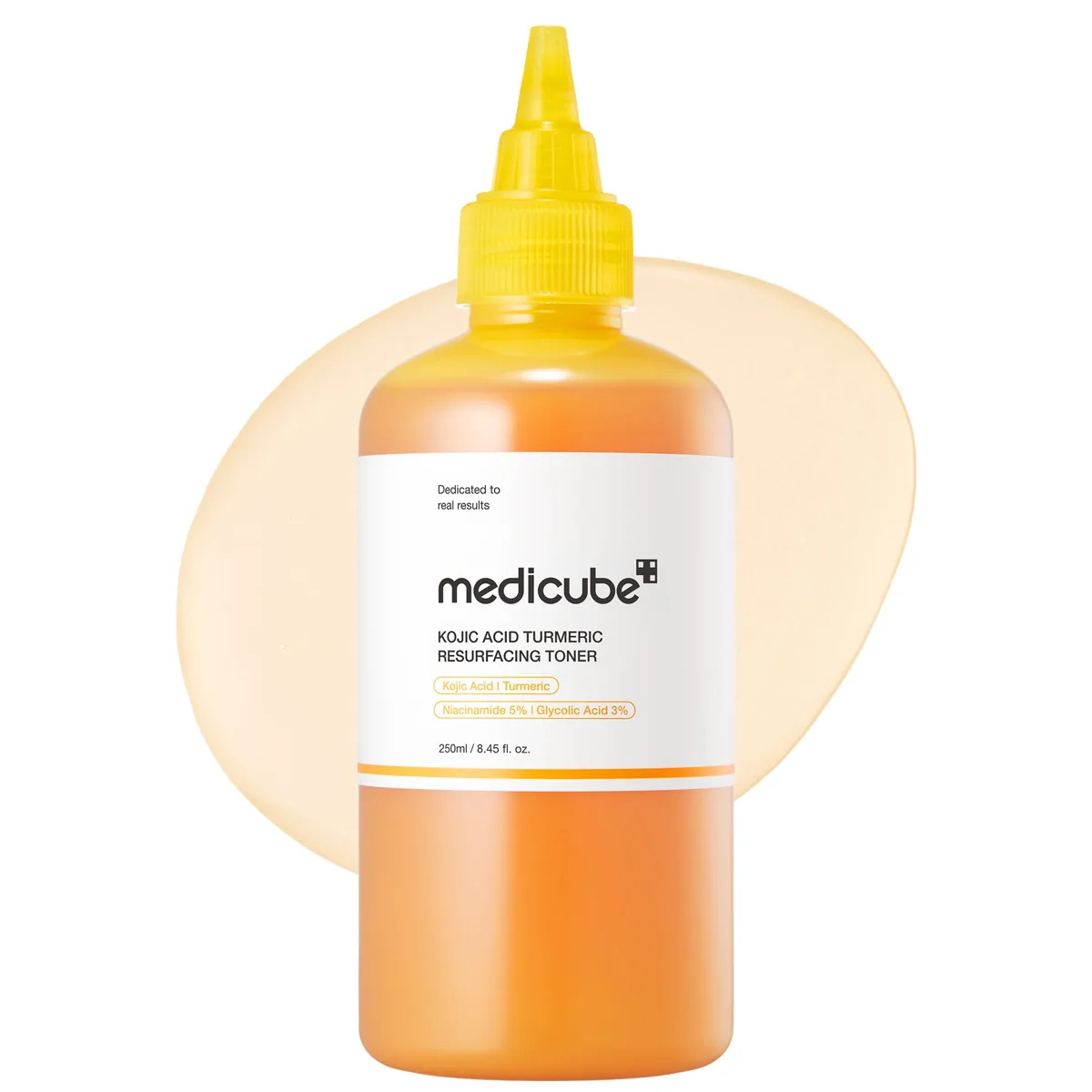
It is a niacinamide-first, mildly glycolic toner sold in a 250 mL nozzle-tip bottle designed for underarms, elbows and knees as much as for the face, an unusual body-brightening pitch for a K-beauty toner, finished with an eight-form hyaluronic complex and a ceramide liposome. The kojic acid and turmeric that name it are lower and lighter than the label suggests, and unlike the line's pad it is scented with lavender and bergamot oils.
A niacinamide-first, mildly glycolic toner in a quarter-litre nozzle bottle built for underarms, elbows and knees as much as for the face, with a generous hyaluronic and ceramide finish that keeps it comfortable. It smooths rough body patches well and brightens the surface gradually; its kojic acid is a light supporting note, and its lavender and bergamot oils make it the scented, more sensitising sibling of the line's fragrance-free pad, with a sunscreen obligation the underarm pitch does not mention.
Launched in September 2025, this toner has about a year of sales and roughly twenty-two hundred Amazon ratings behind it, plus a single brand-commissioned instrumental panel that measured skin flakes and overall tone rather than the depth of any dark spot, so the brightening claim is judged from where kojic acid and turmeric sit in the list rather than from any test of the product. Medicube prints niacinamide at 5 percent and glycolic acid at 3 percent but not the kojic acid and does not state whether its bergamot oil is bergapten-free, so the photosensitivity caution is precautionary.
Verdicts
How well it fits each concern
Verdict by concern tap a concern for the case
Supporting rolefor Rough TextureIn your profileYou chose · Glycolic Acid is a reference standard by mechanism for rough texture, but this liquid carries it below the studied range — a supporting role at best.Moderate evidenceStandard tolerabilityNo reviews collected yet
The case for it
Glycolic Acid has trial-supported standing for this concern.
It is present below the studied range.
The formula carries no trigger this concern is sensitive to, with the cautions noted.
What would change this: A concentration inside the studied range would raise this a step.
Same rule for everyone. “Supporting role” is the verdict on 8,197 of 45,024 concern verdicts across the catalog; rule R7 decided 258 of them.
As of September 25, 2026, engine 5.1.1.
R7 — A supported active under-dosed cannot be recommended for the concern; if the category has a supportive job it may still help alongside treatment. · the full register
Carrying active
Glycolic Acid
Standing
supported — its mechanism is established
Form
sub threshold (declared 3%) — studied range 4–10%, from the trials on the row; needs leave-on contact; judge it after ~8 weeks
Tolerability
standard
Row checked
against its sources on July 17, 2026 (evidence table ev-2026.09-r228)
The studies behind the evidence row
International Cosmetic Ingredient Dictionary and Handbook — declared function — Personal Care Products Council
Harry's Cosmeticology / Baran & Maibach Textbook of Cosmetic Dermatology — humectant, emollient and occlusive classification — standard reference text
Supporting rolefor DullnessIn your profileYou chose · Glycolic Acid is a reference standard by mechanism for dullness, but this liquid carries it below the studied range — a supporting role at best.Moderate evidenceStandard tolerabilityNo reviews collected yet
The case for it
Glycolic Acid has trial-supported standing for this concern.
It is present below the studied range.
The formula carries no trigger this concern is sensitive to, with the cautions noted.
What would change this: A concentration inside the studied range would raise this a step.
Same rule for everyone. “Supporting role” is the verdict on 8,197 of 45,024 concern verdicts across the catalog; rule R7 decided 258 of them.
As of September 25, 2026, engine 5.1.1.
R7 — A supported active under-dosed cannot be recommended for the concern; if the category has a supportive job it may still help alongside treatment. · the full register
Carrying active
Glycolic Acid
Standing
supported — its mechanism is established
Form
sub threshold (declared 3%) — studied range 4–10%, from the trials on the row; needs leave-on contact; judge it after ~8 weeks
Tolerability
standard
Row checked
against its sources on July 17, 2026 (evidence table ev-2026.09-r228)
The studies behind the evidence row
Harry's Cosmeticology / Baran & Maibach Textbook of Cosmetic Dermatology — humectant, emollient and occlusive classification — standard reference text
Promisingfor Dark SpotsIn your profileYou chose · Niacinamide has trial-level evidence for dark spots but no guideline or regulatory standing yet — promising, short of a recommendation; the other actives here are not yet assessed for it.Moderate evidenceStandard tolerabilityNo reviews collected yet
The case for it
Niacinamide has trial-level evidence for this concern but no guideline or regulatory standing yet.
It is present at an effective concentration, declared or high in the ingredient list.
The formula carries no trigger this concern is sensitive to, with the cautions noted.
Cautions: a photosensitising active — use sun protection.
What would change this: Guideline or regulatory standing for the active on this concern would move this from a promising bet to a recommendation.
Same rule for everyone. “Promising” is the verdict on 7,858 of 45,024 concern verdicts across the catalog; rule R9p decided 7,858 of them.
As of September 25, 2026, engine 5.1.1.
R9p — 0.5.0: 'Unproven' beside three filled dots read as one question answered twice with opposite words (7,018 rows). The chip measures standing, the dots measure trial volume; where the row carries at least one RCT or a tier-2 source (moderate dots) and the active is present at a working level, the honest word is Promising. Unproven is reserved for plausible-standing rows with limited or weak evidence, or an under-dosed form. Same rank as Unproven — a bet either way; the dots order them. · the full register
Carrying active
Niacinamide
Standing
plausible — trials support it
Form
adequate (declared 5%)
Tolerability
standard — photosensitization
Row checked
against its sources on July 17, 2026 (evidence table ev-2026.09-r228)
Promisingfor Excess OilinessIn your profileYou chose · Niacinamide has trial-level evidence for excess oiliness but no guideline or regulatory standing yet — promising, short of a recommendation; the other actives here are not yet assessed for it.Moderate evidenceStandard tolerabilityNo reviews collected yet
The case for it
Niacinamide has trial-level evidence for this concern but no guideline or regulatory standing yet.
It is present at an effective concentration, declared or high in the ingredient list.
The formula carries no trigger this concern is sensitive to, with the cautions noted.
What would change this: Guideline or regulatory standing for the active on this concern would move this from a promising bet to a recommendation.
Same rule for everyone. “Promising” is the verdict on 7,858 of 45,024 concern verdicts across the catalog; rule R9p decided 7,858 of them.
As of September 25, 2026, engine 5.1.1.
R9p — 0.5.0: 'Unproven' beside three filled dots read as one question answered twice with opposite words (7,018 rows). The chip measures standing, the dots measure trial volume; where the row carries at least one RCT or a tier-2 source (moderate dots) and the active is present at a working level, the honest word is Promising. Unproven is reserved for plausible-standing rows with limited or weak evidence, or an under-dosed form. Same rank as Unproven — a bet either way; the dots order them. · the full register
Carrying active
Niacinamide
Standing
plausible — trials support it
Form
adequate (declared 5%) — studied range 2%, from the trials on the row; needs leave-on contact; judge it after ~8 weeks
Tolerability
standard
Row checked
against its sources on July 17, 2026 (evidence table ev-2026.09-r228)
Unprovenfor Keratosis PilarisIn your profileYou chose · Glycolic Acid has early or mechanistic evidence for keratosis pilaris — a reasonable bet, not a recommendation; the other actives here are not yet assessed for it.Limited evidenceStandard tolerabilityNo reviews collected yet
The case for it
Glycolic Acid has early or mechanistic evidence for this concern, not trial-backed standing.
It is present at an effective concentration, declared or high in the ingredient list.
The formula carries no trigger this concern is sensitive to, with the cautions noted.
What would change this: Trial evidence for the active on this concern would move this from a bet to a recommendation.
Same rule for everyone. “Unproven” is the verdict on 1,111 of 45,024 concern verdicts across the catalog; rule R9 decided 1,111 of them.
As of September 25, 2026, engine 5.1.1.
R9 — Plausible-tier actives alone do not earn a recommendation, and 'not for this' would overstate the case against them. 'Unproven' with the evidence dots lets the reader judge the bet (added 0.2.0 after the first shadow run put a 10% niacinamide serum at 'not for this' for hyperpigmentation). 0.5.0: the closing clause reads the other heroes — "nothing else here addresses it" only when every other active has a researched 'none' row; "not yet assessed" when that is the truth. Rows whose dots read moderate or better now reach R9p first. · the full register
Carrying active
Glycolic Acid
Standing
plausible — trials support it
Form
adequate (declared 3%)
Tolerability
standard
Row checked
against its sources on July 17, 2026 (evidence table ev-2026.09-r228)
Does the jobDoes what a toner is for: adds something real, not alcohol-driven. Not measured from the label: restores skin pH, plays well with what follows.
A verdict is DermApproved’s assessment of how well a product’s ingredients fit a concern — never a claim about what the product treats. Evidence dots and collected reviews sit beside it and are never blended in.
Rules 0.5.1 · evidence table ev-2026.09-r228 · how we decide
Assessment
Pros & Cons
Pros
✓ Niacinamide at second gives a credible dose for tone, sebum and post-shave darkening
✓ Buffered glycolic acid smooths rough elbows, knees and bumpy arms within days
✓ Nozzle tip makes hands-free body application tidy and hygienic
✓ Eight-form hyaluronic complex plus a ceramide liposome keep it comfortable
✓ 250 mL at twenty-one dollars is generous for a K-beauty toner
✓ Around twenty-two hundred Amazon ratings at 4.5 stars in its first year
✓ Lightweight, non-sticky finish that layers under anything
Cons
✗ Kojic acid sits thirteenth, a supporting note rather than a treatment
✗ Lavender and bergamot oils add sensitisers to a product aimed at underarms
✗ Bergamot oil may be photosensitising; brand does not state it is bergapten-free
✗ Glycolic acid stings on freshly shaved or sensitive skin
✗ Sunscreen obligation on treated body areas goes unmentioned in the pitch
✗ Brand's panel measured flakes and tone, not pigment depth
Review
Full Review
The nozzle is the tell. Most K-beauty toners come in a bottle you tip onto a cotton pad; this one has a narrow tip under a flip cap so it can be squirted directly onto underarms, elbows and knees without touching them, and the brand's own copy leads with those body parts. That is a product designed for the kojic-acid-soap moment, when social media decided dark underarms were a problem kojic acid could solve, and it is an honest place to start because the formula's real work on those areas is done by two ingredients the trend never mentions.
The first is niacinamide, second in the list, ahead of the acid, which makes this fundamentally a niacinamide toner. The bottle prints it at five percent, a trial-strength dose, the kind that calms post-shave darkening, tempers oil and evens tone over weeks, and it is the most plausible source of the tone improvement in Medicube's contract-lab panel. The second is glycolic acid at third, three percent on the label, partly neutralised by sodium hydroxide three places down so that it sits at a daily-use strength rather than a peel, and it is what clears the dead-cell build-up that makes elbows grey, knees rough and underarms look darker than the skin beneath; the fifty-two percent flake reduction in the same panel is this ingredient's doing. Between them they account for what reviewers actually report, smoother rough patches within a week and a brighter, more even look over a month or two.
The kojic acid that names the bottle sits thirteenth, beside a red-yeast Monascus extract that lends some colour and a folk-brightening story, at a placement that implies a fraction of the one to four percent kojic acid needs in a leave-on cream to fade pigment. It is not nothing, a tyrosinase inhibitor at any dose adds a little, but it is a supporting note in a product named after it, and the reviews that say the dark spots did not change are describing the dose accurately. Turmeric root extract does better at fifth, with real antioxidant activity and thin clinical support, and it and gardenia paint the toner its turmeric yellow.
The tail is where Medicube's toner expertise shows and the reason the product feels lighter than its list. Allantoin and panthenol soothe, eight hyaluronate species of varying size leave the skin damp rather than tight, and a ceramide NP liposome with lecithin and glycerin closes the formula with a little barrier support, so a nightly glycolic toner can honestly be called non-sticky and lightweight. It dries in a minute and layers under anything.
Then the two ingredients that separate this toner from the line's pad and should give underarm users pause. Lavender oil and bergamot fruit oil sit at fourteenth and fifteenth, scenting the toner with a soft herbal citrus that fades in minutes and adding two recognised contact sensitisers to a product applied to thin, frequently shaved, occluded skin. Bergamot oil is also photosensitising unless its bergapten has been removed, and Medicube does not say whether it has. Combine that with a glycolic acid that itself raises sun sensitivity, and the toner carries an obligation the body pitch never mentions: evening use, and sunscreen the next morning on anything treated, which for underarms is easy and for elbows and knees in summer is not automatic. The fragrance-free pad in the same line has none of this baggage.
On the face the toner behaves like a gentle daily AHA with strong niacinamide, suited to oily, combination and normal skin, tolerable on dry skin at two or three nights a week, and wrong for sensitive, rosacea-prone or eczema-prone faces, where the acid and the oils compound each other. Nobody should stack it with another acid or a strong retinoid on the same night, and a fresh shave anywhere turns its tingle into a sting.
Medicube, APR Corporation's skincare brand since 2014, launched this bottle in September 2025 as the body-care wing of its second franchise, and it has gathered around twenty-two hundred Amazon ratings at four and a half stars in a year, with the praise concentrated on smoother elbows, knees and bumpy arms and the complaints on stinging, scent and unchanged spots. At twenty-one dollars for 250 millilitres it is priced generously for a K-beauty toner, lasting months even with daily body use, and the nozzle is a small, real convenience.
So read the nozzle for what it says and the list for what it does. This is a good niacinamide-and-glycolic body toner that smooths and gradually brightens rough, dull, post-shave skin, packaged around a kojic acid story it cannot fully deliver and scented with two oils the underarm-and-sun combination did not need. Buy it for elbows, knees and resilient faces, apply it in the evening, wear sunscreen, and reach for the line's pad if fragrance-free matters.
Formula
Key Ingredients
The hero actives that drive this product's performance.
Second in the list at a disclosed 5 percent, ahead of the glycolic acid, which makes this toner a niacinamide product wearing an exfoliant's label: a trial-strength dose that evens tone, tempers sebum and buffers the acid's sting, and the most plausible source of the tone improvement in the brand's panel.
Third at a disclosed 3 percent, partly neutralised by sodium hydroxide three places later, giving a mild daily-use AHA that loosens flakes and smooths rough patches on face, elbows and knees; it is the mechanism behind the fifty-two percent flake reduction Medicube reports and the reason the toner tingles on first use.
Established mechanismfor Rough Texture · established mechanism
The label's headliner at thirteenth, beside a red-yeast Monascus extract that supplies both a folk-brightening story and some of the toner's warm colour. Kojic acid inhibits tyrosinase and works on dark spots at one to four percent in leave-on creams; here the placement implies a fraction of that, so it is a supporting note rather than a treatment.
Fifth in the list, a curcuminoid-rich antioxidant extract with anti-inflammatory activity in vitro and thin clinical support for pigmentation, better placed here than in the line's pads and responsible with gardenia for the toner's yellow tint. It is the second half of the name and the story of the line.
Two essential oils at fourteenth and fifteenth that scent the toner and, with the brand's underarm-and-body pitch, are its main liability: linalool-rich lavender and a bergamot oil that, unless bergapten-free, is photosensitising. They are the reason this toner is scented while the line's pad is not.
The soothing tail: eight hyaluronate species, allantoin and panthenol followed by a ceramide NP liposome with lecithin and glycerin, leaving skin damp and calm after the acid so the toner reads as hydrating rather than stripping. It is why a daily glycolic toner can claim to be lightweight and non-sticky.
Plausible mechanismfor Dullness
Ingredient standings describe the active at treatment-level doses and
vehicles; this product's own condition grades weigh its actual formula.
Dispense from the nozzle onto a cotton pad or straight onto elbows, knees and underarms, let it dry, then follow with serum and moisturizer; keep other acids and strong retinoids to different nights. On the body, apply to dry, unshaved skin and never within a day of shaving or waxing. Because of the bergamot oil, use it in the evening and wear sunscreen the next morning.
Results Timeline
Rough, flaky patches smooth within a week from the glycolic acid, and skin looks a touch brighter after the first few uses. Tone and sebum settle over two to four weeks from the niacinamide; any softening of dark underarms, elbows or post-acne marks takes eight to twelve weeks and will be modest at this kojic level.
Pairs Well With
A fragrance-free moisturizerBroad-spectrum sunscreen SPF 30+ each morningMedicube Kojic Acid Turmeric Vita Capsule Cream
The toner's demonstrable effects come from its second and third ingredients. Niacinamide at the second position, disclosed at 5 percent, has randomized, controlled evidence at two to five percent for reduced facial sebum, reduced erythema and reduced hyperpigmentation through inhibition of melanosome transfer to keratinocytes, and its high placement makes it the formula's most credible route to the six percent tone improvement in Medicube's panel. Glycolic acid at third, disclosed at 3 percent and partly neutralised by sodium hydroxide at sixth to a daily-tolerable pH, reduces corneocyte cohesion and accelerates desquamation, with consistent evidence in low-percentage leave-on use for reduced surface roughness and scaling; it also increases photosensitivity for several days after application. Kojic acid at thirteenth is a tyrosinase inhibitor with clinical support for melasma and post-inflammatory hyperpigmentation at one to four percent in leave-on creams over two to three months, and at the fraction-of-a-percent level its placement implies its contribution is expected to be small; it is also a documented contact sensitiser. Monascus extract, a red-yeast ferment, and Curcuma longa root extract at fifth contribute antioxidant activity with limited clinical evidence for pigmentation at cosmetic doses. The humectant and barrier tail, allantoin, panthenol, eight hyaluronate species and a ceramide NP liposome with hydrogenated lecithin, has consistent evidence for improving stratum corneum hydration and reducing irritation, offsetting the acid's barrier stress. The formula's sensitisation profile rests on Lavandula angustifolia oil, whose linalool oxidation products are frequent patch-test positives, and Citrus aurantium bergamia fruit oil, which contains the furocoumarin bergapten unless furocoumarin-free grades are used; Medicube does not specify the grade, so phototoxic potential on sun-exposed treated areas cannot be excluded. The brand's panel was conducted by a Korean contract laboratory and is not peer-reviewed; no independent study of the toner exists.
Dermatologist Perspective
A buffered glycolic acid toner with a high niacinamide dose is a reasonable maintenance product for oily or rough-textured skin and for keratosis-pilaris-type roughness on arms and legs, and the body-application design is sensible in principle; the discussion in clinic would centre on where and when it is used. Underarm and body application of an AHA with an unspecified bergamot oil calls for evening use and daily sunscreen on treated areas, avoidance for at least a day after shaving or waxing, and discontinuation if stinging persists, since the axilla is thin, occluded skin that sensitises readily. The kojic acid would be set in proportion for anyone hoping to treat dark underarms or post-inflammatory marks: at this placement the toner is a surface smoother and mild tone-evener, not a pigment treatment, and true axillary hyperpigmentation is usually a friction, shaving and occlusion problem to be addressed at its source before any brightener, with azelaic acid or a dosed niacinamide cream as the topical options. Patients with rosacea, eczema, a fragrance allergy or a compromised barrier would be steered toward the line's fragrance-free pad or away from daily acids altogether.
Guidance
Usage & Recommendations
How to Use
In the evening, flip the cap and dispense a thin stream of toner from the nozzle onto a cotton pad for the face, sweeping outward and avoiding the eyes and lips, or squirt it directly onto dry underarms, elbows, knees or bumpy upper arms and spread with fingertips; do not rinse, and let it dry for a minute before serum and moisturizer or body lotion. Start at two or three evenings a week and build toward nightly only if there is no lingering sting, keeping other acids and strong retinoids to separate nights. Never apply it within a day of shaving or waxing or on broken skin. Every morning, apply a broad-spectrum SPF 30 or higher to any treated area that will see sun, since both the glycolic acid and the bergamot oil raise photosensitivity. Close the cap firmly; the nozzle dispenses generously, so a light squeeze is enough.
Value Assessment
Twenty-one dollars for 250 millilitres is generous by K-beauty toner standards and cheaper per millilitre than Medicube's own pads, and because the toner is meant to cover face, underarms, elbows and knees, the quarter litre is sized for that use, lasting two to four months depending on how much body it covers. For the money it delivers a real niacinamide dose, a competent buffered glycolic acid, a soothing hyaluronic and ceramide finish and a useful nozzle, which is fair value for a body-smoothing toner. It does not deliver a kojic acid treatment, and shoppers who choose it over a plain niacinamide or glycolic body product for the name are paying a small premium for a story; those who need fragrance-free will find the line's pad the better buy at a similar price per use. Amazon lists it a few dollars above the brand site.
Who Should Buy
People with oily, combination or normal skin and rough, dull, flaky texture on the face or body, especially grey elbows, rough knees, bumpy upper arms or post-shave underarm darkening, who want one nozzle-tip toner for all of it and do not mind a light lavender-bergamot scent. It suits fans of niacinamide toners looking for a little exfoliation and a body-care angle at a low price per millilitre.
Who Should Skip
The daily acid and the two essential oils rule it out for sensitive, rosacea-prone, eczema-prone or barrier-compromised skin, which should avoid both and the two essential oils, and anyone with a fragrance or kojic acid allergy should choose the line's fragrance-free pad or another product. Those expecting it to fade defined dark spots or genuinely hyperpigmented underarms will be disappointed by the kojic dose, and anyone unwilling to wear sunscreen on treated body areas should not use an AHA with bergamot oil there.
A watery, faintly yellow toner with the barest slip from the hyaluronic tail, dispensed as a thin stream from a nozzle tip; it spreads easily, tingles briefly and dries in about a minute to a damp, non-sticky finish.
Scent
A soft lavender-and-bergamot herbal citrus, clear on application and fading within a few minutes.
Packaging
A tall 250 mL translucent orange bottle with a bright yellow nozzle cap, a white label reading Kojic Acid Turmeric Resurfacing Toner, the on-pack name, with Niacinamide 5% and Glycolic Acid 3% printed beneath.
Finish
lightweightfast-absorbing
What to Expect on First Use
The first application brings a mild glycolic tingle for a minute, sharper on freshly cleansed skin or anywhere recently shaved, and a soft lavender-citrus scent, then a damp, comfortable feel from the hyaluronic tail; rough patches feel smoother within a few days. Sensitive skin may find nightly use too much in the first week and should ease to alternate nights. Any brightening of dark areas is a slow, modest story over two to three months.
How Long It Lasts
About four months of nightly face use, or two to three months if used daily on face, underarms, elbows and knees.
Medicube's Kojic Acid Turmeric line launched in 2025 as the brand's second franchise after the Zero Pore pads, pitched at dark spots and uneven tone and coloured turmeric yellow. This toner followed the line's pad by a few weeks in September 2025, adding a body-care angle, underarms, elbows and knees, borrowed from the kojic-acid soap trend then circulating on social media, and shipped with a contract-lab panel measuring flakes and tone rather than pigment depth.
About Medicube Established Brand (5–20 years)
Medicube is the skincare brand of Seoul's APR Corporation, founded in 2014 and grown on clinic-adjacent branding, viral pads and device pairings. Each launch ships with a small instrumental panel from a Korean contract lab, as this toner's texture and tone readings do, but the brand publishes no peer-reviewed trials; the Kojic Acid Turmeric line is its 2025 brightening franchise and this nozzle-tip toner arrived that September.
Brand founded: 2014 · Product launched: 2025
Myth vs. Reality
Common Myths
Myth
A kojic acid toner lightens dark underarms the way kojic acid soap does on social media.
Reality
Neither does much, but for different reasons. Kojic acid sits thirteenth in this toner, at a fraction of the one to four percent used in leave-on brighteners, and the visible smoothing and evening of underarm skin comes from the glycolic acid clearing dead cells and the niacinamide calming post-shave darkening. Genuine underarm hyperpigmentation needs a dosed leave-on brightener and, above all, less friction and gentler hair removal.
Myth
A toner that contains ceramides and hyaluronic acid cannot be irritating.
Reality
The soothing tail makes the toner feel comfortable, but it does not cancel the glycolic acid at third or the lavender and bergamot oils at fourteenth and fifteenth, which are the ingredients reactive skin will notice. On freshly shaved underarms or a sensitive face the tingle can become a sting regardless of what follows in the list.
FAQ
Frequently Asked Questions
Can I use Medicube Kojic Acid Turmeric Toner on my underarms?
Yes, that is the nozzle's purpose, but apply it to dry skin at least a day after shaving or waxing, since the glycolic acid stings on a fresh shave. The smoothing and evening it gives comes mainly from the acid and niacinamide; the kojic acid at thirteenth is a light supporting brightener, so expect gradual, modest change over months.
Does Medicube Kojic Acid Turmeric Toner make skin sun-sensitive?
In two ways: glycolic acid increases photosensitivity for days after use, and bergamot fruit oil can be photosensitising unless the bergapten has been removed, which Medicube does not state. Use it in the evening and wear a broad-spectrum sunscreen every morning on any area treated.
What is the difference between Medicube Kojic Acid Turmeric Toner and the Toner Pad?
The pad is fragrance-free, leads with 3 percent glycolic acid and comes on two-sided cotton; the toner puts 5 percent niacinamide first with the same 3 percent glycolic acid, adds a ceramide liposome, and is scented with lavender and bergamot oils in a 250 mL nozzle bottle built for body areas. Pick the pad for face texture and the toner for elbows, knees and underarms.
Is Medicube Kojic Acid Turmeric Toner fragrance-free?
No. It contains lavender oil and bergamot fruit oil at fourteenth and fifteenth, which give it a soft herbal-citrus scent and add two recognised contact sensitisers. The line's toner pad is the fragrance-free option; sensitive or eczema-prone skin should choose that or another fragrance-free exfoliant.
How often should I use Medicube Kojic Acid Turmeric Toner?
Medicube suggests daily, and oily or resilient skin usually manages nightly use on the face and body. Sensitive, dry or retinoid-using skin should start at two or three nights a week, never combine it with another acid on the same night, and treat lingering redness or stinging as a sign to cut back.
Does Medicube Kojic Acid Turmeric Toner fade dark spots?
Modestly and slowly. Niacinamide at second does the most credible tone work, glycolic acid evens the surface, and kojic acid at thirteenth adds a light tyrosinase-inhibiting note; expect a brighter, more even look over eight to twelve weeks rather than the fading of a defined spot, which needs a dosed leave-on brightener and diligent sunscreen.
What percentages of niacinamide and glycolic acid are in Medicube Kojic Acid Turmeric Toner?
The label prints niacinamide at 5 percent and glycolic acid at 3 percent, with the on-pack name Resurfacing Toner. The kojic acid percentage is not disclosed; its thirteenth position suggests well under one percent.
Reviews
What Reviewers Tend to Say
Recurring themes our editors read across retailer reviews of this product — summaries in our words, not quotations, and not a substitute for your own patch test.
Common Praise
Smooths rough elbows, knees and bumpy arms quickly
Nozzle tip is tidy for underarms and body
Skin looks brighter and more even after a few weeks
Lightweight and not sticky for a toner this loaded
Common Complaints
Stings on freshly shaved underarms or sensitive skin
Lavender-bergamot scent is not to everyone's taste
The fourth most frequent positive patch test in North America is an oxidation product of a molecule that occurs naturally in lavender. Nobody synthesised it into your face cream.
The smallest AHA gets deepest and shows results soonest — which is precisely why routines built around it overshoot, and why the people who do best with it use it least.
A generation started using acids daily because the bottle said 'daily,' then wondered why their skin turned raw, shiny, and spotty. The right cadence is almost always lower than the label suggests.
Essential oils are declared by botanical name rather than as fragrance, which is why the most heavily perfumed products in the natural aisle can carry the reassuring word — and why the bottle gets more sensitising the longer you own it.
Aug 28, 2026· 11 min
Questions people ask about Hyperpigmentation
Verified answers from our questions library — the nuance a product page cannot carry.
Products, answers, therapy guides, tools and articles in one search. Brand names,
slang and abbreviations all work — accutane finds isotretinoin, bacne finds truncal acne.