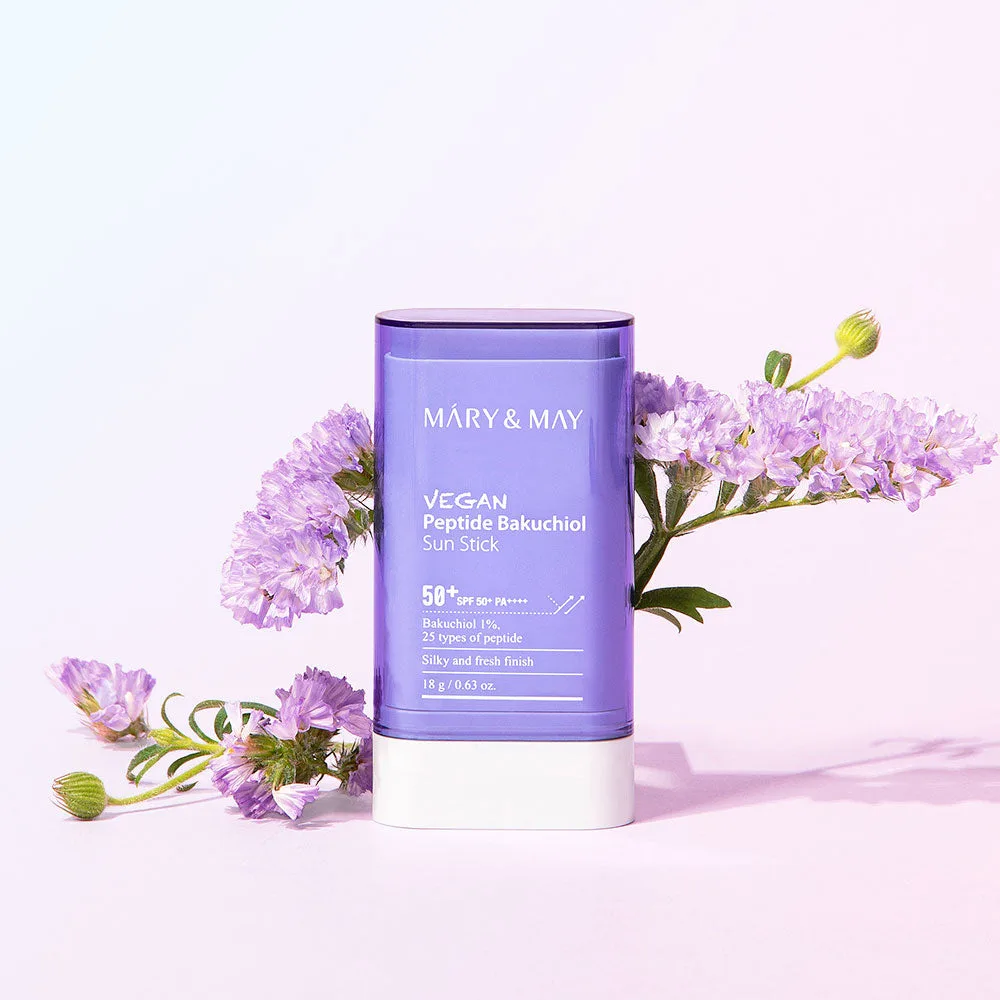
It is an affordable, fragrance-free hybrid sun stick marketed as an anti-aging treatment, with 1% bakuchiol and a long peptide list. The sun protection is genuinely decent; the anti-aging actives are mostly label appeal, since a sunscreen is the wrong vehicle to deliver them meaningfully.
Mary & May's Vegan Peptide Bakuchiol Sun Stick is a decent, affordable, fragrance-free hybrid sun stick with genuinely respectable UV protection. The catch is the marketing: the 1% bakuchiol and long peptide list are framed as an anti-aging treatment, but in a thin, partly-transferable sunscreen layer they do very little. Buy it as a good-value sun stick; ignore the treatment claims.
Note: This sun stick is a relatively recent launch from an emerging brand, so its independent long-term track record is limited. Our scoring relies on ingredient analysis and available user feedback, and we will revisit this review as more real-world data accumulates.
Verdicts
How well it fits each concern
Verdict by concern tap a concern for the case
Full protectionfor Sun DamageIn your profileYou chose · Broad-spectrum SPF 50 with Uvinul A Plus, bemotrizinol (Tinosorb S), titanium dioxide: the protection sun damage calls for.Moderate evidenceGentleNo reviews collected yet
The case for it
Diethylamino Hydroxybenzoyl Hexyl Benzoate is a first-line active — approved, monograph-listed or named in current guidelines — for this concern.
It is plausibly present at a working level, though the concentration is not declared.
The formula carries none of the triggers this concern is sensitive to.
What would change this: A declared concentration would move this to a firmer reading of the dose.
Same rule for everyone. “Full protection” is the verdict on 2,288 of 45,024 concern verdicts across the catalog; rule P1 decided 2,232 of them.
Unchanged since September 5, 2026, engine 5.1.1.
P1 — Photoprotection standing is regulatory (M020 / Annex VI filters; 21 CFR 201.327 attaches the early-skin-aging claim to tested broad-spectrum SPF 15+). SPF 30 is the AAD daily-use bar. · the full register
Full protectionfor AgingIn your profileYou chose · Broad-spectrum SPF 50 with Uvinul A Plus, bemotrizinol (Tinosorb S), titanium dioxide: the protection aging calls for.Moderate evidenceGentleNo reviews collected yet
The case for it
Bakuchiol has early or mechanistic evidence for this concern, not trial-backed standing.
It is present at an effective concentration, declared or high in the ingredient list.
The formula carries none of the triggers this concern is sensitive to.
What would change this: Trial evidence for the active on this concern would move this from a bet to a recommendation.
Same rule for everyone. “Full protection” is the verdict on 2,288 of 45,024 concern verdicts across the catalog; rule P1 decided 2,232 of them.
Unchanged since September 5, 2026, engine 5.1.1.
P1 — Photoprotection standing is regulatory (M020 / Annex VI filters; 21 CFR 201.327 attaches the early-skin-aging claim to tested broad-spectrum SPF 15+). SPF 30 is the AAD daily-use bar. · the full register
Carrying active
Bakuchiol
Standing
plausible — trials support it
Form
adequate (declared 1%) — studied range 0.5%, from the trials on the row; needs leave-on contact
Tolerability
gentle
Row checked
against its sources on July 17, 2026 (evidence table ev-2026.09-r228)
Full protectionfor HyperpigmentationIn your profileYou chose · Broad-spectrum SPF 50 with Uvinul A Plus, bemotrizinol (Tinosorb S), titanium dioxide: the protection hyperpigmentation calls for.Not yet assessedGentleNo reviews collected yet
The case for it
Diethylamino Hydroxybenzoyl Hexyl Benzoate has no evidence row yet for this concern — it is in the research queue.
The formula carries none of the triggers this concern is sensitive to.
What would change this: A researched evidence row for the lead active would replace this with a verdict.
Same rule for everyone. “Full protection” is the verdict on 2,288 of 45,024 concern verdicts across the catalog; rule P1 decided 2,232 of them.
Unchanged since September 5, 2026, engine 5.1.1.
P1 — Photoprotection standing is regulatory (M020 / Annex VI filters; 21 CFR 201.327 attaches the early-skin-aging claim to tested broad-spectrum SPF 15+). SPF 30 is the AAD daily-use bar. · the full register
Does the jobDoes what a sunscreen is for: UVA coverage, kind to the skin wearing it. Not measured from the label: pleasant enough to actually use.
A verdict is DermApproved’s assessment of how well a product’s ingredients fit a concern — never a claim about what the product treats. Evidence dots and collected reviews sit beside it and are never blended in.
Rules 0.5.1 · evidence table ev-2026.09-r228 · how we decide
Assessment
Pros & Cons
Pros
✓ Decent modern hybrid filter system with genuine SPF 50+ PA++++ protection
✓ Fragrance-free, alcohol-free, and free of cooling agents
✓ Gentle enough for most skin, including sensitive
✓ Convenient, portable stick format, easy to reapply over makeup
✓ Genuinely affordable, one of the lowest prices in its category
✓ Vegan formula
Cons
✗ Anti-aging bakuchiol and peptide claims are largely marketing
✗ Treatment actives sit at trace levels in the wrong vehicle
✗ Contains comedogenic isopropyl palmitate, poor for breakout-prone skin
✗ Easy to apply too thin a layer for full labeled protection
✗ Can leave a slight sheen or faint cast
Review
Full Review
Here is a fact worth stating plainly before anything else: sunscreen is, by a wide margin, the most effective anti-aging product in skincare. Not retinol, not peptides, not vitamin C, sunscreen. The overwhelming majority of what people think of as 'aged' skin, wrinkles, sagging, dark spots, leathery texture, is photoaging, cumulative UV damage. Prevent the UV and you prevent most of the aging. So a sunscreen marketed as an 'anti-aging' product is, in the most important sense, telling the truth. The interesting question with Mary & May's Vegan Peptide Bakuchiol Sun Stick is the next one: once you have the sunscreen, does adding bakuchiol and a long list of peptides make it a meaningfully better anti-aging product? And the honest answer is: barely, and you should not pay for it.
Let us deal with the marquee actives directly, because the product name leads with them. Bakuchiol is a genuine, plant-derived retinol alternative with promising evidence behind it, and Mary & May includes it at a real 1% concentration, which in a serum would be a respectable dose. The peptides, the brand touts more than 25 of them, are a recognized anti-aging ingredient class. So far so good. But look at where these ingredients sit in the formula. Bakuchiol appears partway down the list, and the entire peptide roster sits at the very bottom, after the preservatives, which on an ingredient list means trace, fractional-percent amounts. More fundamentally, this is a sunscreen, and a stick sunscreen at that. It is a thin, wax-based film designed to sit on the surface of your skin, reflect and absorb UV, and then be partly rubbed off, sweated off, and washed off by the end of the day. That is the opposite of what a treatment active needs. Bakuchiol and peptides do their work absorbed into the skin, over hours, ideally overnight, in a leave-on product at adequate concentration. Putting them in a daytime sunscreen stick is putting them in the wrong vehicle at the wrong time of day. The '25 peptides' is classic ingredient-list theater: a long, impressive-looking roster that contributes far more to the marketing than to your skin. None of this is unique to Mary & May, the 'treatment sunscreen' trend is everywhere, but our readers deserve to know that the anti-aging story here is mostly decoration.
So ignore the name, and judge the thing as what it is: a sunscreen stick. On those terms, it is genuinely decent. The filter system is a sensible modern hybrid, Uvinul A Plus for long-wave UVA, ethylhexyl triazone for UVB, Tinosorb S for broad photostable coverage, polysilicone-15, and titanium dioxide, with no octinoxate or oxybenzone. That delivers a credible SPF 50+ PA++++. The formula is fragrance-free and alcohol-free, with no menthol or cooling agents, which makes it genuinely gentle and a reasonable option even for sensitive skin. The wax stick glides on smoothly, leaves a thin film with a slight sheen, and is mess-free and portable. And it is cheap, one of the most affordable products in this whole batch.
The limitations are the standard sun-stick ones plus one formulation flag. As with every stick, it is easy to apply too little: a single quick swipe lays down an inadequate film, and you need several passes to build up the even, slightly opaque layer that the SPF rating assumes. The formulation flag is isopropyl palmitate, a known comedogenic ingredient, fairly high in the list; combined with the other esters, that makes this a poor choice for breakout-prone and fungal-acne-prone skin. And it can leave a slight sheen or faint cast from the titanium dioxide, minor, but worth knowing.
What about value? This is where the product redeems itself. It is inexpensive, and for that low price you get a fragrance-free, gentle, modern-filter sun stick that protects well when applied properly. The bakuchiol and peptides, even if they do little, are not costing you much, you are not paying a treatment-serum premium. So the value verdict is straightforward: as a budget sun stick, it is a solid buy. As an anti-aging treatment, it is not one, and you should not let the name talk you out of also owning a real bakuchiol or retinoid serum for your evening routine, used in a leave-on product at night, those actives actually work.
For US readers, the usual note: this is a Korean import whose filters are approved in Korea and the EU but not by the US FDA, a regulatory gap rather than a safety problem, and you will buy it through importers.
The bottom line: this is a good, cheap, gentle sun stick wearing an anti-aging costume. Buy it for what it genuinely is, convenient, fragrance-free, well-priced UV protection, and apply it in proper multiple passes. The sunscreen is the anti-aging product. The bakuchiol and the 25 peptides are the marketing. Keep your actual treatment actives where they belong: in a leave-on serum, at night.
Formula
Key Ingredients
The hero actives that drive this product's performance.
A dedicated long-wave UVA filter and one of the higher-placed UV actives in the stick, it targets the deep-penetrating rays linked to photoaging, the protection that genuinely earns this product its anti-aging framing.
Regulator-approvedfor Sun Damage · limited certainty
A highly efficient, photostable UVB filter that supplies the core UVB-blocking power, working with the triazine and titanium dioxide to bring the wax-based stick to SPF 50+.
Regulator-approvedfor Sun Damage · limited certainty
The mineral filter in this hybrid stick, titanium dioxide adds broad-spectrum coverage and a touch of opacity that helps the stick lay down a visible, even protective film.
Regulator-approvedfor Sun Damage · limited certainty
A plant-derived retinol alternative included at a genuine 1% level, bakuchiol is the headline anti-aging active, though in a thin, wax-based sunscreen layer that is partly worn off and washed away, its real treatment effect is far smaller than in a dedicated leave-on serum.
A long roster of peptides sits at the very end of the ingredient list, indicating trace concentrations. Marketed as a multi-peptide anti-aging blend, in practice it functions more as label appeal than as a meaningful treatment dose in this format.
Limitedfor Aging
Ingredient standings describe the active at treatment-level doses and
vehicles; this product's own condition grades weigh its actual formula.
Apply in several passes to build an even, slightly opaque layer, then blend lightly. It works as a primary face sunscreen with enough passes, and as a reapplication tool over makeup. If you want a real anti-aging treatment, use a dedicated bakuchiol or retinoid serat night, not this stick, for it.
Results Timeline
Immediate: a smooth, even protective film with a slight sheen. Short-term: convenient daily protection and easy top-ups. Full benefit: the genuine anti-aging payoff is UV prevention itself, accruing over months and years of consistent, generous use; the bakuchiol and peptides add little measurable treatment effect.
Mary & May Vegan Peptide Bakuchiol Sun Stick SPF 50+
Sample PM Routine
Cleanser
Bakuchiol or retinoid serum
Moisturizer
Evidence
Science & Expert Perspective
The Science
The sunscreen science here is sound. The filter system is a modern hybrid: diethylamino hydroxybenzoyl hexyl benzoate (Uvinul A Plus) for long-wave UVA, ethylhexyl triazone (Uvinul T 150) for UVB, bis-ethylhexyloxyphenol methoxyphenyl triazine (Tinosorb S) for broad photostable coverage, polysilicone-15 as a film-forming UVB absorber, and titanium dioxide as a mineral filter. This combination credibly supports an SPF 50+ and PA++++ rating, and these filters carry strong international safety data.
The anti-aging claims require a more critical eye. Bakuchiol has promising published evidence, including a comparative study suggesting efficacy similar to retinol with less irritation, but that evidence comes from leave-on treatment products at adequate concentration and duration of skin contact. In a sunscreen, particularly a wax-based stick, the active sits in a thin surface film that is partly transferred and removed through the day; the absorbed, retained dose available to influence dermal processes is far lower than from a treatment serum. The peptide complex sits at the very end of the ingredient list, indicating trace concentrations, and topical peptides already face genuine questions about penetration and stability; at these levels, in this vehicle, a measurable clinical effect is implausible.
The scientifically honest framing is this: the product's real anti-aging mechanism is photoprotection, which is well established and substantial. The bakuchiol and peptides are present, but the format, concentration, and contact time mean their independent treatment contribution is minimal. The standard stick caveat also applies: rated SPF assumes a 2 mg per square centimeter application density that sticks are prone to under-delivering.
Dermatologist Perspective
Dermatologists are unanimous that sunscreen is the single most effective anti-aging intervention, since most visible aging is cumulative UV damage. They generally welcome any product that increases sunscreen use, including convenient stick formats, while consistently cautioning that sticks are easy to under-apply and should be built up in several passes. On 'treatment sunscreens,' clinicians tend to be measured: they note that adding actives like bakuchiol or peptides to a sunscreen rarely delivers a meaningful treatment effect, because effective use of those actives requires adequate concentration and leave-on contact, and they advise patients to keep dedicated treatment products in their routine rather than rely on a sunscreen for them. Bakuchiol itself is regarded as a gentle, well-tolerated retinol alternative when used appropriately. Dermatologists would also flag comedogenic ingredients such as isopropyl palmitate as a consideration for acne-prone patients.
Guidance
Usage & Recommendations
How to Use
Bring it in as the last step of the morning, sitting over your moisturizer, or use it to reapply through the day. Swipe the stick over each area in several passes, building an even, slightly opaque film, then blend lightly with fingertips, the multi-pass technique is essential to reach the labeled SPF. It applies cleanly over makeup for midday top-ups. Reapply at two-hour intervals when the sun is on you, sooner if you have been in the water or sweating. For genuine anti-aging treatment, use a dedicated bakuchiol or retinoid serum in your evening routine, this stick does not replace it. Remove thoroughly with a proper cleanse at day's end.
Value Assessment
As a budget sun stick, the value is genuinely good; as an anti-aging treatment, it offers no value because it is not one. The price is among the lowest in this batch, and for that you get a fragrance-free, gentle, modern-filter hybrid sun stick that protects well when applied properly, which is a sound, practical purchase. The key to the value verdict is not paying a premium for the bakuchiol-and-peptide story: fortunately, the product is cheap enough that you are not, those actives come along essentially for free, doing little but costing little. The 18 g size lasts roughly two months as a primary face sunscreen, longer used for reapplication. Just do not let the anti-aging framing convince you to skip a real treatment serum; budget that separately. Bought clear-eyed as an inexpensive, decent sun stick, it is fair value.
Who Should Buy
Pick this up if you want an affordable, gentle, fragrance-free sun stick for everyday protection or convenient reapplication. It suits normal, combination, dry, and most sensitive skin, and anyone who wants stick convenience at a low price and is not relying on it for anti-aging treatment.
Who Should Skip
Look elsewhere if you are breakout-prone or managing fungal acne, since the isopropyl palmitate and esters can clog pores and aggravate that condition. It's also not for you if you are buying it expecting a genuine anti-aging treatment, the bakuchiol and peptides will not deliver that, so look to a dedicated leave-on serum instead.
Ready to try Mary & May Vegan Peptide Bakuchiol Sun Stick SPF 50+?
A firm, wax-based stick that glides on smoothly and leaves a thin protective film with a slight sheen.
Scent
Fragrance-free and essentially scentless.
Packaging
A compact twist-up stick, portable and mess-free for daily and on-the-go use.
Finish
natural
What to Expect on First Use
The stick applies smoothly with no sting or scent, leaving a thin, lightly sheeny film. There is no purging, as a sunscreen is a protective step; the bakuchiol is gentle and does not cause the adjustment retinoids can.
How Long It Lasts
About 2 months as a primary face sunscreen, longer if used mainly for reapplication.
Mary & May built its name on affordable, vegan, ingredient-forward Korean skincare with on-trend actives. The Vegan Peptide Bakuchiol Sun Stick reflects the marketing trend of fusing sunscreen with anti-aging treatment claims, putting bakuchiol and peptides into a convenient, low-cost stick.
About Mary & May Established Brand (5–20 years)
Mary & May is a Korean brand founded in 2018, known for vegan, ingredient-forward, affordably priced skincare. It has built a following on accessible formulas with trend-driven actives, though as an emerging brand its independent long-term track record is limited.
Brand founded: 2018 · Product launched: 2023
Myth vs. Reality
Common Myths
Myth
This sun stick doubles as a real anti-aging treatment.
Reality
The bakuchiol and 25-plus peptides are mostly marketing in this format. They sit low on the ingredient list at trace levels, in a thin, partly transferable sunscreen layer. The genuine anti-aging benefit here is the UV protection itself, not the treatment actives.
Myth
Bakuchiol in a sunscreen replaces a nighttime retinol or bakuchiol serum.
Reality
It does not. To get a real treatment effect from bakuchiol you need an adequate concentration in a leave-on product worn overnight. A daytime sunscreen stick is the wrong vehicle and the wrong time of day for that.
FAQ
Frequently Asked Questions
Does the bakuchiol in this sun stick have an anti-aging effect?
Minimally. Bakuchiol is included at a real 1% level, but in a thin, wax-based sunscreen layer that is partly worn off and washed away, its treatment effect is far smaller than in a dedicated leave-on serum. The sun protection itself is the genuine anti-aging benefit.
Can this sun stick replace my retinol or bakuchiol serum?
No. A real bakuchiol treatment effect needs an adequate concentration in a leave-on product, ideally used at night. Treat this as a sunscreen with marketing extras, and keep a dedicated treatment serum in your evening routine.
How do I apply the Mary & May Bakuchiol Sun Stick correctly?
Swipe it over the skin in several passes to build an even, slightly opaque film, then blend lightly. A single quick pass applies too little to reach the labeled SPF, so building up the layer is essential for real protection.
Is this sun stick good for sensitive skin?
It is reasonably gentle. The formula is fragrance-free, alcohol-free, and free of cooling agents, and bakuchiol is well tolerated. Most sensitive skin should find it comfortable, though a patch test is always sensible.
Is the Mary & May Bakuchiol Sun Stick fungal-acne safe?
No. It contains isopropyl palmitate and other esters that can feed the yeast involved in fungal acne and clog pores. Breakout-prone and fungal-acne-prone skin should be cautious.
Is this sun stick worth buying?
As an affordable, gentle, fragrance-free sunscreen stick, yes, it is decent value. Just buy it for the sun protection, which is genuinely good, and disregard the anti-aging treatment claims, which the format cannot meaningfully deliver.
Reviews
What Reviewers Tend to Say
Recurring themes our editors read across retailer reviews of this product — summaries in our words, not quotations, and not a substitute for your own patch test.
Common Praise
Affordable and convenient stick format
Fragrance-free and gentle on the skin
Easy to reapply over makeup
No strong scent or stinging
Common Complaints
Anti-aging claims overstate what the format can deliver
Easy to apply too thin a layer for full protection
Contains isopropyl palmitate, not ideal for breakout-prone skin
We have spent years praising Japanese filter chemistry while ignoring that the filter is the last line of a system built out of fabric, shade and timing — the part that needs no importing and does not depend on you remembering to reapply.
The trials are real, they are positive, and the pooled effect sizes are moderate. They also average fewer than forty people each, and what they measure is an instrument reading rather than something anyone notices in a mirror.
Products, answers, therapy guides, tools and articles in one search. Brand names,
slang and abbreviations all work — accutane finds isotretinoin, bacne finds truncal acne.