Hyaluronic Acid Can Actually Dehydrate Your Skin (Here's When)
The internet's favorite hydrator has a counterintuitive dark side — in dry air, a humectant with nothing to seal it can pull water out of your skin instead of into it.
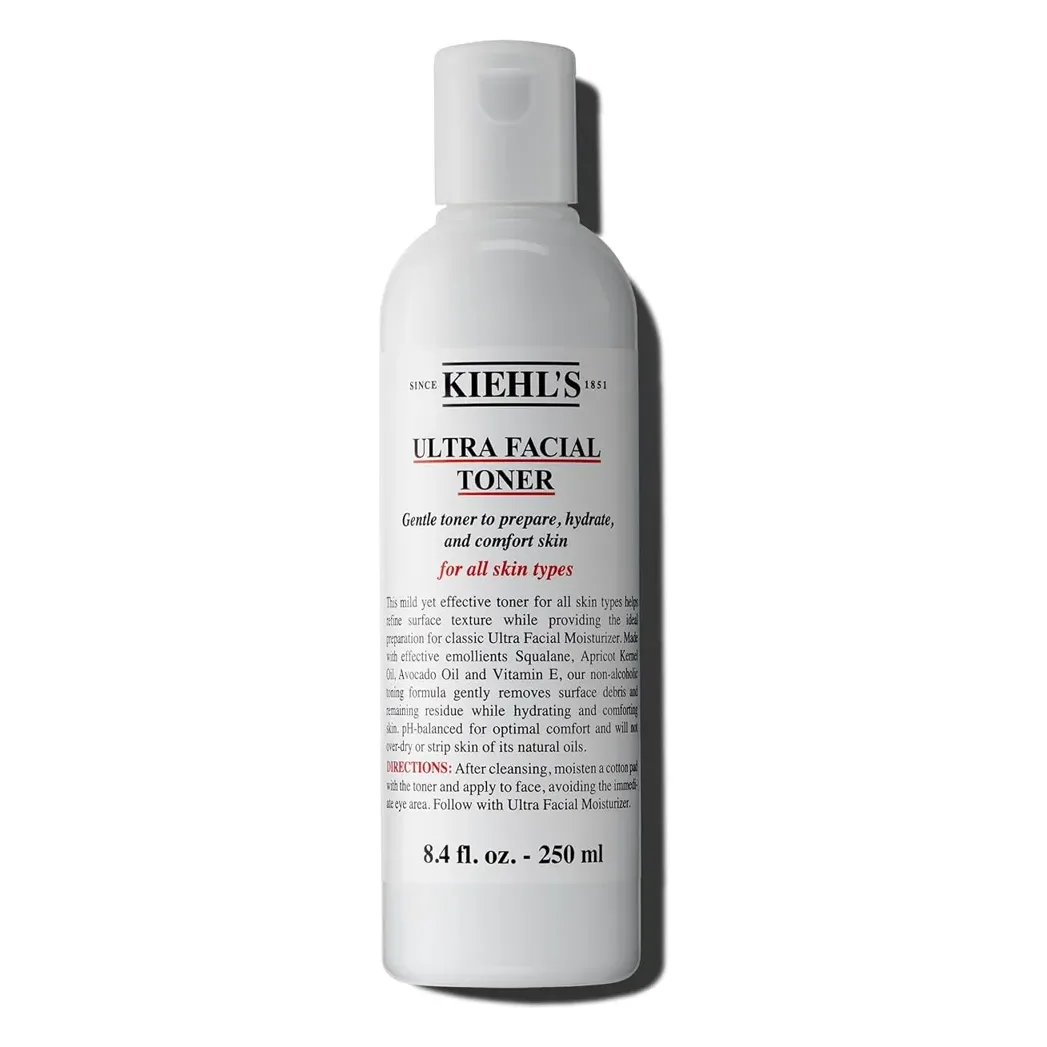
Where most toners are either astringent waters or hyaluronic-heavy hydrating layers, this is an emulsion-style toner with squalane at third on the list and three plant oils at the tail, so it restores lipid as well as water after cleansing. It is one of the shortest, plainest formulas in Kiehl's catalogue, and that plainness is the point for reactive skin.
A seventeen-ingredient, alcohol-free, fragrance-free milky toner built on glycerin and squalane that makes post-cleanse tightness disappear and asks nothing else of you. It is one of the gentlest toners sold and one of the least ambitious, and at twenty-six dollars it charges prestige money for a comfort step that dry and reactive skin will love and oily skin can skip.
This toner has sold for well over a decade and has several hundred reviews across Amazon and Ulta, but Kiehl's has published nothing on it and its short formula needs no study to interpret, so the assessment rests on the disclosed ingredients and the general evidence on glycerin, squalane and plant oils. User feedback consistently describes comfort and hydration; it does not, and could not, document any treatment effect.
The case for it
Same rule for everyone. “Good choice” is the verdict on 9,564 of 45,024 concern verdicts across the catalog; rule R5 decided 9,072 of them. As of September 25, 2026, engine 5.1.1.
Brand or formulator? Disclose a concentration or correct a fact →
The studies behind the evidence row
The case for it
Same rule for everyone. “Good choice” is the verdict on 9,564 of 45,024 concern verdicts across the catalog; rule R5 decided 9,072 of them. As of September 25, 2026, engine 5.1.1.
Brand or formulator? Disclose a concentration or correct a fact →
The studies behind the evidence row
The case for it
What would change this: A researched evidence row for the lead active would replace this with a verdict.
Same rule for everyone. “Good choice” is the verdict on 1,938 of 45,024 concern verdicts across the catalog; rule F2 decided 1,938 of them. As of September 25, 2026, engine 5.1.1.
Brand or formulator? Disclose a concentration or correct a fact →
Does the jobDoes what a toner is for: not alcohol-driven, adds something real. Not measured from the label: restores skin pH, plays well with what follows.
A verdict is DermApproved’s assessment of how well a product’s ingredients fit a concern — never a claim about what the product treats. Evidence dots and collected reviews sit beside it and are never blended in. Rules 0.5.1 · evidence table ev-2026.09-r228 · how we decide
No step in skincare has changed its job more often than the toner. In the apothecary era it was an astringent rinse, alcohol and witch hazel to strip whatever the soap left behind, and Kiehl's sold that kind for a century. Then it became a delivery vehicle for exfoliating acids, then a seven-layer Korean hydration ritual, then a mist. Ultra Facial Toner belongs to a fourth, humbler lineage that gets little attention: the toner as a lipid-and-water apology for what cleansing does to the skin. Understand it that way and its seventeen-ingredient formula, its milky separation in the bottle and its refusal to do anything dramatic all make sense.
The list is short enough to read aloud. Water, glycerin, squalane, then a preservative, a thickener and an emulsifier, an ester, a pH adjuster, a stable vitamin C derivative, sodium hyaluronate, and at the tail sweet almond, apricot kernel and avocado oils with a little tocopherol. Squalane at third is the tell. Most hydrating toners are entirely water-phase, glycerin and hyaluronic acid and nothing that would leave a lipid behind; putting a sebum-identical oil that high on the list, with three plant oils to reinforce it, means this toner replaces a little of the fat that cleansing removes as well as the water. That is why it separates into a cloudy layer in the bottle, why it needs a shake, and why it leaves the skin feeling softened rather than merely damp.
In use it does one thing extremely well. Wash your face with anything foamier than a cream cleanser and the skin tightens as it dries; sweep this over it on a cotton pad, or press it in with the palms, and the tightness is simply gone, replaced by a faint, non-tacky softness that a serum glides over. On dry skin in winter that is the difference between needing a heavy moisturizer and not. On reactive skin it is a layer with nothing to react to: no alcohol, no fragrance, no essential oils, no acids, no menthol, and only a couple of ingredients on the list that anyone has ever reacted to, the sweet almond oil for the nut-sensitive and, very rarely, the salicylate ester used as an emollient. The reviews from sensitive-skin users are the warmest the product gets, and they are earned.
What it does not do is anything else. The ascorbyl glucoside twelfth on the list is too little, in a product mostly wiped away, to brighten anything. The sodium hyaluronate is a modest surface humectant. There is no niacinamide, no acid, no soothing extract with a study behind it, no ingredient that will change the skin over months. Reviewers who call it nothing spectacular are right, and so are the ones who say it cleared their skin in a week, because what they likely stopped doing was over-drying their face and triggering rebound oil. It is a comfort product, and the only honest claim for it is comfort.
There is a small ritual question worth settling, because it changes how long the bottle lasts and how much lipid actually stays on the face. Swept on with a cotton pad, the toner does what its apothecary ancestors did, lifting the last traces of cleanser and hard-water residue, but the pad takes most of the squalane with it and the bottle empties in three months. Pressed in with the palms, it leaves the full emollient film behind and stretches to five. Kiehl's directions allow either; dry skin should press, and anyone using it after a cream cleanser that leaves residue should sweep. The formula is forgiving enough that neither choice is wrong, which is itself a small argument in its favour.
That leaves the two real objections. The first is fit. On oily or acne-prone skin the squalane-and-oil film is more lipid than the skin needs after cleansing, and the same brand's Oil-Free toner exists for exactly that reason; the sweet almond oil also puts this off-limits for anyone strictly avoiding fungal-acne triggers. The second is price. Twenty-six dollars for 8.4 ounces is a prestige tag for glycerin, squalane and three plant oils, and while the bottle lasts four or five months, the same comfort can be had from a plain glycerin-and-squalane hydrating toner at a third of the cost, or from skipping the step and using a gentler cleanser. Kiehl's is charging for the name and the reliability, and the reliability is real.
So the fourth lineage of toner deserves its defence. A step that undoes the small damage of cleansing, contains nothing that could go wrong and makes every subsequent layer feel better is not glamorous, but for dry and reactive skin it is genuinely useful, and this is about as well-judged an example as exists. Buy it if your face is tight after washing and you want the plainest possible fix; skip it if your skin is oily, your cleanser is already gentle, or you want a toner to actually treat something.
The hero actives that drive this product's performance.
| Ingredient | Function | Evidence |
|---|---|---|
| Squalane | Third on a seventeen-ingredient list, which is an unusually high position for an oil in a toner and the reason this one behaves like a thin emulsion rather than a water. It mimics the skin's own sebum lipids and leaves a faint, non-greasy softness that the classic astringent toners this replaced would have stripped away. | Established mechanism for Dryness · established mechanism |
| Glycerin | Second on the list, the humectant that does most of the hydrating work. With the squalane beside it the toner delivers a humectant-plus-lipid pairing that makes skin feel comfortable straight after cleansing, before any serum goes on. | Established mechanism for Dryness · established mechanism |
| Sodium Hyaluronate + Ascorbyl Glucoside | A humectant and a stable vitamin C derivative mid-list, adding a little surface water-binding and antioxidant support. Their doses are small; they round out the formula rather than driving it, and no brightening should be expected from the vitamin C at this level. | Established mechanism for Dehydration · established mechanism |
| Apricot Kernel Oil + Sweet Almond Oil + Avocado Oil | A trio of light plant oils near the end of the list, all rich in oleic acid, that reinforce the squalane's softening and give the toner its milky look when shaken. They are the emollients Kiehl's names on the label, present at trace levels that add feel more than function. | Not yet assessed |
| Ethylhexyl Salicylate | Better known as the sunscreen filter octisalate, used here at seventh position as an emollient ester and solvent rather than for any UV protection; it contributes a dry, silky slip. It is worth knowing about for the rare person sensitised to salicylate esters, and it does not make the toner a sunscreen. | Not yet assessed |
Ingredient standings describe the active at treatment-level doses and vehicles; this product's own condition grades weigh its actual formula.
Aqua/Water, Glycerin, Squalane, Phenoxyethanol, Acrylates/C10-30 Alkyl Acrylate Crosspolymer, Sorbitan Oleate, Ethylhexyl Salicylate, PEG-100 Stearate, Potassium Sorbate, Triethanolamine, P-Anisic Acid, Ascorbyl Glucoside, Sodium Hyaluronate, Prunus Amygdalus Dulcis (Sweet Almond) Oil, Prunus Armeniaca (Apricot) Kernel Oil, Tocopherol, Persea Gratissima (Avocado) Oil
toner
AM & PM
Shake the bottle, sweep it over the face on a cotton pad or press it in with the palms after cleansing, then follow with serum and moisturizer while the skin is still damp; it is gentle enough to use under acids and retinoids as a comfort layer.
Skin feels softened and less tight immediately after cleansing. The main benefit is that the post-cleanse dryness that used to need extra moisturizer stops appearing, which is obvious within a few days; there is no cumulative treatment effect to wait for.
The formula's rationale is the physiology of cleansing. Surfactant washing removes a fraction of the stratum corneum's intercellular lipids and natural moisturizing factor and transiently raises skin pH and transepidermal water loss, which is the tightness felt as the face dries; the skin corrects the pH within about an hour on its own, but the lipid and water deficits take longer, and a post-cleanse layer that supplies both shortens that recovery. Glycerin at second position is the best-characterised humectant in dermatology, retained in the stratum corneum after application and associated with improved hydration and barrier recovery in controlled studies. Squalane, a hydrogenated form of the squalene that makes up around a tenth of human sebum, is a stable, non-comedogenic emollient that spreads readily and reduces water loss without occluding heavily, and its position at third on the list, ahead of the emulsifier, means the toner deposits a measurable lipid film rather than a trace. The apricot kernel, sweet almond and avocado oils are oleic-rich triglyceride oils that reinforce that film at low levels; oleic-dominant oils can increase permeability on compromised skin, but at these trace positions in a rinse-light product the effect is emollient rather than disruptive. Sodium hyaluronate contributes surface water-binding, and ascorbyl glucoside, a glucose-conjugated vitamin C that requires enzymatic release, is present at a level and contact time that preclude any brightening effect while offering modest antioxidant protection to the oils in the bottle. Ethylhexyl salicylate, the UV filter octisalate, functions here as an emollient ester and solvent at a concentration far below sunscreen use and confers no photoprotection; salicylate ester sensitisation is rare but documented. The preservative system of phenoxyethanol, potassium sorbate and p-anisic acid is low-sensitising. The absence of ethanol, fragrance, essential oils and hydroxy acids removes the components responsible for most toner-related irritation, and the formula's pH-balanced claim is consistent with its buffered composition, though pH restoration after cleansing is something skin achieves unaided.
Toners occupy an optional position in most clinical skincare advice, and the distinction practitioners draw is between astringent or acid toners, which have specific uses and specific risks, and bland hydrating toners, which are harmless and occasionally helpful for patients whose cleanser leaves them tight or whose skin is being treated with drying actives. This product belongs firmly to the second group, and with no alcohol, fragrance, essential oils or acids and a short list led by glycerin and squalane, it would be regarded as suitable for sensitive, rosacea-prone, eczema-prone and retinoid-treated skin as a comfort layer, with the caveat that it treats nothing and can be omitted without loss if the cleanser is already gentle. The two points likely to be raised are the plant-oil content, which makes it a poorer choice for acne-prone or Malassezia-prone skin than an oil-free hydrating toner, and the sweet almond oil for patients with tree-nut allergy, who are usually advised to avoid topical nut oils as a precaution even though cutaneous reactions are uncommon. The salicylate ester and the trace vitamin C are not clinically significant at these levels.
Shake the bottle for a second to recombine the milky oil phase, then, after cleansing morning and night, either moisten a cotton pad and sweep it over the face and neck or pour a small amount into the palms and press it into the skin. Follow with serum and moisturizer while the skin is still slightly damp, since the humectants work best with a layer sealed over them. Pressing it in rather than wiping uses less product and avoids removing the lipid film it is meant to leave. It is gentle enough to use under acids and retinoids as a comfort base. Oily or acne-prone skin may prefer the brand's Oil-Free version, and anyone with a tree-nut allergy should note the sweet almond oil.
Twenty-six dollars for 8.4 fluid ounces works out to a little over three dollars an ounce, and because the bottle lasts four or five months at twice-daily use the monthly cost is modest; the 16.9 oz refill brings it lower still. Judged against what the formula contains, glycerin, squalane and three plant oils with a low-sensitising preservative system, the price is a prestige premium, and equivalent comfort is available from simpler hydrating toners or from a gentler cleanser at a fraction of the cost. What Kiehl's is charging for is a reliably gentle, unchanged formula from a legacy brand, and for reactive skin that has been burned by cheaper toners the predictability has some value. It is fair rather than good value, and it is poor value for anyone whose skin does not feel tight after cleansing in the first place.
People with dry, normal or sensitive skin whose face feels tight after cleansing and who want a plain, alcohol-free, fragrance-free layer that restores comfort before serum and moisturizer, especially those using retinoids or acids that leave the skin parched. It suits anyone who wants a toner they can trust not to sting and does not need it to do anything else.
Oily, acne-prone or fungal-acne-prone skin will find the squalane and plant oils more than it needs, and should look at an oil-free hydrating toner instead. Anyone wanting a toner to exfoliate, brighten or treat should choose one with a working active, tree-nut-allergic users should avoid the almond oil, and anyone whose cleanser already leaves skin comfortable can skip the step and the twenty-six dollars.
Ready to try Kiehl's Ultra Facial Alcohol-Free Toner?
Buy at Amazon ♥A thin, faintly milky liquid that separates into a clear layer and a cloudy one in the bottle, shaking into a lightly emollient water that leaves a soft, non-tacky finish.
Fragrance-free; a faint, clean, nutty note from the plant oils that disappears on the skin.
A tall 8.4 fl oz plastic bottle with a screw cap and a restrictor top in the Ultra Facial line's white and blue; a 2.5 oz travel size and a 16.9 oz refill size are also sold.
The first use tells the whole story: the tight, squeaky feeling after cleansing is gone the moment the toner goes on, and skin feels softened rather than treated. There is no tingle, no scent and no adjustment period; oily skin may find the light film of squalane and oils slightly more than it wants.
About four to five months with twice-daily use on a cotton pad; longer if pressed in with the hands.
All Year
Kiehl's built the Ultra Facial line around its famous cream and added this toner as the alcohol-free answer to the stripping astringents the brand itself once sold in its apothecary days, when toners were understood as cleansers' final rinse. The formula has stayed essentially unchanged as the line grew, with the milky squalane-and-oil base becoming its signature as hydrating toners replaced astringent ones across the market.
Kiehl's, the 1851 New York apothecary owned by L'Oréal since 2000, built the Ultra Facial range into its best-selling franchise on the strength of simple, emollient-led formulas, and this toner has been a fixture of the line for well over a decade. It carries no clinical study of its own; its credibility rests on the plainness of its formula and a long sales history.
A toner is needed to rebalance the skin's pH after cleansing.
Skin restores its own acidic surface within an hour of washing, and a gentle, pH-balanced cleanser barely disturbs it. This toner is pH-balanced, but its usefulness is comfort and a first layer of hydration and lipid, not correcting anything; skipping it and going straight to moisturizer does no harm.
The vitamin C in this toner brightens skin.
Ascorbyl glucoside sits twelfth on a seventeen-ingredient list in a product sweeped on and largely wiped away, so its dose and contact are far too small for any brightening effect. It contributes a little antioxidant stability to the oils; genuine brightening needs a leave-on serum at a working concentration.
Because it is a light emulsion, not a water: squalane and three plant oils sit in a glycerin-water base with minimal emulsifier, so the oil phase settles into a cloudy layer between uses. Shaking for a second recombines it, and the separation is normal rather than a sign it has spoiled.
This alcohol-free toner is an emollient formula with squalane, apricot, almond and avocado oils, best for normal, dry and sensitive skin. The Oil-Free version drops the oils for a lighter, water-based hydrating toner aimed at combination and oily skin. Both are alcohol-free and fragrance-free.
Yes; it is one of the gentlest toners on the market, with no alcohol, fragrance, essential oils or exfoliating acids and only seventeen ingredients. The one thing to note is sweet almond oil, which people with a nut allergy sometimes prefer to avoid on the skin.
No. It lists ethylhexyl salicylate, which is the UV filter octisalate, but here it is used as an emollient solvent at a low level and the product has no SPF rating or sunscreen claim. A separate broad-spectrum sunscreen is still needed every morning.
You can. The toner adds comfort and a first layer of hydration and lipid after cleansing, which dry and reactive skin appreciates, but it contains no active that a good moisturizer does not cover. If your cleanser does not leave you tight, the step is optional.
Shake the bottle, then either sweep it over the face and neck on a cotton pad or pour a little into the palms and press it in, morning and night after cleansing. Follow with serum and moisturizer while the skin is still damp; pressing it in uses less product and makes the 8.4 oz bottle last five months or more.
Recurring themes our editors read across retailer reviews of this product — summaries in our words, not quotations, and not a substitute for your own patch test.
Removes post-cleanse tightness instantly
Milky, gentle, fragrance-free
Safe for sensitive and reactive skin
Large bottle lasts for months
Does nothing beyond hydrating
Pricey for a toner
Separates and must be shaken
Slightly slippery for oily skin