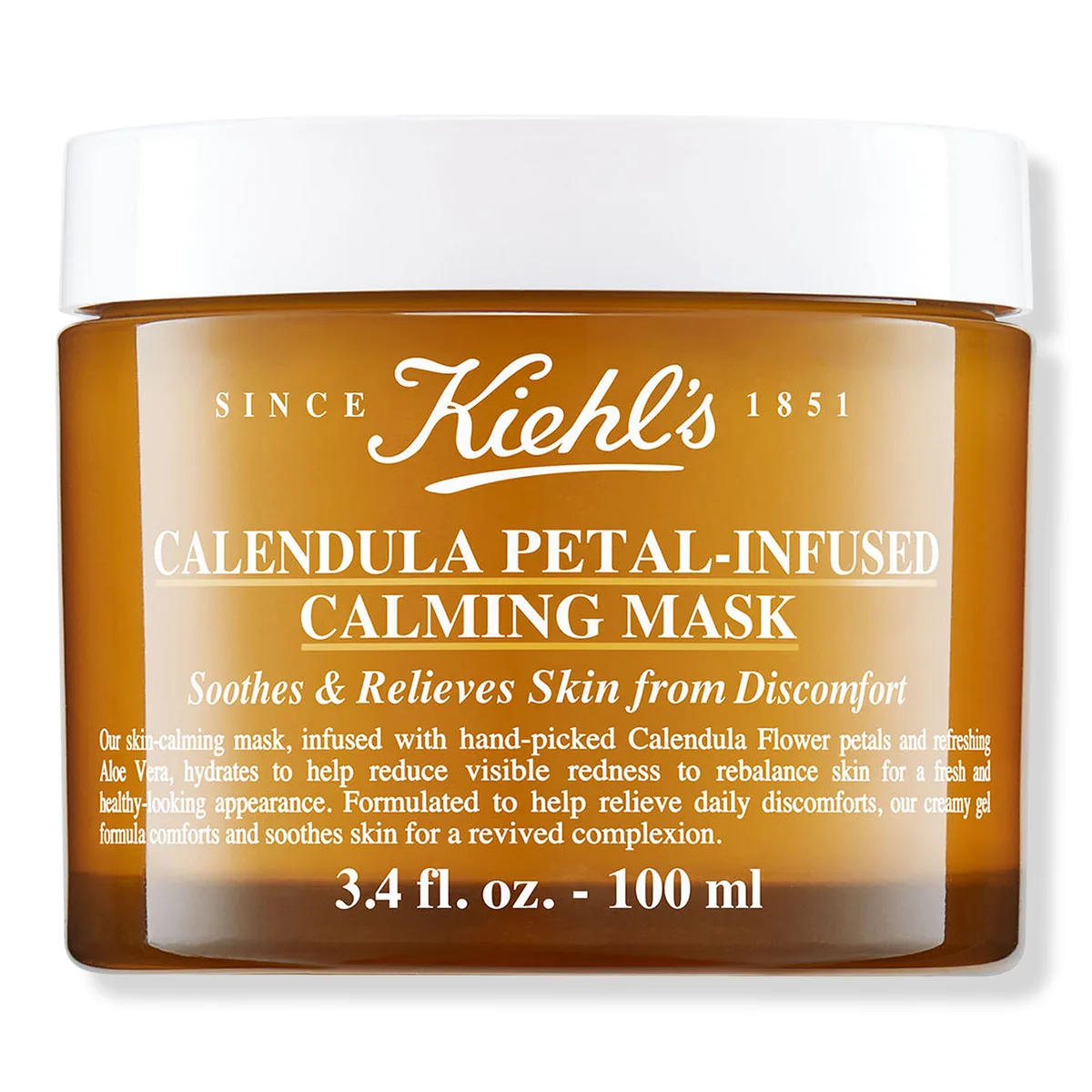
It is a fragrance-free aloe-and-humectant gel with a serious soothing tail, bisabolol, centella, skullcap, licorice, chamomile and green tea, that also carries whole calendula petals suspended in it, which no other mask in the category does and which are the reason people photograph it. The petals are the heritage and the theatre; the aloe second on the list and the bisabolol are why it calms a flushed face in a quarter of an hour.
Kiehl's Calendula Petal-Infused Calming Mask with Aloe Vera Review
Petal-Studded Cool Compress
maskgelluxuryParaben FreeVeganNot Cruelty Free
A cool aloe-and-humectant gel with whole calendula petals floating in it and a genuinely good soothing tail of bisabolol, centella and licorice, that calms a flushed, sensitised face in fifteen minutes and never stings. The petals are theatre and the aloe is the mechanism; forty-nine dollars is a lot for a rinse-off gel, and the hydration lasts an evening. The best mask Kiehl's makes for reactive skin, and the most overpriced way to buy aloe.
Good choicefor SensitivityIn your profileYou chose · No fragrance, drying alcohol, declarable allergens or sensitising preservatives in this gel — the profile sensitive skin looks for.Not yet assessedGentleNo reviews collected yet
The case for it
Centella Asiatica Extract has been researched for this concern and the evidence does not support it.
It is plausibly present at a working level, though the concentration is not declared.
The formula carries none of the triggers this concern is sensitive to.
What would change this: A declared concentration would move this to a firmer reading of the dose.
Same rule for everyone. “Good choice” is the verdict on 1,938 of 45,024 concern verdicts across the catalog; rule F2 decided 1,938 of them.
As of September 25, 2026, engine 5.1.1.
Good choicefor DehydrationIn your profileYou chose · Aloe Vera is a reference standard by mechanism for dehydration; this gel carries it high in the ingredient list.Moderate evidenceGentleNo reviews collected yet
The case for it
Aloe Barbadensis Leaf Juice has trial-supported standing for this concern.
It is present at an effective concentration, declared or high in the ingredient list.
The formula carries none of the triggers this concern is sensitive to.
Same rule for everyone. “Good choice” is the verdict on 9,564 of 45,024 concern verdicts across the catalog; rule R5 decided 9,072 of them.
As of September 25, 2026, engine 5.1.1.
Good choicefor DrynessIn your profileYou chose · Glycerin is a reference standard by mechanism for dryness; this gel carries it.Moderate evidenceGentleNo reviews collected yet
The case for it
Glycerin, Propanediol & Pentylene Glycol has trial-supported standing for this concern.
It is plausibly present at a working level, though the concentration is not declared.
The formula carries none of the triggers this concern is sensitive to.
What would change this: A declared concentration would move this to a firmer reading of the dose.
Same rule for everyone. “Good choice” is the verdict on 9,564 of 45,024 concern verdicts across the catalog; rule R5 decided 9,072 of them.
As of September 25, 2026, engine 5.1.1.
Promisingfor Post-ProcedureIn your profileYou chose · Aloe Vera has trial-level evidence for post procedure but no guideline or regulatory standing yet — promising, short of a recommendation; the other actives here are not yet assessed for it.Moderate evidenceGentleNo reviews collected yet
The case for it
Aloe Barbadensis Leaf Juice has trial-level evidence for this concern but no guideline or regulatory standing yet.
It is plausibly present at a working level, though the concentration is not declared.
The formula carries none of the triggers this concern is sensitive to.
What would change this: A declared concentration would move this to a firmer reading of the dose.
Same rule for everyone. “Promising” is the verdict on 7,858 of 45,024 concern verdicts across the catalog; rule R9p decided 7,858 of them.
As of September 25, 2026, engine 5.1.1.
R9p — 0.5.0: 'Unproven' beside three filled dots read as one question answered twice with opposite words (7,018 rows). The chip measures standing, the dots measure trial volume; where the row carries at least one RCT or a tier-2 source (moderate dots) and the active is present at a working level, the honest word is Promising. Unproven is reserved for plausible-standing rows with limited or weak evidence, or an under-dosed form. Same rank as Unproven — a bet either way; the dots order them. · the full register
Carrying active
Aloe Barbadensis Leaf Juice
Standing
plausible — trials support it
Form
plausible
Tolerability
gentle
Row checked
against its sources on July 17, 2026 (evidence table ev-2026.09-r228)
As a maskNot judged: what a mask is for — works within its wear time, benefit outlasts the mask, comes off cleanly — cannot yet be measured from the ingredient list (only intensity without injury can).
A verdict is DermApproved’s assessment of how well a product’s ingredients fit a concern — never a claim about what the product treats. Evidence dots and collected reviews sit beside it and are never blended in.
Rules 0.5.1 · evidence table ev-2026.09-r228 · how we decide
Assessment
Pros & Cons
Pros
✓ Aloe leaf juice second on the list makes the base genuinely soothing
✓ Bisabolol, centella, licorice and skullcap give a real anti-redness tail
✓ Fragrance-free, alcohol-free and acid-free, so it never stings
✓ Visibly calmer, plumper skin within fifteen minutes, matching the brand's grading
✓ Ideal recovery step after retinoids, acids or sun
✓ Whole calendula petals make it a pleasant ritual
✓ Suits nearly every skin type, including the most reactive
Cons
✗ Forty-nine dollars for a gel mask that rinses off
✗ Petals are inert in fifteen minutes and fiddly to rinse away
✗ Hydration and calming last an evening, not longer
✗ Jar format invites finger-dipping
✗ Calendula and chamomile are a concern for daisy-family pollen allergy
✗ Plain aloe gels deliver much of the same effect for far less
Review
Full Review
The petals are the first thing anyone notices and the last thing that matters. Whole calendula flowers, pressed and dried, are suspended through this pale gel like leaves in ice, and they are why the jar is photographed, why it feels like an apothecary object rather than a tube of aloe, and why it belongs to the oldest line in Kiehl's range, descended from a calendula toner the brand has sold since its pharmacy days. They are also, in fifteen minutes of contact, nearly inert: calendula's anti-inflammatory triterpenoids live in extracts concentrated far beyond what a few petals release into a rinse-off gel. The mask calms the skin, and it calms it well, but the reason is second on the ingredient list, not sixteenth.
That reason is aloe leaf juice, placed above the glycerin, which means the base is substantially aloe rather than water with a botanical flourish. Around it are glycerin, propanediol and pentylene glycol, a humectant trio that with the aloe delivers the hydration the brand's fifteen-minute clinical grading measured, a light triglyceride and a trace of squalane for a soft finish, and gelling polymers that hold the whole thing in a thick, cool layer. Then, well down the list, the tail that separates this from a plain aloe gel: centella extract, calendula extract, skullcap root, bisabolol, licorice root, green tea, chamomile, rosemary, ginger. Bisabolol and centella have real evidence for reducing visible redness, licorice and skullcap have supporting data, and together they are the difference between soothing and merely cooling. There is no fragrance, no alcohol, no acid, nothing that a reactive face could object to except, for the pollen-allergic, the daisy family that calendula and chamomile both belong to.
On the skin it does exactly what the reviews say and what the ingredient list predicts. A thick layer straight from the jar is cold and calming in the way a compress is, the petals pressing into the gel, and by the time it rinses the flush from a retinoid, an acid or an afternoon in the sun has visibly settled and the skin feels plumped and soft rather than tight. Kiehl's clinical test reports reduced visible redness and dryness at fifteen minutes, and that is precisely the window in which the mask is honest. It is the evening-after mask, the one to reach for when a routine has gone a step too far, and used that way it is among the most useful things on the Kiehl's counter for sensitised skin. Chilled, it is better still: fifteen minutes in the fridge before application turns the gel into something close to a cold compress, and on a sunburnt or over-exfoliated evening that is the difference between a face that settles and one that keeps radiating heat under the moisturiser. Regulars keep the jar in the bathroom cabinet and move it to the fridge on the days they know they will need it.
It also earns a specific place in a routine that most masks do not: the buffer night. Anyone building up a retinoid or an acid knows the rhythm of a good week undone by a night that went too far, and this is the mask for the evening after, applied before a plain moisturiser, with nothing active in the routine at all. There is no purge, no tingle and no risk of stacking, which cannot be said of most masks sold as brightening or clarifying.
What it does not do is last or treat. The hydration fades by morning, since a rinse-off leaves nothing behind but what the humectants pulled in and the trace of squalane; there is no cumulative change, and persistent redness or rosacea needs a leave-on treatment and often a prescription, not a gel. The petals, charming on the face, are a nuisance at the sink, taking a minute of massage under warm water to loosen and heading straight for the drain if rinsed carelessly; the reviews that mention plumbing are not joking. And the jar is a jar, dipped with fingers unless a spatula is kept beside it.
Which brings the price, and here the charm has to be weighed against the arithmetic. Forty-nine dollars for a hundred millilitres of gel that rinses off after fifteen minutes is a luxury sum, and aloe gels with glycerin and bisabolol soothe a flushed face for a fraction of it. What the money buys is the completeness of the soothing tail, the absence of fragrance and every other irritant, the petals and the amber apothecary jar, and a jar that lasts about two months at three uses a week. For someone with reactive skin who has learned that most masks sting, that combination is worth something real; for anyone with easy skin who simply wants a cool gel now and then, it is the most expensive aloe on the shelf.
So the recommendation is warm and bounded. If your skin is sensitive, sensitised or in recovery from retinoids, acids or sun, and you want a fragrance-free gel mask that reliably calms it for an evening, this is a very good one and the theatre is a pleasant bonus. If you want a mask that changes your skin, or you resent paying for petals that do nothing but look lovely and clog the sink, the aloe second on the list is available in plainer bottles for much less, and it will calm you just as well.
Formula
Key Ingredients
The hero actives that drive this product's performance.
Second on the list, ahead of the glycerin, which means the mask's base is substantially aloe rather than water with aloe added. Aloe's polysaccharides hydrate and cool, and its modest anti-inflammatory evidence for minor irritation and sunburn is the most credible support for the redness claim; at this placement it is doing real work rather than decorating the label.
The whole petals suspended in the gel, listed sixteenth, and an extract further down: the visible signature of Kiehl's Calendula line. Calendula's triterpenoids have anti-inflammatory activity in wound-healing studies at concentrations well above what a cosmetic mask carries, so here the petals are the ritual and the reputation while the aloe, bisabolol and glycerin do most of the calming.
Third, fifth and seventh, the humectant trio that with the aloe delivers the fifteen-minute hydration the brand's clinical grading measured, pulling water into the outer skin under a thick gel layer. A caprylic triglyceride and a trace of squalane add a little emollience so the skin does not feel bare when the gel is rinsed.
Established mechanismfor Dehydration · established mechanism
The chamomile-derived anti-inflammatory listed twenty-seventh, with centella extract, skullcap, licorice and chamomile around it: the ingredient set with the best evidence for reducing visible redness in a short contact time. Bisabolol in particular has controlled data for calming irritation, and its presence lifts this mask above a plain aloe gel.
Nineteenth on the list, a soothing botanical with genuine trial evidence for reducing erythema and supporting barrier repair in leave-on products, here at a supporting level in a rinse-off; it contributes to the calming rather than driving it, and it reads as a nod to the K-beauty soothing category the mask competes with.
Limitedfor Post-Procedure
Ingredient standings describe the active at treatment-level doses and
vehicles; this product's own condition grades weigh its actual formula.
Spread a thick layer over a cleansed face, leave it fifteen minutes and rinse with warm water, massaging the petals away, then follow with serum and moisturiser; it is the mask to reach for the evening after a retinoid, an acid or a day in the sun, and it can be chilled for a stronger cooling effect.
Results Timeline
Skin looks calmer, feels cooler and reads more hydrated within fifteen minutes, which matches the brand's clinical grading, and the effect lasts the evening. Used a few times a week it keeps reactive skin comfortable; there is no cumulative change beyond that, and persistent redness needs a leave-on treatment.
Pairs Well With
Hydrating serum afterwardsCeramide moisturiserRetinoid and acid routines, as the recovery stepSunscreen the next morning
A rinse-off soothing gel works through three short-contact mechanisms: cooling, humectancy and the direct anti-inflammatory action of a few well-studied ingredients, and this formula is built around all three. Aloe barbadensis leaf juice, second on the list, is a mucopolysaccharide-rich gel with evidence for hydration and for reducing erythema in minor burns and irritant reactions, and its placement above the glycerin makes it a meaningful fraction of the mask; glycerin, propanediol and pentylene glycol draw water into the stratum corneum under the occlusive layer of gel, producing the measurable rise in hydration that the brand's fifteen-minute clinical grading recorded. Caprylic/capric triglyceride and squalane leave a light emollient trace after rinsing that slows the immediate loss of that water, though not for long.
The anti-redness ingredients are lower on the list but have the better evidence. Bisabolol, the chamomile-derived sesquiterpene, has controlled data for reducing irritant-induced erythema and inhibiting inflammatory mediators; centella asiatica extract has trial evidence for calming erythema and supporting barrier repair in leave-on use; glycyrrhiza root extract supplies glycyrrhetinic acid with documented anti-inflammatory activity; and scutellaria baicalensis contributes baicalin, an antioxidant flavonoid with in-vitro anti-inflammatory findings. In fifteen minutes of contact these act on the visible flush of irritated skin rather than on any underlying process, which is consistent with the brand's test showing reduced visible redness at that interval and with the reversibility users report.
The calendula itself is mostly emblematic. Calendula officinalis flower, listed sixteenth as whole petals, and its extract further down contain triterpenoid esters and flavonoids with anti-inflammatory and wound-healing evidence at pharmaceutical concentrations; whole petals suspended in a gel release very little of these in a quarter of an hour, and the extract's placement suggests a supporting rather than driving role. Calendula and chamomile are both Asteraceae, a relevant note for people with daisy-family pollen allergy, though contact reactions to cosmetic concentrations are uncommon. Rosemary and ginger extracts in the tail are minor potential irritants. The formula's absence of fragrance, alcohol, essential oils and actives gives it a very low irritation profile. No independent study of the product has been published; the brand's fifteen-minute result is a brand-run test without a published sample size.
Dermatologist Perspective
Dermatologists regard soothing gel masks as a comfort measure rather than a treatment, and they are happy to see patients use one during the adjustment weeks of a retinoid, after a chemical peel or laser once the skin has closed, or after sun, provided it contains nothing that will make a compromised barrier worse. On that count this mask does well: no fragrance, alcohol, acids or essential oils, an aloe base with real hydrating and calming data, and a tail of bisabolol, centella and licorice that clinicians recognise from the ingredient lists of post-procedure products. The reservations are the usual ones for the category. A rinse-off cannot treat rosacea, seborrhoeic dermatitis or any persistent redness, all of which need leave-on and often prescription care, and patients should not read a calmer face at fifteen minutes as progress on an inflammatory condition. Calendula and chamomile belong to the daisy family, and patients with ragweed or related pollen allergy are occasionally sensitised to them. Most dermatologists would add that a plain aloe gel or a fragrance-free hydrating mask does much of the same job at a fraction of the price, and that the petals, however pretty, are not the reason it works.
Guidance
Usage & Recommendations
How to Use
In the evening, after cleansing, scoop a generous amount from the jar with a clean spatula or dry fingers and spread a thick, visible layer over the face and neck, avoiding the eyes; the petals will sit pressed into the gel. Leave it for fifteen minutes, ideally lying back so the gel stays in place, and chill the jar beforehand if you want a stronger cooling effect. To remove it, wet the face with warm water and massage gently in circles until the gel liquefies and the petals loosen, then wipe them away with a damp cloth before rinsing the rest, to keep them out of the drain. Pat dry and follow with serum and moisturiser. Use up to three times a week, and especially the evening after a retinoid, an acid or a day in the sun. Patch test if you have a daisy-family pollen allergy.
Value Assessment
At $49 for 100 mL this is priced like a treatment serum for a gel that rinses off after fifteen minutes, and the comparison to plain aloe gels with glycerin and bisabolol, which soothe a flushed face for a tenth of the cost, is not kind. The premium buys the completeness of the soothing tail, a formula with no irritant of any kind, the petals and the amber apothecary jar, and a supply that lasts about two months at three uses a week or four at one. For reactive skin that has been stung by most masks, a reliably gentle one has real value and the cost per use is a few dollars; for anyone with easy skin, the same evening of calm is available far more cheaply. There is one size, and the jar format adds waste that a tube would not.
Who Should Buy
People with sensitive, sensitised or reactive skin who want a fragrance-free gel mask that reliably calms a flushed face for an evening, particularly during retinoid or acid adjustment or after sun, and who enjoy the ritual and heritage of Kiehl's calendula line enough to pay a luxury price for a rinse-off.
Who Should Skip
Anyone expecting a mask to treat rosacea or persistent redness, which need leave-on care, and anyone with a daisy-family pollen allergy who should patch test first. Buyers with easy skin, or choosing on value, will find plain aloe gels soothe nearly as well for a fraction of the cost and without petals in the sink.
Ready to try Kiehl's Calendula Petal-Infused Calming Mask with Aloe Vera?
A cool, translucent, pale-yellow gel studded with whole calendula petals, thick enough to sit in a visible layer for fifteen minutes and rinsing to a soft, lightly hydrated feel with a faint emollient trace.
Scent
Fragrance-free, with a faint green, herbal note from the petals and botanical extracts that is barely noticeable.
Packaging
A 100 mL amber-tinted glass jar with a white screw lid and Kiehl's white lettering, the petals visible through the tinted glass; a jar rather than a tube, so a clean spatula is worth using.
Finish
dewylightweight
What to Expect on First Use
The first application is cold and calming, the gel sitting like a cool compress with petals pressed into it, and any post-retinoid tightness or sun flush settles noticeably by the time it rinses off. Reactive skin usually tolerates it from the first use; the petals take a minute of gentle massage under warm water to remove.
How Long It Lasts
About two months at three thick applications a week; four at a weekly cadence.
Kiehl's calendula story begins with its Calendula Herbal Extract Toner, one of the brand's oldest products, and the line grew into a cleanser, cream and mask over the 2010s. The current mask is the 2020 reformulation of the earlier Calendula & Aloe Soothing Hydration Mask, rebuilt with a longer botanical tail and marketed on a fifteen-minute clinical result, positioning it against the K-beauty soothing gels that had made calming masks a category of their own.
About Kiehl's Legacy Brand (20+ years)
Kiehl's Calendula line is the brand's oldest soothing range, descended from its 1851 apothecary herbal toner, and the brand has drawn on L'Oréal's testing resources since 2000 to support it with brand-run clinical grading. This mask is the 2020 reformulation of an earlier calendula-and-aloe gel; its claims rest on the brand's fifteen-minute test and on the general evidence for aloe, bisabolol and its botanical soothers.
Brand founded: 1851 · Product launched: 2020
Myth vs. Reality
Common Myths
Myth
The calendula petals are what calm the skin.
Reality
Whole petals in a gel release very little of calendula's active triterpenoids in fifteen minutes; the calming comes mainly from aloe second on the list, the humectants and bisabolol. The petals are the line's signature and a pleasant ritual, and they are also the part that clogs the sink.
Myth
A calming mask treats rosacea or persistent redness.
Reality
It soothes a flushed, tight or sensitised face for an evening, which is useful after retinoids, acids or sun. Rosacea and chronic redness are inflammatory conditions that need leave-on treatment and often prescription care; a rinse-off gel is comfort, not therapy.
FAQ
Frequently Asked Questions
What is in the Kiehl's Calendula Petal-Infused Calming Mask?
An aloe-leaf-juice base second only to water, glycerin and other humectants, a light emollient, gelling polymers and whole calendula petals, followed by a soothing tail of centella, squalane, calendula extract, skullcap, bisabolol, licorice, green tea, chamomile, rosemary and ginger. It has no fragrance, alcohol or actives.
How long should I leave the Kiehl's Calendula mask on?
Fifteen minutes, which is the duration of Kiehl's clinical test, then rinse with warm water while gently massaging the petals loose. Longer does not add benefit, and the gel starts to dry and tighten past twenty minutes.
Can I use the Kiehl's Calendula mask after retinol or acids?
Yes, that is its best use. It is fragrance-free and acid-free, with aloe, bisabolol and centella to settle the flush and tightness that follow a retinoid or exfoliant; use it the next evening or after a day in the sun.
Is the Kiehl's Calendula mask suitable for sensitive and rosacea-prone skin?
For most sensitised skin, yes, and it is one of the gentlest masks Kiehl's makes. People with a daisy-family pollen allergy should note that calendula and chamomile are both Asteraceae, and rosacea itself needs leave-on treatment; the mask only soothes for the evening.
How do I rinse off the calendula petals without blocking the sink?
Massage the gel with warm water so it liquefies, then wipe the loosened petals off with a damp cloth before rinsing the rest, or rinse over a small sieve. Rinsing everything straight down the basin is how the petals end up in the drain.
Is the Kiehl's Calendula mask worth forty-nine dollars?
It is a luxury price for a gel that rinses off after fifteen minutes, and simpler aloe gels soothe for a fraction of the cost. The premium buys a fragrance-free formula with a genuinely good soothing tail, the petals and the Kiehl's name; a jar lasts about two months at three uses a week.
Reviews
What Reviewers Tend to Say
Recurring themes our editors read across retailer reviews of this product — summaries in our words, not quotations, and not a substitute for your own patch test.
Common Praise
Users consistently describe skin that looks calmer and less red after fifteen minutes
Cooling, hydrating gel that never stings
Fragrance-free and safe after retinoids, acids or sun
The floating petals feel luxurious
Common Complaints
Expensive for a gel mask that rinses off
Petals are fiddly to rinse away and can clog the drain
Hydration does not last much past the evening
Some find it does no more than a plain aloe gel
Notable Endorsements
A regular in editorial lists of soothing masks and a Kiehl's counter recommendation for sensitised skin
The burn trials are real and the skeptics who dismiss aloe as folklore are wrong — but the same substance has delayed healing in other wounds, and none of it says anything about what a soothing gel does to intact skin.
Chamomile's active fraction inhibits the same inflammatory pathways a steroid does, at a fraction of the strength — and the version that works best is grubbed out of Brazilian cerrado, while the synthetic substitute is half inactive by construction.
Products, answers, therapy guides, tools and articles in one search. Brand names,
slang and abbreviations all work — accutane finds isotretinoin, bacne finds truncal acne.