Hinoki cypress water makes up 65% of the formula, standing in for plain water, and the essence carries a full five-ceramide set with cholesterol and phytosphingosine — rare in a toner pad. The label is also candid, listing the centella and its triterpenes in ppm and ppb.
A calm, fragrance-free pad that is better formulated than its name suggests: hinoki water at 65%, a sensible humectant blend and a complete five-ceramide complex make it a genuinely useful barrier-friendly toner step. The 'Cica' is almost decorative — centella sits at under 0.05% — and a touch of tea tree and rosemary oil keeps it from being truly sensitive-skin proof.
$32.00
50 pads (250ml), sold as a set with a 20-pad (100ml) refill
Independent English-language reviews of this pad could not be found; the ratings on its packaging come from Korean beauty apps. Our assessment is based on its fully disclosed formula, including the brand's stated hinoki and centella concentrations.
Verdicts
How well it fits each concern
Verdict by concern tap a concern for the case
Supporting rolefor DehydrationIn your profileYou chose · Nothing here targets dehydration directly; humectant hydration is the recognised companion to treating it, and this pad does that without known triggers.Not yet assessedStandard tolerabilityNo reviews collected yet
The case for it
Chamaecyparis Obtusa has no evidence row yet for this concern — it is in the research queue.
The formula carries no trigger this concern is sensitive to, with the cautions noted.
What would change this: A researched evidence row for the lead active would replace this with a verdict.
Same rule for everyone. “Supporting role” is the verdict on 8,197 of 45,024 concern verdicts across the catalog; rule R8 decided 4,250 of them.
As of September 25, 2026, engine 5.1.1.
R8 — The category's job (barrier care, humectant hydration, gentle cleansing, photoprotection) is the documented supportive role for this concern. This is the honest verdict for a moisturizer on an acne page. · the full register
Avoidfor Compromised Skin BarrierIn your profileYou chose · This formula carries fragrance — a known trigger for compromised skin barrier — so it is not a fit however good its actives are.Moderate evidenceCarries a triggerNo reviews collected yet
The case for it
Ceramide Complex has trial-supported standing for this concern.
It is present at an effective concentration, declared or high in the ingredient list.
The formula carries a known trigger for this concern, which decides the verdict before any efficacy question.
What would change this: Removing the trigger named above would let the actives be judged on their own.
Same rule for everyone. “Avoid” is the verdict on 1,909 of 45,024 concern verdicts across the catalog; rule R1 decided 1,304 of them.
As of September 25, 2026, engine 5.1.1.
R1 — Safety outranks praise (MASTER-PLAN §1.7). A condition-weighted trigger (multiplier ≥ 2 in condition-fit-matrix) decides the verdict before any efficacy question. · the full register
Carrying active
Ceramide Complex
Standing
supported — its mechanism is established
Form
adequate — studied range 0.5–1%, from the trials on the row; needs leave-on contact; judge it after ~4 weeks
Tolerability
harsh — fragrance load
Row checked
against its sources on July 17, 2026 (evidence table ev-2026.09-r228)
The studies behind the evidence row
Elias PM, Skin Barrier / Coderch et al., ceramides and skin barrier function — ceramides ~50% of SC intercellular lipid mass, essential to the permeability barrier — reference work
Does the jobDoes what a toner is for: adds something real, not alcohol-driven. Not measured from the label: restores skin pH, plays well with what follows.
A verdict is DermApproved’s assessment of how well a product’s ingredients fit a concern — never a claim about what the product treats. Evidence dots and collected reviews sit beside it and are never blended in.
Rules 0.5.1 · evidence table ev-2026.09-r228 · how we decide
Assessment
Pros & Cons
Pros
✓ No added perfume; the scent comes from hinoki water
✓ Full five-ceramide complex with cholesterol and phytosphingosine
✓ Balanced humectant blend including trehalose and erythritol
✓ Discloses concentrations of hinoki water and centella on the label
✓ Cooling compress use suits warm or flushed skin
✓ Set includes a 20-pad refill for better value
Cons
✗ Centella is present at under 0.05%, despite the 'Cica' name
✗ Contains tea tree and rosemary oils
✗ Ceramides are modest in amount compared with a cream
✗ Triglyceride and lipids may not suit strict fungal-acne routines
✗ No English-language user reviews to confirm results
Review
Full Review
Most toner pads start with water. This one starts with Chamaecyparis obtusa water, and the label says how much: 65 percent. Hinoki cypress is the fragrant, pale wood of Japanese baths and temples, and in Korea, where it is called pyeonbaek, it is associated with forest bathing and phytoncides — the aromatic compounds trees release into the air. That is the 'Phyton' in the name of the JAYJUN It Began Phyton Cica Calming Pad, and it tells you the mood the product is going for: a cool, green, forest-scented pause for flushed or tired skin.
What a hydrosol actually brings to skin is modest. Hinoki water is the aromatic water left from distillation, containing traces of the volatile compounds that make the wood smell so clean. Those compounds, such as hinokitiol, have antimicrobial and anti-inflammatory activity in laboratory studies, but a hydrosol carries only small amounts. In practice, the hinoki water gives the essence a subtle woody scent without added perfume and replaces most of the plain water with something more pleasant. It is atmosphere more than treatment, but it is honest atmosphere.
The formula behind it is better than the pad needs to be. Butylene glycol, propanediol, trehalose, erythritol and glycerin make a well-balanced humectant blend. Trehalose, a sugar that helps cells survive dehydration, and erythritol, a sugar alcohol with water-binding properties, are both choices that suggest care. Gluconolactone, ninth on the list, is a polyhydroxy acid that adds humectancy and a faint smoothing effect; it is gentle enough that it should not sting intact skin. Beta-glucan and sodium hyaluronate round out the hydration.
Then comes a surprise: a full ceramide complex. Ceramides NP, NS, AP, AS and EOP appear together, followed by phytosphingosine and cholesterol, and are held in the watery essence with hydrogenated lecithin and hydrogenated phosphatidylcholine. Barrier lipids work best in combination, and this is a thoughtfully complete set. It sits after the stearic acid, so the amounts are modest, and a pad essence will never deliver the same lipid load as a cream. Still, it is rare to see this much attention to barrier chemistry in a toner pad.
The 'Cica' deserves a closer look. Centella asiatica extract is disclosed at 487 ppm, just under 0.05 percent, and the four centella triterpenes — asiaticoside, asiatic acid, madecassic acid and madecassoside — are each listed in parts per billion. JAYJUN deserves credit for printing these numbers, which many brands would not, but it also means the centella is present mainly to be named. Whatever calming these pads provide comes from the cooling, hydrating compress itself, the humectants and the lipids, not from cica.
Near the end of the list are tea tree leaf oil and rosemary leaf oil. There is no added fragrance, and at this position the oils are likely present at very low levels, perhaps included for their antimicrobial reputation and scent. Most skin will not notice them, but for people with rosacea, eczema or known essential-oil sensitivity they are worth knowing about, particularly when a pad is left in place for several minutes.
In use, the pads are soft, thick and well soaked, though slightly less drenched than the brand's Tansy Watery Pad: 250ml of essence for fifty pads. The essence is light and faintly milky from the lipid phase, cools the skin on contact and absorbs within a minute without stickiness. JAYJUN's suggested method — leave a pad on warm or tight areas for five to ten minutes, then wipe the face and pat in the rest — works well, and the result is skin that feels calmer and hydrated rather than shiny.
Because the essence contains caprylic/capric triglyceride and lipids, people strictly avoiding ingredients associated with fungal acne may want to check before using it daily. For most oily and combination skin, though, it is light enough to sit under moisturiser and sunscreen without adding weight.
The product is sold as a set with a twenty-pad refill pouch, which stretches the value. At the listed Olive Young Global price of thirty-two dollars for seventy pads in total, it is fairly priced for a formula with this much thought behind it.
The refill format is a small but welcome touch. Pads in jars tend to dry out or become less pleasant as a jar empties, and topping up with a sealed pouch means fresher pads for the second half of the supply. It also cuts packaging, which fits the vegan, plant-derived positioning of the It Began line more convincingly than the label claims alone. Keep the pouch sealed and cool until it is needed.
Real-world reviews in English are scarce. The jar carries Korean beauty-app satisfaction scores and a magazine award seal, which suggest a following at home but are not independent evidence.
This pad is a good pick for oily, combination or normal skin that wants a gentle, fragrance-free, barrier-minded toner step, especially alongside retinoids or acids. Just buy it for the hinoki, the humectants and the ceramides — and treat the cica as a name, not a promise.
Formula
Key Ingredients
The hero actives that drive this product's performance.
The 'Phyton' in the name: hinoki cypress hydrosol replaces most of the water, giving the essence its woody, forest-like scent and a mild antimicrobial, freshening character.
A humectant blend that keeps the hydrosol from feeling thin; trehalose in particular helps skin hold water through the minutes the pad sits on a tight or warm patch.
Five ceramides with cholesterol and phytosphingosine, stabilised by hydrogenated lecithin — a barrier-lipid set rarely found in a toner pad, though at modest levels after the stearic acid.
Established mechanismfor Compromised Skin Barrier · established mechanism
The 'Cica' of the name, disclosed at 487 ppm, with asiaticoside, asiatic acid, madecassic acid and madecassoside each listed in parts per billion — enough to be named, not enough to drive the calming.
Press a pad onto warm or flushed patches for five to ten minutes, then sweep it over the rest of the face and pat in what remains; moisturiser follows directly, or a treatment serum in the evening.
Results Timeline
Skin feels cooled and hydrated after each use. Barrier comfort may improve over 2-4 weeks of daily use, mostly from the humectants and ceramide complex rather than the centella.
The pad's most substantive feature is its combination of humectants and barrier lipids. Trehalose has been shown in laboratory studies to protect cells from desiccation by stabilising membranes and proteins, and erythritol has been reported to improve skin hydration in small studies. Glycerin, butylene glycol and propanediol provide conventional humectancy, and gluconolactone, a polyhydroxy acid, adds mild exfoliation and water-binding with lower irritation potential than glycolic acid.
The ceramide complex is notable. Research on barrier repair indicates that physiological lipid mixtures — ceramides, cholesterol and free fatty acids in balanced ratios — support faster recovery than any single lipid alone. This formula includes five ceramide types, cholesterol, phytosphingosine and stearic acid, emulsified with hydrogenated lecithin, which approximates that approach, although at the lower concentrations typical of a toner.
Hinoki cypress (Chamaecyparis obtusa) contains hinokitiol and other terpenoids with antimicrobial and anti-inflammatory activity in vitro. A hydrosol contains only water-soluble traces of these compounds, so its effect at 65% is mainly sensory. Centella asiatica triterpenes, particularly madecassoside and asiaticoside, have evidence for supporting wound healing and reducing inflammation, but at the disclosed 487 ppm extract and parts-per-billion triterpene levels, a meaningful effect is unlikely.
Tea tree oil (terpinen-4-ol) has antimicrobial activity and some clinical evidence for acne at 5%, far above the trace level likely here; oxidised tea tree oil is a recognised contact allergen.
Dermatologist Perspective
For patients using retinoids, acids or prescription acne treatments, dermatologists often recommend adding hydrating, barrier-supporting products to reduce irritation, and a gentle, fragrance-free pad with humectants and ceramides fits that role. Clinical calming is better supported by barrier repair and avoidance of irritants than by trace botanical extracts, so the centella here should not be considered a treatment. Patients with known sensitivity to tea tree or essential oils should patch-test, as oxidised tea tree oil is a documented allergen. For persistent redness, clinicians would evaluate for rosacea or dermatitis rather than rely on over-the-counter calming products.
Guidance
Usage & Recommendations
How to Use
After cleansing, take out one pad with clean fingers or tweezers. For a calming compress, place it on warm, tight or flushed areas — cheeks, chin or forehead, avoiding the eyes — and leave it for five to ten minutes. Then use the pad to wipe gently over the rest of the face and pat the remaining essence in. Follow with moisturiser, and sunscreen in the morning. It can be used once or twice daily. Seal the jar and refill pouch tightly to keep the pads moist.
Value Assessment
Olive Young Global lists the set — a 50-pad jar plus a 20-pad refill — at thirty-two dollars, which works out to under fifty cents a pad. For a fragrance-free formula with a hinoki water base, a well-chosen humectant blend and a full five-ceramide complex, that is fair value. Buyers expecting a potent centella treatment would be overpaying for the name, but as a barrier-friendly hydrating pad it earns its price.
Who Should Buy
Oily, combination or normal skin looking for a gentle, fragrance-free toner pad with barrier-supporting ceramides, particularly as a companion to retinoids or acids, and anyone who likes a cooling compress step with a subtle woody scent.
Who Should Skip
People sensitive to tea tree or rosemary oil, those following strict fungal-acne ingredient avoidance, and anyone buying specifically for a strong centella treatment, since cica here is present only in trace amounts.
Ready to try JAYJUN It Began Phyton Cica Calming Pad?
Soft, thick cotton pads soaked in a light, faintly milky essence that feels cool and absorbs within a minute.
Scent
No added perfume; a subtle woody, cypress-forest aroma from the hinoki water, with a hint of tea tree.
Packaging
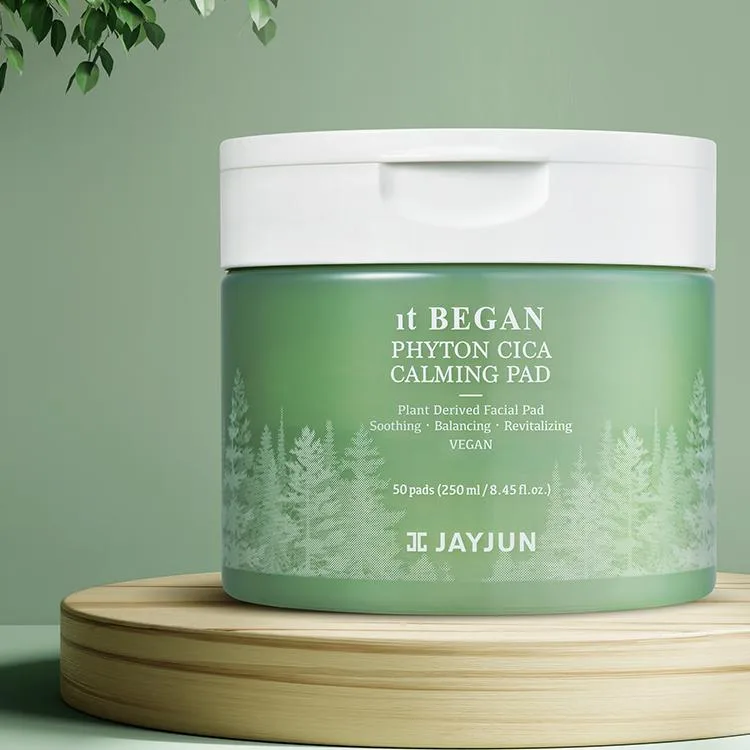
A frosted sage-green jar printed with pale fir trees and a white flip lid, holding 50 pads; the set adds a 20-pad refill pouch.
Finish
naturallightweightfast-absorbing
What to Expect on First Use
Pads feel noticeably cooling on warm or reddened skin. There should be no tingling; the gluconolactone is too gentle to sting intact skin. The tea tree and rosemary oils are low, but very reactive skin should still try one pad on the jaw before using it as a compress.
How Long It Lasts
About seven weeks for the jar plus refill at one pad a day, or five weeks at twice-daily use.
The Korean name uses 편백, hinoki cypress, and 'Phyton' refers to phytoncides, the aromatic compounds cypress forests release. The pad is the green, calming counterpart to the blue Tansy Watery Pad in JAYJUN's vegan-labelled It Began line.
About JAYJUN Established Brand (5–20 years)
Founded in 2013, JAYJUN grew out of the Korean sheet-mask market before adding the vegan-labelled It Began skincare line. This pad is produced by a contract manufacturer; the brand discloses several ingredient concentrations on the label but no clinical results.
Brand founded: 2013
Myth vs. Reality
Common Myths
Myth
The 'Cica' in the name means this is a centella treatment.
Reality
Centella extract is disclosed at 487 ppm, under 0.05%, and its active triterpenes in parts per billion. The calming comes mostly from the humectants, ceramides and the pad's cooling effect.
Myth
Phytoncides from hinoki water fight acne bacteria on the skin.
Reality
Hinoki oil has antimicrobial activity in laboratory studies, but a hydrosol contains only traces of those compounds. Expect a fresh scent and hydration, not an acne treatment.
FAQ
Frequently Asked Questions
How much centella is in JAYJUN's Phyton Cica Calming Pad?
The label discloses centella extract at 487 ppm (under 0.05%), with asiaticoside, asiatic acid, madecassic acid and madecassoside listed in parts per billion. It is a named ingredient, not the main active.
What is 'Phyton' in the It Began Phyton Cica pad?
It refers to phytoncides from hinoki cypress. Chamaecyparis obtusa water makes up 65% of the formula, replacing most of the plain water.
Is the Phyton Cica Calming Pad fragrance-free?
There is no added perfume, but hinoki water, tea tree oil and rosemary oil give it a natural woody scent, and the two essential oils can bother very reactive skin.
Can the JAYJUN cica pad help a damaged skin barrier?
It contains five ceramides with cholesterol and phytosphingosine plus humectants, which support barrier comfort; a ceramide moisturiser afterwards will do more of the repair work.
Can I use the Phyton Cica pad with retinol?
Yes. It is gentle and hydrating, and using it before a retinoid in the evening can help offset some dryness.
Is JAYJUN's Phyton Cica pad safe to use during pregnancy?
Its ingredients — hinoki water, humectants, ceramides and a trace of centella — are not typically restricted in pregnancy. The small amounts of tea tree and rosemary oil are unlikely to matter, but check with a clinician if unsure.
Reviews
What Reviewers Tend to Say
Recurring themes our editors read across retailer reviews of this product — summaries in our words, not quotations, and not a substitute for your own patch test.
Picking one skin state and selling through hospital dermatology departments is a genuinely smart strategy. Whether the house botanical earns its billing is a separate question, and the answer is not the one either side wants.
Western sensitive skincare works by subtraction — remove the fragrance, remove the alcohol, shorten the list. Japan's answer adds a designed molecule back in, and one of the two bets has a trial literature.
A wrecked barrier is the most common self-inflicted skin condition and the one with the clearest fix — the difficulty is that the routine which caused it feels productive and the one that repairs it feels like giving up.
'Barrier damage' has become the internet's all-purpose diagnosis. It's also a real, specific condition with a specific and slightly boring cure: mostly, stop doing things.
Products, answers, therapy guides, tools and articles in one search. Brand names,
slang and abbreviations all work — accutane finds isotretinoin, bacne finds truncal acne.