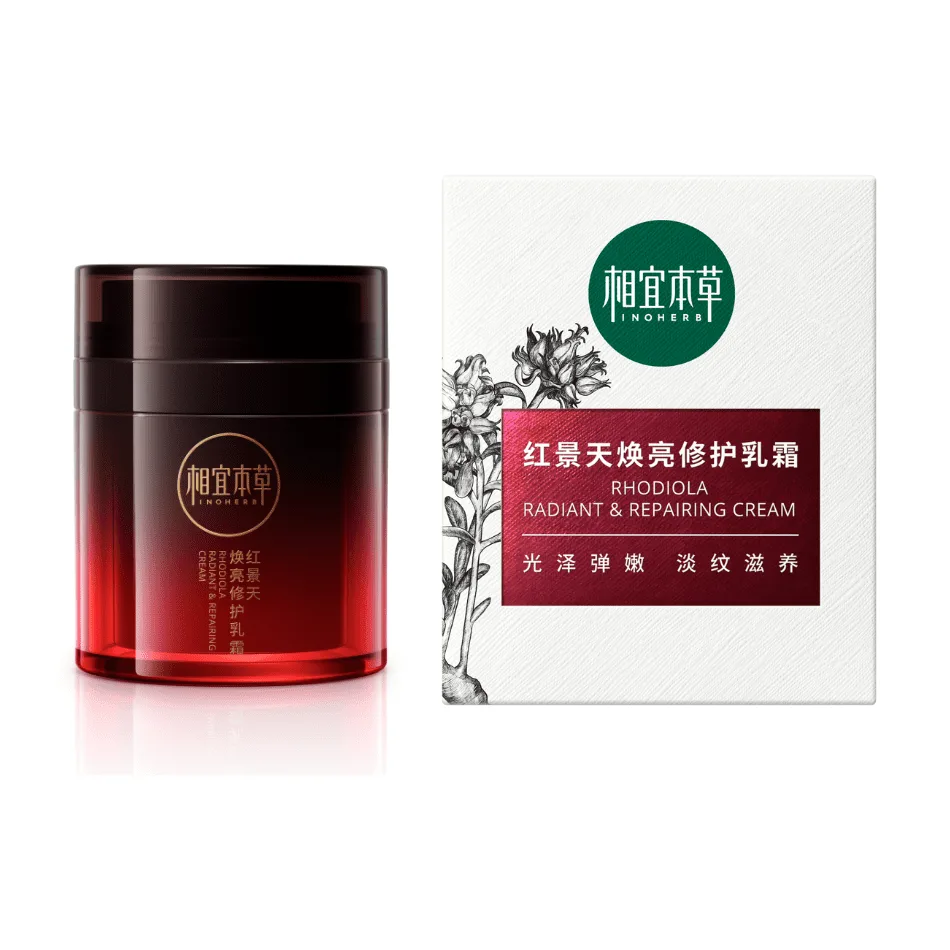
Its hydration comes from an osmolyte pair — trehalose and betaine — rather than the usual hyaluronic acid, wrapped in shea and silicone and layered with twelve TCM botanicals including skullcap and gentian, plus sodium DNA borrowed from the polynucleotide trend. The airless pump-jar and the 'stronger under light' antioxidant story are the pitch; the osmolytes and shea are what you actually feel.
A rich-but-not-heavy herbal cream whose real hydration engine is a trehalose-and-betaine osmolyte pair under shea and silicone, with twelve botanicals, a whisper of mica and a dash of sodium DNA along for the ride. Comfortable on dry skin, oversold on its packaging claims, perfumed, and priced abroad above what the evidence supports.
Inoherb's user feedback lives on Chinese platforms this review cannot audit, and the Singapore retailers stocking the cream publish no ratings at all. Everything here is drawn from the complete ingredient list on Metro Singapore's listing, the placement of each functional ingredient, and the brand's long domestic record — not from any tracked overseas outcomes, which do not yet exist.
Verdicts
How well it fits each concern
Verdict by concern tap a concern for the case
Good choicefor DrynessIn your profileYou chose · Shea Butter is a reference standard by mechanism for dryness; this cream carries it high in the ingredient list.Moderate evidenceStandard tolerabilityNo reviews collected yet
The case for it
Butyrospermum Parkii has trial-supported standing for this concern.
It is present at an effective concentration, declared or high in the ingredient list.
The formula carries no trigger this concern is sensitive to, with the cautions noted.
Cautions: fragrance.
Same rule for everyone. “Good choice” is the verdict on 9,564 of 45,024 concern verdicts across the catalog; rule R5 decided 9,072 of them.
As of September 25, 2026, engine 5.1.1.
Supporting rolefor AgingIn your profileYou chose · Nothing here targets aging directly; hydration and barrier support is the recognised companion to treating it, and this cream does that without known triggers.Not yet assessedStandard tolerabilityNo reviews collected yet
The case for it
Trehalose + Betaine has no evidence row yet for this concern — it is in the research queue.
The formula carries no trigger this concern is sensitive to, with the cautions noted.
What would change this: A researched evidence row for the lead active would replace this with a verdict.
Same rule for everyone. “Supporting role” is the verdict on 8,197 of 45,024 concern verdicts across the catalog; rule R8 decided 4,250 of them.
As of September 25, 2026, engine 5.1.1.
R8 — The category's job (barrier care, humectant hydration, gentle cleansing, photoprotection) is the documented supportive role for this concern. This is the honest verdict for a moisturizer on an acne page. · the full register
Supporting rolefor DehydrationIn your profileYou chose · Nothing here targets dehydration directly; humectant hydration is the recognised companion to treating it, and this cream does that without known triggers.Not yet assessedStandard tolerabilityNo reviews collected yet
The case for it
Trehalose + Betaine has no evidence row yet for this concern — it is in the research queue.
The formula carries no trigger this concern is sensitive to, with the cautions noted.
What would change this: A researched evidence row for the lead active would replace this with a verdict.
Same rule for everyone. “Supporting role” is the verdict on 8,197 of 45,024 concern verdicts across the catalog; rule R8 decided 4,250 of them.
As of September 25, 2026, engine 5.1.1.
R8 — The category's job (barrier care, humectant hydration, gentle cleansing, photoprotection) is the documented supportive role for this concern. This is the honest verdict for a moisturizer on an acne page. · the full register
Also listed for Dullness — the actives here (Trehalose, Shea Butter, Botanical Extracts) are in our research queue for that concern; there is no verdict until their evidence rows are written. That is a gap in our table, not a mark against the product.
Does the jobDoes what a moisturizer is for: draws in water, softens and smooths.
A verdict is DermApproved’s assessment of how well a product’s ingredients fit a concern — never a claim about what the product treats. Evidence dots and collected reviews sit beside it and are never blended in.
Rules 0.5.1 · evidence table ev-2026.09-r228 · how we decide
Assessment
Pros & Cons
Pros
✓ Trehalose and betaine give durable, osmolyte-based hydration that outlasts the surface film
✓ Shea butter and light silicones make it rich in feel without greasiness
✓ Skullcap, gentian and glycyrrhizate form a credible calming core
✓ Airless pump-jar keeps the cream hygienic and doses cleanly
✓ No drying alcohol or parabens; mild modern preservation
✓ Buffers retinol well as a final evening layer
✓ Twenty-five-year brand with consistent pharmacy-scale manufacturing
Cons
✗ Fragrance is assertive and calamus and citrus extracts add sensitiser routes
✗ Mica leaves a visible pearl cast in daylight
✗ '65 percent herbal' and 'stronger under light' claims are unverifiable brand copy
✗ Isohexadecane and shea in a silicone base suit neither acne-prone nor fungal-acne-prone skin
✗ Sodium DNA and the rhodiola sit at trace positions despite headlining
✗ Converted overseas price of about $45 for 50 g is high for the evidence
Review
Full Review
Chinese herbal skincare marketing has its own grammar, and this cream speaks it fluently: a '65 percent herbal formula', microencapsulated rhodiola released over twelve hours, an antioxidant that 'grows stronger in the presence of light'. To a Western INCI reader every one of those claims sounds like a red flag. To a Chinese pharmacy shopper they are the ordinary language of a brand that has sold TCM-inspired creams since 2000. The interesting exercise is to hold the two side by side and ask what the jar actually contains — because the answer is a competent, comfortable dry-skin cream that would have been easier to like if it had described itself plainly.
Start with the 65 percent. The base is aloe barbadensis leaf juice rather than water, which is presumably the arithmetic behind the number; water itself is listed twenty-seventh, and all twelve botanicals — albizia bark, bletilla, rhodiola, poria, calamus, citrus peel, primula, alfalfa, centella, peony, skullcap, gentian — sit after it, behind carbomer and a starch thickener. That places them at the signature end of a formula, present in fractions of a percent. The claim is not false so much as beside the point: the aloe base is doing the counting, and the herbs are doing the branding.
What the cream is really built from is more interesting than its copy. Dimethicone, glycerin, betaine and propanediol lead, followed by isohexadecane, C14-22 alcohols, trehalose and diglycerin. Trehalose and betaine are osmolytes, small molecules cells use to hold water under stress, and they are the reason this cream keeps skin feeling hydrated long after the initial slip has faded — a more durable kind of moisturizing than hyaluronic acid's surface film, and a smart choice for dry skin in heated rooms. Shea butter mid-list is the one true occlusive; C10-18 triglycerides and a dicaprylate ester keep it spreadable. Two silicone crosspolymers, cyclopentasiloxane and polysilicone-11 give the whipped, cushiony feel and the slight slickness on application.
Then a few ingredients that are trying to be talked about. Mica, at twentieth, tints the cream and leaves a faint pearl cast in daylight — 'radiant' in the optical sense, and something to know before wearing it to a well-lit meeting. Deoxyribonucleic acid, sodium DNA, is the formula's gesture towards the polynucleotide repair trend; at its position after the botanicals it is a humectant-grade inclusion, and the salmon-DNA research it borrows glamour from involved injected or high-dose clinical products. Dimethoxymethoxy benzaldehyde is a niche antioxidant, and silanediol salicylate is a silicon-bound salicylate that appears in firming formulas — a curiosity, not a dose of anything. Whether any of this is what the 'stronger under light' claim refers to, the brand does not say, and no independent data exists to check it.
The herbs deserve a fairer hearing than the marketing gives them. Scutellaria baicalensis — Chinese skullcap — is the source of baicalin, a flavonoid with solid in vitro anti-inflammatory and antioxidant evidence and a small body of human skin research; gentian root and dipotassium glycyrrhizate beside it are credible soothers, and centella is centella. That trio is a reasonable basis for the 'repairing' half of the name, in the sense of calming a dry, stressed barrier. Rhodiola, the headline, remains a well-studied oral adaptogen with almost no topical evidence; the microencapsulation story explains how it is stabilised, not what it does once released.
On the skin, the experience is better than a cynical reading would predict. The whipped texture melts on contact, spreads generously, and settles within a few minutes to a satin sheen that stays comfortable rather than greasy. Overnight, dry cheeks wake up soft without the tightness that lighter creams leave behind; under sunscreen it needs a minute to set and then holds. After a month, dry and normal skin looks better hydrated and marginally plumper, with the mica adding a glow that is pleasant at night and slightly conspicuous by day. It does not fade pigment, it does not fill lines, and it does not claim to — the four Chinese characters on the box promise glow, bounce, softened lines and nourishment, which is a fair description of a good cream's honest ceiling.
Tolerability is the weak point for the audience most likely to be tempted. Fragrance is present and assertive on opening, acorus calamus and citrus peel extract are two warming, sensitising botanicals, and isohexadecane with shea makes the base a poor fit for acne-prone or fungal-acne-prone skin. The preservation is modern and mild — hydroxyacetophenone, 1,2-hexanediol, ethylhexylglycerin — and there is no drying alcohol or paraben, so ordinary dry and normal skin will find it easy. Reactive, rosacea-prone or eczema-prone skin should patch-test and probably pass.
Price, once again, is a conversion rather than a listing: with no US retailer, Metro Singapore's recommended price translates to about forty-five dollars for 50 grams, or ninety cents a gram. That is prestige-adjacent money for a fragranced silicone-shea cream whose most evidence-backed ingredients are its osmolytes and its licorice salt. Deep resale discounts in the region suggest the overseas RRP is aspirational, and at half price the cream becomes a reasonable dry-skin buy. Inoherb's quarter century in Chinese pharmacies speaks well of its manufacturing; it says nothing about the claims on the box, which remain the brand's own.
For dry or normal skin that wants a rich-feeling, non-greasy night cream with durable hydration and a herbal signature, and that does not mind perfume or a little shimmer, this earns its place in the routine. For anyone buying the antioxidant-under-light story, the DNA, or the 65 percent, the ingredient list is the better read than the box.
Formula
Key Ingredients
The hero actives that drive this product's performance.
Inoherb's signature adaptogen, here wrapped in what the brand calls microencapsulation for a twelve-hour release and marketed as an antioxidant that strengthens under light; it sits among a dozen botanicals after the water and thickeners, so it is a signature-level antioxidant rather than a bulk active.
The eighth and fourth ingredients, a sugar and an amino-acid osmolyte that together give the cream its water-holding staying power; they explain why the skin feels hydrated hours after the shea and silicone film has stopped being noticeable.
The one true occlusive emollient in the list, positioned mid-formula with isohexadecane and C10-18 triglycerides around it; it is why this 'light cream' is richer than the emulsion in the same range without becoming a balm.
Established mechanismfor Dryness · established mechanism
Chinese skullcap, the source of baicalin, appears late in the twelve-herb run beside gentian and dipotassium glycyrrhizate as the anti-inflammatory core of the 'repairing' claim — a more evidence-backed soother than the rhodiola that headlines.
Sodium DNA, listed after the botanicals, is the formula's nod to the PDRN-style 'repair' trend; at this position it is a humectant-grade inclusion, and the salmon-derived polynucleotide research it borrows credibility from used injected or far higher topical doses.
Not yet assessed
Ingredient standings describe the active at treatment-level doses and
vehicles; this product's own condition grades weigh its actual formula.
Use as the final step after serum or the line's essence; the shea and silicone film seals whatever is under it, so put actives on first. In the morning it takes a sunscreen over it without pilling if given a minute to set.
Results Timeline
Immediate softness and a faint mica glow; steadier hydration within one to two weeks from the trehalose and betaine, and a slightly plumper, more even look after four to eight weeks. It will not fade pigmentation or fill established lines.
The measurable hydration in this cream comes from its osmolytes. Trehalose, a non-reducing disaccharide, stabilises membranes and proteins under desiccation in extremophile organisms and, in skin, acts as a humectant that also protects keratinocytes against dehydration stress in vitro; betaine, an amino-acid derivative, is an osmoprotectant that improves skin hydration and reduces the tightness associated with surfactant damage in small human studies. Together they explain the cream's lasting comfort better than any of the botanicals. Shea butter contributes triterpene esters with documented anti-inflammatory activity as well as occlusion. Among the herbs, Scutellaria baicalensis root extract has the strongest support: its principal flavonoid, baicalin, inhibits inflammatory mediators and scavenges radicals in cell models, and topical baicalin has reduced UVB-induced damage in murine skin, although human data in a finished cream are lacking. Dipotassium glycyrrhizate is a well-characterised topical anti-inflammatory at the fractions of a percent typical of cosmetics. Rhodiola rosea root extract has in vitro antioxidant and tyrosinase-inhibiting activity and no controlled topical trials; the brand's 'sixfold antioxidant increase under light' figure is not available for review and should be treated as marketing. Sodium DNA in cosmetics functions as a film-forming humectant; the regenerative evidence for polynucleotides comes from injectable PDRN and concentrated clinical preparations, not from a trace inclusion in a moisturizer. Mica is an inert light-scattering pigment. The formula is best understood as an osmolyte-and-shea moisturizer with a plausible anti-inflammatory botanical trio, wrapped in claims the ingredient list cannot substantiate.
Dermatologist Perspective
Herbal night creams from Chinese brands reach Western clinics through patients who shop cross-border, and the standard clinical reading of this one would be reassuring on the base and skeptical of the label. Betaine, trehalose and shea are ingredients dermatologists are happy to see in a dry-skin moisturizer, and the baicalin-bearing skullcap plus glycyrrhizate are reasonable calming additions. What draws caution is the fragrance combined with acorus calamus and citrus peel extract, a trio that can provoke allergic contact dermatitis in already-sensitised patients, and the isohexadecane-shea-silicone base, which is not what an acne-prone or Malassezia-prone patient should sleep in. The 'antioxidant stronger under light' language is the kind of claim clinicians warn against, because it invites patients to treat a moisturizer as photoprotection; broad-spectrum sunscreen remains the only thing that does that job. For dry, non-reactive patients who enjoy the texture, it is a harmless and pleasant cream. For barrier repair in eczema or rosacea, the recommendation stays with fragrance-free ceramide formulations.
Guidance
Usage & Recommendations
How to Use
After toner and any serum or essence, press the top of the airless jar once for a pea-sized dose — it goes further than it looks — and warm it between the fingertips before pressing and smoothing over the face and neck, working from the centre outward. At night it is the final step and pairs well over a retinol, which it buffers. In the morning give it a minute to set before sunscreen, and use a lighter hand or skip to the line's emulsion if the mica sheen is more than you want by day. Once or twice daily is the brand's guidance; if the fragrance or the calamus extract warms your skin in the first days, patch-test on the jawline and consider evening-only use.
Value Assessment
No US retailer stocks this cream, so the price here converts Metro Singapore's recommended price to roughly forty-five dollars for 50 grams — about ninety cents a gram, which is where mid-prestige night creams with published clinical testing sit. In exchange you get a genuinely comfortable osmolyte-and-shea cream, an airless jar, and a long herbal signature; you do not get a fragrance-free base, disclosed concentrations, or any evidence for the technical claims printed on the box. Inoherb's twenty-five years of pharmacy retail lower the manufacturing risk but do not carry clinical weight, and the brand's own positioning at home is accessible, not prestige. Regional resellers cut this by half or more, and at that level it is a fair dry-skin buy. At full overseas RRP you are paying for the story.
Who Should Buy
Dry and normal skin looking for a night cream that feels rich, sinks in without grease and keeps its hydration until morning, especially in heated or cold-weather months. It suits people who like a herbal signature and a soft perfume, and anyone curious about a TCM-branded moisturizer with a modern osmolyte backbone.
Who Should Skip
Oily, acne-prone or fungal-acne-prone skin should avoid the isohexadecane, shea and silicone base; sensitive, rosacea-prone or eczema-prone skin should avoid the fragrance, calamus and citrus extracts. Anyone buying it for the DNA, the rhodiola, or the antioxidant-under-light claim will not find those promises in the ingredient order.
Ready to try Inoherb Rhodiola Radiant & Repairing Cream?
A dense, whipped cream with a faint pearl cast that melts into a slippery, silicone-smooth layer and settles to a soft satin sheen after a few minutes.
Scent
A clear sweet-herbal perfume, the strongest in the Rhodiola range, that softens but does not vanish over the first quarter hour.
Packaging
A gradient-red 50 g airless jar with a press-top pump under the lid, boxed in white card with the line's rhodiola drawing and the four-character claims in Chinese.
Finish
satinglowy
What to Expect on First Use
The first application feels cushioned and slightly slick from the silicone crosspolymers, and the mica lends a subtle shimmer that shows in daylight; there is no tingling or purging, though the fragrance and the calamus extract can warm reactive cheeks in the first days.
How Long It Lasts
Roughly two months at a pea-sized pump twice a day from the 50 g jar, closer to three if used at night only.
The Rhodiola Radiant & Repairing Cream is the moisturizer step of Inoherb's premium red-glass line, launched to move the twenty-five-year-old herbal brand upmarket, and it carries the line's most elaborate technical claims — microencapsulated rhodiola with a twelve-hour release, an antioxidant that 'grows stronger in the presence of light', and a '65 percent herbal' formula. Those numbers are the brand's own; what the INCI shows is a silicone-shea cream with an aloe base and a long botanical tail.
About Inoherb Legacy Brand (20+ years)
Inoherb (相宜本草) is a Shanghai herbal skincare house founded in 2000 that has spent twenty-five years in Chinese pharmacies and supermarkets translating the traditional materia medica into daily products. Its development is in-house and its efficacy claims are supported by internal and Chinese-language testing rather than English-language peer-reviewed trials of finished products.
Brand founded: 2000 · Product launched: 2023
Myth vs. Reality
Common Myths
Myth
'65 percent herbal formula' means most of the jar is plant extract.
Reality
Water appears at position 27 and the twelve botanicals all sit after it, so the figure can only describe the aloe juice base; the extracts themselves are present at signature-level doses behind the emollients and thickeners.
Myth
The DNA in the cream repairs skin the way PDRN injections do.
Reality
Sodium DNA in a cream is a humectant-grade ingredient; the wound-healing and rejuvenation evidence for polynucleotides comes from injected or high-dose clinical products, not from a trace inclusion in a moisturizer.
FAQ
Frequently Asked Questions
Is the Inoherb Rhodiola Radiant & Repairing Cream a day or night cream?
Both, but it leans night. The shea butter, silicone film and mica give it a satin, faintly luminous finish that dry skin enjoys under sunscreen, while oilier or combination skin will find it more comfortable as an evening cream with the line's emulsion in the morning.
Does the Rhodiola Radiant & Repairing Cream have shimmer in it?
Yes — mica is the twentieth ingredient, and in daylight the cream leaves a subtle pearl cast. It is a cosmetic glow, not a change in skin tone, and anyone who dislikes shimmer in a moisturizer should know it is there.
What does 'stronger in the presence of light' mean on the Inoherb Rhodiola cream?
It is the brand's description of its rhodiola antioxidant system, which it claims increases protection sixfold under light exposure. No independent data supports the figure, and a cream is not a substitute for sunscreen, which should always go over it in the morning.
Can I use the Inoherb Rhodiola cream over retinol?
Yes, and it is a sensible pairing — the shea, trehalose and betaine buffer retinol dryness, and there are no exfoliating acids in the cream to compound irritation. Apply the retinol first, wait a few minutes, then seal with the cream.
Is the Inoherb Rhodiola Radiant & Repairing Cream suitable for acne-prone skin?
Probably not. Isohexadecane and shea butter both rank as potentially pore-clogging, the silicone film is heavy for breakout-prone skin, and the fragrance and calamus extract add irritation risk. Dry and normal skin are the intended audience.
Is the Inoherb Rhodiola cream safe to use during pregnancy?
Nothing on its ingredient list is a recognised pregnancy exclusion — no retinoids, no salicylic acid at treatment levels, no hydroquinone. The fragrance and the long herbal list make it a patch-test-first choice, and anyone avoiding scented skincare in pregnancy has fragrance-free options.
Reviews
What Reviewers Tend to Say
Recurring themes our editors read across retailer reviews of this product — summaries in our words, not quotations, and not a substitute for your own patch test.
That headline is the story every brand tells about trehalose. It is also, as of a 2017 paper in Molecular Cell, not quite true — which turns out to be the most interesting thing about the ingredient.
Cutting a beard hair takes about a twentieth of a newton. You press with two and stretch your skin by a fifth — which is why almost every shaving problem is a technique problem wearing a hardware costume.
The burn trials are real and the skeptics who dismiss aloe as folklore are wrong — but the same substance has delayed healing in other wounds, and none of it says anything about what a soothing gel does to intact skin.
Your immune cells already make it to kill microbes. Now it's in a spray bottle for breakouts and redness, and the real evidence is quietly stronger than the 'miracle mist' marketing that's outrunning it.
Products, answers, therapy guides, tools and articles in one search. Brand names,
slang and abbreviations all work — accutane finds isotretinoin, bacne finds truncal acne.