


Hyaluronic Acid Can Actually Dehydrate Your Skin (Here's When)
The internet's favorite hydrator has a counterintuitive dark side — in dry air, a humectant with nothing to seal it can pull water out of your skin instead of into it.

Most retinol-containing toners at any price point either dose the retinol too low for meaningful effect or too high for tolerability without a retinoid acclimation period. The Goku-jyun Alpha lotion threads a different needle — uses retinyl palmitate (the mildest practical retinoid) at low concentration to provide a gentle daily-use anti-aging contribution that the user can layer immediately without irritation acclimation. The trade-off is modest clinical results; the benefit is broad tolerability and a useful entry point for retinoid-naive users.
The anti-aging upgrade of Hada Labo's iconic Gokujyun Lotion — adds retinyl palmitate, thioctic acid, beta-carotene, and a peptide stack to the brand's multi-hyaluronic-acid hydration base. Genuine value at the drugstore price point, with the meaningful caveat that retinyl palmitate is the weakest retinoid choice and clinical results are correspondingly modest.
The case for it
What would change this: A declared concentration would move this to a firmer reading of the dose.
Same rule for everyone. “Promising” is the verdict on 7,858 of 45,024 concern verdicts across the catalog; rule R9p decided 7,858 of them. Unchanged since September 5, 2026, engine 5.1.1.
Brand or formulator? Disclose a concentration or correct a fact →
The studies behind the evidence row
The case for it
What would change this: A declared concentration would move this to a firmer reading of the dose.
Same rule for everyone. “Good choice” is the verdict on 9,564 of 45,024 concern verdicts across the catalog; rule R5 decided 9,072 of them. Unchanged since September 5, 2026, engine 5.1.1.
Brand or formulator? Disclose a concentration or correct a fact →
The studies behind the evidence row
The case for it
What would change this: A declared concentration would move this to a firmer reading of the dose.
Same rule for everyone. “Promising” is the verdict on 7,858 of 45,024 concern verdicts across the catalog; rule R9p decided 7,858 of them. Unchanged since September 5, 2026, engine 5.1.1.
Brand or formulator? Disclose a concentration or correct a fact →
The studies behind the evidence row
The case for it
What would change this: A declared concentration would move this to a firmer reading of the dose.
Same rule for everyone. “Unproven” is the verdict on 1,111 of 45,024 concern verdicts across the catalog; rule R9 decided 1,111 of them. Unchanged since September 5, 2026, engine 5.1.1.
Brand or formulator? Disclose a concentration or correct a fact →
The studies behind the evidence row
Also listed for Dryness — the actives here (Peptides, Retinyl Palmitate, Alpha-Lipoic Acid, Vitamin E) are in our research queue for that concern; there is no verdict until their evidence rows are written. That is a gap in our table, not a mark against the product.
Does the jobDoes what a toner is for: not alcohol-driven, adds something real. Not measured from the label: restores skin pH, plays well with what follows.
Where our review and the verdict differ. The review below was written on the formulation and the published trials; the verdicts above apply the stricter standing test in our methodology — an active earns a recommendation only with guideline or regulatory standing for the concern. Where the two disagree, the verdict is DermApproved’s position.
A verdict is DermApproved’s assessment of how well a product’s ingredients fit a concern — never a claim about what the product treats. Evidence dots and collected reviews sit beside it and are never blended in. Rules 0.5.1 · evidence table ev-2026.09-r228 · how we decide
There is a specific user the Goku-jyun Alpha lotion is designed for, and it is not someone with extensive retinoid experience or precise anti-aging goals. It's someone in their late twenties to early forties who has absorbed the message that anti-aging skincare should involve vitamin A somewhere, who does not want to endure the acclimation period of an over-the-counter retinol or navigate a prescription for tretinoin, and who would like their evening routine to include a low-effort daily brush with retinoid chemistry without rearranging anything else. For that person, this is one of the better entry-level options at the price. For anyone with sharper goals, the formulation honesty matters considerably more than the marketing does.
The retinoid choice is the whole story. Retinyl palmitate is the mildest member of the family — an ester of retinol bonded to palmitic acid, which the skin must cleave to release retinol, then oxidize to retinaldehyde, then oxidize again to retinoic acid before anything actually happens at the receptor. Every step of that chain sheds active dose. The published literature treats retinyl palmitate as meaningfully weaker than retinol, and retinol is itself something like ten to twenty times weaker than tretinoin. So no: this is not tretinoin in a bottle, and anyone selling it as equivalent is being generous with the truth.
What you get in exchange is tolerance. No peeling, no purging, no two-week acclimation misery, no dramatic photosensitivity. For someone who tried a proper retinol and hated their face for a fortnight, or who has never used one and wants the gentlest possible on-ramp, retinyl palmitate is exactly the right compromise. For someone who wants visible wrinkle reduction on a reasonable timeline, it is exactly the wrong one.
The rest of the formula is classic Hada Labo — competent hydration chemistry with anti-aging actives layered on top. The multi-hyaluronic-acid stack (sodium hyaluronate plus the acetylated form the brand calls Super HA) provides the same humectant chassis that anchors the entire Gokujyun franchise, and it works immediately. Thioctic acid — alpha-lipoic acid — is a genuinely interesting inclusion: an antioxidant soluble in both water and lipid, capable of regenerating vitamins C and E as it goes, and particularly sensible alongside a retinoid. Beta-carotene and tocopherol complete the fat-soluble antioxidant trio, doing double duty by stabilizing the formula in the bottle as well as protecting the skin.
The peptide stack is the most oversold part. Hydrolyzed soy protein and hydrolyzed collagen deposit a humectant, film-forming benefit on the surface, and that's genuinely nice — but collagen applied topically does not reach the dermis and does not stimulate your own collagen production, no matter what the box implies. Take it as a smoothing film, not a structural intervention.
The preservative system draws the most consumer fire. Methylparaben handles preservation; BHT protects the retinyl palmitate and the meadowfoam, sunflower and corn oils from going off. Both carry decades of safety data at cosmetic concentrations, and the clean-beauty aversion to them reflects preference rather than evidence. If you avoid them on principle, the brand's Premium line has newer paraben-free formulations; this one has kept the same stabilizer architecture for over a decade, which is precisely why the formula behaves so predictably.
In use, it's about as dramatic as tap water. The watery, faintly viscous lotion pours easily, spreads fast, absorbs in thirty seconds. No tingle, no warmth, no scent. Skin feels hydrated at once. Four or five drops pressed into damp skin, moisturizer on top, done.
Which points to the other honest limitation: a toner is a delivery vehicle, not a treatment. This lotion contributes hydration and a small daily exposure to vitamin A chemistry. It cannot function as an anti-aging routine on its own, and expecting it to is the fastest route to disappointment. The real work happens in the leave-on steps around it — and in the sunscreen, which is not optional. A retinoid without SPF is a rowing machine pointed downstream.
Results honor the formulation. Across eight to twelve weeks of consistent nightly use with daily sun protection, most people see modest improvement in surface smoothness and tone. Visible wrinkle reduction is rare at this potency, because this is a small daily dose rather than a treatment. Anyone wanting more should be looking at a proper over-the-counter retinol, or having the tretinoin conversation with a dermatologist. Pregnancy rules it out entirely — the standard Gokujyun lotion, retinoid-free, is the correct substitute.
Value is solid at the Japanese drugstore tier: roughly $22 for 170ml, two and a half to three months of nightly use, which lands the monthly cost around eight or nine dollars for a formula carrying multi-HA, a retinoid, alpha-lipoic acid, beta-carotene and vitamin E. That's more formulation depth than most drugstore anti-aging toners bother with, and across some six and a half thousand reviews the sentiment is consistently, unglamorously positive.
The only real question is whether the retinoid contribution is worth the upgrade over the plain Gokujyun lotion. If you want the gentlest possible introduction to vitamin A and you're realistic about what that means, yes. If you don't, the original is cheaper and does the hydration just as well.
The hero actives that drive this product's performance.
| Ingredient | Function | Evidence |
|---|---|---|
| Retinyl Palmitate | The mildest member of the retinoid family — an ester form of vitamin A (retinol + palmitic acid) that slowly converts to retinol then to retinoic acid in the skin. Clinical effect is meaningfully smaller than pure retinol or prescription tretinoin, but the tolerance profile is much better, which makes it suitable for retinoid-naive users in a daily-use lotion format. | Not yet assessed |
| Multi-Hyaluronic Acid Stack (Sodium Hyaluronate + Sodium Acetylated Hyaluronate) | Two molecular-weight HA forms — the standard high-MW for surface humectant action plus the brand's 'Super HA' acetylated form for sustained skin-surface binding. The same hydration chassis Hada Labo uses across the Gokujyun line, providing the moisture base on which the anti-aging actives sit. | Established mechanism for Dehydration · established mechanism |
| Thioctic Acid (Alpha-Lipoic Acid) | Both fat- and water-soluble antioxidant with documented activity against multiple oxidative pathways — pairs with the beta-carotene and vitamin E in this formula to support the anti-aging positioning through oxidative-stress dampening, particularly relevant when retinyl palmitate is also present (which can increase photosensitivity). | Not yet assessed |
| Hydrolyzed Soy Protein + Hydrolyzed Collagen Peptide Stack | Plant-and-animal-derived peptide complex that contributes humectant-and-film-forming benefits on skin — the hydrolyzed collagen specifically deposits a smoothing film during leave-on use that supports the lotion's anti-aging firmness positioning, even if the deeper dermal collagen-stimulation claims are overstated for topical peptides at typical concentrations. | Limited for Aging |
| Beta-Carotene + Tocopherol Antioxidant Pair | Two fat-soluble antioxidants stacked together — beta-carotene as the precursor to vitamin A (complements the retinyl palmitate) and tocopherol for membrane lipid antioxidant protection. Important supporting cast for the retinoid chemistry, helping to stabilize the formula in the bottle as well as deposit antioxidant protection on skin. | Limited for Aging |
Ingredient standings describe the active at treatment-level doses and vehicles; this product's own condition grades weigh its actual formula.
Water, Butylene Glycol, Glycerin, PEG-20 Sorbitan Isostearate, Caprylic/Capric Triglyceride, PPG-10 Methyl Glucose Ether, Methylparaben, Triethanolamine, Sodium Hyaluronate, Carbomer, Hydroxyethylcellulose, Tocopherol, Hydrolyzed Soy Protein, Limnanthes Alba (Meadowfoam) Seed Oil, Hydrolyzed Collagen, BHT, Disodium EDTA, Retinyl Palmitate, Helianthus Annuus Seed Oil, Sodium Acetylated Hyaluronate, Thioctic Acid, Zea Mays Oil, Beta-Carotene
toner
PM
Apply after cleansing on slightly damp skin, then follow with the Goku-jyun Alpha Milk or another moisturizer. Evening use preferred due to the retinyl palmitate presence — pair with daily SPF in the morning. Do not stack with prescription retinoids or high-percentage AHA/BHA on the same evening.
Skin feels hydrated and softer immediately. Anti-aging benefits from the retinyl palmitate are modest and build slowly — typically 8-12 weeks for visible smoothness and tone improvements, longer for dermal-level changes. Daily SPF is non-negotiable to capitalize on the retinoid work.
Retinyl palmitate is the most upstream member of the retinoid metabolic pathway used in cosmetic formulations. After topical application, the skin's endogenous esterases cleave the palmitate group to release retinol; retinol is then oxidized to retinaldehyde and finally to retinoic acid, which is the metabolically active form that binds to retinoid receptors (RAR and RXR) to produce the cellular effects associated with anti-aging skincare. Each conversion step reduces the active dose reaching the dermis, and the cumulative loss makes retinyl palmitate substantially less potent than topical retinol, which is itself approximately 10-20 times less potent than prescription tretinoin (retinoic acid). The published clinical literature on retinyl palmitate documents modest effects on surface smoothness and tone but limited evidence for the dermal-level collagen synthesis improvements that more potent retinoids produce.
The trade-off in choosing retinyl palmitate over retinol is tolerability. Pure retinol typically requires a 2-4 week acclimation period during which users experience some combination of dryness, peeling, mild irritation, and increased photosensitivity. Retinyl palmitate at typical use concentrations produces minimal acclimation-period side effects, which makes it suitable for daily-use formulations targeting retinoid-naive users.
The multi-hyaluronic-acid hydration chemistry (sodium hyaluronate plus sodium acetylated hyaluronate) is the formula's reliable workhorse. The mechanism is the same documented across the Hada Labo Gokujyun line — surface humectant action plus sustained skin-surface binding through the acetylated form. The combined humectant deposition is meaningful and contributes to the immediate skin-comfort improvement users notice on first application.
Thioctic acid (alpha-lipoic acid) is a fat-and-water-soluble antioxidant with documented activity against multiple oxidative pathways, including regeneration of other antioxidants (vitamin C, vitamin E, glutathione). The leave-on literature documents anti-aging benefits at concentrations achievable through topical application, particularly when paired with other antioxidants. Beta-carotene and tocopherol (vitamin E) are the fat-soluble antioxidant pair commonly combined with retinoid chemistry — both contribute to formula stability in the bottle and provide complementary antioxidant deposition on skin.
The peptide stack (hydrolyzed soy protein, hydrolyzed collagen) is the formulation's most overhyped chemistry. Hydrolyzed collagen at typical cosmetic concentrations does not penetrate deep enough to stimulate endogenous collagen synthesis; the practical contribution is humectant-and-film-forming on the surface. The 'collagen-boosting' marketing language attached to hydrolyzed collagen in skincare overstates the dermal effects.
Methylparaben and BHT are well-tolerated preservatives and stabilizers respectively, with extensive cosmetic safety data at the concentrations used in finished products. The 'paraben-free' marketing trend reflects consumer preference; the scientific safety profile of parabens in cosmetic use is well-established.
Dermatologists working with patients new to anti-aging skincare frequently recommend retinyl palmitate-containing products as a gentle introduction to retinoid chemistry, particularly for patients who have reacted poorly to OTC retinol or who are not yet ready for the prescription tretinoin conversation. The Hada Labo Goku-jyun Alpha lotion fits this clinical positioning well — affordable, fragrance-free, well-tolerated, with a competent hydration base that supports daily use. The standard clinical caveat is the expectations conversation: this product produces modest results, and patients seeking dramatic wrinkle reduction or significant photodamage repair should be directed to higher-potency retinoid options. For pregnancy and breastfeeding patients, the topical retinoid content rules out use entirely; the standard Hada Labo Gokujyun Lotion is the appropriate substitute. For patients with rosacea, eczema, or chronically reactive barriers, the BHT and the broader retinoid chemistry are reasons to avoid this product in favor of fragrance-free non-retinoid hydration alternatives.
Apply after cleansing in the evening only. Dispense 4-5 drops into clean palms or onto a cotton pad, then press gently into the face and neck. Wait 30-60 seconds for absorption, then layer the Goku-jyun Alpha Milk or another moisturizer on top. Daily SPF in the morning is non-negotiable due to the retinyl palmitate content. Do not stack with prescription retinoids, high-percentage AHA/BHA, or other potent actives on the same evening. Suitable for daily evening use.
At roughly $22 for the 170ml bottle through Asian-beauty retailers, the per-bottle price is meaningfully below what comparable Western anti-aging toners run (Olay Regenerist toner, RoC Retinol toner) and competitive with the broader Japanese drugstore anti-aging tier. The formulation depth — multi-HA, retinyl palmitate, alpha-lipoic acid, beta-carotene, vitamin E, peptides — is genuinely above what most drugstore anti-aging toners deliver, and the 2.5-3 month duration at twice-daily use puts the per-month cost in the $8-9 range. The 'is this worth the upgrade from the standard Gokujyun Lotion' question depends on whether you want the retinoid contribution — if yes, the Alpha line is the right pick at modest additional cost; if no, the standard Gokujyun Lotion is more cost-effective.
Retinoid-naive users in their late 20s through early 40s looking for a gentle daily-use introduction to anti-aging chemistry at drugstore-tier pricing. Best for users who appreciate Hada Labo's hydration heritage and want the same multi-HA base they trust with a small retinoid addition.
Users seeking aggressive wrinkle reduction or significant photodamage repair (OTC retinol or prescription tretinoin are the right answers), pregnant or breastfeeding users (retinoid content), users with rosacea or chronically reactive barriers (BHT and retinoid load), and users with documented paraben or BHT preference sensitivities.
Ready to try Hada Labo Goku-jyun Alpha Anti-Aging Lotion?
Buy at Amazon ♥Watery, slightly viscous toner — visibly thinner than the brand's Premium Lotion, faster to absorb and easier to layer.
Genuinely fragrance-free with no botanical or chemical scent contributions — exactly what the brand's positioning suggests.
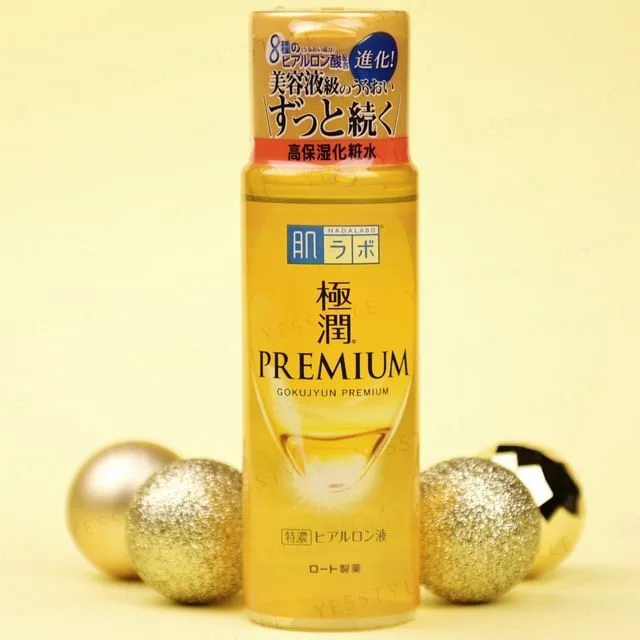
White plastic bottle with the brand's standard clinical-looking design — utilitarian, no design ambition.
First-use impression is the watery, almost serum-like consistency that spreads easily across the face and absorbs within 30 seconds. No tingling, warming, or fragrance bloom. Skin feels noticeably more hydrated immediately. The anti-aging contribution from the retinyl palmitate is invisible on day one and accumulates very slowly over weeks of consistent use.
Roughly 2.5-3 months applied morning and evening face-and-neck application for the 170ml bottle.
All Year
Hada Labo added the Goku-jyun Alpha sub-line to its flagship Gokujyun franchise to address user requests for anti-aging chemistry within the brand's drugstore-pricing positioning. The retinyl palmitate inclusion was a deliberate formulation choice — Rohto Pharmaceutical's R&D team weighing the trade-off between clinical potency (which would have required more aggressive retinol or retinoic acid forms) and broad daily-use tolerability (which is what they prioritized for the line's mainstream Japanese drugstore audience).
Hada Labo Goku-jyun Alpha is the anti-aging sub-line of the brand's flagship Gokujyun franchise — adding retinyl palmitate, niacinamide, and additional anti-aging actives to the multi-hyaluronic-acid hydration chassis the brand built its reputation on. Rohto Pharmaceutical (Hada Labo's parent, founded 1899) has substantial dermatological R&D infrastructure that backs the line's quasi-drug regulatory positioning in Japan.
Retinyl palmitate is just as effective as retinol or tretinoin.
It's not. Retinyl palmitate is the mildest member of the retinoid family — an ester form of vitamin A that requires multiple metabolic conversion steps in the skin to become active retinoic acid. The clinical literature treats it as having significantly smaller effects than retinol (which is 10-20x weaker than tretinoin to begin with). For users wanting meaningful anti-aging results, prescription tretinoin or OTC retinol is the right pick; for users wanting gentle daily-use exposure to vitamin A chemistry, retinyl palmitate fits.
Anti-aging lotions can replace a complete anti-aging routine.
A toner is a delivery vehicle, not a leave-on treatment in the way a serum or cream is. The Goku-jyun Alpha lotion is best used as the toner step in a broader anti-aging routine — leave-on retinol or peptide serum at night, vitamin C serum in the morning, daily SPF. The lotion contributes hydration and a small daily retinoid exposure; the rest of the work happens elsewhere.
The standard Gokujyun Lotion is the brand's flagship hydration toner focused on multi-hyaluronic-acid moisture delivery. The Goku-jyun Alpha adds anti-aging chemistry on top — retinyl palmitate, thioctic acid (alpha-lipoic acid), beta-carotene, vitamin E, and hydrolyzed collagen peptides. The Alpha version is the anti-aging upgrade of the same core hydration chassis.
Modestly. Retinyl palmitate is the mildest practical retinoid, requiring multiple metabolic conversion steps to become active retinoic acid in the skin. Clinical literature treats its effects as significantly smaller than retinol or prescription tretinoin. For meaningful wrinkle reduction, prescription tretinoin or OTC retinol is the right choice; this product is better positioned as a gentle daily-use anti-aging contribution within a broader routine.
No — most prenatal-skincare guidance recommends avoiding all topical retinoids during pregnancy and breastfeeding, including the milder retinyl palmitate. Switch to the brand's standard Gokujyun Lotion (no retinoid) for pregnancy use, and return to the Alpha line after the recommended postpartum interval.
Not on the same evening — stacking retinyl palmitate on top of prescription tretinoin or tazarotene produces unnecessary irritation without meaningful additional benefit. If you're using a prescription retinoid, switch the Goku-jyun Alpha lotion to a non-prescription night or skip it entirely. The standard Gokujyun Lotion (no retinoid) is the better Hada Labo pairing for prescription retinoid routines.
BHT stabilizes the retinyl palmitate (and the meadowfoam, sunflower, and corn oils) against oxidation in the bottle — an important practical consideration in a retinoid product. The methylparaben preservative is standard Hada Labo formulation chemistry for the longer-standing SKUs in the line. Newer Hada Labo Premium variants have updated paraben-free formulations; the Goku-jyun Alpha lotion retains the older preservative system that has anchored its formula stability for over a decade.
Hydration benefits show immediately. Anti-aging benefits from the retinyl palmitate are modest and slow — typically 8-12 weeks of consistent nightly use for visible surface smoothness and tone improvements, longer for any dermal-level changes. Daily SPF is non-negotiable to capitalize on the retinoid work and to prevent the UV-induced damage that ages skin faster than the lotion can repair.
Recurring themes our editors read across retailer reviews of this product — summaries in our words, not quotations, and not a substitute for your own patch test.
Affordable entry point into anti-aging hyaluronic acid skincare
Lightweight watery texture absorbs quickly
Doesn't irritate the way prescription retinoids can
Fragrance-free formula works for most users
Retinyl palmitate is too weak for users wanting visible wrinkle reduction
Paraben and BHT presence is a deal-breaker for clean-beauty-minded users
Single-step lotion isn't enough as standalone anti-aging routine
Brand makes multiple similar Alpha SKUs that confuse purchase decisions