


Peptides: Signal, Carrier, Copper — Which Ones Actually Do Anything?
'Peptides' is one word standing in for a dozen unrelated molecules with wildly different evidence — most serums are hope in a bottle, but a few classes earn their place.
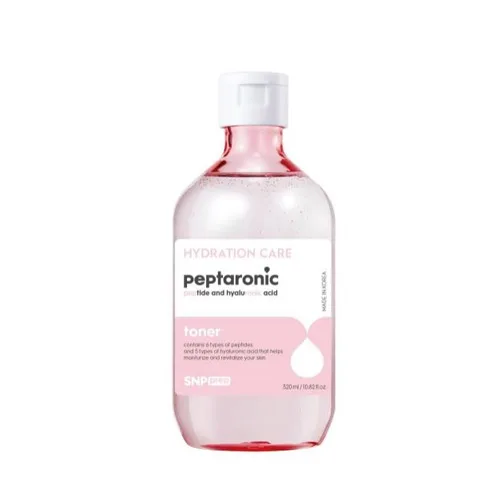
Most peptide toners are sold in small 150ml bottles at a premium; SNP packs a six-peptide blend and a five-type hyaluronic acid complex into a 320ml bottle at a drugstore price. The value proposition is the differentiator — it is built to be used generously and often, as a hydrating base layer rather than a precious treatment you ration.
A big, affordable bottle of competent hydration dressed up in peptide marketing. The five-type hyaluronic acid base genuinely plumps and preps skin, and at this size-to-price ratio it is an easy daily workhorse. Just don't buy it expecting the six peptides to rewrite your fine lines — they're along for the ride, not driving.
The case for it
What would change this: A declared concentration would move this to a firmer reading of the dose.
Same rule for everyone. “Good choice” is the verdict on 9,564 of 45,024 concern verdicts across the catalog; rule R5 decided 9,072 of them. Unchanged since September 5, 2026, engine 5.1.1.
Brand or formulator? Disclose a concentration or correct a fact →
The studies behind the evidence row
The case for it
What would change this: A declared concentration would move this to a firmer reading of the dose.
Same rule for everyone. “Promising” is the verdict on 7,858 of 45,024 concern verdicts across the catalog; rule R9p decided 7,858 of them. Unchanged since September 5, 2026, engine 5.1.1.
Brand or formulator? Disclose a concentration or correct a fact →
The studies behind the evidence row
The case for it
What would change this: A declared concentration would move this to a firmer reading of the dose.
Same rule for everyone. “Promising” is the verdict on 7,858 of 45,024 concern verdicts across the catalog; rule R9p decided 7,858 of them. Unchanged since September 5, 2026, engine 5.1.1.
Brand or formulator? Disclose a concentration or correct a fact →
The studies behind the evidence row
Also listed for Dryness — the actives here (Arginine, Hydrolyzed Collagen, Copper Peptides, Hyaluronic Acid) are in our research queue for that concern; there is no verdict until their evidence rows are written. That is a gap in our table, not a mark against the product.
Does the jobDoes what a toner is for: adds something real, not alcohol-driven. Not measured from the label: restores skin pH, plays well with what follows.
A verdict is DermApproved’s assessment of how well a product’s ingredients fit a concern — never a claim about what the product treats. Evidence dots and collected reviews sit beside it and are never blended in. Rules 0.5.1 · evidence table ev-2026.09-r228 · how we decide
The name does a lot of work before you even open the bottle: six peptides, five types of hyaluronic acid, all for the price of a couple of coffees and packed into a 320ml bottle big enough to double as a hand-pour for your whole face and neck. It reads like a clinical serum that wandered into the budget aisle. Read the ingredient list from the other direction, though, and a more honest picture emerges — one that is still genuinely worth your money, just not for the reasons the front label is selling.
Start with what this toner actually does well, because it does plenty. The backbone is a multi-weight hyaluronic acid system: sodium hyaluronate for surface binding, a crosspolymer form that holds water in a springy gel-like cushion, and a hydrolyzed low-molecular fraction that sinks in a little deeper. Stacked with glycerin near the top of the list, this is a properly humectant-rich formula, and you feel it immediately. Skin goes from cleanser-tight to plump and cushioned within seconds, and the toner absorbs without the tackiness that a lot of HA-heavy products leave behind. As a first hydrating step that primes the skin to receive whatever serum comes next, it is doing exactly what a good prep toner should.
Now the peptides. There are six of them, and the roll call is impressive on paper — Palmitoyl Pentapeptide-4 (the famous Matrixyl building block), Palmitoyl Tripeptide-1, a couple of hexapeptides, and Copper Tripeptide-1, the GHK-Cu copper peptide that has the most interesting independent research behind it. The catch is where they appear: clustered at the very tail of the INCI list, after the hyaluronic acid fractions and the hydrolyzed collagen. Ingredient lists are ordered by concentration down to roughly the one-percent threshold, and everything past that point is present in fractions of a percent. So while the peptides are real, they are present at conditioning levels, not the treatment doses you would find in a serum built around them. The realistic benefit is a thin film of moisture-binding peptide fragments that add to the toner's overall supple after-feel — not a measurable assault on your wrinkles.
This is not a knock so much as a recalibration. Plenty of perfectly good products oversell their hero ingredients, and the trick is to buy them for what they actually deliver. Here, that is hydration, comfort, and an easy-layering texture at a price that lets you be generous. The hydrolyzed collagen plays a similar supporting role to the peptides: at around 12,000 Daltons it is a surface humectant and film-former, not a collagen-replacement therapy, and it leaves skin feeling soft rather than doing anything structural underneath.
The texture is the kind of thing K-beauty does well — a thin, faintly viscous liquid that sits right between a watery toner and a light essence. You can pat it in with your hands in one pass or layer it in two or three for a more saturated 'skin-flooding' approach, and the big bottle makes that affordable to do twice a day. It sinks in fast, leaves no greasy residue, and slots cleanly under serums, essences, and moisturizers without pilling.
Where I have to dock points is the fragrance. There is a soft floral-musky perfume in here that is noticeable on application before it fades, and it is unmistakably an added scent rather than a botanical byproduct. For a product whose entire pitch is gentle preparation and hydration, the fragrance is an odd choice — it is the single thing most likely to make a sensitive-skinned user regret a 320ml commitment. If your skin is reactive or you are deep into a barrier-repair phase, this is the detail that should give you pause. There are fragrance-free hydrating toners that do the same core job without the risk.
The other minor quibbles are formulation footnotes rather than dealbreakers. The PEG-60 hydrogenated castor oil and polyglyceryl-10 laurate mean this is not a safe pick if you are specifically managing fungal acne (malassezia-prone skin), and the same emulsifiers are why it is not technically a barebones formula. None of that matters for the average dry-to-combination user looking for a cushiony hydration layer; it matters a lot to the specific subset of people those ingredients affect.
On value, this is where the product earns its keep without any asterisks. A 320ml bottle of a genuinely effective hydrating toner at a drugstore price is a rare thing — most peptide toners come in 150ml bottles at twice the cost per milliliter. If you are the kind of person who goes through toner quickly because you use it generously, soak cotton pads with it, or pat on multiple layers, the math here is hard to beat. You are not paying for clinical peptide concentrations, and you shouldn't expect them, but you are getting a large, reliable, comfortable hydrator that makes the rest of your routine go on more smoothly.
The honest recommendation: buy this if you want an affordable, no-drama hydrating base you can use lavishly, and you are not fragrance-averse. Skip it if you came for the peptides specifically, or if your skin flags at added scent. Judged as the hydrating workhorse it actually is rather than the anti-aging treatment its name implies, it is a quietly excellent bottle of skincare.
The hero actives that drive this product's performance.
| Ingredient | Function | Evidence |
|---|---|---|
| 6-Peptide Complex (Palmitoyl Pentapeptide-4, Palmitoyl Tripeptide-1, Tripeptide-1, Hexapeptide-9, Hexapeptide-11, Copper Tripeptide-1) | The marketing centerpiece of the formula — a stack of six signal peptides positioned at the tail of the INCI list, where they sit alongside the hyaluronic acid fractions. In a watery toner used as a first hydrating step, their realistic job is to deposit a thin film of moisture-binding peptide fragments that prime the skin for the serums that follow, rather than to deliver the wrinkle-rewriting effects the names imply at these low concentrations. | Limited for Aging |
| Copper Tripeptide-1 (GHK-Cu) | The one peptide here with the most interesting independent literature — a copper-bound tripeptide studied for barrier signaling and skin remodeling. In this toner it appears in trace amounts as part of the six-peptide blend, contributing to the formula's overall conditioning story more than acting as a standalone treatment dose. | Not yet assessed |
| 5-Type Hyaluronic Acid (Sodium Hyaluronate, Sodium Hyaluronate Crosspolymer, Hydrolyzed Hyaluronic Acid) | The real hydration engine of this toner. The crosspolymer form binds water at the surface for a plumping cushion while the hydrolyzed low-molecular fraction sinks in deeper, and together they give the peptides a humectant-rich vehicle to ride in. This multi-weight approach is why the toner reads as genuinely moisturizing rather than just wet. | Established mechanism for Dehydration · established mechanism |
| Hydrolyzed Collagen | A low-molecular-weight collagen fragment (around 12,000 Da) that functions as a film-forming humectant on the skin surface. It cannot replace the skin's own collagen, but in this formula it pairs with the hyaluronic acid to leave a soft, supple after-feel that supports the toner's 'prep and plump' positioning. | Not yet assessed |
| Arginine | An amino acid that doubles as a pH buffer for the carbomer system and a mild humectant. Its presence helps keep the toner comfortable and non-stripping, fitting the formula's role as a gentle hydrating first layer rather than an active treatment. | Not yet assessed |
Ingredient standings describe the active at treatment-level doses and vehicles; this product's own condition grades weigh its actual formula.
Water, Glycerin, Propylene Glycol, 1,2-Hexanediol, PEG-60 Hydrogenated Castor Oil, Carbomer, Arginine, Hydroxyethylcellulose, Ethylhexylglycerin, Fragrance, Disodium EDTA, Pentylene Glycol, Xanthan Gum, Butylene Glycol, Sodium Hyaluronate, Sodium Hyaluronate Crosspolymer, Polyglyceryl-10 Laurate, Hydrolyzed Collagen, Hydrolyzed Hyaluronic Acid, Palmitoyl Pentapeptide-4, Palmitoyl Tripeptide-1, Tripeptide-1, Hexapeptide-9, Hexapeptide-11, Copper Tripeptide-1
toner
AM & PM
Pat into clean skin straight after cleansing, before serums and essences. Because it is humectant-heavy, follow within a minute or two with a moisturizer to seal the water it draws in — in dry climates, applying it to slightly damp skin helps prevent the humectants from pulling moisture back out.
Immediate plumping and a softer, more cushioned feel on first use. Over 1-2 weeks of twice-daily use, skin holds hydration better and looks less tight. Any firming or fine-line benefit from the peptides, if present at these concentrations, would be subtle and emerge only over 8-plus weeks of consistent layering.
The interesting science here is less about whether the individual ingredients work and more about whether they can work at the concentrations a thin, inexpensive toner can deliver. The hyaluronic acid story is the solid part. Hyaluronic acid's water-binding capacity is well documented, and the value of using multiple molecular weights — a strategy this formula employs with sodium hyaluronate, a crosspolymer, and a hydrolyzed fraction — is supported by work showing that different HA sizes hydrate at different depths of the stratum corneum, with low-molecular-weight forms penetrating further than high-molecular-weight forms that sit on the surface. That is why a multi-weight blend tends to feel both immediately plumping and longer-lasting than a single-weight one.
The peptide claims rest on shakier ground in this specific product, not because the peptides lack evidence but because concentration is everything. Palmitoyl Pentapeptide-4 (the Matrixyl signal peptide) has supporting data for stimulating collagen and reducing wrinkle depth, but those results come from leave-on formulas dosed at meaningful percentages over weeks of use. Copper Tripeptide-1 (GHK-Cu) has the most compelling independent literature of the group, with research suggesting roles in barrier signaling, antioxidant activity, and skin remodeling. The honest caveat is that in a toner where the entire peptide cluster sits below the hydrolyzed collagen on the INCI list, the delivered dose is almost certainly a fraction of what those studies used. The peptides are real and the research behind them is legitimate; the question is whether enough of them are present here to reproduce the effects, and the ingredient order suggests the answer is 'not as a primary mechanism.' Treating this toner as a hydration product that happens to contain peptides, rather than a peptide treatment, keeps expectations aligned with what the formula can plausibly do.
Hydrating toners built on layered hyaluronic acid are a routine recommendation in clinical settings for dry and dehydrated skin, valued less for active treatment than for restoring the comfortable, cushioned feel that strips away after cleansing. Clinicians generally frame products like this as supportive rather than corrective — a way to deliver humectants before the rest of a routine without adding actives that could irritate. The common professional caveat lands squarely on the added fragrance: dermatologists routinely steer patients with sensitive, eczema-prone, or barrier-compromised skin toward fragrance-free alternatives, since perfume is among the more frequent contact-sensitizers in leave-on products. The peptide content tends to be regarded as a pleasant bonus rather than a reason to choose the product, given that meaningful peptide effects require concentrations rarely achievable in an inexpensive, watery toner. For uncomplicated dry or combination skin, it is viewed as a reasonable, low-stakes hydration step.
Use morning and night as the first step after cleansing. Dispense a small amount into your palms and press it into the face and neck, or soak a cotton pad and sweep it across the skin. For a more saturated hydration boost, apply two or three thin layers, patting each one in before the next. Always follow within a minute or two with a serum and a moisturizer to lock in the humectants — in dry weather, applying it to slightly damp skin helps prevent the hyaluronic acid from drawing moisture back out of the skin. It can be used under sunscreen in the morning and under heavier creams at night.
This is the product's strongest argument. At roughly fifteen dollars for 320ml, the per-milliliter cost undercuts almost every peptide-marketed toner on the market, most of which ship in 150ml bottles at a premium. The generous size is the point: it invites you to use the toner the way hydrating layers work best — lavishly, twice a day, across face and neck — without rationing. You are not paying for clinical peptide concentrations, and the formula does not pretend to deliver them once you read the ingredient order, but you are getting a genuinely effective multi-weight hyaluronic acid hydrator in a format built for daily generosity. For anyone who treats toner as a high-use staple rather than a precious treatment, the value here is excellent and the math works out clearly in your favor.
Dry, normal, or combination skin looking for an affordable, generously sized hydrating toner to use as a daily first layer. It is ideal for fans of skin-flooding or multi-layer K-beauty routines who go through toner quickly and want plump, cushioned hydration without a precious price tag.
Reactive or fragrance-sensitive skin should steer toward a fragrance-free hydrating toner instead, as the added perfume is the most likely irritant here. Anyone managing fungal acne should also pass, given the PEG and polyglyceryl emulsifiers, and shoppers specifically chasing clinical peptide results won't find treatment-level concentrations in this formula.
Ready to try SNP Prep Peptaronic Toner?
Buy at Amazon ♥Thin, slightly viscous liquid that sits between a watery toner and a light essence. Spreads easily and sinks in within seconds without leaving a film.
A soft, clean floral-musky fragrance that is noticeable on application and fades within a minute. Clearly an added perfume rather than an ingredient byproduct.
Tall, slim plastic bottle with a flip-top cap that dispenses through a small opening. Functional and travel-tolerant, though the wide-mouth pour can over-dispense if squeezed hard.
On first use the toner feels cool and instantly hydrating, with a brief perfumed note. Most people notice skin feels plumper and less tight right away; there is no tingling or adjustment period, and it plays well as the first step of an existing routine from day one.
Roughly 3-4 months applied morning and evening, given the generous 320ml size and the small amount needed per application.
All Year
SNP made its name on novelty sheet masks before SD Biotechnologies pushed the brand toward daily skincare with the Peptaronic and Vitaronic lines. Peptaronic was the company's bid to translate the peptide-and-hyaluronic-acid trend into an accessible, large-format routine staple, and the toner became the line's most repurchased product on the strength of its size-to-price ratio.
SNP (Shining Nature Purity) is the flagship skincare line of SD Biotechnologies, a Korean cosmetics manufacturer founded in 2008 that built its reputation on dermatologist-positioned sheet masks before expanding into daily skincare. The brand has a long manufacturing track record in K-beauty and the Peptaronic line in particular has accumulated years of real-world use, though its formulations lean accessible-mass-market rather than clinical.
Six peptides in a toner means six times the anti-aging power.
The peptides sit near the end of the INCI list, indicating low concentrations. In a rinse-adjacent, fast-absorbing toner they realistically condition and hydrate more than they remodel — the wrinkle-smoothing claims attached to names like Palmitoyl Pentapeptide-4 come from leave-on serums dosed far higher.
Hydrolyzed collagen in skincare rebuilds your skin's collagen.
Topical collagen fragments are too large to replace lost dermal collagen and instead act as surface humectants. In this formula the collagen contributes a soft after-feel, not structural repair.
It is better understood as a hydrating, skin-prepping toner with an anti-aging accent. The six peptides are present but at low concentrations near the end of the ingredient list, so the realistic benefit is plumper, better-hydrated skin rather than measurable wrinkle reduction.
Yes. Fragrance is listed in the INCI, and the scent is noticeable on application before fading. If your skin reacts to added fragrance, this is worth flagging before you commit to a 320ml bottle.
Apply it right after cleansing as your first hydrating layer, patting it in with your hands. Because it is humectant-heavy, follow within a minute or two with a moisturizer so the hyaluronic acid seals water into the skin rather than letting it evaporate.
Yes — it is oil-free and lightweight, so oily and combination skin can layer it without heaviness. The main caveat is the polyglyceryl and PEG ingredients, which make it less ideal if you are specifically managing fungal acne.
The formula contains no retinoids, salicylates, or other ingredients typically flagged during pregnancy, so it is generally considered low-risk. As with any product, run it past your doctor if you have specific concerns, particularly given the added fragrance.
No. While SNP positions itself as a cruelty-conscious brand, this specific formula contains hydrolyzed collagen, which is typically animal- or marine-derived, so it is not vegan.
SNP manufactures at scale and positions the Peptaronic line as mass-market rather than prestige. You are paying for a large 320ml bottle of a competent hydrating toner, not a high-concentration clinical peptide treatment — which is exactly why it is a strong value as a daily base layer.
Recurring themes our editors read across retailer reviews of this product — summaries in our words, not quotations, and not a substitute for your own patch test.
Big 320ml bottle lasts for months
Lightweight and absorbs fast
Noticeably hydrating without stickiness
Affordable for the size
Pleasant to layer in multiple passes
Added fragrance bothers sensitive users
Peptide claims feel more like marketing than results
Slightly tacky if over-applied
Scent is stronger than expected for a 'prep' product