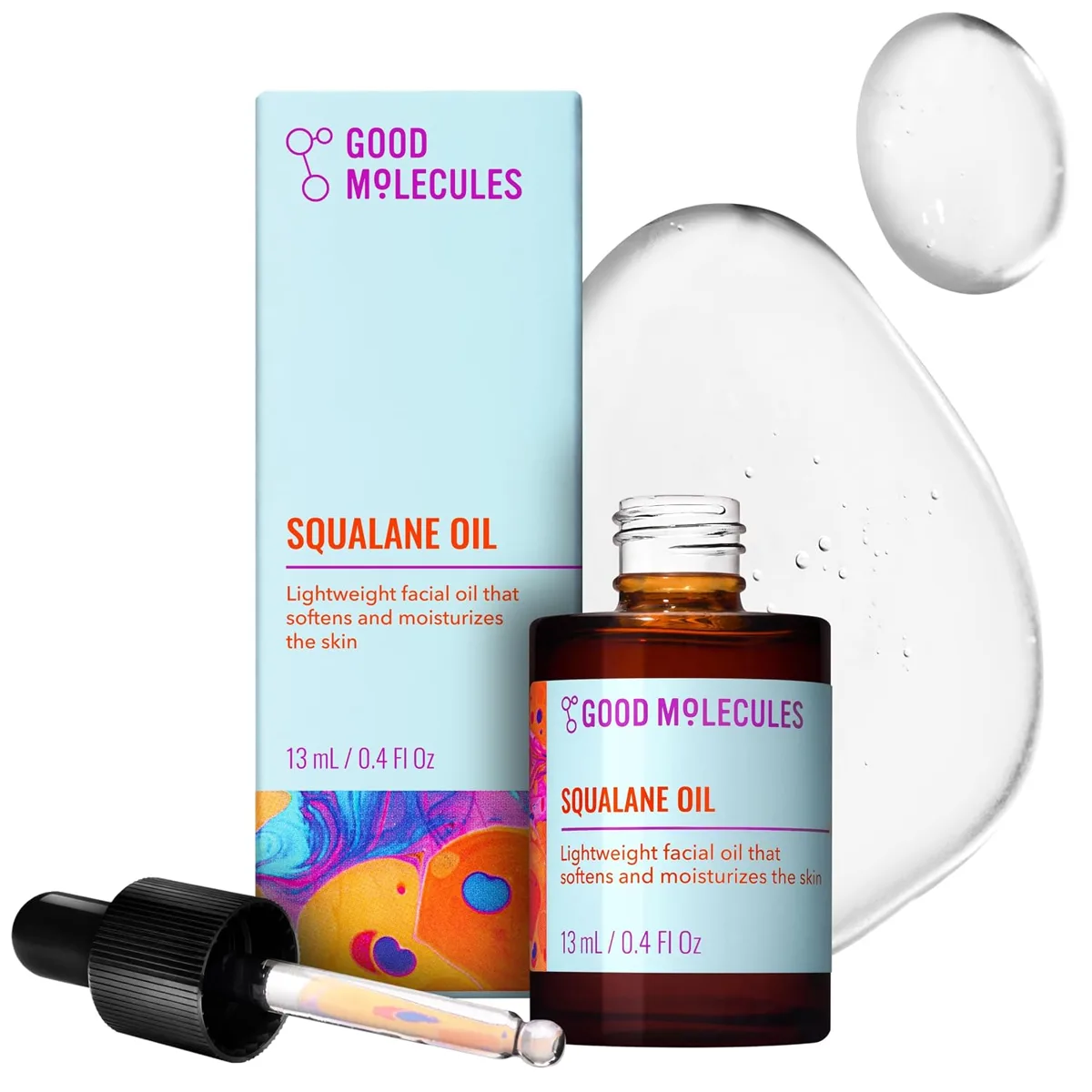
It is squalane and nothing else, olive-derived and fully declared at 100 percent, in a small amber dropper bottle at $8; there is no proprietary blend, no fragrance and no story, just the emollient that most closely resembles the skin's own sebum lipid, sold near cost by a brand whose whole model is transparency. What distinguishes it from other pure squalanes is the price and the size, not the molecule.
One ingredient, fully declared, eight dollars: olive-derived squalane in a 13 ml dropper that softens, seals hydration in, buffers retinoid dryness and suits nearly every skin type, with nothing in it to react to. It does exactly one job and nothing else, the bottle is small enough that the per-ounce price is not the bargain the sticker suggests, and it needs a water-based layer under it to be a moisturiser rather than a softener. As a first squalane or a routine staple, it is hard to fault.
Good choicefor DrynessIn your profileYou chose · Squalane is a reference standard by mechanism for dryness; this oil carries it at 100%.Moderate evidenceGentleNo reviews collected yet
The case for it
Squalane 100% has trial-supported standing for this concern.
It is present at an effective concentration, declared or high in the ingredient list.
The formula carries none of the triggers this concern is sensitive to.
Same rule for everyone. “Good choice” is the verdict on 9,564 of 45,024 concern verdicts across the catalog; rule R5 decided 9,072 of them.
As of September 25, 2026, engine 5.1.1.
Supporting rolefor Compromised Skin BarrierIn your profileYou chose · Nothing here targets compromised skin barrier directly; lipid replenishment is the recognised companion to treating it, and this oil does that without known triggers.Not yet assessedGentleNo reviews collected yet
The case for it
Squalane 100% has no evidence row yet for this concern — it is in the research queue.
The formula carries none of the triggers this concern is sensitive to.
What would change this: A researched evidence row for the lead active would replace this with a verdict.
Same rule for everyone. “Supporting role” is the verdict on 8,197 of 45,024 concern verdicts across the catalog; rule R8 decided 4,250 of them.
As of September 25, 2026, engine 5.1.1.
R8 — The category's job (barrier care, humectant hydration, gentle cleansing, photoprotection) is the documented supportive role for this concern. This is the honest verdict for a moisturizer on an acne page. · the full register
Good choicefor SensitivityIn your profileYou chose · No fragrance, drying alcohol, declarable allergens or sensitising preservatives in this oil — the profile sensitive skin looks for.Not yet assessedGentleNo reviews collected yet
The case for it
Squalane 100% has no evidence row yet for this concern — it is in the research queue.
The formula carries none of the triggers this concern is sensitive to.
What would change this: A researched evidence row for the lead active would replace this with a verdict.
Same rule for everyone. “Good choice” is the verdict on 1,938 of 45,024 concern verdicts across the catalog; rule F2 decided 1,938 of them.
As of September 25, 2026, engine 5.1.1.
Also listed for Dehydration and Winter Skin — the actives here (Squalane) are in our research queue for those concerns; there is no verdict until their evidence rows are written. That is a gap in our table, not a mark against the product.
As a oilNot judged: what a oil is for — fatty-acid profile, seals moisture, resists going rancid — cannot yet be measured from the ingredient list (only pore and malassezia risk can).
A verdict is DermApproved’s assessment of how well a product’s ingredients fit a concern — never a claim about what the product treats. Evidence dots and collected reviews sit beside it and are never blended in.
Rules 0.5.1 · evidence table ev-2026.09-r228 · how we decide
Assessment
Pros & Cons
Pros
✓ Single ingredient, 100 percent olive-derived squalane, fully declared
✓ Non-comedogenic, fungal-acne-safe and oxidation-stable
✓ Odourless, fragrance-free, with nothing to sensitise
✓ Absorbs to a satin finish without greasiness; one drop suits oily skin
✓ Excellent buffer for retinoid and acid dryness
✓ Works on hair ends, cuticles and dry body patches
✓ Eight dollars, and a bottle lasts two to three months at the right dose
Cons
✗ Thirteen millilitres; dearer per ounce than larger squalane bottles
✗ Adds no water; needs a humectant layer under it on dehydrated skin
✗ Too light to seal very dry skin alone in winter
✗ Rubber-bulb dropper is fiddly and dispenses unevenly
✗ Can pill under sunscreen applied too soon
✗ Does nothing beyond emollience, whatever face-oil marketing implies
Review
Full Review
A review normally weighs the formula, and this bottle has none. The label reads Squalane 100%, Good Molecules prints percentages on everything so there is no ambiguity, and the only questions left are what the molecule does, whether this version of it is a good one and whether $8 for 13 millilitres is the right price. Those turn out to be enough questions to fill a review, because squalane is one of the few skincare ingredients that does more or less what it is said to do, and the interesting judgement is where it belongs in a routine.
Squalane is the hydrogenated, fully saturated form of squalene, the hydrocarbon that makes up around a tenth of human sebum and that oxidises quickly on the skin's surface. Saturating it removes the double bonds that oxidise, so squalane stays stable, does not go rancid in the bottle or on the face, does not feed the yeast behind fungal acne and scores at or near zero on comedogenicity assays. It sinks into the outer skin as a light emollient, smoothing rough surfaces and slowing the escape of water, and it does this without the heaviness of a triglyceride oil or the film of a silicone. The commercial versions were once distilled from shark liver; the modern ones, including this, are made from olive oil or sugarcane fermentation, and the molecule is identical. That is the whole science, and it is solid, which is more than can be said for most of the ingredients that share a shelf with it.
The Good Molecules bottle is olive-derived, vegan, odourless and clear, and in use it behaves as squalane should: two or three drops pressed over a moisturiser feel lighter than most plant oils, slip for a minute, and settle within five into a soft, faintly satin finish with no residue. On retinoid nights it is the cheapest good buffer there is, pressed over the treatment or the cream that follows it, and the flaking that tretinoin or an acid produces is visibly softer by morning. On oily skin one drop at night is the right dose and three is too many, which is a matter of quantity rather than chemistry; on very dry skin in winter it softens but does not seal enough on its own and wants a richer occlusive over it. Mixed into a moisturiser that feels too thin, or a drop into foundation, it does what people buy face oils to do without a scent to argue with. The record is enormous for a product this simple, over fifteen thousand Amazon ratings in five years plus Ulta and Beautylish pools, and its complaints are the predictable ones: the bottle is tiny, the dropper is fiddly, it occasionally pills under a sunscreen applied too soon, and it does nothing except moisturise, which some reviewers say as if it were a surprise. The volume of that record matters less than it would for a complex formula, because there is nothing hidden in the bottle for fifteen thousand people to discover, but it does confirm that the oil is what it claims and arrives fresh.
That last point is the honest limit. Squalane adds no water, so on dehydrated skin used alone it makes the surface smoother without replenishing anything, and it belongs over a humectant serum or onto damp skin rather than in place of them. It brightens nothing, firms nothing, treats nothing, and a buyer who reads 'improves fine lines' on a squalane label anywhere is reading the softening of dehydration lines that any emollient produces. It is a final step, not a treatment, and used as one it is among the most reliable products in a routine.
On price the arithmetic is more nuanced than the sticker. Eight dollars is cheap, but 13 millilitres is small, and larger squalane bottles from other brands cost less per millilitre; what the Good Molecules format offers is a low entry price and a size that will not go stale before it is finished, which suits a first-timer or a one-drop-a-night oily-skinned user better than a 100 millilitre bottle would. At two or three drops a night it lasts two to three months, and there is nothing in it that a more expensive squalane improves on, because there is nothing in it but squalane; the premium squalanes on the market are selling a bottle and a brand, not a better molecule.
So the recommendation is uncomplicated. For anyone with dry, normal, combination, sensitive or retinoid-worn skin who wants a light, fragrance-free, non-comedogenic emollient to finish a routine, this is a very good bottle at a price that removes the risk of trying it. For oily skin it works at one drop. For very dry winter skin it is a layer rather than the answer, and for anyone hoping a face oil will do something beyond softening and sealing, no squalane will, and this one is at least honest enough to print that on the label.
Formula
Key Ingredients
The hero actives that drive this product's performance.
The entire bottle: hydrogenated squalene from olives, a fully saturated hydrocarbon that mimics the squalene in human sebum without its tendency to oxidise, sinks into the skin without greasiness, and works on the face as a light emollient that seals hydration in over serums; no carrier, no fragrance, no preservative needed because there is no water.
Established mechanismfor Dryness · established mechanism
Ingredient standings describe the active at treatment-level doses and
vehicles; this product's own condition grades weigh its actual formula.
Press two or three drops on as the last step, after water-based serums and moisturiser, or mix a drop into a moisturiser that feels too light; on oily skin a single drop at night is plenty. It buffers a retinoid or acid night well, sits under sunscreen if given a minute, and doubles as a hair-end and cuticle oil.
Results Timeline
Immediate: skin feels softer and looks lightly luminous within a minute, with the slip gone in five. Short-term (1-2 weeks): flaking and post-retinoid dryness ease as the lipid layer reduces water loss. Long-term: a steadier barrier with continued use; it does not brighten, firm or treat anything, and does not need to.
Pairs Well With
any water-based serum underneatha retinoid or acid nighta plain moisturizer to sealmixing into foundation for a dewy finish
Squalane is the fully hydrogenated derivative of squalene, a C30 triterpene hydrocarbon that constitutes roughly 10 to 15 percent of human sebum and is a precursor in cholesterol synthesis. Saturating squalene's six double bonds yields a molecule that is chemically inert to oxidation, which matters because sebaceous squalene peroxidises readily under UV and is implicated in comedone formation and inflammation; squalane carries none of that liability, and in comedogenicity testing on the rabbit ear and in human back assays it scores at or near zero. Its emollient action is physical: it spreads readily over the stratum corneum, fills gaps between corneocytes and forms a light, non-occlusive-to-semi-occlusive lipid layer that reduces transepidermal water loss modestly, less than petrolatum or mineral oil but with far greater cosmetic acceptability. Controlled studies of squalane-containing emollients show improvements in hydration, roughness and barrier recovery, and squalane has a long history as a vehicle in dermatological preparations because of its inertness and skin compatibility.
Because squalane is a saturated hydrocarbon rather than a triglyceride, it is not a substrate for Malassezia lipases and is considered compatible with fungal-acne-prone skin, and it does not hydrolyse to free fatty acids on the skin. It has no humectant capacity, does not penetrate to the dermis in meaningful amounts and exerts no biological signalling, so claims of anti-ageing, brightening or collagen effects for pure squalane rest on the softening of dehydration lines rather than on any mechanism. Modern commercial squalane is produced from olive oil squalene or from sugarcane via fermentation-derived farnesene; the products are chemically identical, and olive-derived material is typically 92 to 95 percent squalane with minor saturated hydrocarbons. Pure squalane requires no preservative, and its allergenic potential is negligible, with contact allergy essentially unreported in the literature. No study of this specific product exists, and none would add to the ingredient's record.
Dermatologist Perspective
Dermatologists regard squalane as one of the safest emollients available, frequently suggesting it for patients on topical retinoids, benzoyl peroxide or acids whose skin needs a bland lipid layer without added actives, fragrance or preservatives, and for acne-prone patients who want an oil without the comedogenic risk of coconut or heavy triglyceride oils. Its inertness makes it suitable for rosacea, eczema and post-procedure skin as a finishing layer, with the usual caution that it is an emollient rather than a full occlusive and that very dry or eczematous skin still needs a humectant beneath it and, often, a heavier ointment on top. Clinicians would not attribute any anti-ageing or brightening effect to pure squalane and would describe such claims as marketing; they would also note that for acne-prone patients the correct dose is a drop or two, since any oil in excess sits on the surface. A single-ingredient, fully declared squalane at this price is the kind of product clinicians can recommend without qualification about the formula, because there is no formula.
Guidance
Usage & Recommendations
How to Use
Use it as the last step of the routine, morning or night, after water-based serums and moisturiser have absorbed: squeeze the dropper bulb to draw up a little oil, drop two or three drops onto the fingertips, warm them briefly and press them over the face and neck rather than rubbing. Oily skin starts with a single drop at night; dry skin can use three and layer a heavier cream over it in winter. On retinoid or acid nights, press it over the treatment or over the moisturiser that follows to buffer dryness. In the morning, allow a minute before sunscreen so it does not pill. A drop can be mixed into a moisturiser or foundation, smoothed over hair ends or rubbed into cuticles. Store it out of direct sun with the cap tight, though pure squalane does not go rancid.
Value Assessment
Eight dollars for 13 ml is about $18 an ounce, which is not the cheapest squalane per millilitre, since larger bottles from other brands undercut it, but is a low absolute outlay and a sensible size for an oil used two or three drops at a time; a bottle lasts two to three months at a nightly dose and longer for a one-drop oily-skin user. The money buys the identical molecule found in squalanes at any price, fully declared, vegan, with a brand that sells near cost; there is nothing an expensive squalane adds beyond packaging. For a first squalane or a routine staple bought in small, fresh quantities the value is excellent, and the only better deal is the same ingredient in a bigger bottle for someone certain they will use it all.
Who Should Buy
Nearly everyone: dry, normal, combination and sensitive skin wanting a light, fragrance-free emollient to finish a routine, retinoid and acid users needing a bland buffer, oily and acne-prone skin wanting a non-comedogenic, fungal-acne-safe oil at one drop, and anyone trying squalane for the first time who wants an $8 bottle rather than a commitment.
Who Should Skip
Very dry winter skin expecting a single oil to be the whole moisturiser, since squalane softens without sealing enough alone, and dehydrated skin using it without a humectant beneath. Heavy users who go through oil quickly will find bigger bottles cheaper per millilitre, and anyone wanting a face oil to brighten or firm is looking for a different product entirely.
A clear, thin, entirely odourless oil that feels lighter than most plant oils, glides over the skin and sinks in within a few minutes to a soft, faintly satin finish with no film
Scent
None at all; pure squalane is odourless, which is one of its virtues
Packaging
A 13 ml amber glass bottle with a rubber-bulb dropper
Finish
satinnon-greasyfast-absorbing
What to Expect on First Use
Two drops pressed over a moisturiser feel lighter than expected and vanish within minutes, leaving the skin soft and slightly luminous with no oil slick; retinoid-dried patches feel better the next morning. There is no scent, no tingle and no adjustment period. Very dry skin in winter may find it needs a richer occlusive over the top, and oily skin should start with a single drop at night.
How Long It Lasts
About 2-3 months at two or three drops nightly; longer at one drop
Good Molecules launched in 2019 as Beautylish's answer to the single-ingredient, low-price skincare wave, and added this squalane in 2021 to complete a small set of plain oils alongside its rosehip and facial oil blends. Olive-derived squalane, produced by hydrogenating squalene from olive oil, replaced the shark-liver squalane of earlier decades; the brand's version is vegan, and its 13 ml size keeps the price under ten dollars.
About Good Molecules Established Brand (5–20 years)
Good Molecules has been Beautylish's near-cost house brand since 2019, printing full percentages on every label; this single-ingredient squalane, on sale since 2021, is about as transparent as a product can be. The brand runs no clinical trials, and for a one-ingredient oil the evidence is the ingredient's own, which is substantial.
Brand founded: 2019 · Product launched: 2021
Myth vs. Reality
Common Myths
Myth
Squalane will clog pores or make oily skin oilier
Reality
Squalane is a saturated hydrocarbon with a comedogenic rating of zero to one in the usual assays, does not feed the Malassezia yeast behind fungal acne, and does not oxidise on the skin the way its unsaturated cousin squalene does. Oily skin can use a single drop; it is the amount, not the molecule, that makes a face feel greasy.
Myth
Squalane hydrates the skin
Reality
It does not add water; it is an emollient that smooths the surface and reduces the rate at which water escapes. Applied over a water-based serum or onto damp skin it locks hydration in; applied alone to dry, dehydrated skin it softens without replenishing, which is why it works best as a final layer.
FAQ
Frequently Asked Questions
What is in the Good Molecules Squalane Oil?
One ingredient: 100 percent plant-derived squalane, made by hydrogenating squalene from olives. There is no carrier oil, fragrance, preservative or additive, which is possible because an anhydrous single oil needs none of them.
Is the Good Molecules Squalane Oil good for oily or acne-prone skin?
Yes, in the right amount. Squalane is non-comedogenic, fungal-acne-safe and does not oxidise on the skin, and a single drop pressed on at night gives oily skin a barrier-supporting lipid without a greasy film. Three drops on an already oily face will feel like too much, so start small.
When in a routine should the squalane oil go?
Last, or mixed into the last step. Apply it after water-based serums and moisturiser so it seals them in, or add a drop to a moisturiser that feels too light; in the morning give it a minute before sunscreen. On retinoid or acid nights it buffers dryness well when pressed on over the treatment.
Does the Good Molecules squalane help with retinol dryness?
It is one of the best cheap options for it. Squalane reduces water loss and smooths flaking without any active of its own to add irritation, so two or three drops over a retinoid or over the moisturiser that follows it takes the edge off the peeling phase.
Is the Good Molecules Squalane Oil worth it at $8 for 13 ml?
Per ounce it is not the cheapest squalane sold, since larger bottles from other brands cost less per millilitre, but at two or three drops a night a 13 ml bottle lasts two to three months, so the outlay is small and the format suits anyone trying squalane for the first time. The molecule is identical wherever it is bought.
Can the squalane oil be used on hair, cuticles or the body?
Yes. A drop smoothed over hair ends tames frizz without weight, a drop rubbed into cuticles softens them, and it is pleasant on dry patches of the body, though the 13 ml bottle makes whole-body use impractical.
Reviews
What Reviewers Tend to Say
Recurring themes our editors read across retailer reviews of this product — summaries in our words, not quotations, and not a substitute for your own patch test.
Common Praise
absorbs without greasiness
calms retinol dryness
works on face, hair and cuticles
no smell, no sting
unbeatable price
Common Complaints
tiny 13 ml bottle
dropper is fiddly
too light for very dry skin in winter
does nothing beyond moisturising
occasional pilling under sunscreen
Notable Endorsements
Single-ingredient formula, 100% declaredSold at Ulta, Amazon and Beautylish
The burn trials are real and the skeptics who dismiss aloe as folklore are wrong — but the same substance has delayed healing in other wounds, and none of it says anything about what a soothing gel does to intact skin.
The poreless, lit-from-within look is part real barrier health and part genetics, lighting, and a good primer — and chasing it literally can wreck the very skin you're trying to perfect.
The internet's favorite hydrator has a counterintuitive dark side — in dry air, a humectant with nothing to seal it can pull water out of your skin instead of into it.
Jun 10, 2026· 5 min
Questions people ask about sensitive skin
Verified answers from our questions library — the nuance a product page cannot carry.
Products, answers, therapy guides, tools and articles in one search. Brand names,
slang and abbreviations all work — accutane finds isotretinoin, bacne finds truncal acne.