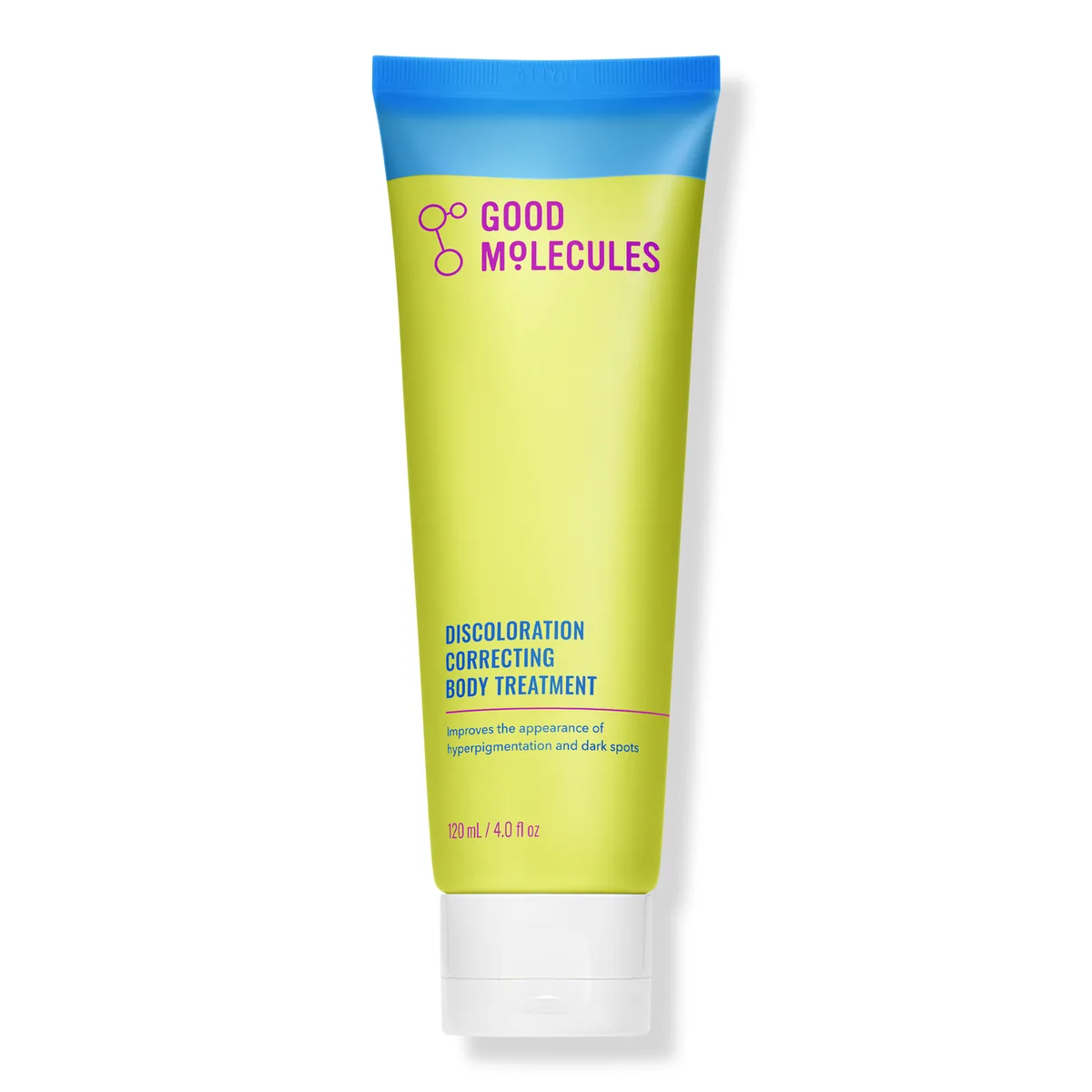
It takes the exact active trio of the brand's best-selling face serum, a lipophilic tranexamate ester, four percent niacinamide and two percent acetyl glucosamine, and re-engineers it into a body lotion with an LHA to cut through thicker skin and a fatty-acid base to hold onto a large area, at fifteen dollars for a hundred and twenty millilitres. Body brighteners in the US either use hydroquinone-adjacent actives or mostly fragrance and shea; this one is a treatment-strength formula sold as a lotion.
Good Molecules Discoloration Correcting Body Treatment Review
Face-Serum Actives for the Body
body carelotionindieParaben FreeCruelty FreeVegan
A rare thing at fifteen dollars: a body lotion with face-serum brighteners at declared doses and nothing fragranced or gimmicky around them. It softens skin within a week and lightens underarm, bikini-line and post-acne marks gradually over two to three months for most people who stick with it; knees, elbows and chafed thighs respond slowly and partially, some skin does not respond at all, and a few users react to it. Worth a tube for fresh body marks, with patience and sunscreen.
Good choicefor HyperpigmentationIn your profileYou chose · Niacinamide is a trial-supported active for hyperpigmentation; this lotion carries it at 4%.Moderate evidenceStandard tolerabilityNo reviews collected yet
The case for it
Niacinamide 4% has trial-supported standing for this concern.
It is present at an effective concentration, declared or high in the ingredient list.
The formula carries no trigger this concern is sensitive to, with the cautions noted.
Same rule for everyone. “Good choice” is the verdict on 9,564 of 45,024 concern verdicts across the catalog; rule R5 decided 9,072 of them.
As of September 25, 2026, engine 5.1.1.
Promisingfor Dark SpotsIn your profileYou chose · Niacinamide has trial-level evidence for dark spots but no guideline or regulatory standing yet — promising, short of a recommendation; the other actives here are not yet assessed for it.Moderate evidenceStandard tolerabilityNo reviews collected yet
The case for it
Niacinamide 4% has trial-level evidence for this concern but no guideline or regulatory standing yet.
It is present at an effective concentration, declared or high in the ingredient list.
The formula carries no trigger this concern is sensitive to, with the cautions noted.
What would change this: Guideline or regulatory standing for the active on this concern would move this from a promising bet to a recommendation.
Same rule for everyone. “Promising” is the verdict on 7,858 of 45,024 concern verdicts across the catalog; rule R9p decided 7,858 of them.
As of September 25, 2026, engine 5.1.1.
R9p — 0.5.0: 'Unproven' beside three filled dots read as one question answered twice with opposite words (7,018 rows). The chip measures standing, the dots measure trial volume; where the row carries at least one RCT or a tier-2 source (moderate dots) and the active is present at a working level, the honest word is Promising. Unproven is reserved for plausible-standing rows with limited or weak evidence, or an under-dosed form. Same rank as Unproven — a bet either way; the dots order them. · the full register
Carrying active
Niacinamide 4%
Standing
plausible — trials support it
Form
adequate (declared 4%)
Tolerability
standard
Row checked
against its sources on July 17, 2026 (evidence table ev-2026.09-r228)
Not for thisfor Acne ScarringIn your profileYou chose · The actives here have been researched for acne scarring and the evidence does not support the claim.Not yet assessedStandard tolerabilityNo reviews collected yet
The case for it
Niacinamide 4% has been researched for this concern and the evidence does not support it.
It is present at an effective concentration, declared or high in the ingredient list.
The formula carries no trigger this concern is sensitive to, with the cautions noted.
Same rule for everyone. “Not for this” is the verdict on 488 of 45,024 concern verdicts across the catalog; rule R10 decided 488 of them.
As of September 25, 2026, engine 5.1.1.
Supporting rolefor Keratosis PilarisIn your profileYou chose · Nothing here targets keratosis pilaris directly; emollient hydration is the recognised companion to treating it, and this lotion does that without known triggers.Not yet assessedStandard tolerabilityNo reviews collected yet
The case for it
Niacinamide 4% has no evidence row yet for this concern — it is in the research queue.
The formula carries no trigger this concern is sensitive to, with the cautions noted.
What would change this: A researched evidence row for the lead active would replace this with a verdict.
Same rule for everyone. “Supporting role” is the verdict on 8,197 of 45,024 concern verdicts across the catalog; rule R8 decided 4,250 of them.
As of September 25, 2026, engine 5.1.1.
R8 — The category's job (barrier care, humectant hydration, gentle cleansing, photoprotection) is the documented supportive role for this concern. This is the honest verdict for a moisturizer on an acne page. · the full register
Also listed for Rough Texture — the actives here (Niacinamide, Cetyl Tranexamate Mesylate, Acetyl Glucosamine, linoleic acid) are in our research queue for that concern; there is no verdict until their evidence rows are written. That is a gap in our table, not a mark against the product.
As a body productNot judged: what a body product is for — real substance, not just slip, realistic to use daily — cannot yet be measured from the ingredient list (only fragrance load can).
A verdict is DermApproved’s assessment of how well a product’s ingredients fit a concern — never a claim about what the product treats. Evidence dots and collected reviews sit beside it and are never blended in.
Rules 0.5.1 · evidence table ev-2026.09-r228 · how we decide
✓ Lipophilic salicylic acid exfoliates thick body skin without stinging
✓ Fragrance-free, alcohol-free and non-greasy for a body lotion
✓ Softer, smoother skin within the first week for most users
✓ Gradual lightening of underarm, bikini-line and post-acne marks over 8-12 weeks
✓ Panthenol, allantoin and bisabolol keep the formula calming
✓ Fifteen dollars for 120 mL of treatment-level actives
Cons
✗ Unexplained Aspergillus and Saccharomyces ferments high in the list
✗ A steady minority see no change on knees, elbows or thighs after a tube
✗ Occasional itching, redness or hives, sometimes despite a patch test
✗ Slow: months, not weeks, and partial on deep or friction pigment
✗ Tube empties fast if used over large areas twice daily
✗ Fatty acids and fatty alcohols make it unsuitable for fungal-acne-prone backs
Review
Full Review
Body hyperpigmentation is one of the most common skin complaints there is and one of the least served. Dark underarms from shaving, a bikini line that has gone brown from friction, knees and elbows, the scatter of marks a bout of back acne leaves behind: millions of people have them, and the drugstore shelf answers with fragranced shea lotions that promise even tone and deliver moisturising. Anything with actual brighteners has tended to live in the face aisle, in thirty-millilitre bottles priced for a face. Good Molecules noticed that its own face serum was being smeared onto underarms and elbows by customers who had run out of alternatives, and built this tube for them: the same actives, a body base, a hundred and twenty millilitres, fifteen dollars.
The actives are declared and they are the real ones. Cetyl tranexamate mesylate at two percent, a lipophilic ester of tranexamic acid built to cross oily, thick skin and release the acid inside it. Niacinamide at four percent and acetyl glucosamine at two, the pairing a controlled facial study tested for discolouration, which blocks pigment transfer and tyrosinase activation from two directions. Capryloyl salicylic acid, the gentle lipophilic exfoliant, to work through the keratin-heavy surface that body areas build. Linoleic acid, with small data for hastening the breakdown of tyrosinase, and panthenol, allantoin and bisabolol to keep the whole thing calm. Two fermentation ingredients sit high in the list, an Aspergillus ferment at third and a Saccharomyces ferment at seventh; the brand says nothing about them, and the most charitable reading is that the koji ferment carries traditional brightening compounds, but a declared active in third place would have been better than a mystery. No fragrance, no alcohol, no essential oils. It is, ingredient for ingredient, a treatment sold in a lotion tube. It is also worth saying what the tube is not: there is no hydroquinone, no retinoid and no alpha hydroxy acid in it, which keeps it usable on skin that is shaved every few days and makes it a gentler proposition than most body-brightening routines people assemble from face products.
The base is a conventional emulsion of fatty alcohols, glyceryl stearate and a conditioning quaternary, medium-weight, non-greasy, quick to sink in and pleasant to wear under clothes; on that alone it is a decent unscented body lotion. Reviewers are near-unanimous that skin feels softer and smoother within the first week, which is the LHA and the emollients doing their part, and it is the first thing anyone notices. The brightening takes far longer, and here the reviews split in a way that deserves honest reporting. The majority who used it twice daily for two to three months describe gradual, real lightening of underarms, bikini lines and post-acne marks on the arms, chest and back, the areas where pigment sits relatively shallow and is not being re-made every day. A steady minority used a full tube on knees, elbows or inner thighs and saw nothing, and their frustration is reasonable, though the target is the hardest one there is: friction pigment on thick skin that gets rubbed dark again with every step. And a small number reacted, with itching, redness and in at least one case hives spreading beyond the treated area despite a clean patch test. Cetearyl alcohol, the quaternary conditioner and the fungal ferment are the plausible suspects; the honest advice is to patch test on the inner arm for several days, not two, before covering a large area.
That pattern is what a body brightener looks like when it works about as well as topical brighteners work. The face-serum evidence for these actives is real and modest; body skin is thicker, slower and more abused, so the effect is slower and more modest again, and the difference between the underarm that lightens and the knee that does not is mostly anatomy and friction rather than the formula. Sunscreen on exposed areas by day is not optional, because pigment the lotion is dismantling at night is re-laid by an afternoon in short sleeves faster than any lotion can undo it.
On cost, a hundred and twenty millilitres for fifteen dollars is inexpensive for declared actives at these levels, and expensive as a body lotion, which is the right way to think about it: this is a treatment to be applied to the areas being treated, not slathered all over, and used that way a tube covers two moderate areas for about a month. People who spread it over both legs twice a day are the ones who complain about tube size.
So the recommendation comes with a map. Fresh post-acne marks on the back and arms, dark underarms and bikini lines from shaving, and shallow friction marks are where it does its best work and where a tube or two with patience and sunscreen is money well spent. Knees, elbows and chafing thighs are a long, partial project that it may help with and may not, and old, deep pigment is outside what any lotion can do. Anyone with a history of reacting to body products should treat the patch test as serious, and everyone else should give it twelve weeks before deciding.
Formula
Key Ingredients
The hero actives that drive this product's performance.
Ingredient
Function
Evidence
Cetyl Tranexamate Mesylate 2% (TXVector) (2%)
A lipophilic ester of tranexamic acid, declared at two percent and ninth on the list, designed to cross the thick, oily barrier of body skin better than the water-soluble acid and to release tranexamic acid where it can quiet the signalling that drives pigment; it is the same headline active as the brand's face serum, carried in a richer body base.
Sixth on the list at four percent, blocking the transfer of pigment granules from melanocytes into the surrounding skin cells, paired here with acetyl glucosamine in the ratio a published study tested for facial discolouration and applied across a much larger area of body skin.
The amino sugar that inhibits the final step of tyrosinase activation, placed right after the tranexamate at two percent and chosen specifically because its combination with four percent niacinamide has controlled data for reducing the look of hyperpigmentation.
The lipophilic salicylic derivative near the end of the list, exfoliating cell by cell at the surface so the brighteners reach skin that is not buried under the rough, keratin-heavy layer that body areas like knees, elbows and underarms build up.
The essential fatty acid eleventh on the list, with cell-culture data for hastening the breakdown of tyrosinase and a small human study of lightening UV-induced pigment, doubling here as a barrier lipid that keeps a twice-daily treatment from drying body skin.
Not yet assessed
Ingredient standings describe the active at treatment-level doses and
vehicles; this product's own condition grades weigh its actual formula.
Massages into clean, dry body skin on its own, morning and night, over the areas being treated rather than all over; a body moisturiser can follow if the areas are dry, and by day any exposed area needs sunscreen or it will re-darken faster than the lotion can lighten it. Keep it away from freshly shaved or waxed skin for a day.
Results Timeline
Smoother, softer skin within the first week from the base and the LHA. Post-inflammatory marks on arms, legs and underarms lighten gradually over eight to twelve weeks of twice-daily use, with sunscreen; deeper or long-standing pigment such as chafing-darkened thighs and knees can take three to six months and may only partially improve.
Pairs Well With
Body sunscreen on exposed areasGentle body washUrea or lactic body lotion on alternate nightsHydrocortisone-free anti-chafe care
The brightening core mirrors the brand's face serum and rests on three mechanisms. Tranexamic acid, an antifibrinolytic drug, reduces hyperpigmentation by blocking plasminogen activation in keratinocytes, which lowers the prostaglandin and arachidonic-acid signalling that stimulates melanocytes after inflammation or UV; oral and topical tranexamic acid have controlled trials in melasma, and topical concentrations of two to five percent have shown improvement comparable to hydroquinone in some small studies. Cetyl tranexamate mesylate is a lipophilic ester designed to improve delivery of the polar parent acid through the stratum corneum and to hydrolyse to tranexamic acid in the skin; its evidence consists of supplier studies and formulation work rather than independent trials, and no study applies it to body skin. Niacinamide inhibits melanosome transfer from melanocytes to keratinocytes, with randomised facial trials at two to five percent showing reduced hyperpigmentation over eight to twelve weeks; N-acetyl glucosamine inhibits glycosylation of tyrosinase, and a randomised, vehicle-controlled facial trial of four percent niacinamide with two percent acetyl glucosamine, the ratio used here, reported significantly greater reduction in the appearance of irregular pigmentation than either agent alone.
The body adaptation is mostly about penetration. Capryloyl salicylic acid, a lipophilic derivative of salicylic acid, exfoliates corneocytes individually at the surface with less irritation than salicylic acid, and it has clinical data in acne and photoaging; here it addresses the thicker, more keratinised stratum corneum of body sites. Linoleic acid has cell-culture data showing accelerated proteasomal degradation of tyrosinase and a small human study of topical linoleic acid lightening UV-induced pigmentation. The two fermentation ingredients, Aspergillus ferment third on the list and Saccharomyces ferment seventh, have traditional and in-vitro brightening associations through kojic-type metabolites and antioxidant activity, but the brand does not declare their content or role, and no claim can be made for them. The emulsion base of cetearyl and cetyl alcohols, glyceryl stearate and behentrimonium methosulfate is standard and well tolerated by most, though cetearyl alcohol and quaternary conditioners are recognised, if uncommon, contact allergens, consistent with the small number of reported reactions.
The important gap is that all controlled evidence for these actives comes from facial studies; body skin is thicker, turns over more slowly and, at friction sites, is under continual re-stimulation, so slower and smaller effects should be expected. No clinical study of this product has been published.
Dermatologist Perspective
Dermatologists see body hyperpigmentation constantly, most often as post-inflammatory darkening at the underarms, groin and inner thighs from shaving and friction, and as the residue of truncal acne, and the standard advice starts with removing the cause: gentler hair removal, reducing chafing, treating the acne. For the pigment itself, the actives in this lotion are ones clinicians recognise from facial practice: tranexamic acid, niacinamide and acetyl glucosamine all have controlled data, and a lipophilic salicylate is a reasonable choice to help them through thicker skin. The realistic clinical expectation is a slow, partial improvement on shallow post-inflammatory marks over three months and much less on deep, long-standing pigment, which usually needs prescription retinoids, hydroquinone or procedures. In practice a patient would be told to patch test on the inner arm for several days, to apply it only to the areas concerned, to use sunscreen on any exposed treated skin, and to stop at any itching, since an occasional contact reaction to emulsifiers or ferments is reported. It is a sensible over-the-counter first step, and a poor one for melasma on the body or for anyone hoping to change baseline skin tone.
Guidance
Usage & Recommendations
How to Use
Twice a day, after washing and drying, squeeze a small amount onto the fingertips and massage into the specific areas being treated, underarms, bikini line, knees, elbows or marks on the back and arms, until absorbed; there is no need to cover skin that is not discoloured. Let it sink in for a minute before dressing. Wait at least a day after shaving or waxing before applying to that area, and before first use test a patch on the inner arm for several days rather than one, since occasional reactions surface late. By day, any treated area that sees sun needs sunscreen, or the pigment will return faster than it fades. Expect softer skin in a week and give lightening eight to twelve weeks of consistent use; stop at any itching, rash or hives.
Value Assessment
Fifteen dollars for 120 mL is inexpensive for a formula with three declared brighteners at these doses; comparable actives on the face cost similar money for a quarter of the volume. Judged as a body lotion it is pricey, so the value depends on using it as a targeted treatment on the areas being lightened rather than as an all-over moisturiser, in which case a tube lasts about a month on two moderate areas. The value holds for shallow marks, underarms and post-acne pigment, where most users see a change in two to three months, and falls for knees, thighs and old pigment, where a significant minority finish a tube with nothing to show. There is a single size, and the brand sells a two-pack at a small saving.
Who Should Buy
Anyone with dark underarms, a discoloured bikini line, or post-acne marks on the back, chest and arms who wants a fragrance-free, active-driven body treatment at a drugstore price and is prepared to use it twice daily for three months with sunscreen. It also suits people already using the brand's face serum who want the same approach below the neck.
Who Should Skip
People targeting deep, long-standing pigment on knees, elbows or inner thighs may be disappointed, and anyone with a history of reacting to body lotions should treat the patch test seriously or pass. Fungal-acne-prone backs do poorly with its fatty acids and alcohols, and pregnant users should ask a clinician before covering large areas with a salicylate-containing product.
Ready to try Good Molecules Discoloration Correcting Body Treatment?
A medium-weight white lotion, creamier than a body milk but lighter than a body butter, that spreads easily over a large area, sinks in over a minute and leaves a soft, non-greasy, slightly conditioned feel from the fatty alcohols.
Scent
Unscented, with a faint fatty, faintly yeasty note from the ferments and fatty acids that fades as it absorbs.
Packaging
A 120 mL soft squeeze tube in acid yellow with a blue cap panel and a white flip-top, the brand's block lettering in magenta; the tube dispenses cleanly and shows how much remains.
Finish
non-greasysatin
What to Expect on First Use
The first applications feel like an ordinary conditioning body lotion, with no tingle for most people and a mild warmth on freshly shaved skin from the LHA. Softer, smoother texture is the first change, within days; there is no visible lightening for several weeks, which is normal, and any itching or bumps in the first week is a signal to stop, since a small number of users react to it.
How Long It Lasts
About a month at twice daily on two moderate areas such as underarms and knees, or two months once daily on one.
Good Molecules launched its Discoloration Correcting Serum in 2020 around cetyl tranexamate mesylate, a Korean-developed tranexamic acid ester, and it became the brand's signature product. Body hyperpigmentation, from underarms and bikini lines to knees and post-acne marks on the back, was the most common request for a version of it, and in 2022 the brand released this tube to answer that with the same actives in a body-appropriate base.
About Good Molecules Established Brand (5–20 years)
Good Molecules has sold ingredient-forward, low-cost skincare since 2019 through Beautylish, Ulta, Target and Amazon, and its Discoloration Correcting Serum became one of the brand's signature products; this 2022 body version extends the same tranexamate-and-niacinamide approach. The brand publishes complete ingredient lists and percentages for headline actives but has not run or released clinical testing on the product.
Brand founded: 2019 · Product launched: 2022
Myth vs. Reality
Common Myths
Myth
A body brightener can lighten natural skin tone or make skin uniformly paler.
Reality
The actives here interrupt excess pigment production from inflammation, friction and sun, so they can fade a dark underarm or a post-acne mark toward the surrounding skin; they do not lighten baseline skin colour and are not designed to.
Myth
Knees, elbows and inner thighs will fade as quickly as a face serum fades a spot.
Reality
Body skin is thicker, turns over more slowly and, in friction areas, is being re-darkened daily by rubbing. Expect months rather than weeks, partial rather than complete improvement, and little change unless the friction or sun that caused the pigment is also addressed.
FAQ
Frequently Asked Questions
What does the Good Molecules Discoloration Correcting Body Treatment do?
It is a fragrance-free body lotion built on two percent cetyl tranexamate mesylate, four percent niacinamide and two percent acetyl glucosamine, with a lipophilic salicylic acid to exfoliate, aimed at dark marks on the body: underarms, bikini line, knees, elbows, and post-acne marks on the back, chest and arms.
How long does the Good Molecules body treatment take to work on dark underarms?
Most users who see a change report it at eight to twelve weeks of twice-daily use; underarms and post-acne marks tend to respond sooner than knees, elbows or inner thighs, where friction keeps re-darkening the skin. Reducing the friction and shaving irritation matters as much as the lotion.
Can the Good Molecules Discoloration Correcting Body Treatment be used on the face?
It is formulated for body skin, with a heavier fatty-alcohol base and an LHA. The brand's Discoloration Correcting Serum carries the same actives in a face-appropriate texture and is the better choice above the neck.
Is the Good Molecules body treatment safe for the bikini line and inner thighs?
Yes, on intact, unshaved skin; it is fragrance-free and the LHA is mild. Wait a day after shaving or waxing, patch test first, and stop if it itches, since a small number of reviewers have reacted with redness or hives.
Does the Good Molecules Discoloration Correcting Body Treatment contain hydroquinone or acids?
No hydroquinone. It contains capryloyl salicylic acid, a gentle lipophilic exfoliant, and the tranexamate ester, niacinamide and acetyl glucosamine as brighteners; there are no alpha hydroxy acids or retinoids.
Can I use the Good Molecules body treatment while pregnant?
Its salicylic derivative is present in a small amount over a potentially large area, and the tranexamate ester has no pregnancy data, so it is one to raise with a clinician rather than assume. The niacinamide and acetyl glucosamine are not a concern on their own.
Reviews
What Reviewers Tend to Say
Recurring themes our editors read across retailer reviews of this product — summaries in our words, not quotations, and not a substitute for your own patch test.
Common Praise
Users consistently report softer, smoother skin on arms and legs within a week
Gradual lightening of underarm, bikini-line and post-acne marks over two to three months
Fragrance-free and non-greasy for a body lotion
Price against face-serum-strength actives
Common Complaints
A common complaint is no visible change after a full tube on knees and thighs
Occasional itching, redness or hives, sometimes despite a clear patch test
It was invented to stop bleeding during surgery. In 2026 it's in dozens of brightening serums — and the evidence is better than most trend ingredients can claim.
Body grooming produces the same four complications in the same order, in a predictable population — and almost every fix is upstream of the razor rather than downstream of it.
Antiperspirants and deodorants solve unrelated problems, a large share of people buying either are genetically incapable of producing the smell, and the aluminium question has a real answer that nobody bothers to give.
Burn depth is governed by acidity and contact time, not by the percentage on the front — which makes the one number these kits print the one number that predicts nothing.
Aug 28, 2026· 9 min
Questions people ask about Hyperpigmentation
Verified answers from our questions library — the nuance a product page cannot carry.
Products, answers, therapy guides, tools and articles in one search. Brand names,
slang and abbreviations all work — accutane finds isotretinoin, bacne finds truncal acne.