


Your 'Skin Barrier' Is a Brick Wall — and Most 'Barrier Repair' Creams Don't Have the Mortar
'Barrier repair' is the most over-used phrase in skincare, usually printed on products that contain none of the lipids a barrier is actually built from.
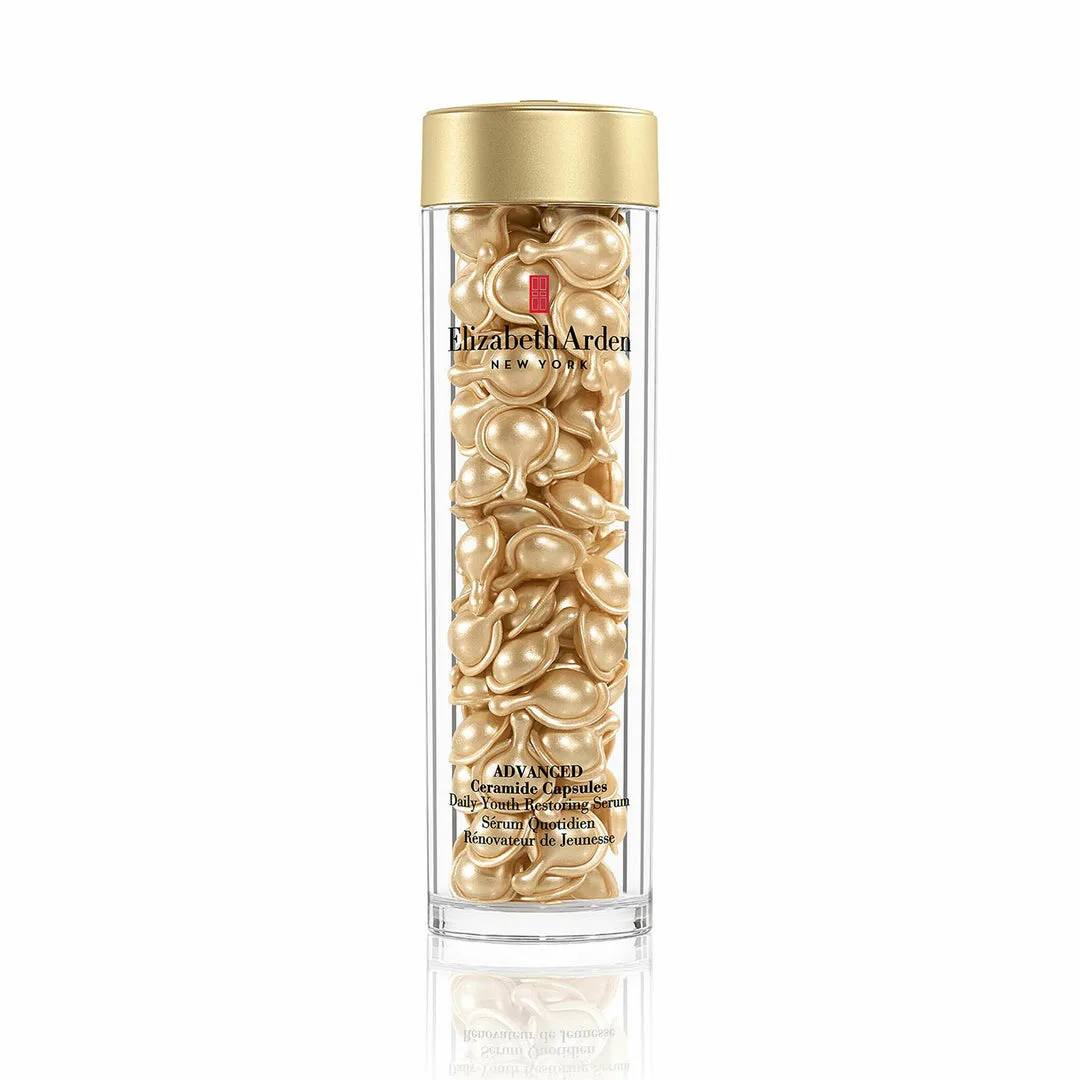
This was the original single-dose skincare capsule — Elizabeth Arden pioneered the biodegradable capsule delivery system for facial serums in 1990, and it's still the reason anyone buys this product. Because each dose is sealed in an airtight capsule, the ceramides, cholesterol, and retinyl palmitate stay fresh for the full shelf life, which no jarred ceramide cream can claim.
One of the few pieces of prestige skincare theater that's also legitimate barrier science. The biodegradable capsule format keeps the ceramide, cholesterol, and fatty acid blend stable for its whole shelf life, which most jarred ceramide creams can't match. The price is a lot to swallow for what is, mechanistically, a sophisticated lipid-replacement serum.
The case for it
What would change this: A concentration inside the studied range would raise this a step.
Same rule for everyone. “Unproven” is the verdict on 1,111 of 45,024 concern verdicts across the catalog; rule R9 decided 1,111 of them. Unchanged since September 5, 2026, engine 5.1.1.
Brand or formulator? Disclose a concentration or correct a fact →
The studies behind the evidence row
The case for it
What would change this: A declared concentration would move this to a firmer reading of the dose.
Same rule for everyone. “Good choice” is the verdict on 9,564 of 45,024 concern verdicts across the catalog; rule R5 decided 9,072 of them. Unchanged since September 5, 2026, engine 5.1.1.
Brand or formulator? Disclose a concentration or correct a fact →
The studies behind the evidence row
The case for it
What would change this: A declared concentration would move this to a firmer reading of the dose.
Same rule for everyone. “Good choice” is the verdict on 9,564 of 45,024 concern verdicts across the catalog; rule R5 decided 9,072 of them. Unchanged since September 5, 2026, engine 5.1.1.
Brand or formulator? Disclose a concentration or correct a fact →
The studies behind the evidence row
Also listed for Dullness and Winter Skin — the actives here (Cholesterol, Fatty Acids, Retinyl Palmitate, Vitamin E) are in our research queue for those concerns; there is no verdict until their evidence rows are written. That is a gap in our table, not a mark against the product.
Where our review and the verdict differ. The review below was written on the formulation and the published trials; the verdicts above apply the stricter standing test in our methodology — an active earns a recommendation only with guideline or regulatory standing for the concern. Where the two disagree, the verdict is DermApproved’s position.
A verdict is DermApproved’s assessment of how well a product’s ingredients fit a concern — never a claim about what the product treats. Evidence dots and collected reviews sit beside it and are never blended in. Rules 0.5.1 · evidence table ev-2026.09-r228 · how we decide
When Elizabeth Arden launched Ceramide Capsules in 1990, single-dose skincare didn't really exist as a category. Pills, yes. Serums sealed into individual vials, no. The brand bet that women would pay a premium for a product that came in little twist-off capsules instead of a bottle, and the bet paid off spectacularly — the line is still one of Arden's most reliable sellers more than three decades later, even as the prestige counter has otherwise undergone a quiet apocalypse. For a house founded in 1910 by Florence Nightingale Graham, one of the oldest continuously operating names in prestige skincare, the capsule turned out to be its most durable modern invention. What's interesting about revisiting this product in 2026 is that the capsule format, which looked like marketing theater at the time, turns out to have been quietly ahead of its time on a question modern formulators still wrestle with: how do you keep delicate ingredients stable?
The ingredients inside each capsule read like a textbook barrier-repair formula: three ceramides (1, 3, and 6 II), cholesterol, phytosphingosine, linoleic and linolenic acids, squalene, and a small amount of retinyl palmitate and tocopherol for antioxidant and signaling support, with camellia seed oil, sea fennel, and alfalfa extracts as quiet passengers. This is the classic physiologic lipid blend — the exact lipid species your own stratum corneum uses to hold water in — delivered in an anhydrous ester and silicone vehicle that glides like a dry oil. In 2026 terms, this is a very competent, very straightforward ceramide serum. What makes it unique isn't the ingredient list per se; it's the packaging.
Ceramides, cholesterol, retinyl palmitate, and essential fatty acids all have something in common: they hate air. Exposure to oxygen, light, and heat degrades them, which is why your jar of ceramide cream is probably less potent six months after you open it than on day one. Elizabeth Arden's single-dose capsules neatly sidestep the problem. Each capsule is sealed, anhydrous, and preservative-free, which means the ceramides inside are as stable on day 365 as they were on day one. This is a real formulation advantage, not a manufactured one, and it's part of why the product has held up for so long in a category that tends to churn. Anyone tempted to write off capsule skincare as a packaging tax should note that for oxidation-prone lipids specifically, the sealed dose is the science, not the gimmick.
The texture is the other thing it gets right. Twist the top off — it's designed to snap cleanly — squeeze the contents onto fingertips, and the oil is startlingly lightweight: closer to a silicone-based dry oil than to the viscous serums most modern brands sell. Pressed into slightly damp skin, it absorbs within seconds and leaves a cushioned, non-greasy finish that layers cleanly under moisturizer and sunscreen. If a retinoid is part of your evening, apply it first and give it fifteen or twenty minutes before the capsule goes on top. The result is one of the best-feeling prestige serums on the market for dry and mature skin, and one that sensitive users almost universally tolerate thanks to the fragrance-free, alcohol-free, preservative-free formulation. The brand's own 12-week clinical test reported firmer-appearing skin and improvements in apparent age — outcomes consistent with what serious barrier restoration alone can do for dehydrated mature skin — and the thousands of retail reviews accumulated over decades repeat the same experience: immediately softer, plumper skin, a hygienic-feeling ritual, and no reactions.
The obvious question is whether the effect justifies the price, and this is where the review gets more nuanced. At roughly $98 for 60 capsules — about two months at once-nightly use, half that if you go twice daily — you're paying in the neighborhood of $1.60 per application for what is, ingredient-wise, a very elegant ceramide serum. You can get the same physiologic lipid logic from a twelve-dollar jar of drugstore ceramide cream, and mechanistically you won't be missing much. What you lose at the drugstore is the stability, the capsule ritual, and the lightweight dry-oil feel — and what you pay to keep those things is a steep premium. The 90-capsule cartons soften the per-dose math slightly. For someone with serious dry skin, a prestige-counter aesthetic, and the budget, the trade is defensible. For someone optimizing purely for ingredient value, it's hard to argue against the drugstore ceramide cream.
The other quibbles are real but manageable. The capsule shells are biodegradable but not recyclable, which is a small environmental annoyance for a product bought monthly. Very oily and acne-prone skin will find the coconut oil and isopropyl myristate in the formula comedogenic-leaning and should probably look elsewhere. The retinyl palmitate is included mostly as a nod to anti-aging positioning rather than as a serious retinoid — the ester converts to retinoic acid too inefficiently to remodel anything, so don't expect retinol-style results; expect barrier support.
As a piece of skincare history, this product is genuinely important: it helped establish both the capsule format and the idea that ceramides were worth paying for. As a piece of skincare in 2026, it's still quietly excellent at what it does — reformulated over the years, most recently in its 'Advanced' iteration, but never straying from the original concept — held back only by a price that's harder to defend now that ceramides are available everywhere. If you love the ritual, own one. If you love the science, know that the ceramide revolution it helped start has made equally good formulations much cheaper.
The hero actives that drive this product's performance.
| Ingredient | Function | Evidence |
|---|---|---|
| Ceramides 1, 3, 6 II | This trio of ceramide species mirrors the structural lipids in a healthy stratum corneum and is delivered here in an anhydrous, silicone-and-ester vehicle that preserves their stability better than the water-based ceramide creams most brands sell. Because each single-dose capsule is sealed, the ceramides don't oxidize or degrade on a shelf, which is the entire argument for buying a capsule format in the first place. | Established mechanism for Dryness · established mechanism |
| Cholesterol and Phytosphingosine | Paired with the three ceramides to create a physiologic lipid blend closer to the natural ratio found in healthy skin. In this serum, they act as the structural scaffolding that makes the ceramides functional rather than decorative — without cholesterol, topical ceramides don't organize into the lamellar sheets that actually hold water in. | Not yet assessed |
| Linoleic Acid and Linolenic Acid | Essential fatty acids that fill out the third leg of the physiologic lipid tripod alongside ceramides and cholesterol. In the context of this serum, they reinforce the ceramide argument — the formula isn't just a ceramide-dusted oil, it's a complete lipid-replacement strategy. | Not yet assessed |
| Retinyl Palmitate | A gentler retinoid ester that provides a mild signaling nudge in a formula that's otherwise focused on barrier lipids. In this oil-based, fragrance-free base sealed in a single-dose capsule, it stays stable for its entire shelf life — a problem most drugstore retinyl palmitate products struggle with. | Not yet assessed |
| Squalene and Tocopherol | Provides non-comedogenic emollient feel and antioxidant protection for the lipid phase of the capsule. In this formula they soften the silicone backbone so the serum glides on like an oil without the occlusive heaviness, while tocopherol helps protect the ceramides and retinyl palmitate from oxidation. | Limited for Aging |
Ingredient standings describe the active at treatment-level doses and vehicles; this product's own condition grades weigh its actual formula.
Isononyl Isononanoate, Isodecyl Neopentanoate, Isododecane, Isopropyl Myristate, Dimethicone, Camellia Japonica Seed Oil, Divinyldimethicone/Dimethicone Crosspolymer, Caprylic/Capric Triglyceride, Cyclopentasiloxane, Ceramide 1, Ceramide 3, Ceramide 6 II, Cholesterol, Cocos Nucifera (Coconut) Oil, Crithmum Maritimum Extract, Dimethiconol, Lecithin, Linoleic Acid, Linolenic Acid, Medicago Sativa (Alfalfa) Extract, Phytosphingosine, Retinyl Palmitate, Squalene, Tocopherol
serum
AM & PM
Twist off the top of the capsule and press the contents onto clean, slightly damp skin before moisturizer. The lipid-rich formula layers better on hydrated skin — apply a hydrating toner or essence first. In the AM, follow with sunscreen.
Immediate: softer, plumper, more cushioned skin. 1-2 weeks: improved hydration and reduced tightness, especially in dry or winter conditions. 4-8 weeks: clinical testing cites firmer-appearing skin and diminished fine lines with consistent daily use.
The scientific foundation of this serum is the physiologic lipid replacement model, pioneered in barrier research by Peter Elias and colleagues at UCSF in the 1990s. The model holds that topical barrier repair works best when the three key lipid species — ceramides, cholesterol, and free fatty acids — are applied together in ratios resembling native stratum corneum composition. Single-lipid creams can actually impair barrier recovery if the ratios are wrong, while complete physiologic blends restore trans-epidermal water loss values faster than petrolatum-only formulas in experimental studies. Elizabeth Arden's capsule gets this ratio broadly right by including three ceramides alongside cholesterol, phytosphingosine, and linoleic and linolenic acids. The capsule format itself has a separate scientific argument: ceramides and essential fatty acids are prone to oxidative degradation in open-air packaging, and sealed single-dose delivery meaningfully extends their functional potency. The retinyl palmitate addition is the weaker link — this ester requires multiple enzymatic conversions to become retinoic acid in skin, and the published clinical evidence for retinyl palmitate at over-the-counter concentrations shows only modest effects on fine lines and hyperpigmentation compared with retinol or prescription retinoids. Elizabeth Arden's own 12-week clinical test with 25 participants reported measurable improvements in apparent age and firmness, which is consistent with what barrier restoration alone can do for mature, dehydrated skin, independent of the retinoid ester.
Dermatologists tend to view this product as a well-formulated luxury ceramide serum whose clinical argument rests on barrier repair rather than on anti-aging remodeling. Skin-care clinicians often recommend ceramide-and-cholesterol blends for patients with dry, mature, or compromised skin barriers — particularly those who can't tolerate the waxy feel of typical ceramide creams — and the dry-oil texture here makes it a good fit for that patient profile. The capsule format is also commonly cited as a sensible way to deliver stable ceramides, though dermatologists rarely consider single-dose capsules essential if a patient is price-conscious. The main clinical caveats are for acne-prone patients (due to coconut oil and isopropyl myristate) and for patients who want a clear retinoid pathway, for whom retinol or tretinoin remains the more defensible choice.
Twist the top off a single capsule — it's designed to snap cleanly. Squeeze the contents onto fingertips and press into clean, slightly damp face and neck skin, working outward from the center. Use once daily at night, or twice daily if your skin is very dry. Apply after any water-based serums or toners and before moisturizer. If you use a retinoid, apply the retinoid first, let it absorb for 15-20 minutes, then follow with the capsule. Discard the empty capsule shell — each one is single-use. Store the carton in a cool, dry place.
At approximately $98 for 60 capsules, this lands firmly in prestige pricing territory. The per-application cost is roughly $1.60, which compares poorly with drugstore ceramide creams but reasonably well with other capsule-format prestige skincare and with oils in the $80-$120 range. Larger 90-capsule cartons offer modestly better per-capsule value. Given Elizabeth Arden's 115-year brand history and decades of clinical testing on this specific line, the price isn't an unearned hype tax — but it's also not a rational purchase for anyone optimizing purely for ceramide delivery efficiency. Buy it for the ritual, the texture, and the stability; don't buy it expecting a better molecular outcome than a $15 cream.
Dry, normal, or mature skin types who want a luxurious ceramide serum with a clean sensory experience and are willing to pay a premium for the capsule format and the prestige brand history. Particularly good for sensitive skin that reacts to fragranced serums and for anyone who wants a stable ceramide delivery system without the compromises of jarred packaging.
Oily and acne-prone skin should avoid this formula — the coconut oil and isopropyl myristate may aggravate breakouts. Shoppers looking for the best pure ceramide efficiency per dollar will find cheaper drugstore equivalents that deliver similar barrier support. And anyone expecting a retinoid-level anti-aging effect will be disappointed; the retinyl palmitate is supporting, not starring.
Ready to try Elizabeth Arden Ceramide Capsules Daily Youth Restoring Serum?
Buy at Amazon ♥Clear, silky, lightweight oil that glides rather than sits — closer to a dry oil than a traditional serum
Essentially scentless with a very faint neutral lipid note
Twist-top single-dose biodegradable capsules housed in a cardboard carton — a format Elizabeth Arden pioneered for facial skincare
First use feels like a pampered ritual: twist the capsule, squeeze the oil, press into the skin. Immediately softens and cushions. No tingling, no break-in period. Most users notice reduced tightness and a subtle glow within the first week.
Roughly 2 months with once-daily use of a 60-capsule pack, or 1 month applied morning and night
All Year
Elizabeth Arden launched the Ceramide Capsules line in 1990, at a time when topical ceramides were a frontier ingredient and stability was a real barrier to their use. The capsule format solved both problems at once — precise dosing, no preservatives needed, and a 'ritual' element that gave prestige counters something tangible to sell. The product has been reformulated several times, most recently as the 'Advanced' version, but the capsule concept is the brand's most enduring skincare innovation.
Elizabeth Arden was founded in 1910 by Florence Nightingale Graham and is one of the oldest continuously operating prestige skincare houses. The Ceramide Capsules line, launched in 1990, pioneered single-dose biodegradable capsule delivery for facial serums and remains one of the brand's flagship products with decades of clinical testing behind it.
Capsule skincare is just a gimmicky premium packaging tax.
For oxidation-prone ingredients like ceramides, retinyl palmitate, and essential fatty acids, single-dose sealed dosing is a legitimate stability strategy — not a gimmick. The trade-off is the non-recyclable capsule waste, not the science.
This product will work like a retinol serum because it contains retinyl palmitate.
Retinyl palmitate is a mild retinoid ester that converts very inefficiently to retinoic acid in skin. This product's main mechanism is barrier lipid replacement, not retinoid-style remodeling. Expect softer, plumper skin — not dramatic wrinkle remodeling.
One capsule is designed for a full face application — its formula spreads thin and a single dose is usually enough for face and neck. Some users with very dry skin use two capsules or share one between face and décolleté.
The capsule shells are biodegradable but not curbside-recyclable, and the outer packaging is cardboard. If sustainability is a priority, this is the most significant downside of the format compared with a single refillable bottle.
The physiologic lipid logic — ceramides plus cholesterol plus fatty acids — is essentially the same. What you're paying the premium for here is stability (the sealed capsule format) and the lightweight dry-oil vehicle, which layers differently than a ceramide cream. Cheaper ceramide creams like CeraVe work on the same principle at a fraction of the price, just in a jarred or pump format.
Yes — the oil-based ceramide vehicle is a good buffer for retinoid-induced dryness. Apply the retinoid first, wait 15-20 minutes, then press in a capsule and layer moisturizer on top.
The formula does contain retinyl palmitate, a mild retinoid ester. Some dermatologists consider low-dose retinyl palmitate acceptable in pregnancy while others recommend avoiding all retinoids during gestation. Check with your OB before using.
The brand's 12-week clinical test with 25 participants showed measurable improvements in apparent skin age, which is consistent with what physiologic lipid replacement therapy does for aging skin. It's real but subtle — the product restores rather than remodels.
Recurring themes our editors read across retailer reviews of this product — summaries in our words, not quotations, and not a substitute for your own patch test.
Skin feels immediately softer and plumper
Capsule dosing feels hygienic and luxurious
Fragrance-free so even sensitive skin tolerates it
Noticeable difference on dry or mature skin
Expensive per capsule
Capsules are plastic and not recyclable
Too rich for oily skin