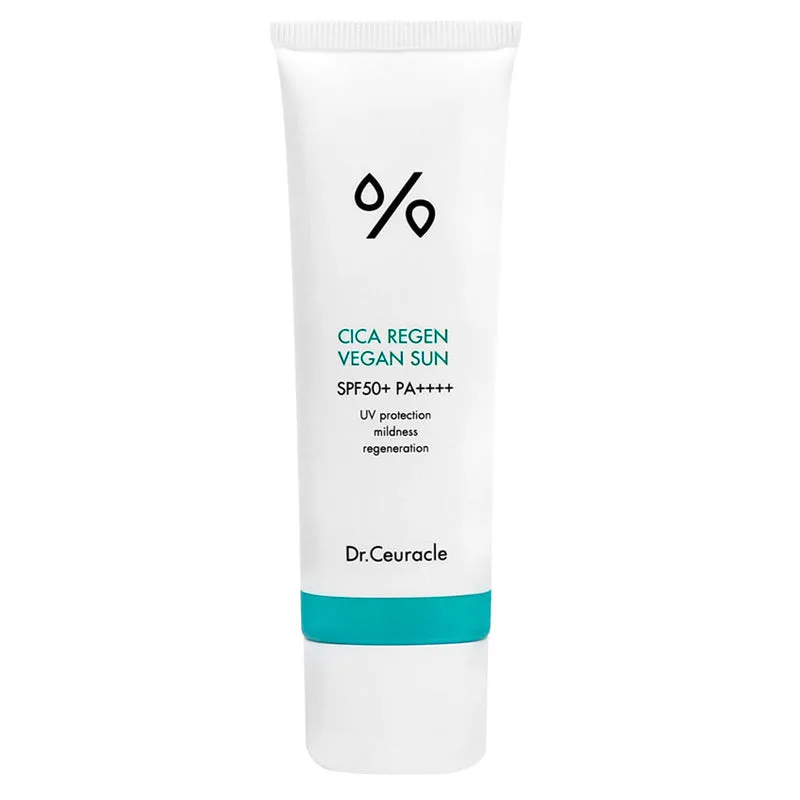
This sunscreen uses a combination of four modern UV filters — Ethylhexyl Triazone, Mexoryl SX, Uvinul A Plus, and Tinosorb S — none of which are approved by the FDA for use in US sunscreens. That filter stack is more photostable, more elegant, and provides stronger UVA protection than what's available in the American market. Layered on top is a full centella asiatica madecassoside complex, niacinamide, and adenosine.
A genuinely excellent modern K-beauty chemical sunscreen built on a filter stack Americans can't legally buy domestically, layered with a full centella asiatica complex, niacinamide, and adenosine. Elegant, invisible on all skin tones, and a legitimately recommendable daily SPF for anyone willing to order from a K-beauty retailer. The alcohol content is the main minor quibble.
Note: This cream has been available for about four years with a concentrated review base among K-beauty enthusiasts. Our scoring relies on ingredient analysis, the well-documented performance of the filter stack, and consistent positive feedback from that user community. This review will be refreshed as the product's track record lengthens.
Verdicts
How well it fits each concern
Verdict by concern tap a concern for the case
Full protectionfor Sun DamageIn your profileYou chose · Broad-spectrum SPF 50 with ecamsule (Mexoryl SX), Uvinul A Plus, bemotrizinol (Tinosorb S): the protection sun damage calls for.Moderate evidenceGentleNo reviews collected yet
The case for it
Ethylhexyl Triazone + Terephthalylidene Dicamphor Sulfonic Acid is a first-line active — approved, monograph-listed or named in current guidelines — for this concern.
It is plausibly present at a working level, though the concentration is not declared.
The formula carries none of the triggers this concern is sensitive to.
What would change this: A declared concentration would move this to a firmer reading of the dose.
Same rule for everyone. “Full protection” is the verdict on 2,288 of 45,024 concern verdicts across the catalog; rule P1 decided 2,232 of them.
Unchanged since September 5, 2026, engine 5.1.1.
P1 — Photoprotection standing is regulatory (M020 / Annex VI filters; 21 CFR 201.327 attaches the early-skin-aging claim to tested broad-spectrum SPF 15+). SPF 30 is the AAD daily-use bar. · the full register
21 CFR § 352.10 Sunscreen active ingredients — US FDA — 21 CFR Part 352 (Sunscreen Drug Products for Over-the-Counter Human Use), via Cornell Legal Information Institute; part heading marked [STAYED INDEFINITELY], effective date stayed at 66 FR 67485, opened September 1, 2026
Full protectionfor AgingIn your profileYou chose · Broad-spectrum SPF 50 with ecamsule (Mexoryl SX), Uvinul A Plus, bemotrizinol (Tinosorb S): the protection aging calls for.Moderate evidenceGentleNo reviews collected yet
The case for it
Niacinamide has early or mechanistic evidence for this concern, not trial-backed standing.
It is plausibly present at a working level, though the concentration is not declared.
The formula carries none of the triggers this concern is sensitive to.
What would change this: A declared concentration would move this to a firmer reading of the dose.
Same rule for everyone. “Full protection” is the verdict on 2,288 of 45,024 concern verdicts across the catalog; rule P1 decided 2,232 of them.
Unchanged since September 5, 2026, engine 5.1.1.
P1 — Photoprotection standing is regulatory (M020 / Annex VI filters; 21 CFR 201.327 attaches the early-skin-aging claim to tested broad-spectrum SPF 15+). SPF 30 is the AAD daily-use bar. · the full register
Carrying active
Niacinamide
Standing
plausible — trials support it
Form
plausible — studied range 4–5%, from the trials on the row; needs leave-on contact; judge it after ~8 weeks
Tolerability
gentle
Row checked
against its sources on July 17, 2026 (evidence table ev-2026.09-r228)
Good choicefor Compromised Skin BarrierIn your profileYou chose · Niacinamide is a reference standard by mechanism for compromised skin barrier; this cream carries it high in the ingredient list.Moderate evidenceGentleNo reviews collected yet
The case for it
Niacinamide has trial-supported standing for this concern.
It is present at an effective concentration, declared or high in the ingredient list.
The formula carries none of the triggers this concern is sensitive to.
Same rule for everyone. “Good choice” is the verdict on 9,564 of 45,024 concern verdicts across the catalog; rule R5 decided 9,072 of them.
Unchanged since September 5, 2026, engine 5.1.1.
Good choicefor SensitivityIn your profileYou chose · No fragrance, drying alcohol, declarable allergens or sensitising preservatives in this cream — the profile sensitive skin looks for.Not yet assessedGentleNo reviews collected yet
The case for it
Centella Asiatica Complex has been researched for this concern and the evidence does not support it.
It is plausibly present at a working level, though the concentration is not declared.
The formula carries none of the triggers this concern is sensitive to.
What would change this: A declared concentration would move this to a firmer reading of the dose.
Same rule for everyone. “Good choice” is the verdict on 1,938 of 45,024 concern verdicts across the catalog; rule F2 decided 1,938 of them.
Unchanged since September 5, 2026, engine 5.1.1.
Full protectionfor Post-ProcedureIn your profileYou chose · Broad-spectrum SPF 50 with ecamsule (Mexoryl SX), Uvinul A Plus, bemotrizinol (Tinosorb S): the protection post procedure calls for.Moderate evidenceGentleNo reviews collected yet
The case for it
Centella Asiatica Complex has early or mechanistic evidence for this concern, not trial-backed standing.
It is plausibly present at a working level, though the concentration is not declared.
The formula carries none of the triggers this concern is sensitive to.
What would change this: A declared concentration would move this to a firmer reading of the dose.
Same rule for everyone. “Full protection” is the verdict on 2,288 of 45,024 concern verdicts across the catalog; rule P1 decided 2,232 of them.
Unchanged since September 5, 2026, engine 5.1.1.
P1 — Photoprotection standing is regulatory (M020 / Annex VI filters; 21 CFR 201.327 attaches the early-skin-aging claim to tested broad-spectrum SPF 15+). SPF 30 is the AAD daily-use bar. · the full register
Carrying active
Centella Asiatica Complex
Standing
plausible — trials support it
Form
plausible — studied range 0.05%, from the OTC monograph or label; needs leave-on contact
Tolerability
gentle
Row checked
against its sources on July 17, 2026 (evidence table ev-2026.09-r228)
Does the jobDoes what a sunscreen is for: UVA coverage, kind to the skin wearing it. Not measured from the label: pleasant enough to actually use.
A verdict is DermApproved’s assessment of how well a product’s ingredients fit a concern — never a claim about what the product treats. Evidence dots and collected reviews sit beside it and are never blended in.
Rules 0.5.1 · evidence table ev-2026.09-r228 · how we decide
Assessment
Pros & Cons
Pros
✓ Four modern UV filters unavailable in US sunscreens
✓ Stronger UVA protection than most domestic chemical SPFs
✓ Full cica asiatica complex (all four triterpenes) supports barrier health
✓ Niacinamide and adenosine add meaningful skincare benefit
✓ Invisible on all skin tones with no white cast
✓ Elegant, non-greasy texture that layers under makeup
✓ Vegan-friendly and cruelty-free
Cons
✗ Contains alcohol denat high on the INCI
✗ Not water-resistant — daily wear only
✗ 50ml runs through quickly with proper application
✗ Limited US retail availability
✗ Contains rosemary oil, a minor irritation risk for very sensitive users
Review
Full Review
There is a genuinely odd situation in American skincare that most shoppers don't realize exists. The Food and Drug Administration classifies sunscreens as over-the-counter drugs, which subjects them to a level of regulatory scrutiny that doesn't apply to cosmetics. That scrutiny is, in many ways, good — sunscreen should be rigorously evaluated. But the side effect has been that no new UV filter has been approved for US sunscreens since 1999. Meanwhile, in Europe and Asia, a whole generation of modern filters — Tinosorb S, Tinosorb M, Uvinul A Plus, Mexoryl SX, Ethylhexyl Triazone — has been in widespread use for over two decades, producing sunscreens that are more photostable, more elegant, and more effective at UVA protection than the filters available to American consumers. This product is what that situation looks like in practice. Dr. Ceuracle Cica Regen Vegan Sun uses four of those modern filters, in combination, in a single sunscreen. Ethylhexyl Triazone covers the high end of UVB. Mexoryl SX and Uvinul A Plus handle UVA. Tinosorb S is a broad-spectrum filter that also stabilizes the others. Together they produce a level of protection — particularly in the UVA range, which is responsible for photoaging and much of the skin cancer risk — that simply isn't available in the US over-the-counter aisle. Worth saying plainly, because sunscreen anxiety is a real force in shopping decisions: the reflexive fear of chemical filters mostly traces back to older molecules like oxybenzone, and it doesn't transfer to this generation. The newer filters here have strong safety data and low photoreactivity — that's much of why the rest of the world moved on to them. The formula is also more elegant than American chemical sunscreens tend to be. It applies as a lightweight milky cream that sinks in within a minute, leaves no white cast on any skin tone, and settles into a silky semi-matte finish that sits comfortably under makeup. The texture is one of those things you have to feel to understand — if you've only used US sunscreens, the first application of a modern K-beauty or European SPF usually comes with a small moment of wondering whether the product is actually doing anything, because it disappears so cleanly. Some of that elegance is built in the base: dibutyl adipate, a light dry-touch emollient, does the spreading work that heavier oils would do greasily, while glycerin and propanediol keep the emulsion from feeling parched, and a trio of botanical extracts — hardy kiwi, lotus flower, and hibiscus — rounds out the antioxidant backdrop. Supporting the photoprotection is the 'Cica Regen' component, which is the reason to pick this sunscreen over another modern-filter option. The INCI lists madecassoside, madecassic acid, asiaticoside, and asiatic acid — all four of the active triterpenes in centella asiatica, rather than just a generic 'centella extract' that might be mostly inert. This full complex has a reasonable body of evidence supporting barrier repair, anti-inflammatory activity, and wound healing, and it's exactly the kind of supporting cast you want in a sunscreen designed to be worn by people with compromised, post-procedure, or reactive skin. Niacinamide is positioned high enough in the INCI to function, adding post-sun pigment protection and further barrier support. Adenosine rounds out the 'this is actually a multifunctional daytime cream, not just a sunscreen' positioning. The brand context fits the product: Dr. Ceuracle launched in 2017 around dermatologist-style, barrier-first formulation, and this 2021 release sits squarely in that lane — down to the white squeeze tube with the clean clinical look Korean derm-adjacent brands favor. It's also certified vegan and cruelty-free, which the name advertises up front. The early consensus is strong for a product with limited Western distribution: across roughly 850 reviews it averages 4.5, and reviewers keep circling the same virtues — no cast on deeper skin tones, a finish that behaves under makeup, and visibly calmer skin among the reactive-skinned users the cica complex is aimed at. The small complications are worth noting. Alcohol denat sits fairly high in the INCI — typical of K-beauty SPF formulations, which use alcohol to help chemical filters dissolve into the emulsion and to speed up absorption for that signature elegant finish. For most users, this is fine; for anyone with very dry or alcohol-reactive skin, it's a minor caveat worth patch-testing. Rosemary oil is on the INCI in trace amounts and could be an issue for the most sensitive users; it also lends the faint herbal note you'll catch on application. The product is not waterproof, so it's a daily-wear SPF rather than a beach or sport option — if you need water resistance, Dr. Ceuracle makes a separate Waterproof variant. The 50ml size runs out more quickly than you'd like with proper application quantity — two finger-lengths for face and neck every morning, reapplied every two to three hours in real sun, will empty the tube in a month or two — and US retail availability is limited to K-beauty online stores. At roughly $25 for 50ml from US K-beauty retailers, the price is reasonable for the category and actively excellent given what's inside. For anyone with access to a K-beauty retailer and the willingness to order online, this is one of the smarter daily SPF purchases available to American consumers in 2026 — a sunscreen with the filter stack and supporting actives that domestic formulations simply cannot match. If you're serious about daily photoprotection and you've plateaued on what US drugstore SPF can offer, this is the kind of product that quietly upgrades your routine.
Formula
Key Ingredients
The hero actives that drive this product's performance.
A genuinely impressive quartet of modern, photostable UV filters — the kind of stack you simply can't find in American sunscreens because the FDA hasn't approved any of them. Together they give broad-spectrum UVA and UVB protection with far better photostability than avobenzone-based chemistries and much lower elegance costs than mineral filters.
Regulator-approvedfor Sun Damage · limited certainty
The 'Cica' in Cica Regen — the full four-component madecassoside/madecassic acid/asiaticoside/asiatic acid blend rather than just a plain centella extract. This is the evidence-based form of centella, with documented barrier-repair, anti-inflammatory, and wound-healing effects that pair logically with daily sun exposure.
Placed high enough in the INCI to be functional, niacinamide supports the barrier-repair story and adds post-sun pigmentation protection. In a sunscreen that's positioned for compromised or post-procedure skin, its inclusion makes the whole formula feel like an integrated recovery product.
Established mechanismfor Compromised Skin Barrier · established mechanism
A well-studied anti-wrinkle active included here as a supporting ingredient. In a daily sunscreen, adenosine adds a small but measurable anti-aging benefit on top of the photoprotection — a smart quality-of-life addition.
Limitedfor Aging
Ingredient standings describe the active at treatment-level doses and
vehicles; this product's own condition grades weigh its actual formula.
Apply as the closing step of your AM routine, two finger-lengths for face and neck. Reapply every 2-3 hours with extended sun exposure. Pairs well under makeup — the silky finish gives a smooth base.
Results Timeline
Immediate: comfortable, non-greasy sun protection with no white cast. Short-term (2-4 weeks): calmer, less reactive skin from the cica complex. Full benefits: this is a daily-use preventive product — long-term use protects against photoaging, hyperpigmentation, and UV-induced skin cancer.
The strongest scientific story here is the filter stack itself. Ethylhexyl Triazone is one of the highest-protection UVB filters available, with an extinction coefficient significantly higher than avobenzone or octinoxate. Terephthalylidene dicamphor sulfonic acid (Mexoryl SX) and diethylamino hydroxybenzoyl hexyl benzoate (Uvinul A Plus) are both UVA filters with strong photostability profiles, and Uvinul A Plus in particular covers the long-UVA range (UVA1, 340-400nm) that most US chemical sunscreens struggle with. Bis-ethylhexyloxyphenol methoxyphenyl triazine (Tinosorb S) is a broad-spectrum filter that absorbs across both UVA and UVB, and importantly helps stabilize other filters in the formula by reducing photodegradation. The combination has been well-characterized in European and Asian regulatory submissions and produces measurably higher UVA-PF values than avobenzone-based chemistries at comparable SPF ratings. The centella asiatica complex is the other evidence-backed element. The four main triterpene actives — madecassoside, madecassic acid, asiaticoside, and asiatic acid — have a substantial body of research supporting anti-inflammatory, wound-healing, and collagen-synthesis effects. Studies on madecassoside specifically have shown benefits in managing UV-induced inflammation and supporting barrier recovery, which creates a logical pairing with daily sun exposure. Niacinamide has robust data for reducing UV-induced pigmentation and supporting barrier function, and adenosine has published research on fine line reduction. The overall formula is built on more evidence than most sunscreens in its price tier.
Dermatologist Perspective
Dermatologists broadly recognize that modern UV filters available in European and Asian markets — Tinosorb S, Uvinul A Plus, Ethylhexyl Triazone, and Mexoryl SX among them — represent a meaningful upgrade over the US over-the-counter sunscreen aisle, particularly in UVA protection and photostability. Skin-care clinicians typically note that American consumers seeking state-of-the-art sun protection have historically needed to order from international sources, and K-beauty and European SPF has become a common recommendation in the dermatology community for patients who ask. This product's supporting cica complex and niacinamide are generally viewed as reasonable, evidence-aligned additions. The alcohol content is the main derm concern, particularly for patients with rosacea or compromised barriers, but for the majority of users it's considered acceptable in daily-wear sunscreen formulations.
Guidance
Usage & Recommendations
How to Use
Apply as the final step of your morning skincare routine, after moisturizer and before makeup. Use approximately two finger-lengths of product (or about 1/4 teaspoon) for the face and neck together — most users significantly under-apply sunscreen, which cuts the effective SPF dramatically. Allow 60-90 seconds to absorb before applying makeup. Reapply every 2-3 hours with extended outdoor exposure. This is a daily-wear SPF, not a water-resistant one — for swimming, beach days, or heavy sweat exposure, use a dedicated water-resistant sunscreen.
Value Assessment
At roughly $25 for 50ml, this sunscreen is priced in the mid-range for K-beauty SPF sold through US retailers and is a legitimate value given what's inside. The filter stack alone — four modern UV filters in combination — is not available at any price point in domestic US formulations, which effectively makes this product its own category. The supporting cica complex, niacinamide, and adenosine are meaningful upgrades over basic sunscreens at this price. The 50ml size runs through quickly with proper application, which is the main practical limitation on value. For daily-wear facial sun protection specifically, this is among the better value propositions in the K-beauty SPF category and a clear upgrade over comparable US drugstore options.
Who Should Buy
Anyone who wants a genuinely elegant, modern-filter daily sunscreen for face and neck, particularly those with sensitive or reactive skin who benefit from the full cica complex. A great pick for anyone disappointed by the elegance and UVA protection of US drugstore sunscreens.
Who Should Skip
Anyone who needs water-resistant or sport SPF — choose a different product. Anyone with very severe alcohol sensitivity should patch-test first. Anyone unable to order from K-beauty retailers will need to look at domestic alternatives.
Ready to try Dr. Ceuracle Cica Regen Vegan Sun SPF 50+?
Lightweight milky-cream that absorbs into a silky, semi-matte finish
Scent
Faint herbal note from the centella and rosemary oil
Packaging
White squeeze tube with a clean clinical aesthetic typical of Korean derm-adjacent brands
Finish
satinnon-greasyinvisible
What to Expect on First Use
On first use, the cream spreads easily, sinks in within a minute, and leaves no white cast or greasy feel. Most users notice immediately that it's more elegant than any US chemical sunscreen they've tried, which is the entire reason K-beauty SPF has a cult following.
How Long It Lasts
1-2 months applied morning and night face-and-neck application following proper sunscreen quantity guidance
Dr. Ceuracle launched in 2017 as a Korean skincare brand positioning itself around dermatologist-style formulations and barrier-focused care. The Cica Regen Vegan Sun came out around 2021, building on the popularity of cica-centered skincare and the wider K-beauty reputation for elegant, modern-filter sunscreens.
About Dr. Ceuracle Established Brand (5–20 years)
Dr. Ceuracle is a South Korean skincare brand launched around 2017, combining clinical-feeling packaging with K-beauty texture sensibilities. The brand is carried by a range of K-beauty retailers worldwide and has built a following specifically around its cica-barrier products.
Brand founded: 2017 · Product launched: 2021
Myth vs. Reality
Common Myths
Myth
American sunscreens are just as good as Korean ones.
Reality
Not currently. The FDA hasn't approved newer UV filters like Tinosorb S, Uvinul A Plus, or Ethylhexyl Triazone that are standard in Europe and Asia. Modern K-beauty and European sunscreens use these filters and achieve more elegant formulations with stronger UVA protection.
Myth
Chemical sunscreens are dangerous.
Reality
Modern UV filters — including the ones in this product — have strong safety data. Older filters like oxybenzone have raised concerns, but most newer filters (Tinosorb S, Uvinul A Plus) have excellent safety profiles and low photoreactivity.
FAQ
Frequently Asked Questions
How is this different from US sunscreens?
It uses four modern UV filters — Ethylhexyl Triazone, Mexoryl SX, Uvinul A Plus, and Tinosorb S — that aren't approved by the FDA. These filters are more photostable and provide stronger UVA protection than most US chemical sunscreens, while feeling lighter and leaving no white cast.
Can sensitive skin tolerate Cica Regen Vegan Sun SPF 50+?
Generally yes. The full cica asiatica complex and niacinamide make it well-suited to reactive and compromised skin, and the modern filters are well-tolerated by most. The alcohol content is a minor caveat — if you react strongly to alcohol, patch test first.
Does it leave a white cast?
No. This is a chemical sunscreen with no mineral filters, and it's completely invisible on all skin tones. Deep skin tones in particular will find this much more elegant than any mineral SPF.
Is it waterproof?
No. For swimming, beach days, or heavy sweating, choose a water-resistant sunscreen like Dr. Ceuracle's Waterproof Sun variant or another dedicated water-resistant formula.
Can I buy it in the US?
Yes, through K-beauty retailers like Olive Young, YesStyle, Be Mused Korea, and various Amazon sellers. It's not carried in mainstream US department stores, but online availability is generally good.
How much should I apply?
Follow the standard sunscreen quantity — about two finger-lengths for the face and neck together, or roughly 1/4 teaspoon for the face alone. Most people significantly under-apply sunscreen, which cuts the effective SPF dramatically.
Reviews
What Reviewers Tend to Say
Recurring themes our editors read across retailer reviews of this product — summaries in our words, not quotations, and not a substitute for your own patch test.
The K-beauty buzzword slaps a green leaf on half the shelf — but centella is one of the rare botanicals with genuine wound-healing data. The trick is knowing which molecule is doing the job.
The smallest AHA gets deepest and shows results soonest — which is precisely why routines built around it overshoot, and why the people who do best with it use it least.
Hands take more water, more surfactant and more friction than any other skin you own — and the intervention that fixes them takes about ten seconds nobody spends.
The industry now sells $80 'anti-aging' serums to 22-year-olds — but two cheap habits do roughly 90% of the real work, and most of the rest is money spent on anxiety.
Jun 17, 2026· 6 min
Questions people ask about sensitive skin
Verified answers from our questions library — the nuance a product page cannot carry.
Products, answers, therapy guides, tools and articles in one search. Brand names,
slang and abbreviations all work — accutane finds isotretinoin, bacne finds truncal acne.